by Norton Juster
illustrated by G. Brian Karas
Schwartz & Wade / Random House 2011
Moving to a new neighborhood is tough. How do you find and make new friends? One boy has an interesting solution...
It's move-in day, and there's little for a boy to do while his parents begin unloading boxes and setting up the house. Mom can see that he's upset, she knows that it's hard to be the new kid in town, and suggests that maybe he should take a walk around the neighborhood. Maybe he'll make some new friends. "Yeah, sure," he says.
At the end of the block he shouts out "NEVILLE!" and is surprised when he's joined by another boy who tells him he's not loud enough. Soon the two boys are joined by a girl who tells them they aren't doing it correctly. Soon, a whole neighborhood of kids is shouting out for Neville and asking who this mystery boy is. As the sun sets and the kids return home they are convinced that this Neville must be a pretty cool kid, and his friend isn't so bad either. As the boy returns home Neville himself has to admit to admit that his walk around the neighborhood wasn't so bad.
The astute young reader will figure out pretty quickly that the unnamed boy is Neville and that he's accidentally stumbled into a pretty clever way to make new friends. Whether this will ring as true to kids today as it did for me I would be curious to know. Growing up it wasn't uncommon for us kids to wander in the general area of where we knew certain kids lived and just shouted out their names. Goofuses on the roofuses, hollering our heads off so to speak. Phones were for adults, and it always seemed we only ever sort of knew where our friends lived. It also wasn't unusual for parents to roam the streets calling for their kids to come home either. That cacophony of neighborhood life, another victim of better manners and the age of cell phones.
Karas's illustrations are inviting and softly rendered with a very child-like quality to them. At times there are images where the children are drawn small on the page, almost too small; I think at this point in publishing every picture book needs to take best advantage of the page's canvas. I'm not saying a page can't include white space or needs to be crowded and busy but that traditionally printed picture books can hardly make their case against a digital world if they aren't making the most of their real estate.
Simply written and cleanly told, Neville is a pleasant take on the new-kid-in-town story.
Showing posts with label schwartz and wade. Show all posts
Tuesday, November 29
Neville
Labels:
11,
g brian karas,
new kid,
norton juster,
picture book,
random house,
schwartz and wade
Monday, October 19
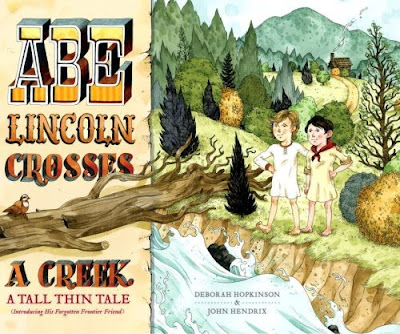
Abe Lincoln Crosses a Creek

A Tall, Thin Tale
(Introducing His Forgotten Frontier Friend)
by Deborah Hopkinson
picture by John Hendrix
Schwartz & Wade / Random House 2008
If in 2007 a book appeared by a 90 year old author claiming to have been a boyhood friend of JFK, relating an experience where the two as boys nearly drowned in the Charles River of Boston one summer day, where the author saved the young JFK's life and thus played an important role in our nation's history (who would have defeated Nixon in 1960 if JFK weren't even alive?), and there was no one alive who could refute it...
Did it really happen? And would we tell the story as a picture book?
Abe Lincoln Crosses a Creek tells a similar story concerning Abraham Lincoln's Kentucky neighbor Austin Gollaher, about how the the two as young boys attempted to cross a creek, and how Austin rescued Lincoln which allowed him to live and, eventually, become our 16th president. The book attempts to tie up this story with the moral that "what we do matters, even if we don't end up in history books."
That's all well and good, but who's to say it happened? Hopkinson sites at the beginning of the book two titles that quote Gollagher from 1898 and 1921 and a third from 1922 that confirms the story, probably taken from the same sources. Given all the biographical scholarship on Lincoln done in the past 90 years it seems odd that more recent references couldn't be cited.
Unless the story couldn't be proven to modern standards.
Here, again, we see another recent example of the "storyography," the biographical recounting that place story before biography and, in this case, the anecdotal above the known. Hopkinson covers her bases by saying "The events described in this story, so far as this author can determine... did, in fact, take place..." Yes, well, short of Lincoln's personal account, or a third party's account, what we have is, as the subtitle indicates, a tall tale concerning a real individual from history. And since it is a tall tale is there really any reason to lend the story a level of legitimacy by pointing out sources? Does the fact that Lincoln is a character require this level of explanation?
And, as always, shouldn't this information be spelled out to the reader in the text and not placed in tiny type on the Library of Congress page intended for adults who won't be as nearly confused about the legitimacy of the story as the intended reader?
Actually, Hopkinson does attempt to alert the reader in the text that the story contains some questionable details. At the point when Lincoln falls into the creek a giant, incongruous caution warning splashes across the illustration announcing "I want to make sure we get this right. Because maybe it didn't happen like that." The narrative then proceeds with an alternative version of the event in question because, as Hopkinson later suggests, "For that's the thing about history – if you weren't there, you can't know for sure."
Ah, I see. Because we were not there, because the source of the story is perhaps an interested party who could profit from the attention of having been the late president's boyhood friend, because no one can say for sure it didn't happen we can proceed to tell this story as if it did.
A book is a powerful thing. It represents the labors of a lot of people – writers and illustrators, editors and publishers and printers – and when presented by adults like parents, librarians, and teachers takes on the weight of authority in a young reader's eyes. They would not have gone through all this trouble if the story weren't true, would they? When a child is handed Abe Lincoln Crosses a Creek and reads the text only, do they have any reason to doubt the story happened as described, or at all? Do we teach young readers how and when to question historical events and to vet them for accuracy? No, of course not. They accept what they are given because they trust adults to be honest with them.
That said I do not suggest that Abe Lincoln Crosses a Creek should not have been written, and that other books that attempt to tell historical anecdotes from the childhood of historical figures cannot be retold, only that it be clearly and directly related to the reader that such stories might not be factually accurate. There should no question in a reader's mind about the story they have just been told, nor should they confuse that story for history if there is any question.
I have an unusual perspective in this area, having been researching Lincoln's life from the period just after the events in this book. Earlier biographies contain second and third hand accounts of events that do not hold water in biographies written after the 1920s. In fact, I could write a few similar picture books concerning the pre-teen life of Lincoln that, while entertaining, would not be considered accurate by modern Lincoln scholars.
For the past decade we've seen a number of biographical picture books that seem to escape the rigor and expectations we would apply to books intended for older readers. This is a mistake, because (and I think I've said this many times before) that this young age is when we do the most damage in terms of misinformation. Children today STILL have heard the story of Washington chopping down a cherry tree when we now know that the story was a fabrication of Washington's childhood neighbors, told to their children as a morality story, recounted to biographer Parson Weems as gospel truth. It is not true and yet the power of this misinformation still courses through our national psyche.
Accuracy should not suffer at the hands of entertainment, not in the books we present to picture book readers. "What we do matters."
Exactly.
Monday, March 2
Piano Starts Here

The Young Art Tatum
by Robert Andrew Parker
Schwartz & Wade / Random House 2008
This year's winner of the American Library Association's Schneider Family Book Award is a picture book biography of legendary jazz pianist Art Tatum' early days. It follows Tatum as a young prodigy who can barely reach the keys of the family piano up to his days as a young man when he starts to make a name for himself and move out into the world on his own. Rendered in Parker's loose watercolor illustrations, the book has the cozy feel of American nostalgia, the warm fuzzies of a bygone childhood era free of strife and fear.
That isn't entirely a sarcastic summary, but there are may things about this book that stick in my craw the wrong way.
Let's talk about first-person for a moment. The book opens with Tatum introducing us to the house he was born in, to his father the mechanic and his mother the church singer, and the room where the piano is located. In these first four pages author Parker accompanies narrator Tatum's tour of his early days in simple language and images that are placed on the page like snapshots in a photo album. The initial feeling is that of sitting in the room looking at the images as Tatum stands over your shoulder explaining what you're looking at.
But then there's a shift, and a young Tatum is shown on tip-toe plunking away at that piano as he explains in the text how one day he just started playing. His mother enjoys his etudes than suggests he go outside and play while there's still light.
But because of my bad eyes, day and night, dark and light, don't really matter to me.
Because Tatum had cataracts in his eyes from an early age, was blind in one eye and could barely see out the other. That information isn't in the text, and coming five pages in on the picture book I'm suddenly struck with the question: How could Tatum be narrating what I'm looking at if he can't even see himself? If day and night mean nothing to him, how can this narrator explain that I'm looking at the house he was born in. And with a young Tatum's appearance in the illustrations we jump out of the detached viewpoint and into a more observational mode. It's an odd shift, and this change of perspective goes toward a lot of my confusion over this book.
Only in childen's books do we see stared reviews for biographies written in the first person; in the adult world we call his "historical fiction" no matter how well researched. To have Parker, speaking in Tatum's voice, describing to us what Tatum himself could not have seen calls to question a great deal of authenticity. We are being shown the world through Tatum's eyes, which is a pretty good feat for a nearly blind man.
Now I'm an adult (by age at least) and I can tell when to send up the flashing warning signs, but the young readers this book is aimed at aren't necessarily going to have the same abilities to question what they are being shown. They'll understand the difference between an illustration and an photo of a house, but not that the first-person voice is a construct of an author to tell a story. It may be accurate to a degree, but not factual in the sense we would normally expect from a biography.
I jump to the back of the book at this point, hoping to find that the author is quoting Tatum from his own autobiography. Nope. Parker lists over half a dozen titles, only one specifically about Tatum, and leaves us no clue as to whether or not he's paraphrasing other's research or rephrasing Tatum's own words for the audience. I'm on guard now.
Two pages later Tatum talks about a summer night being too hot to turn on the lights, about playing the piano while the neighborhood kids go around catching lightning bugs in bottles. For a kid who can barely see I find it curious that from his distanced perch inside the house, at night, he can see their jars grow lighter as they continue to catch the luminous insects. I've seen my share of lightning bugs, and I'm having a hard time believing a nearly blind boy can see the glow of these bugs growing from a distance.
I get what Parker is doing, He's showing us a slice of Tatum's early days, about how he was segregated from a normal childhood, listing the titles of songs he did (or might have) played on the piano during those years. But what does Tatum think about this, how does he feel? Does he wish he were out there running around, or has he found such a home and refuge in music that he no longer misses these magical moments. The image on the page isn't even of Tatum but of silhouettes black against the dark blue of night catching little flecks of gold. This is as it would look to normally sighted children, this magical nighttime scene, and the absence of Tatum from the illustration suggests his point of view. It becomes as deceptive as the authenticity of the narrative, it makes the cautious reader wary of every depiction. If nothing else the image and words convey an emotional weight that might not be accurate or honest. A reader could walk away from this book imagining Tatum happily playing the piano on a summer's eve, enjoying the magical glow of jars full of lightning bugs when the truth could be the exact opposite.
The story proceeds with some more troubling undertones that might escape a younger reader. Tatum's father and a friend take the boy to a nearby bar where he performs songs he has learned by ear. There are coins stuffed in the boy's pockets and late at night they have to sneak in so as not to wake Tatum's sleeping mother. Clearly what Tatum's father is doing wouldn't meet with his mother's approval, and in fact might be more exploitative that the text lets on. Even if he didn't object -- and many young boys might have found it exciting to perform in bars for adults -- we still have no idea what Tatum thinks about any of this. Did he resent these clandestine performances, did he suspect his father taking a cut of the money, would his mother have put a stop to it if she found out? It was as if Parker, in showing us the world through Tatum's eyes, has extrapolated the boy's blindness to include his thoughts and feelings.
Another curious omission comes between Tatum's barroom days and his performance on local radio. During that time Tatum attended a school for the blind and was given structured musical training. As depicted in the book Parker would have the reader believe that Tatum merely progressed to larger and larger venues. Even if Tatum's developed his unique style on his own it is impossible to know how much of an influence this musical training had on him. Even if he rejected what he learned -- and that he learned it from another visually impaired black musician named Overton Rainey -- his style would be informed by what he learned or rejected.
Yes, a picture book is limited, and concessions need to be made, stories need to be condensed for the audience. But for a book set in the 1920's and 30's I would think that readers would be interested to know that there were schools for the blind with instructors who were African American. And speaking of history, I think I'd like to know that this story took place in the Toledo of the 1920's and 30's; without and real points of reference this story could have been set in the rural parts of the South during the 1960's. Both eras might seem long ago and far away to today's readers, but there's a world of difference between the two and there's no reason for the reader to be kept in the dark.
The American Library Association says "The Schneider Family Book Awards honor an author or illustrator for a book that embodies an artistic expression of the disability experience for child and adolescent audiences." I'm left wondering if the "artistic expression" of Tatum's experience, as depicted by Parker, trumps the authentic emotional aspects of the subject's life. I question whether young Art Tatum's life as warm and, as depicted by Parker, innocently carefree, and if that's really an honest expression of the disability experience.
Labels:
08,
art tatum,
biography,
jazz,
piano,
picture book,
random house,
robert andrew parker,
schwartz and wade
Subscribe to:
Posts (Atom)
