Showing posts with label speculative fiction. Show all posts

Wednesday, August 11

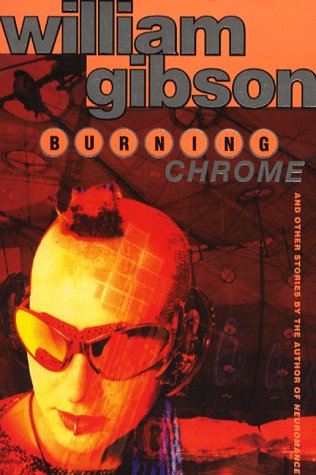
Burning Chrome

and other stories  
by William Gibson
various editions since 1986

A classic collection of sci-fi stories by the writer who invented the term cyberspace and probably did more to shape what our vision of the future looks like in movies than most people realize.

Though technically not a book written for children, I am including it here because I think it's a solid read for teens, and have a review for it up at Guys Lit Wire specifically for that purpose.  I thought rather than cross posting reviews I'd take this moment to talk a little more about the problem of sci-fi in children's writing.  Specifically to ask why there isn't more of it.

As genres go, there are plenty of detective mysteries in children's literature, and books about interpersonal relations between boys and girls to qualify as romance, and certainly enough fantasy to fit any young reader's interest in things from wizards to mermaids to magic.  But where are the stories that speak of the future, a future that isn't entirely a dystopic nightmare?  Where are the stories that look at the problems of artificial intelligence, that propose difficult solutions to our current problems, allegories and cautionary tales, stories about ideas kids can latch onto?

I think we sell younger readers short by not providing them with these stories and having to send them to the adult shelves to find what they're looking for. 

And they are looking for them.  If books like The City of Ember and life as we knew it and The Hunger Games and The Adoration of Jenna Fox and Unwound have taught us anything it's that kids really like talking about the issues these books bring up.  And this is what science fiction does well, it brings up social issues in settings that allow the reader to perhaps see them for the first time and challenge the thinks they think they know or feel.

Perhaps the fear in providing younger readers with science fiction is that they will take the wrong lessons from it, misinterpret the message in a way that binds and blinds.  It was only recently that Ray Bradbury acknowledged that for years people have taken the wrong messages from Fahrenheit 451, that it's not (as its taught in high schools) about censorship, or a reaction to the McCarthyism of the 1950s, but a cautionary tale about the dangers of television destroying the interest in reading.  But even as we misread Bradbury's intent the fact remains that the literature provides a point of contemplation, so I'm not sure the excuse holds up as a reason for a dearth of science fiction for children.

Is the problem Science-based fiction? 

Have we become a society that fears to discuss speculative ideas based on science and technology for fear of an anti-science backlash?  Has science fiction become the Dalits of children's literature, or been smeared with the taint of the creationist-evolutionist battles? My hope is that we can hold back on the aliens, on the life-in-space stories, on all the external elements that get shoved into science fiction for kids, and instead seek out more stories about who we are as a species and where we are headed, or might be headed, down the road. 

Thursday, November 12

When You Reach Me


Rebecca Stead
Wendy Lamb / Random House 2009


I'm going to punt on the review here. People have been talking, and mostly raving, about this book for the better part of this year so I don't know that I have much to add. Because I agree, it's good, and because I think others have said pretty much what I would have said. So in the interest of not clogging the blogosphere with more arterial review plaque I'll merely add those things that are personal, that wouldn't be duplicated elsewhere (I hope).

This was the first book I've read in some time that made me want to go back and re-read it instantly. I'm not a big re-reader, mostly because there's so much out there to read and I am, generally, a slow reader. But this was not only a breezy read but a fun one, and the feeling of wanting to steep more in its mood left me running to get back on the ride.

The book feels "classic." I don't know if it's because it taps into the river of nostalgia that I believe I share with the author – growing up when books like Harriet the Spy were new – of the strong memories I import into the books 70s settings, but this book reads to me like an older title that is still fresh today. Which, obviously, is peculiar when it's a new book.

Then there's the speculative fiction element. The book has a light touch and the multiple levels of time travel – a traveler from our contemporary future goes back to the past, as viewed from that past – is really satisfying. I'm sure there are some who could pick apart some of the time travel elements, but I don't care. If there are flaws they didn't bother me.

And we need more speculative fiction for middle grade readers. Not science fiction, not fantasy, not alien invasions (cute or menacing), but solid stories that deal with real middle grade issues and at the same time play with big ideas. Trend-watching aside, I personally think this is the greatest gap in middle grade fiction: stories about Big Ideas that do not have a "trouble story" or a dystopia at their core. I don't know if Ms. Stead sees the book this way, or if she'd rather think of it as simply what it is – a great middle grade book – but I'm telling you it falls right into a giant gap in the types of books kids enjoy.

Not much of a review, I admit, but I'd been putting this off for a couple months now because I didn't know if there was anything new to add to the din of what is already out there. I have a couple books that have fallen off the shelf, so to speak, and languished unreviewed because I was unable to get a grip on how to articulate my joy or excitement with them (I think Gennifer Choldenko's If a Tree Falls at Lunch Period might be the one that haunts me most for lack of review). So for other takes on When You Reach Me you might want to check out fuse #8's review, or the 100 Scope Notes review, or maybe the teenreads.com review. This book is showing up on a lot of Best Books and awards shortlists, and well-deserved I should think. But as far as I'm concerned if it won no awards or accolades it still sits in the rare pantheon in my experience - those books that bear rereading.