The recent arrival of the graphic novel to children's literature is a bit like Columbus discovering America; Like the North American continent, graphic novels have been there and for quite some time.
I bring this up partly in response to a post over at
pixie stix kids pix that reports on the "trend" in children's literature over wordless picture books and graphic novels. All this recognition by the American Library Association and
Publisher's Weekly gleefully reporting the popularity and sales of graphic novels (like movie grosses splashed across the front page
as if they were actually news) , while welcome, comes a little late to the party. How late depends on how the community at large eventually comes to define the graphic novel.
By my count the party is at least 20 years late, but I may make a case for 50 years if we're all willing to stretch things a bit.
The 1980's
I think it's safe to say that the graphic novel as we are currently recognizing it is a product of changes the comic book industry during the early to mid-1980's. Attempting to shore up flagging sales the traditional comic book industry -- Marvel and DC primarily -- looked to creating high-end imprints that would be printed on coated stocks (no more tawdry newsprint) with edgier, grittier art and stories than the superhero comics of the 50's and 60's. This was when Frank Miller re-envisioned Batman as an avenger of justice in his
Dark Knight series. Here was an over-buffed batman than the man-in-tights we had once known fighting like a ronin against the forces of Gotham's evil elite. Miller took the materials of Batman's past, material that had always been in the comic books, and gave it more of an adult weight, the
gravitas of a person haunted into a life of secret identities and vigilantism. It's from Miller's reworking that the current spate of movie adaptations take their cues, and where young readers looking for graphic storytelling went when they outgrew the inherent silliness of the old school comics with their stilted dialog and simplistic plots.
Miller didn't invent the idea of a multi-issue story arc with traditional dramatic story structure -- it was more common than a stand-alone story, primarily to keep readers buying them -- but when the final work was finished and published in book form the full vision of what Miller had accomplished was noteworthy. Like the comic readership itself he had bumped graphic storytelling up a notch in the popular culture to an acceptable novelesque experience.
Or had he? Let's wait before we see if that statement sticks.

Around the same time Alan Moore had begun a totally original comic based on a group of superheroes driven underground by the government for causing more harm than good. (If you're having
deja vu then perhaps you've seen Brad Bird's humorous riff on this idea with
The Incredibles a few years back). Where Miller was reinventing a familiar character, Moore was giving us superheroes who were distinctly human. Poisoned and mutated by radiation, living in squalor or turning their previous fame into a multi-billion dollar industry,
Watchmen tore apart the stereotypes of the superhero as invincible and made them humans with just that much more pathos. Again, envisioned as a complete story,
The Watchmen ran in 12 installments that were titled chapters that were designed with a graphic novel as the end product. Moore would later give similar spin to his 1984-meets-Guy-Fawkes tale
V for Vendetta and Victorian-feeling
League of Extraordinary Gentlemen.
At the same time smaller comic presses were growing, as were independently printed comics. Min-i and self-published comics were picked up by smaller presses and in turn helped build those alternative houses into an industry separate but equal to the big boys. Personal narratives were often the focus of these alternacomics. Chester Brown's
Yummy Fur would tell the

uncomfortable autobiographical narrative of his teen years where Playboy magazine interfered with his relationships between his female peers. Adrian Tomine told the cool, distanced tales of mopey slackers and their disfunctional stories of adjusting to young adulthood. Daniel Clowes would walk the same territory with a palpable sense of the bizarre worked in between his grotesques, though his
Ghost World is the tamest example of his work. And for pure Earth-based fantasy it was hard to ignore Scott McCloud's
Zot for its teen super hero and his troubles with his non-super hero girlfriend. For every artist or title I could mention there are those that could probably name ten or twenty others, equally good and mining the seam with startling originality.
It would be easy to suggest that the explosion of comics into a long-form graphic novel we now know came about as a result of this collective explosion in comics, but what if we looked back an additional 10 years, what would we find?
Will Eisner's Contract
One of the greats in the history of comics -- the Eisner Awards are named after him --
Will Eisner not only drew fame from his serialized comic adventure strip
The Spirit but in 1978 took on the long-form graphic novel with adult themes and startling results.
A Contract with God and Other Tenement Stories is credited with being the first American graphic novel, so I guess if we really must hold to strict definitions then graphic novels in America have enjoyed a good 30 years to date. Eisner's themes are decidedly adult: One story concerns a man who's accidentally listed in the newspaper as dead and in his attempts to prove that he's still alive meets his end and proves the newspaper prescient.
Eisner's style is dark, steeped in the grit of a 1940's noir New York City. While visually rooted in mid-century America his stories of the common man trying to survive in a city-world that has left him behind still speaks volumes. His characters carry so much weight in the drawings they almost seem to be buckling under the oppression of the ink, threatening to pull the page down with them. He was a master of storytelling and visual structure and I would hope that anyone seriously considering graphic novels as a literary medium read his book on the subject
Graphic Storytelling and Visual Narrative (in addition to
Scott McCloud's
Understanding Comics) to get a crash course in what's behind the scenes.
The Father of Manga
In Japan the comic book form most widely in circulation is
manga. I'm not going to pretend to know even a fraction of the history of manga, and there is much about current manga comics that I do not like (the hyper-sexualization of girls and women being primary), but there is at least one amazing piece of graphic novel history to point out, and that is the work of
Osamu Tezuka. His last great epic, the tale of
Buddha, is a mammoth undertaking: 8 volumes each consisting of around 400 pages. Rich in detail and humor it is also brisk in its pacing. It was the first thing I thought about when I began Brian Selznick's
The Invention of Hugo Cabret, mostly for it's historical scope -- not a perfect parallel, but that's the way the mind works.
Tezuka is generally recognized as the father of manga, and for good reason. He has long-form manga series that reach as far back as 1952's
Astro Boy, 1949's
Metropolis and 1948's
Tuberculosis. All of these, by the way, perfectly suitable for middle grade readers today as they were for the commuting salarymen of Japan back in their day.
Does Tintin Count? Little Nemo?Originally comic strips printed in newspapers, both
Tintin and Little Nemo were later to be found in bound form presenting their stories complete as elaborate adventure tales. Herge's various Tintin episodes pack a world-traveling boy and his dog (and assorted regulars) on adventures that wouldn't be out of place alongside the movies serials of the 1930's or the more modern adventures of Indiana Jones. They have remained in print, are continually popular, and if I can be so bold, are in fact graphic novels. They follow the rules of graphic storytelling, complete unto themselves, and yat while most libraries I have been to carry them they somehow aren't kept with the graphic novels. Why is that?

As for
Little Nemo in Slumberland, Windsor McCay's brilliantly rendered Sunday comic that imagined a dreamland more detailed than any ten comics you can find today, I'm bending things a bit here for it's inclusion. McCay I don't think ever imagined his 1905 cartoon would ever be collected into book form, much less considered seriously as a "novel", yet for all its fantasy and rubbery fiction it's as richly rewarding an experience for the reader as any fantasy novel of any era.
Looking ForwardThis by no means is meant as a scholarly examination of the graphic novel, nor should it be construed as anything near complete or exhaustive. But given the recent ALA awards for both
American Born Chinese and
To Dance perhaps this is a good time to pause and reflect just what, exactly, we mean when we talk about graphic novels with regards to children's literature.
What I'm getting a sense of in blog and in the news and in just talking to people is that everyone agrees that graphic novels are a valid literary form but there's a lot of confusion over what constitutes good or worthy graphic literature. Booksellers either don't carry graphic novels because they don't understand the genre or, as with the larger chains, they carry large amounts of what is carried by the major publishers in a scattershot somethings-bound-to-click-with-the-public manner. One Borders I went into recently had an entire wall of Japanese manga -- nine feet tall by twenty feet wide -- and none of it classic, much of it dull, all of it series intended to generate repeat sales and not necessarily tell stories of consequence. They are, to put it bluntly, bound comic books labeled graphic novels in order to catch the zeitgeist.
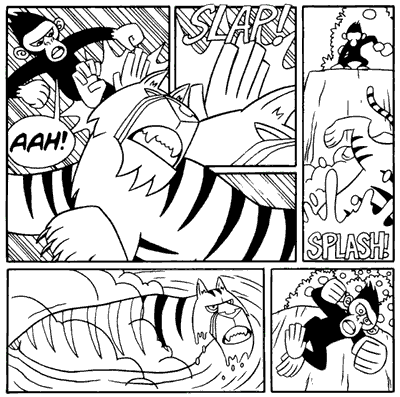
It doesn't end there either. I recently was asked to review a series of non-fiction books that the publisher was calling graphic novel presentations that were nothing more than mere explanations on machinery with the thinnest of storylines ("We need to fix this train") drawn in a comic book format. That's the first danger I see, comic book
appearance being labeled as graphic novels. It seems like we first need a clear definition of the graphic novel and, yes, it is different than a comic book and needs to be recognized as such.
I also happen to think that if we're going to consider graphic novels literature along side traditional novels then we need to apply similar rigor in determining their quality, value and worth. It is far too easy to be wowed by visuals and color, getting caught up in sweep of the unique, and missing the structural flaws in the story. It is equally easy to be moved along by the speed of the narrative and its humor and miss the stereotypes built into the visual shorthand.
Finally (for today at least) if we're going to bestow literary awards on graphic novels then I think we need to give them their own category and not spend a lot of time wringing hands over comparing apples to oranges. Comparing graphic novels with fiction is like comparing a stage play with a movie; Yes, they tell dramatic stories in time and space using actors and a script, but they are unique storytelling media, they are experienced differently by the viewer and they have their own separate awards to reflect that artisanship. Let's get this cleared up now so we don't have years worth of regret over having to pick among disparate artforms.
I have been mulling all this over for months now and haven't gotten to a fraction of the arguments and points I'd been outlining with myself in the shower (where I get most of my best thinking done). I have made a half dozen attempts to wrangle this subject in blog form and finally decided I just needed to spew out what I could and move on. I am not beyond examining the subject further but for now I need to leave this anchor behind and move on.
There's so much I haven't said, so many great graphic novels unmentioned, but I'm only one person, only one voice. I'd love to hear what others think.
Some Recommended ReadingThe Dark Knight &
The Dark Knight Returns Frank Miller
Watchmen by Alan Moore and Dale Gibbons
V for Vendetta by Alan Moore and
A Contract With God by Will Eisner
Graphic Storytelling and Visual Narrative by Will Eisner
Buddha by Osamu Tezuka
Maus: A Survivor's Tale by Art Spiegelman
American Born Chinese by Gene Luen Yang
To Dance by Siena Cherson Siegel and Mark Siegel
Understanding Comics by Scott McCloud
Persepolis by Marjane Satrapi
The Rabbi's Cat by Joann Sfar
Barefoot Gen: A Cartoon History of Hiroshima by Keiji Nakazawa
Blankets by Craig Thompson


