Showing posts with label non-fiction. Show all posts

Wednesday, March 14

Soldier Bear


by Bibi Dumon Tak
spot illustrations by Philip Hopman
translated from the Dutch by Laura Watkinson
Eerdmans Books edition 2011


A cgarette-eating, beer-drinking, ammunition-carrying bear? Only warfare could create a story so improbable.

During World War II as Russia and Germany fight to claim Poland for their own the citizens caught in the middle are taken as prisoners in their own country, forced to flee to neighboring Iran. Among these escaped expatriates are Stanislav and Peter, a pair of inseparable friends who agree to join the British in the fight to help reclaim their homeland. One day while stopped along the road they spy a starving young boy with nothing to trade the soldiers but a small sack containing a bear cub. A cute little bear cub, who so totally entrances Peter that he trades a pocket knife, some cash, and tin of meat for it. None of the soldiers of the 2nd Polish Corps would imagine that this cute little pet would become not just a mascot but a source of comfort and a valuable comrade in the fight.

Once weened from milk the bear they named Voytek, "smiling warrior" in Polish, quickly adapts to his surroundings and behave much like a small child in the camp. Voytek prefers to sleep with Peter instead of his little makeshift bed, he bothers the cook for scraps, and learns how to give himself showers in the heat of the Palestinian desert where they are based before moving closer to the front. When scolded or scared Voytek covers his eyes with his paws and rocks back and forth, and when the soldiers become melancholy he knows to stand on his hind legs and place a reassuring arm on a man's shoulders. Raised around men Voytek learns how to behave as a man, as much as a bear can without betraying his nature. Granted, the soldiers introduce the bear to beer, which he loves and can be bribed with, and he mimics the soldiers smoking by stealing their lit cigarettes and eating them, but he also pitches in and carries ammunition when its time to work, earning Voytek an official designation as a Private in the 2nd Polish Corps.

There is something decidedly old school about Soldier Bear, an innocent absurdity that feeds into the wartime images we have of people doing and performing extraordinary tasks in the face of adversity. The connection with nature, a bear in this case, in the face of something as unnatural as life during wartime keeps the men of the 2nd Polish Corps grounded. All around them humanity is focused on so much destruction and yet here are soldiers chasing a bear, two dogs, and a monkey that they have also adopted around the camp as they wreak havoc. And when a winter snow quiets the war it is the animals who remind the soldiers about the joys of life by frolicking and starting a snowball fight that involves the entire camp. Ironic, that the link these men have to their humanity comes from the antics of a bear who was raised by soldiers in adversity.

photo from the Polish Institute, not from the book
Written in a clean style with a deceptive simplicity, Soldier Bear has the feel of a high-interest title aimed at reluctant readers without talking down to any. As a collection of vignettes, we follow Voytek's story with the 2nd Polish Corps for the five years until the moment after the war when his minders must return home and leave their friend and comrade behind. Though the parting is bittersweet, we learn in the Afterword that Voytek lived happily in the Edinburgh Zoo for another 15 years, which isn't bad for a bear who served during the war, drank beer, and was fond of eating lit cigarettes.

In thinking about it after the fact, the story is remarkable, but completely sidesteps the moral implications of these soldiers deciding to take care of a bear cub over the boy who owned him. A bear cub in the wild without its mother probably wouldn't have survived – indeed, I suspect the only reason the boy has the cub in the first place is because something happened to the bear's mother – but what about the boy, and what of his mother? Why not take the boy as a mascot, feed him and make him an honorary soldier? Is it not entirely possible that Peter and his friends saved the bear at the expense of the boy's own life?

Nonetheless, Soldier Bear was this year's winner of the Mildred L. Batchelder Award for “the most outstanding children’s book originally published in a language other than English in a country other than the United States, and subsequently translated into English for publication in the United States.” A worthy winner, to be sure, but there is nothing "foreign" about the reading experience.

[This review is also cross-posted over at Guys Lit Wire today, your home for books of interest to guys, by some of the best bloggers in the business.]

Wednesday, October 26

Lost States


Lost States:
True Stories of Texlahoma, Transylvania, and Other States That Never Made It
by Michael J. Trinklein
Quirk Books 2010


What if the United States had accepted every proposal to form a new state? One really messed up flag, that's for sure!  

Growing up in Southern California it is hard not to notice that there is a simmering animosity with neighbors to the north. It isn't so much that Sacramento, the state's northern nowheresville capitol, is out of touch with the urban hipness of Los Angeles, Hollywood, and the wealthy enclaves of Santa Barbara and San Diego counties. Nor was it the hippie-centric enclaves of Santa Cruz and San Francisco who felt that the south was nothing more than water-stealing conservatives. It was the fact that California was, and is, a "destination state" that draws immigrants from all over the country, so much so that fewer than one in seven Californians is a native. Basically, the state is full of people up and down the coast who'll never agree with one another; dividing the state into factions seems like a good idea only until it comes time to discuss how to do it, at which point things fall apart.

Every state in the United States, apparently, has some version of this story. Reading Lost States: True Stories of Texlahoma, Transylvania, and Other States That Never Made It is a fun little romp through the growing pains of a young nation and the people who would mold it to their personal agendas. Some of these lost states were merely boundary squabbles latter settled by politicians, others were publicity stunts designed to attract tourists or business, and still more have been proposed as a matter of political or economic practicality like the annexation of various islands for some strategic advantage. Each of the Lost States receives a brief history of its proposal and why it failed as well as a map outlining (or in most cases approximating) it's location in relation to what state is currently in its place. Many of these proposed states are clearly the results of the early land grabs and settlements of the 19th century. The really odd and interesting stories are the ones that reveal hidden, sometimes dark, histories. American Imperialism is alive and well in the proposal for adding the island nation of Saipan to the nation (or incorporating it into Guam and making an honest state of them both). The only problem is that Saipan – a slave-trading sweatshop nation that produces a huge amount of name-brand clothing with "Made in the USA" legally attached to it – would never be allowed to told what to do by a strong democracy like Guam, much less agree to US labor laws under which it would be bound.

Odder still is the former Soviet republic of Albania actively seeking to become the fifty-first state. So eager in fact that English is an official language and when the US seeks allies for foreign intervention in Iraq and Afghanistan, Albania is first to step up. While there might be some political advantage gained by having a state wedged into the Adriatic coast between Greece and Montenegro, chances are better that Russia and the European Union might see the move as an opening salvo toward world domination. As Lost States suggests, Albania courting statehood is akin to "talking about marriage on the first date. Run, America, run!"

There's a lot to be learned in this book beyond the trivial. Apparently when Texas was admitted to the Union it was allowed the provision to divide itself up into as many as four states without having to seek Congressional approval. As the book points out, this means that the area of Texas could have as many as eight senators in Washington instead of two. It seems like Governor Rick Perry should have focused his attentions on dividing his state rather than promoting succession a while back. It amazes me that provision is still on the books.


Trinklein's maps are individual and well-created for the most part. Sometimes modifying older maps, creating new maps as necessary, for anyone who loves looking at or studying maps its fun to imagine how different things would be if, say, we talked vacationing in New Sweden instead of Maryland, or went to the Grand Canyon in New Mexico, or if, somehow, No Man's Land simply remained the unclaimed panhandle of Oklahoma.

(This review is cross-posted at Guys Lit Wire today, a great resource for books of interest to teen boys and their minders.)

Monday, April 25

Underwear

What We Wear Under There  
by Ruth Freeman Swain 
illustrated by John O'Brien 
Holiday House  2008 

A picture book history of undergarments over the ages that provides some basic coverage but nonetheless has a few holes.

This was a book on my radar some time ago that dropped off and resurfaced mysteriously.  All I could remember going in was how I thought this was the perfect subject for a picture book, something that might pair nicely with Fartiste, or perhaps even Captain Underpants. 

For the most part what we get is serviceable.  The book moves historically from breechclouts  and loincloths through the middle ages, hop skit fads, corsets and nylons, and diapers ancient and modern.  The problem for me occurs early on when we start getting some unfamiliar vocabulary and nothing to help us understand it. "During the Middle Ages in Europe, women wore coarse shifts over their loincloths for warmth."  Having only previously been told about loincloths as the single bandage-wrap ancient Egyptians wore, and with no idea what the shape and covering a shift looks like, all we are given as an illustration is a single panel showing a pair of knights jousting.  We sort of get a glimpse of a shapeless garment that might be a shift a couple pages later hanging from a clothes line, but not enough to really understand its coverage or purpose.  

Other unexplained and unseen garments include doublets, petticoats, bloomers and the actual Chinese pants that are constructed in a way that allowed for easy access when using the bathroom.  Pants that open when you squat and close when you stand up?  I have seen these pants and they are an interesting point in fashion engineering and would be the sort of thing a reader would also want to see. 

It's difficult to pin down the source of the problem here.  The book is clearly researched, with an easy-to-read text, but fails to really give us a sense of what the evolution of underwear looked like.  This is a picture book, so that point is unforgivable.  At the same time, working only from the text, an illustrator might have felt limited without doing the author's research all over.  I would like to think that an editor would make sure the illustrator had everything they needed in the way of source materials, or that the pictures illuminated what was hinted at in the text, but that isn't the case here.

So in the end Underwear: What We Wear Under There gives us a peek at at unmentionables but fails to provide enough coverage to satisfy.

Monday, March 7

The Secret of the Yellow Death

A True Story of Medical Sleuthing
by Suzanne Jurmain
Houghton Mifflin 2010

A compelling account of how early medical researchers discovered and isolated the causes of yellow fever in the early part of the 20th century.

Don't start this book if you have just eaten, and I might make the same recommendation for the following description of the symptoms that open The Secret of the Yellow Death: at onset, an icy chill, followed by a crushing headache, yellowing skin and the whites of eyes the color of lemons, delirium and blood-clotted vomit come next and violent spasms.  Within three days a victim could be dead.

You would think that something this virulent would have had its heyday during the plague years, hundreds of years ago, but the outbreak that consumed Cuba and eventually lead to the discovery of the yellow fever virus happened barely 100 years ago. That a combined team of scientists from the United States and Cuba solved the mystery through dogged determination despite a general disbelief among other scientists that mosquitoes were the carrier gives the story its tension. After all, if it wasn't mosquitoes, then what was the cause?  

Heading up the team was Walter Reed, a doctor who was sure that the source of the outbreak that was sweeping across Cuba could be discovered.  Even from a distance, when he was called back to the States, Reed kept contact with the team of four other doctors who attempted to actively manufacture ill patients in order to prove their theories.  Even as they had successes, managing to grow carrier mosquitoes and getting them to bite willing recruits, some managed to avoid illness.  At each turn it is as if the solution is within reach and then comes another setback. But with each trial and set of circumstances they learn a little more until, finally, they isolate the virus and understand the gestation period and the crucial timing necessary to replicate the illness in a controlled setting.  But many of the doctors involved died before the final results were discovered and understood by those who carried their efforts forward.  

It's a compelling mystery because of the variables that must be discovered both through trial and error and because little was known or understood about the simple organisms known as viruses.  Jurmain has chosen to get close to the story, to use primary source material to reconstruct the narrative of how the scientists worked to come to a conclusion.  She admits early on that she is unable to include source material for the Cuban doctors involved because that material is unavailable.  It would be nice to think that some day normalized relations between Cuba and the US might give us the full picture of the story, but as it is written there are few missing gaps of consequence and the story doesn't suffer for the lack.

While not profusely illustrated it does contain plenty of photos from the era that remind the reader just how crude the practice of medicine was just 100 years ago. The crude hospital and research facilities, the crude metal syringes, and the handwritten medical charts all add to the overall mood of the story, yellowed with age and looking for all the world like they might still carry the sickness with them.  There is an appropriate creepiness to The Secret of the Yellow Death and that will be a huge part of its appeal to readers.  Gross when it needs to be, creepy and disgusting in a scientific setting, and the constant question – are they ever going to figure this out? – combine for a compelling read.

Friday, September 10

Don't Touch That Toad

& Other Strange Things Adults Tell You  
written by Catherine Rondina
illustrated by Kevin Sylvester
Kids Can Press  2010


A collection of superstitions and folklore passed down by adults, refuted and supported, and an attempt to arm kids with the facts behind the phrases.  Entertaining, but it's no snopes.com.

I like the idea of arming kids with the truth as a way of disarming the myths kids often find themselves presented with, whether from parents as this book presents or, as I experienced many of them, from other kids.  Everything from french fries can give you acne to ostriches burying their head in the sand when scared shows up here, with the myth presented on one page with the reveal on the page turn.  Grouped under health, science, weird, and animal, with a special section set aside for the unexplainable things parents say ("I wasn't born yesterday, you know!") Don't Touch That Toad fits snugly among those nonfiction titles that benignly amuse and casually educate.

If only.  

In presenting the information in a light-hearted conspiratorial tone it would be nice if the counterarguments presented had some bite to them, and perhaps a little more background.  Early on we get An apple a day keeps the doctor away which we're told is false.  It's yummy and packed with vitamins but eating one a day won't prevent you from getting sick, a reader is told.  So, yes, technically, it's not correct.  And the text goes on to explain how apples have the ability to kill bacteria in the mouth, helping prevent tooth decay, so it reasons that an apple a day might keep the dentist away.  But what is the origin of the phrase?  If a reader were told that an apple helps fight high cholesterol, that daily apples can improve repertory problems including asthma, that the vitamin C they contain helps promote the immune system, could it be that there's more truth to the phrase than simply the idea that if you eat an apple you won't get sick? 

Another canard I was hit with as a kid is here, If you swallow a watermelon seed, a watermelon will grow inside your stomach.  Preposterous, given the number of seeds accidentally swallowed every year by people of all ages.  My aunt used to scare me that an apple seed (apples again!) if swallowed would grow a tree out of my navel.  In disproving this myth the text goes so far as to talk about a doctor trying to replicate the conditions of a human stomach in which to grow seeds.

He should have tried replicating lungs.  As recently as a couple weeks ago a man was discovered to have a pea germinating in his lungs.  And a year ago a man in Russia was discovered to have a fir tree sprouting in his lung.  It doesn't negate the point that the myth of swallowing seeds holds no merit, but if the point is to arm young readers with facts to bat down their parents this counter-intelligence should include things to arm parents into being more responsible with what they tell children.  Another myth was based on the idea of the "three second rule" for eating food that's been dropped on the floor, but one day recently in the kitchen my kids and I heard an NPR story about a scientist who did studies and found that depending on the environment the rule could extend to a full 18 seconds.  That's quite a different result than the one presented in Don't Touch That Toad. What's a kid to do in the face of such contradictions?

I realize this borders on the idea of criticizing the author on what they didn't write, but the fact is my kids heard the news story about the 18 second rule at the same time I did.  They head about the seeds growing in people's lungs as well.  News of the weird is out there, and in the battle against superstition and urban legend truth is almost always more alarming than fiction, and the best antidote.

Okay, so the book probably shouldn't scare kids with too much depth.  I get that.  But that aside, I would have wished the book included more background into where these notions come from in the first place, especially with the "parentisms" at the end of the book.  Many of these are idiomatic phrases, like no use crying over spilt milk and you made your bed now you lie in it, that are written off as "unexplainable" when clearly they could be. 

I like the idea behind Don't Touch That Toad, I like the format and what it covers, but I'm afraid that if you're going to offer kids information to combat the sayings and aphorisms adults toss out then you need to truly arm them with information that will stop them cold.

Wednesday, September 8

Outwitting Squirrels

101 cunning stratagems to reduce dramatically the egregious misappropriation of seed from your birdfeeder by squirrels 
by Bill Adler, Jr 
Chicago Review Press 1988

A very opinionated, wryly humorous approach to preventing squirrels from eating out of bird feeders, intended for serious birders, but chock full of amusing anecdotes and information about those pesky rodents.  

This might not, on the face of it, seem like an appropriate book for children, and indeed, it wasn't written originally with them in mind.  But for the teen who is beginning to take an interest in birding, and for the teen interested in learning more about the cunning of squirrels, this book makes for good reading.  Also, it's pretty funny.

When I was six I announced to my parents that I wanted a pet squirrel.  There was a coat closet under the stairs in our apartment that was under utilized and I was determined to turn it into a squirrel habitat.  Never mind that I had never seen a live squirrel in my urban neighborhood, ever, or that the closet habitat had no source of natural light, and that in my mind it would just live in the dark except for when I chose to visit it and occasionally throw it acorns I found at the park, I was determined.

Until I'd read Outwitting Squirrels I hadn't realized there was such a huge division between bird people and squirrel people, much like there are cat people and dog people.  Clearly, from the age of six, I knew which side I was on, and Adler does a pretty good job in his book proving that I chose the right side.

Adler admits to having casually set out a bird feeder, only to find it ravaged by squirrels due to easy access.  Then, like the maniacal groundskeepper Karl in Caddyshack, he purchases and mounts an increasing array of feeders designed to keep the rodents out... if he can only find the right place to do so.  Squirrels, it turns out, are true acrobats in the animal world, diving and climbing and jumping from incredible angles and dangling from various positions in their attempt at a good, free meal.  They aren't easily discouraged and, compared to birds, appear to be a lot smarter about using the tools at their disposal.  In all, Adler explains how he went through almost two dozen different feeders in his attempts to keep those furry little creatures from eating the seed intended for the winged creatures.

In studying his enemy, Adler learns and shares a great deal of information you would normally expect on a dry nature documentary.  But who would watch a dry documentary about squirrels when you could read one outrageous story after another describing how, in a matter of hours, squirrels have once again defeated Adler in his attempts to keep them away.  Then there are the casual-but-curious facts.  I had assumed (as many do) that squirrels keep a memory of where they bury their nuts.  Not true.  In fact, squirrels are communal animals, socialists if you will, who bury food for the community.  Come spring when they go rooting around for food, they are merely sniffing out the grounds where they suspect others in their community may have buried things.  They have territories, which they share, and they will chase away those digging in their food beds, but otherwise whatever they find is a question of luck, not memory.  Fascinating!

There is a rather dry section – a good middle third of the book – devoted to brands, models, and design features of specific squirrel-proof bird feeders.  The book is very serious in its subtitle.  But After reading it twice for fun I can promise that those pages about feeders can be easily skipped and the rest of the book enjoyed for its tales – unless, of course, the reader is truly interested in birding and finding the right feeder.  Then the book doubles as a valuable resource written by someone who has seemingly tested them all!

Practical, funny, short non-fiction.  Perfect for fall as the family Sciuridae is out and about, stealing from birds and acting like the socialists they are.

(This review, in a slightly different form, is cross-posted today at Guys Lit Wire.  Looking for books recommendations for boys?  That's the place to go!)

Friday, August 6

Picture This

How Pictures Work
by Molly Bang
Chronicle Books 2000


A short study on graphic composition that's an accessible introduction to the subject for the artistically inclined, and those who just want to understand better how illustrations 'work.' 

Picture book illustrator Bang comes to the subject of her book honestly, at the beginning of her introduction.  A visiting friend makes a suggestion about her drawings and then realizes "You really don't understand how pictures work, do you?"  Undaunted, Bang decides to do as she's always done with her illustration career, to learn by doing, and in the process comes up with a book that explains how to compose pictures. 

By showing her trial and error, and by explaining what is and isn't working, Bang gives us a frame-by-frame construction of a scene from Little Red Riding Hood using essentially only two shapes (triangles and rectangles) and four colors (black, white, red, lavender).  Along the way she plays with scale, perspective, balance, focal points, tension, emotion, and other elements that go into the design and layout of an illustration.

In teaching herself these things, Bang originally started by experimenting with third graders before moving on to eighth and ninth graders, and then adults.  Working with cut paper collage and keeping the shapes simple she makes the exercise accessible to everyone, though she admits that it is best understood by teens and older. 

I would consider this a good fundamental text for students who are interested in the arts.  Any of the arts, not just drawing or painting.  The ability to compose an illustration is no different than composing a shot in photography or designing a stage set for the theater.  Animators need to understand how to direct focus, tension, and emotion within a scene, and even creative writers can benefit from understanding the effects of color in setting tone and establishing themes.

Though there are many other books out there that go into far greater detail about how to draw or compose a drawing or illustration, what Bang's book does is make the ideas accessible and encouraging.  A good deal of this probably comes from the fact that Bang herself didn't learn these things formally in an art school setting and so comes about it humbly and suscinctly.

Have have few reference books I would consider required for all students entering high school – Strunk and White's The Elements of Style and Hoff's How to Lie With Statistics – but I'm considering adding Bang's Picture This because, like those other books, it deceptively packs a lot of basic information into very little space and provides a solid foundation for further studies.

Monday, May 24

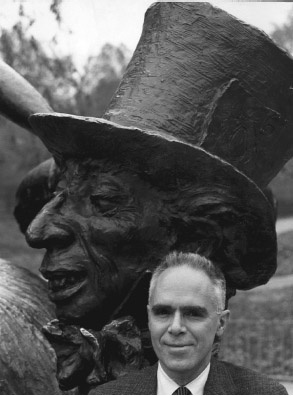
Martin Gardner 1914 - 2010

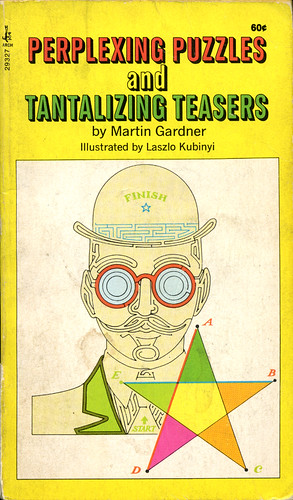
I don't know that I would have cared that much for the books of Lewis Carrol if it hadn't been for Martin Gardner.  I certainly never would have discovered The Hunting of the Snark back in fifth grade, and I don't know that I would have enjoyed lateral thinking if I hadn't discovered Perplexing Puzzles and Tantalizing Teasers around the same time.  As an adult, an educator, seeking sources for presenting logic problems and puzzles to students Gardner's Aha! books reminded me not only of those earlier books but that he had been a much larger influence on my reading then I realized.  

The summer of 1972 my family moved to another part of town, to a new neighborhood.  In those odd, alienated days of late June I remember exploring my new neighborhood and discovering the local branch of our town library.  It was carved into the stage left wing of my new school's cafetorium, a room perhaps ten feet wide and forty feet long.  Seeing that our family of six had just moved from a two-bedroom apartment to a spacious three-bedroom house the smallness didn't seem unusual or limiting to me; cramped living arrangements happened in the world, libraries included.  The library was an open-armed sanctuary with a choice selection of books for a lonely 11 year old boy.  That library and its books shaped a lot of who I am as a person and a reader.  

I was probably looking for books I already knew – Pick a Peck of Puzzles by Arnold Roth seems likeliest – when I stumbled onto Martin Gardner.  I remember Perplexing Puzzles looking very approachable, with clear language and Laszlo Kubinyi's pen and ink illustrations, even though I often couldn't solve the riddles or puzzles.  Unlike many of the other similar books intended for children the puzzles didn't talk down to me as a reader or go for short term entertainment; the problems invited contemplation even after I had given up and gone in search of the answers in the back of the book.

When I went in search of more books by Gardner I was surprised to be led to Alice in Wonderland, exhaustively annotated by Gardner and full of crazy details outlining all of Carrol's logic and whimsy.  I confess, I might not have actually read Alice before then, having probably assumed I knew all I needed to know from the Disney movie adaptation.  I do know that I read and grew a deeper appreciation for for the possibilities of nonsense even when it wasn't thick with hidden meaning.  The invention of words, Carrol's definition of portmanteau words, the rhythm of the language... I can't say I would have picked that up without Gardner and might not have continued my friendship with books and libraries if I wasn't constantly in search of the type of surprise that came with discovering books like Gardner's. 

Edward Lear wasn't far behind, and books of codes and ciphers, Ray Bradbury and Vonnegut closely after that.  Although it sometimes seems like very distinct, wildly disparate times in my reading timeline the through-line from Dahl's Charlie and the Chocolate Factory to Vonnegut's Welcome to the Monkey House is a scant two years.  And in between I don't know how many times I went back to Gardner to help pull at the taffy of my brain and expand it further into shape for lateral thinking.

I don't know that the current generation of emerging adolescent readers have anyone doing for them what Gardner did for me back then, but at least his books are still in print and widely available just in case.

Friday, November 20

The Great and Only Barnum


The Tremendous, Stupendous Life of Showman P.T. Barnum
by Candace Fleming
Random House 2009

Assuming you've read nothing about his life, what do you know of P.T. Barnum? That he was a huckster and a flim-flam man? That his name was the first name in three-ring circuses for a good portion of the 20th century? That he said "There's a sucker born every minute?

That's about as much as I knew – or thought I knew – going into this biography, coupled with a skepticism that was little more than a glorified snake oil salesman. Nothing like a well-written biography intended for middle grade readers (and up) to clear the air.

First, the quote: Barnum never said it, one of his competitors did, apparently cheesed that Barnum was able to corner the market on drawing a crowd. The circuses came later in his career, built from a combination of his showmanship and the desire to mix the curiosities from his "museum" with a traveling show full of animal acts and clowns. In between there was his American Museum of alleged artifacts from history (many of them fake) and the type of human curiosities generally associated with traveling freak shows.

If Barnum's life seems like the natural extension of Professor Harold Hill's fast-talking salesmanship it's clear Barnum was born for the life he led. As a boy he was successful in drawing a crowd and making money from them. And what's most surprising is how genial he seems, how he never regarded the public as the "suckers" despite the importance of making money from their gullibility. He had a genuine regard for what we would probably call low entertainment and discovered that the general public didn't mind "harmless" hoaxes.

Fleming makes this a breezy read, well-documented with a strong narrative thread, and actually fun. Makes me wish there were more biographies like this when I was a kid.

Wednesday, November 18

Secret Subway


The Fascinating Tales of an Amazing Feat of Engineering
by Martin W. Sandler
National Geographic 2009

This is the odd tale of a man named Alfred Ely Beach and his plan to construct the first underground transit system in New York City in the late 1800's. Well illustrated and explained, curious readers will be treated to a world full of secret digging, corrupt politicians, unwieldy inventions, and a city on the verge of collapse due to excessive crowding and manure covered streets. Nothing at all like modern times.

Beach's plan for a pneumatic tubeway is presented in great, twisty detail as he sorts out problems keeping his project secret and dealing with the corrupt Boss Tweed of the Tammany Hall political machine. Sandler presents up all the key players nicely and sets the stage for the demonstration of the city's first subway, then follows through with the political pressure that put a halt to construction of a larger system and the eventual Renaissance of the much improved system still in place today.

Although it makes a briefest attempts to set the New York subway system within the context of other subways in Europe, I think I would have liked some comparisons with other mass transit problems and solutions. The elevated trains that sprouted up before the subways are shown negatively, yet they also appeared in other cities around he same time, suggesting that ideas about mass transit weren't isolated to one particular city. Chicago and Boston, for example, managed to have their mass transit in place before New York, but there is no mention of either of these systems or how any of them influenced each other.

Also, as far as the subtitle's hyperbole, while the tale is fascinating, the engineering doesn't really come off as being particularly amazing. For a book that better lays out how a subway is engineered Joe McKendry's Beneath the Streets of Boston: Building America's First Subway is probably the way to go.

When it comes to non-fiction for kids I like to walk away feeling like I learned something, even if I'm already familiar with the topic. It's a shame of my education that I learned more about Boss Tweed than I remember learning in my AP US History class back in the day. Of course, the fault here could be in my study habits, but I have a much better picture of the political fixer now than I did before.

Friday, July 10

Tricky Video


The Complete Guide to Making
Movie Magic

by John Cassidy and Nicholas Berger
Klutz 2009

Sometimes it's fun to be the grumpy old man and talk to kids about what life was like back in the stone age. Before streaming and downloading, before DVDs, before VCRs, heck, even before cassette tapes! It's fun to see them try and imagine how different things were, and then to watch their faces cringe in horror when they try to compare their present day lives with "way back when."

"You must have been so bored! What did you guys do?"

The same things kids do today: make movies. Only it was with film, and it was expensive, and we didn't have YouTube to upload it to. Still, we made goofy films.

Pretty much everything in Klutz's Tricky Videos is stuff we did back in the day. In-camera edits and forced (or false) perspectives and clever editing tricks – yup, old school. But then, everything old is new again, as always.

It sure would have been a lot easier to have had this book though, and some of the technology to go with it.

We would haunt college short film and animation festivals. They would be Friday or Saturday night affairs in some large campus building, a nominal fee at the door, and hours full of filmed lunacy. Things like counter-top fruit singing Papa Oom-Mao-Mao or even something classy like The Wizard of Speed and Time. Afterward we would be hungry to try and do some of the things we saw, or argue how some of the effects were accomplished. We also read magazines of filmmaking and special effects, or articles about how the films we watched had been produced, so among us we usually had enough knowledge to pull off these tricks.

Tricky Video collects some classic short film effects gags and teaches readers how to achieve the effects, complete with suggested storylines. Much of what's here can be viewed in YouTube, either as a result of this book or simply because they are fairly common, and Klutz even has some specially made links that show the effects in action. There's the faked fight scene, the tiny person in the palm of your hand gag, pixilated drag races, and, of course, talking fruit. Sound effects are covered, as are the finer points of camera placement and staging. It's a good place to start for an aspiring middle grade movie director. Even comes with it's own clapper, thought totally unnecessary in this day and age when sound is recorded with the video or added as an effect in the editing. Naturally, active young filmmakers will quickly master these scenes and come to create other, more complex gags and set-ups.

I realize that Klutz isn't the place, but this kind of book – with it's clear color photo instructions and online video links to show you what the final result looks like – could do with a couple solid follow-up guides. Like one on making tricky horror effects videos, and especially on writing good movie stories, whether comedy, horror or drama. It is too easy to just grab a camera and shoot gags and share them for a quick laugh. It's also too easy for budding filmmakers – and some professional ones as well – to stop at the image and learn nothing about crafting good stories.

That's the truly tricky part.

Monday, October 27

J. Edgar Hoover


A Graphic Biography
by Rick Geary
Hill and Wang 2008

Just what the world was waiting for, the life of J. Edgar Hoover as a graphic novel. Actually, in a way, I was. Sort of. I mean, I think there any number of political and cultural figures from the 20th century who could use some better coverage than might appeal to a younger audience.

Geary in many ways is a perfect choice for Hoover. His mannered crosshatch style almost bespeaks a certain Victoriana that suits the man who built and ran the FBI for over 50 years. Using almost no dialog but plenty of narrative text, he recounts Hoover's rise and fall with carefully staged scenes and expressions. The effect is almost like a Ken Burns documentary in graphic novel format, which isn't a bad thing. You can practically hear the period music as the narration methodically connects the dots in Hoover's life, from his low days as an average government worker to one of the most powerful unelected figures in American politics.

I joked with friends that I was a little upset that Geary stayed clear of gossip and rumor -- though there is a single panel suggesting what Hoover looked like if the rumor of his attending a party in drag was true -- there is also only the lightest gloss on his one man war against those he felt were his and the nation's enemies. In some ways, the chapter on the Kennedy's could be a book unto itself, as could the chapter on his secret surveillance war on MLK and John Lennon, but these events are passed over and given none of he weight I personally felt they deserved.

I also worry that a reader getting all their information on Hoover from this book might not fully understand that he wasn't really all that good for the country. If that sounds a little biased then it balances the book's non-committal position of Hoover as a politically neutral man who ran his office with an iron fist. he ran more than his office with that fist, and ruined a great many lives, and none of that comes through.

I love Geary's work in general, and hope he does more of these books in Hill and Wang's series of biographical graphic novels.

Sunday, October 26

Screenwriting for Teens


The 100 Principles of Screenwriting Every Budding Writer Must Know
by Christina Hamlett
Michael Wiese Productions 2006

It's been a while since I've run across a book that leaves me running hot and cold depending on my mood when I pick it up. On the one hand what we have is a thorough course in film media awareness, a textbook for exploration of writing for television and film; On the other hand the aim seems to be driven toward raising an army of teen screenwriters armed with the skills to keep turning out the same sort of studio drivel that has been cranked out for decades now. In the end I find myself forced to admit that had this book been around when I was a teen I would have owned it and probably would have been a different writer as a result, for better or worse I couldn't say.

Hamlett presents each of the principles on the right side page with a clear explanation and examples. Flip the page and there is a "look and learn" segment recommending films, TV shows, and even commercials that support the principle at hand. There's also a "brainstorming" section that provides three different exercises to reinforce the lesson and provide young readers with a broader background in understand how to write.

The book opens with a lesson on the differentiation between books and movies, with a brief study of classic story structure, and quickly builds up to short studies on cinematic structure and the Hollywood method for developing a marketable screenplay. In these bite-sized segments a young writer will learn much of what is taught in most other books and seminars on screenwriting and it is highly accessible. The examples are, for the most part, well-chosen and the exercises are solid enough even for experienced writers to get something from them.

Where the book falters for me is how it seems to go out of its way to not look like a textbook or something equally formidable, but in doing so treats the serious student too casually. "If you're not already keeping a daily journal, start one" seems like something that should come at the beginning of the book and not as an aside eight chapters in. Additionally, there is an unspoken assumption that the reader has an endless amount of time and access to watching television shows and movies without really letting the budding writer know what they're getting into. Granted, the serious student will devour these assignments and hunt down whatever looks interesting to them, but just as many might find the task daunting part way through and be tempted to give up.

With the ever-changing television line-ups and cultural phenomena there are references to television shows no longer on the air, as well as films that even most film students have never seen (to say nothing of older films they probably never heard of). And very quickly it becomes clear that this is a book that one cannot breeze through in a month or even a few months. Watching the recommended films and programs, following through on the activities will take time. What Hamlett hasn't also adequately prepared the budding screenwriter with is a lesson in patience.

Yet, I still like what this book does. It says to the teenage screenwriter "Okay, this is what it's all about" and plows ahead with its challenge to keep up. Those who think that writing for television or movies is a shortcut to fame will quickly learn that the modern screenwriter's craft is no less arduous than any other writer's. Serious teens who believe this is truly their destiny should make this a first test of their strength and endurance. This would only be a first stop because there is much more about character and scene development that a solid screenwriter needs to know and should learn from other books on the craft. Syd Field's books, and Robert McKee's Story and, just to get some perspective from a master in the field, William Goldman's Adventures in the Screen Trade.

For the first-timer, the student looking to make solid short films and develop themselves as screenwriters, Hamlett's book is a step in the right direction.

Friday, July 4

Duel! Burr and Hamilton's Deadly War of Words


by Dean Brindell Fradin
illustrated by Larry Day
Walker Books 2008

It's a reflection of my quality education that I graduated without knowing the story of the duel between Aaron Burr and Alexander Hamilton. Or it's proof of what a horrible student I used to be. But perhaps if I'd had this nifty little picture book when I was younger it would have stuck with me while I was attempting to handle the grind of AP US History at the same time my family was falling apart.

In a few quick pages Fradin shows us the troubled childhoods of these two men, how they suffered similarly as boys, and grew to be men with something to prove. Throughout their adult lives their paths cross and intertwine, Hamilton the insecure with a chip on his shoulder for being foreign born, Burr the arrogant with anger management issues. It quickly becomes apparent that these two men were as star-crossed as any, rivals fated to shoot it out on the shores of the Hudson river one cold morning. To summarize any more would be to retell the book, and Fradin does such a great job swiftly hitting the highlights in this historic rivalry that it makes you want to reach out and shake either Hamilton and Burr and point out "Dudes! You're on the same side! Quit fighting!"

Day's watercolors have some best dramatic compositions I've seen for a non-fiction book in a stretch. The cover image looks like a frame borrowed from a spaghetti western, and the illustrations throughout are no less striking for their choice of angles and moments.

As always with picture books like this I'm a little uncertain about the audience. Readers old enough to be interested in the details of history like this would prefer, to my mind, something other than a picture book.

Monday, May 19

Sisters & Brothers


Sibling Relationships in the Animal World
by Steve Jenkins and Robin Page
Houghton Mifflin 2008

I learn more from picture books than I probably did back in high school. Of course, I have a different perspective on what interests me than when I was younger, and kid books are pretty much all I read these days so I'm probably not learning as much as I could.

Still.

Did you know that armadillos give birth to four young, either all male or all female, each an exact clone of the other? I can't say I did, and that would make for an interesting relationship if you were raised along side three exact copies of yourself. More weirder than being identical twins.

Turkeys, on the other hand, hang around with mom for a year and then the ladies go off to mate while the brothers stay together in a band. Dudes, it's like some guys I went to school with! I guess they were turkeys of a sort.

Then there are the naked mole rats. Okay, they are practically blind and live in these huge burrows underground, that I knew. What I didn't know was that each colony has a single mom -- sort of like a queen bee -- and that when they meet each other in a narrow passage way they have to sniff one another to determine who has seniority, because the eldest gets to climb over the youngest.

And then finally, a puzzle piece I didn't realize was missing in a story I conceived long ago. New Mexico Whiptail Lizards are all female. There are no males. That just blows my mind.

I think this is the first time I can remember where the text upstaged Jenkins cut paper illustrations. Or perhaps I've just gotten so used to his work that it no longer surprises and delights the way it used to. That doesn't make it bad, it's just become as familiar as Eric Carle's style in it's sameness.

By using sibling relationships to explore these unique animal families, Page and Jenkins supply a lot of great information in a clean, easy to understand style that is obviously engaging enough for an adult but readily accessible to young readers.

Now, if you'll excuse me, I have some Whiptail Lizards to research.

Wednesday, May 14

Physics: Why Matter Matters


created by Basher
written by Dan Green
Kingfisher 2008

From the people who brought you the Periodic Table...

Well, it's been a year since we last visited our friends the Elements, those hip cats who it turns out have their own personalities. Now Basher and Green have given us a companion volume explaining the world of Physics. The book opens with a quote from the the Big Guy on a bike:
"Everything should be made as simple as possible, but not simpler." Albert Einstein
Yup, that just about sums up what's going on here, proving the Einstein's smaller theories were pretty solid as well. The physical world and its inhabitants are once again anthropomorphed and grouped by association. We get the Old School dudes (Mass, Weight, Density, &c.), the Hot Stuff (Energy, Entropy...), the Wave Gang (Sound, Frequency...), the Light Crew (Radio, Microwave...), and so on. It's all here, each aspect with its own spread, a first-person breakdown on the one side and a graffiti-like cartoon portrait on the other. There's also a "first discovered" box and a short historical list of how or when they were famously employed.

As with the Periodic Table: Elements With Style, I think this book works best in the classroom as a supplemental text (though used correctly they could be primary) with wide appeal. A great introduction for budding young scientists to the basics of physics, a playful refresher for older young scientists, and an easily digestible crash-course for adults who need the background to keep up with their budding young scientists.

In a semi-related note, check out what happens when the Periodic Table meets Art. Courtesy of Sara over at Read Write Believe.

Monday, May 12

i love dirt


52 activities to help you & your kids discover the wonders of nature
by Jennifer Ward
foreword by Richard Louv
illustrations by Susie Ghahremani
Trumpeter / Shambhala / Random House 2008

galley provided by publisher

There is absolutely nothing wrong with this book, and everything wrong with it. It's a book for kids, but it's a book for parents. these are the best of times, these are the worst of times...

As a collection of outdoor activities for adults to do with children there's very little fault I can find in the premise of the execution. Most of what is included are simple outings, grouped by season, that allow parents and children to commune with nature of a manageable scale. There are bird watching activities, cloud watching games, backyard camping or a general nocturnal excursion. All with goals attainable in most parts of the country and with little investment. Each of the activities also includes a "Help Me Understand" box with select questions and answers that a child might ask.

But all in all, it's sad that it's come to this.

Going out into nature should be, well, natural. It shouldn't feel guided by a book that provides one activity a week - giving the air of a constitutional duty as opposed to enjoying the enterprise. In the introduction, Richard Louv talks about how when he was a child in the 1950s he would go out into the nearby woods every chance he got. But in half a century we have become a nation of people who must schedule their children's playdates, supervise their destinations with cell phones and text messages, and must budget time to shove our children into nature in order to learn (and hopefully respect) what the Earth Mother has to teach us.

Kids just don't "go out" the way they used to, the way I used to. Physically the neighborhoods haven't necessarily changed, but our relationship to them, and our priorities about this free time, has changed. We no longer trust our children to trundle off to places where they can explore on their own, nor do we allow the time for such behavior by preferring to over-program kids into structured, organized teams and activities. And so, to fill this deficit in our culture, we have books to help us attempt to round out the experiences of our children.

In books like this aimed at parents there is an unavoidable undercurrent that the parent in need of such a book either won't find the book, or will feel condescended to. The point where I feel this most is the little check box at the end of each chapter that summarizes the purpose and goal of the activity. "Encourages exercise and well-being," "Stimulates wonder, experimentation, and a feeling of exhilaration," phrases like these give the book it's pedantic feel and sours everything that proceeds it. It's one thing to have a book as a reference for what to do with kids in he great out-of-doors, it's another entirely to have to be told that the exercise will "Stimulate caring and stewardship for living things." And what if it doesn't, is the exercise a failure? Is there something wrong with parent or child? There's little a family can do with these exercises if they don't go as planned but turn around and go home.

Also, the problem with the "Help Me Understand" sections is the presumption that a child will only have one question per activity. If the exposure to, say, a spider's web or a bird's feather opens a child's imagination there is clearly an opportunity to explore further on line or at the library. As the review copy I received failed to include the Resources and Recommended Reading listed in the table of contents it is hard to judge whether this book is all that helpful in supplemental guidance. Still, to only address one bit of trivia per outing seems a bit shallow.

The publisher feels the activities will appeal to children from 4 to 9 but I can tell you most of what I saw wouldn't float with my girls beyond the age of 7 or so. So it's for the curious, the very young, and the parents who might not otherwise introduce their children to nature without a guide.

Saturday, March 8

Delicious


The Art and Life of Wayne Thiebaud
Susan Goldman Rubin
Chronicle Books 2007

A book so luscious you want to lick it, that's my blurb for this one.

For those unfamiliar of artist Wayne Thiebaud, of any age from middle grade up, this is a great introduction. Better, it explains Thiebaud's growth as an artist and the circuitous route he took to get there, working as a commercial artist, in department stores, drawing cartoons for Disney, and farthest from his thinking was the fine art paintings that have been his claim to fame. What I like about this gentle message of an artist discovering himself is that while he always knew he wanted to do art he wasn't forced to make a decision before he was ready. As he was mentored by individual artists and made his living as a working artist he gained a lot of experience that would later become useful as a painter.

I think there are a lot of creative souls in the schools who know they want to do something with the arts but don't really understand how one figures this out. When I was in high school the idea of working as an artist, of making a living, meant what was called commercial art which primarily meant advertising art. If a high school student said they wanted to be an artist that's what was on offer, that was all anyone really understood about art. If a guidance counselor could have suggested how I could channel my interests in photography and graphics into, say, book design or children's books I think my life would have been very different. If someone could have put this book into my hand, showing me how a fine artist found his footing and did some artful floundering along the way, my life would have taken another very different direction.

So, yeah, I hold some real high hopes that this book finds some middle grade and teen readers who are interested in what the life of an artist looks like.

The book itself is beautifully put together. Chronicle really gets it right, with practically each spread featuring one of Theibaud's luscious cakes, tempting candies, or angular intersections faced with text in white set against an ever changing compliment of backgrounds. The paintings influence the color palate which, by design, give this book an appropriately artistic tone. Honest, just pick this book up and leaf through and ask yourself why all books on art can't look this good.

The gals (can call you guys that?) over at 7Imp did a much better job covering this book that I seem to be able to manage right now. Check out their review and then check this book out.

Friday, February 22

I Lie For a Living


Anthony Shugaar
(The International Spy Museum)
National Geographic 2006

I spotted this on the non-fiction shelf in my local library teen room and thought "Yeah, that's a book a teen boy would pick up." Being a few decades removed I can still tap into my inner teen boy. I picked it up without a seconds worth of hesitation.

But what a disappointment.

It's a smartly designed book, very contemporary graphics, layout and typeface, very much in step with what attracts a younger reader. It's also in keeping with the style of the International Spy Museum in Washington D.C. which is very interactive and modern as single-subject museums go.

After a brief intro about the long history of international spying we jump into chapters where spies are grouped by like: those who did it for the money, master spies, double agents, femmes fatales, and so on. Each of the spies get a full page photo or illustration and one-to-three pages about their lives as spies. And there are a lot of spies in this book. Easily half I've never heard of, most are single-page treatments (generally the non-Americans get short shrift) and they read like much longer entries that have been edited to within an inch of their lives. Many of the bios assume a large amount of understood history -- for example the bio of Allen Dulles, first civilian head of the CIA, assumes knowledge of The Bay of Pigs invasion and why it failed.

While the format of short bios on the subject of spying makes attractive reading for boys, and there's a lot of background stuffed into the pages, the book overall serves as little more than a jumping off point for further investigation in other books. Books, it should be noted, which aren't listed in the back of the book; the bibliography, such as it is, suggests books for further reading from which some of the information was drawn but it is woefully inadequate for a book that handles its information so loosely.

I've been to The International Spy Museum and they do a nifty thing where you pick up a dossier for a spy when you enter, follow their progress along the way through the exhibits, and in the end learn their ultimate fate. It ties the exhibits together, gives you a narrative to hold onto, makes you pay closer attention than you might if you were merely drifting through the space. It's too bad they couldn't bring some of that innovation to this book.

Friday, November 30

How Does the Show Go On?


An Introduction to the Theater
by Thomas Schumacher
with Jeff Kurtti
Disney Editions 2007

This one is killing me.

This handsome book provides a fantastic window into the production of a modern Broadway musical with a solid background in theatre production aimed at the middle grade and early teen set. The book starts at the front of the house explaining how the theatre staff keep things running, then goes on stage, back stage, through rehearsals, all the way through opening night explaining how it all comes together. Throughout there's lots of interactive materials to study; a facsimile copy of Playbill; a reproduction of an actual ticket (detailing how to read your seat assignment); there's an envelope containing a section of a script and later on another bit of script with the lighting cues delineated; there's even a quarter-sized facsimile folder containing a director's production sketches with a photos that follow showing how they were executed.

But it's Disney, and being Disney means that no musical theatre on Broadway existed before The Lion King. The author, being the producer of most of Disney's Broadway shows (it says so twice on the cover!), is more than happy to share this knowledge but every photo is Disney. The enclosed Playbill and ticket are from The Lion King, as are the facsimiles of Julie Taymor's production sketches. Sections of script are from Tarzan and much of the behind the scenes includes images from Mary Poppins. While it was nice of them to explain the differences between theatre types -- a thrust stage from a black box from an amphitheatre -- it seems a bit presumptuous to call the book "an introduction to the theater" and conveniently ignore the world outside the sphere of all things Disney.

Granted, a kid who is into musical theatre might have come to it through Disney originally but what if they didn't? Does it matter that Disney basically turned a bit of self-promotion into an introduction to an art form?

This is what tears me. You see, I've got two girls in the house who have this thing for musical theatre. Their school puts on a musical every year (two actually, a 7th and 8th grade production in the fall, a 2nd through 6th grade production in the spring) and they have elected to participate every year. They are also part of an after-school musical theatre group and perform in those shows in the fall and spring. And then there are the movie musicals we watch at home which, fortunately, they continue to enjoy. Their favorite movie musical is Singin' In the Rain. They recently watched My Fair Lady and Little Shop of Horrors. We took them to see Wicked in October. They sing show tunes in the shower. They know there's a world of musicals that isn't Disney and they also know High School Musical (which to me is like a cross between an 80's sitcom and an Afterschool Special with pop songs grafted onto it).

I really think they might like this book but I don't like the narrow focus. I'm not so rabidly anti-Disney that I would refuse it on those grounds alone -- it would look hypocritical considering we own a number of classic Disney cartoon collections -- but the total pro-Disney aspect of the book leaves a bad taste in my mouth.

Open question for the people at Disney Editions, and their publishing family: Are you so threatened by the entire history of Broadway that you felt the need to exclude all mention of it from your book? Are you so insecure about your right to be on The Great White Way that you had to buy the New Amsterdam Theatre in order to assure yourself a home? Or is it, as with Time Square, you simply want to replace what's out there with good old fashioned family values?

Did you have to produce such an attractively biased book?

As an introduction to theatre I guess I would have hoped for more of an historical perspective. I would feel a lot more comfortable introducing this book to kids if I knew they had something just as good -- and less Disney -- to move on to afterward.