Showing posts with label viking. Show all posts

Monday, September 12

Fast Sam, Cool Clyde, and Stuff

by Walter Dean Myers  
Viking Penguin  1975

A collection of vignettes of teen life in Harlem, though occasionally dated in language and setting, still as bold and authentic sounding as probably was back in the day.  

Francis, aka Stuff, moves to 115th street he finds the local kids wary of the newcomer until he proves his stuff (or lack thereof) on the basketball court. The good-natured humility test passes as a sort of ritual and Stuff is accepted as one of the gang.  

In the collected stories of Stuff recounts tales of broken homes, parental death, drug abuse, and several trips to the jail that echo the prejudices of the day. They also concoct crazy schemes – like dressing up a boy as a girl to enter a dance contest thinking they won't get caught – that rings with the sort of head-shaking humor that truly is kids being kids. The kids also experience the honesty and brutal truth of parents just trying to get by, and to that end they come together as a club that calls itself the Good People who vow to be there for one another. There aren't unrealistic heroics here, and no heavy moralizing either, simply stories of inner-city life told matter-of-fact and dialog heavy that show kids trying to sort out the world for themselves.   

*

I had the opportunity to hear Walter Dean Myers speak this past summer and it was fascinating to hear him talk about how he progressed from a short story writer to a novelist and how he didn't really concern himself with plot structure while writing Fast Sam, Cool Clyde, and Stuff. This may explain part of its appeal and freshness on this current reread, because each of the "chapters" stands as a sort of freestanding story that builds on information from previous stories. Characters come and go and eventually a few threads pull together to reinforce a hard message about community support can only help those who are willing and open to the offer of help. What's refreshing is that the kids already know and articulate the messages the book delivers, long before the book delivers them, so instead of feeling hammered by what happens there's a sadness to the events that weighs on the reader just as it weighs on the kids.

It was also nice to see a novel-length collection of stories that meandered at a comfortable pace through their own time. The self-contained nature of the chapters allows for readers to take a break and reflect if they want or to plunge ahead and see 'what happens next" to Stuff and his crew. The over effect becomes a series of shorter pieces that might, these days, might be extended into larger novels and strung together as a series. So often what I hear people say about series is that they love the characters and want to know more about what they do next, but far too often I find myself impatient with series titles because they seem to have been plotted to draw out the narrative in order to justify their continuing adventures in subsequent volumes.

What Myers does, inadvertently by his account, is give us sketches of characters who grow with each story and expand our knowledge as we go. It is probably possible to take these sketches and better integrate them into a single, more unified narrative which would give the story an overall master effect that would do more to draw attention to the author than the story. This is actually a fairly large problem I have with first-person point-of-view middle grade novels where the author's mannered style or carefully knotted plot gives the story more of a deliberate literary feel and less a sense character verisimilitude. 

So huzzah for Walter Dean Myers and his innocence in crafting a novel with more heart and soul than structure and self-consciousness.

*


Tiny note about the current cover I see circulating these days, not the one above: It has the silhouette of a boy blowing a trumpet with the city in the background. That's all well and good but Stuff plays a saxophone, people, and after previous covers were clear to include a sax if baffles me as to why they would change it. One of the stories begins with the boys headed into town to get a new reed for Stuff's sax but then they end up in jail. There's no reason I could see why these later editions would change the text (so he could go buy a new trumpet mouthpiece?) so I can't understand why they would do this and I sincerely hope that the next chance they get the publishers return to the sax. Or, as the original paperback cover had, the kids hanging out on the stoop.

Wednesday, June 15

Punch in New York

 written and illustrated by
Alice Provensen
Viking  1991


When the star of a famed Italian puppet theatre is stolen fro his owner he goes on a mischievous romp through modern day New York City only to realize there's no place like home... unless you get to rip off someone in the process.

Landing in New York, Il Professore Tucci-Piccini (all Punch puppeteers are referred to as Professor) has one of his bags stolen from him, the one containing his star, Mr. Punch. Back at the thieves den when they discover the suitcase is not full of money they toss Punch out of the window where he lands on a baker in the street and sets of on his very Punch-like adventure across the city. After a couple of isolated incidents Punch falls in with a pack of muggers and quickly becomes their leader, convincing them to help him steal the car of a wealthy man and driving it – preposterously across the roofs of buildings – to his home. Lauded for his excellent driving Punch is hired on as the regular chauffeur but he becomes lonely for his old family, the puppet theatre, and in the end manages to combine his old and new jobs into one sweet deal.

Punch has always been a bad boy, and his antics have always been enjoyed for their outrageousness. In updating the Punch tale, Provensen has found ways to incorporate some of the standby characters – policeman and alligator – in a way very much in keeping with modern times. Other, trickier characters such as the beadle, the devil, the hangman, and even Judy and the baby are sidelined probably because of how quickly they would become hot-button problems if introduced. In the traditional play Punch is a serial murderer and clearly that wouldn't do for a picture book. Instead, Provensen gives us a Punch without his historical trappings but with plenty of bad behavior that walks the tightrope between playful and dangerous.

Provensen's illustrations sit like stacks of multiple planes, almost naive in perspective. The large city scenes are crowded with textual details, names of stores and signs and places that suggest that nothing in New York is real unless it has a name attached to it. Some of the businesses are real (the Waldorf) while the rich man named Helmstrump seems an amalgam of Helmsley and Trump and his name appears on buildings throughout. It's difficult to know if Provensen is going for commentary or providing adults with an inside joke and I'm not quite sure it works either way. But the color palate of oil paint on velum is bright and bold

The historical origins of a Punch and Judy puppet show go pack to the 16th century Italian commedia dell'arte where a set of stock characters would perform farces that openly mocked the morality of decent people. Punch, a hunchbacked hooked-nosed dwarf, was an obnoxious braggart, a violent drunkard, and a coward who settled every disagreement with a paddle that was larger than himself. He would beat police and church figures, outwit the devil, and got away with murder, literally. The no one in their right mind would cheer for such a person in real life. This puppet surrogate allowed audiences to laugh at the folly of the bad guy getting away with it.

And I feel the need to interject here that this desire to root for the bad guy exists to this day in modern entertainment. We like to imagine ourselves getting away with it, yet at the same time feel relief in seeing the lawbreakers get caught or killed. It feeds our fantasies and then calms our sense of morality, but this need of a moral coda is a modern desire; we have come to a place where we would feel guilty without an explicit ending that the bad guys didn't get away with it, unable to allow our sense of morality rest unspoken. In that way we have become rather weak (or at least lazy) as a society when it comes to using our intellect while enjoying entertainment.

I mention this because the reason I had to check this book out was that someone pointed out a couple of bad reviews on this book on Amazon. I am beginning to believe that comments and product reviews on websites are proof of our failures in education and that they represent 90% of the population.  That aside, I was astonished (I shouldn't have been) that someone thought this book taught bad values ("values" being a the operative word that told me all I needed to know about the commenter) and two of the three reviewers felt the book should be banned. The one who complained about the values even suggested people not buy this "book" (the word book in quotes) as if somehow disagreeing with its content made it less of a book than one they agreed with.

Yes, I can see how if you believed that puppets could come to life, talk to people, drive cars around town, and generally create mischief, that you might believe the book is a deliberate attempt to teach young readers how to lie, cheat and steal. If you cannot tell the difference between a drawing of a fictitious character in a picture book and real people in the world – and worse, if you do not know how to have a conversation with your children to help them understand the differences between what is real and what isn't – then you have a bigger problem than can be solved by banning books. I don't think you need to be cultured in a way that you understand the history of Italian commedia and English puppet theatre in order to understand this book, but if you have a problem with this book then you're also going to have a hard time with gangster movies, with the moral ambiguities of James Bond, even with cute little picture books with talking animals in it; I can think of no greater lie than teaching kids animals can think, behave, and reason just like them.  I realize some people take the bible literally, as is their right to do so, but to apply that same standard to all books is to suggest that all fiction is real or that there's no difference between made-up stories and those in the bible.

Come on, is this really the state of our educational system today?

Is Punch in New York a great book? No, but it is a fine introduction to a classic buffoon from another time and place, where the people weren't so smart that they were offended by a broad farce.

Wednesday, May 18

Lion

by William Pene Du Bois  
Viking Press  1956  

In an animal factory in the sky winged artists invent new animals, including one very unusual looking lion.  

Artist Foreman, looking suspiciously like an angel, was one of the first animal designers in the Animal Factory in the sky.  Now in semi-retirement as, well, a foreman to the other artists, he has come up with a new name for an animal -- LION -- and sets about to design an animal to fit the name.  Artist Foreman being a bit rusty designs a multi-colored quadruped with whiskers and a mane of feathers, the tale of a fish, and a variegated striped pattern that defies nature.  Doubting that he has made an animal to match the great name he has given it he goes around to the other animal designers and asks them, in one word, what they think is wrong with the creature.  Size, feathers, color, legs, haircut... each of these responses sends Artist Foreman back to the drawing board to make the necessary adjustments.  

Finally he takes his creation to the Chief Designer and asks what is wrong with this marvelous creature and is told "Nothing!"  Ah, but the Chief Designer hasn't heard the proposed noise for the Lion -- PEEP PEEP! -- but his suggestion that a creature like that would make a mighty ROAR leaves Artist Foreman little choice but to accept that a peeping lion would be as wrong as everything else he originally thought about his creature.  So Artist Foreman returned to his drawing board and roared with happiness over his latest creation.  


This is one of those time capsule books, something I had totally forgotten I'd read as a small boy.  When I stumbled upon the title on a Caldecott book list (it's an Honor title), and with fond memories of his other books besides The 21 Balloons, I had to hunt it down. My first reaction was What an odd take on the creation stories.  Clearly we are shown a heaven in the clouds, with angels of creation in the service of a god, but what we know of the Biblical creation was that the animals were created by God and not his underlings working in a factory.  Then there's the notion that God merely signs off on these creatures not of his design, and that no one dares contradict him... it all reads like an odd bureaucracy, complete with yes-men and semi-competent foremen whose employees laugh at him behind his back. Though fifty years ahead of its time, the book seems to argue both for and against the idea of Intelligent Design.

Of the mid-century children's book authors and illustrators William Pene Du Bois fits an odd space in my nostalgic heart.  There is a childlike whimsy and logic to his stories and illustrations that, as an adult, don't quite hold up.  At the same time that innocence is oddly in keeping with the way kids think.  The odd fraternity of The Three Policemen, the looney inventions of Lazy Tommy Pumpkinhead, even his original illustrations for Roald Dahl's The Magic Finger all speak to this sense of Du Bois channeling some other world that looks like ours but simply isn't.

In Lion he gives a glimpse of a heaven no one has ever claimed, before or since, with angels working an animal factory, working their way through trial and error.  The story allows the reader (or listener) a chance to recognize everything that is wrong with the Lion and decide for themselves what exactly is wrong with Artist Foreman's creation. Were it not for the wings and the clouds the story could be set anywhere, setting becomes almost incidental from the start. The Animal Factory in the Sky is simply a door through which we are given entry into Du Bois imagination.

I was surprised that a single library in my local system had a copy of this book on hand.  Out of print since 1986, I wonder how often it gets checked out by young readers, and how long before this lone copy ends up discarded and lost to the memory of grown children from another era.

Wednesday, November 19

Knucklehead


Tall Tales & Mostly True Stories About Growing Up Scieszka
by Jon Scieszka
Viking 2008

I totally dig that Jon Scieszka had the kind of wigged-out childhood that makes for good kid biographies, but I would hate to see the report some kid would write using this as their source material. Or maybe I wouldn't hate it. Maybe it's what some poor unsuspecting teacher deserves.

In 38 brief and amusing chapters the author of The Stinky Cheese Man and our current National Ambassador of Young People's Literature by the Library of Congress digs up the kind of family dirt that most people try to hide. From pee fights, to fundraising in order to name starving pagan babies in Africa, to threatening to have younger brothers hauled away for misbehaving -- this book is chock-full of all the things that naturally occur in a household of five boys.

This book hardly needs any recommendation. Boys who know the name Scieszka will pick it up and know what to expect. Mostly. If they haven't done similar things recounted in this book they probably thought them. And if they never thought them, then this book will inspire them. Word of mouth will ensure that boys pass this along and read these impossible to forget stories.

Reading, getting boys to read. A steady of diet of this stuff would kill anyone, but boys deserve a treat everyone once in a while. Oh, and for the adult boys out there who might have forgotten what it was like to be 8 or 10 or 12 years old, I'm sure there are a few memories kindled by these accounts.

As for these stories being either tall tales or "mostly true" all I can say is, having once been a boy, a disclaimer like that was probably some editor's idea. I can't imagine any true boy denying any of this as anything but the whole truth.

Wednesday, October 10

Cowboy & Octopus


by Jon Scieszka
illustrated by Lane Smith
Viking 2007

Cowboy and Octopus are friends. Cowboy is a paper doll cut from a book. His clothing tabs occasionally show. Octopus was cut from a comic book. His bold colors and zip-a-tone dots give him a party dress appearance.

"Do you like our book?" asks Cowboy.
"Do you like our book?" asks Octopus.
"Yes, I do. I like it very much," I say.
"Do you think kids will understand the stories?" asks Octopus.
"Sure," I say, " They have that same irreverent humor of George and Martha books, but with some unexpected twists."
"What's a Martha," wonders Octopus.
"Twists?" drawls Cowboy, "What do you mean when you say twists?'
"Well, Cowboy, while Octopus can be a very understanding friend -- eating your seven course meal of beans without complaining the way George eats Martha's pea soup without telling her he didn't like it -- you are much more blunt about things."
"What's a George?" asks Octopus.
"For example," I continue, "When you asked about each others fancy hats, Cowboy, you flat out told your friend that you didn't like Octopus's hat. I believe you compared it to a cow pie."
"Yeah, and he hit me over the head with a hammer!"
"True," I say, "But that was different. That came from a misunderstanding."
"But I said that being a friend meant being honest with one another," says Cowboy. "Should I have lied?"
"You asked me about the twists. That's what I was talking about. I didn't expect you to be so... coarse."
"Horse? You didn't expect me to be a horse?"
"Not horse, course. Rough around the edges."
"That's not my fault I'm rough, I was just cut out that way."
"Me too," says Octopus.
"But you still liked it, our book?" wonders Cowboy.
"Yes."
"You didn't say anything about my scary costume?" whines Octopus.
"We have to save something for people to be surprised about," I say.
"Yeah," says Cowboy, "I still have nightmares about that."
"I trust we'll be seeing more of you boys down the road?"
"Maybe," says Cowboy.
"Maybe," says Octopus.

Monday, May 28

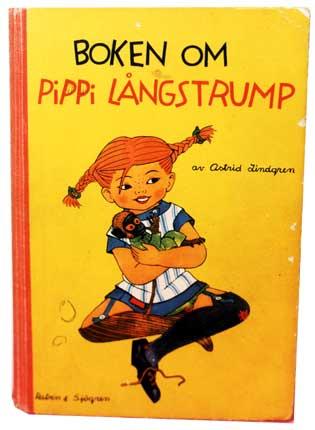
Pippi Longstocking

by Astrid Lindgren
Translated by Florence Lamborn
published in Sweden in 1944
Viking Press edition 1950


Pippi scared me when I was young. It had nothing to do with the books at all, and certainly nothing to do with some sort of threat to my prepubescent masculinity of this scrawny little Amazon, but it had everything to do with the 1960's movie based on the book.

Funny how memory is. I can see these images as part of my childhood vividly like they happened a few years ago, but I have to remind my kids that I first encountered Pippi back in the days before there were DVD's, before videos, and in this case even before my family owned a color television. In that blue-green cathode haze Pippi held a strange power that made me watch with my face half turned away in fear. I knew girls like Pippi, girls that could womp a baseball better than I ever would and wouldn't think twice about jumping down an open manhole cover, but they didn't scare me like this.

Because Pippi was the first movie I ever saw dubbed into English.

How and why did they talk like that? Their mouths and the sounds they made didn't sync up and worse; The way they were dubbed, stilted and forced like bad community theatre thespians trying to read Shakespeare into whimsy, had me feeling there was an invisible presence in the room that had turned down the sound and was making up the dialog for all the characters as they went along. And because of all this I never read Pippi Longstocking until I was a full-grown adult and felt I could handle it subject without the fear of those early memories rushing to accost me.

How nice it was to finally get Pippi in her correct form, a spunky and precocious 10 year old with a pet monkey and a horse that lives on the front porch. She lives by her own rules and with total abandon, and can foil crooks just as handily as Homer Price. That adults are dolts and can be outwitted by a wild child like Pippi is cake for a young reader . That Pippi actually doesn't even care about any adult besides her father is the icing.

Lindgren -- in a fashion that must be a genre unto itself by now -- originally wrote these tales for her own children. Writing to please children may seem obvious but many who try tend to fail because they impose their adult logic and adult world onto the proceedings. Logic alone is enough to kill a good story. Not that children don't long for and crave logic, because they do, but it's the logic they create that's important. When you think about what we do as developing humans, how we take raw data and information and learn to craft connecting ideas, thoughts into images into ideas into logic, the whole of it more impressive than anything we claim as adults. As adults we manipulate the hardware and the software of the brain to make sense of our world; As children we build the hardware and software from scratch and call it the world.

At the core of the Pippiverse are two innocents who serve as our grounding, Tommy and Anika. They provide the necessary balance that allows the Pippi books to endure because they counter the desire to "be good" with the twined desire to explore without rules. When challenged, even to the brink of hysterical danger, everything works out in the end because deep down Pippi has total unspoken faith that it will. I don't think it would take much to apply the lessons of Pippi into some warm-and-comfy self-help impulse item sitting on the counter at your local chain bookstore. Here's hoping no one thinks this is a good idea.

Many books for children feature troubled families and it's an odd comfort we find in seeing that others might have it worse than we readers do. I know I'm not the only person who felt like his family was severely dysfunctional while viewing other equally dysfunctional families as more "normal" than my own. That sense of "other" aside, what tripped me up while reading was that I didn't believe Pippi when she said her father, The Captain, would come home one day. I committed the adult sin of doubting a child. No matter how fictitious, I'm sure that as a child myself I would have taken Pippi at her word or at least given her the benefit of the doubt where my adult mind tried to force the story to conform to my own adult sense of what was "right". What a joy -- an honor, really -- to be bested by Pippi like all the other stubborn fools she's encountered.

Monday, April 23

Up Close: Robert F. Kennedy

A twentieth-century life
by Marc Aronson
Viking 2007

Part of a new series of biographies put out by Viking I was really looking forward to this one on RFK. I was hoping we had finally come to the place where the history of the latter half of the twentieth century would balance out the tri-war arc (Revolutionary, Civil and Second World War) that tends to dominate in textbooks. While Marc Aronson's contribution to this correction might have been welcome the book suffers from trying too hard to do too much.

In telling RFK's life story Aronson goes for a big-picture approach, attempting to give the scope and scale of RFK's world as well as his world view in attempting to define the man. In and of itself this isn't a bad thing but it takes a deft hand to draft a portrait that is both clear and contextual, and it takes greater caution with the way that information is supported. A person's life isn't always encapsulated in easy-to-understand chapters but like any good story it has a beginning, middle and end and, unless the subject has invented a time machine, generally moves in a forward direction through time.

No, I'm not suggesting that the only way to tell a person's life is a narrative a-to-b sequence of events, but the narrative being told needs to feel like it's moving forward in a way that will make sense to the reader and in the end provide them with a clear portrait of the subject. There are moments where history is condensed, where events months apart are casually referenced as taking place one after the other. Where dates are necessary they are given, but often they are presented as reference for other events in a way that provides both milieu and is deceptive.

Let's also be honest about the fact that most biographies written for children are provided as resources for school lessons, not likely pleasure reading, and in that light require a certain level of comprehension so that they can be used in reports. They can even be biased (and Aronson shows hint of his love of Bobby every time he makes sure to underline the man's faults, like an apologist) so long as they honest and clear in their appraisals.

Aronson's picture of RFK is presented deep within the soup of history that belongs to the Kennedy clan, alternately zooming in and out to show Bobby's place and influences. At times, especially in the first half of the book where his older brothers are showcased as foils, the book feels more like a biography of the Kennedy's than an examination of RFK. The book is muddled and slow to gain momentum: you could easily skip the forward, introduction and first two chapters of the book. Chapter One is designed to be one of those book-ending vignettes of Bobby on the presidential campaign trail just before he is assassinated but it presumes a reader born at the end of the Clinton administration has enough historical knowledge to appreciate the tension of this pending event. Aronson makes those sort of assumptions throughout which I think is a mistake.

In an attempt to keep the text breezy Aronson traffics in the unsupported statement, or sentences that must be taken on face value but still raise questions. At the democratic convention he reports that Lyndon Johnson and his aids were disorganized and inefficient, compared to Bobby and his crew, but doesn't explain in what ways or how this was crucial to the process. Further on he makes cursory mention of the buying of delegates in advance of the convention assuming the reader both understands how convention politics works, to say nothing of the electoral college. Throughout Aronson presents information in a way that only makes me want a second opinion, which if nothing else is a distraction from the story at hand.

He also makes spotty use of the attempt to make the book relevant to modern readers that tend to make it look silly. To bolster the idea of RFK coming from East Coast wealth but able to make himself empathetic with farm workers and civil rights activists Aronson points to the tough talk in rap music, to rappers who talk about "keeping it real", while raking in wealth and fame that pull them far from the real streets they rap about. In trying to discuss how unmoored RFK was following his brother's assassination he uses Phillip Pullman's example of what happens when a character in one of the 'His Dark Materials' books loses their animal daemons. What Aronson fails to point out in all this "relevance" is that while RFK was shrewed about his public image it was only after his older brother was assassinated RFK and he was finally free of the insecurities he had been held under since birth, that what he lost was also a personality pegged to always trying to prove he was as good as his brothers, to himself, to his father, to the world. I think that might have deserved a paragraph.

In the end I do think Up Close: Robert F. Kennedy can serve as a catalyst for a history-loving teen or tween to use as a jumping off point for delving into the 1960's. One look at the bibliography full of adult titles proves that there's a need for more age-appropriate materials but that shouldn't prove too much of a hindrance to the hungry.

There are other books in the Up Close series -- I'm looking forward to seeing what Ellen Levine does with Rachel Carson, and another on Johnny Cash by Anne E. Neimark that I might check out -- so I'm going to hold out hope that this was an anomaly.