Showing posts with label simon and schuster. Show all posts

Thursday, October 25

13 Days of Halloween: Flesh & Bone

by Jonathan Maberry
Simon & Schuster 2012

Benny and his friends continue on their quest to find what's left of civilization before the zombies and death cults get to them first. Third in a (seemingly) endless series.

Why is it so hard for writers, agents, editors and publishers to know when a story has gone on too long and jumped the shark? 

Long-time readers here at the excelsior file might remember how much I loved the first book in this series, Rot & Ruin. In it I thought Maberry had followed the time-honored tradition of using a known genre to explore some aspect of society, to provide a touch of social commentary among the horror. In that particular book I thought he'd touched on an allegory to our own times with zombies acting as a focus of xenophobic fear. There was a sense of "zombies were people, too" that underscored the ignorance of those who would simply choose to fear outsiders and live a life sheltered from the world at large. I thought Rot & Ruin might stand up over time as the beginning of a truly unique series.

The second book, Dust and Decay, was a little more of a hero's journey, the dark passage where Benny would become the merciful zombie silencer all the while working his way through the wilderness on a path toward finding the origins of a jet he once saw, his hope for a rebuilt civilization. In a sort of mash-up of influences there was a bit of a samurai movie that eventually gave way to a Thunderdome-esque ending that threatened to sink the entire story. There was also a hint of a new religion sprouting up from the decay, an apocalyptic death cult that was possibly more organized than Benny and company ever imagined.

Now comes Flesh and Bone, and in the anti-spoiler alert of the year, Benny and his friends don't end up any closer to finding that jet. Perhaps it was something in me that expected the story to come to some conclusion with this third book but it is so clear half way through (and confirmed in the end) that there is a great battle looming in an as-yet-published fourth book that I started feeling bored. How sad, to have felt such great promise in the beginning only to not really care enough by the end of the third book to even want to read the fourth.

I am not against the notion of epic tales, but when I look at a trilogy like Lord of the Rings and see what was accomplished in three books I tend to question whether lengthy series can actually justify their length. I also begin to wonder of the idea of television series, with their seemingly endless storylines, have conditioned readers to amble along until interest drops and then things get hastily wrapped up. Story arcs have multiplied and become so elastic and I don't always think that it serves the best interest of fiction in the end.

So Benny and Nix and Lilah and Chong continue on, with an army of mutated zombies and a war-hungry death cult and  escaped zoo animals all venturing into the wastelands of North America. If any traces of civilization survived that civil world has clearly been outnumbered by the rot and decay to the point where this reader asks "What's the point?"

But if your taste runs towards a small band of heroes facing off against zoms, Flesh and Bone's got your number.

Wednesday, October 24

13 Days of Halloween: The Gashlycrumb Tinies

Or, After the Outing  
by Edward Gorey
Simon & Schuster 1963 

A ghastly little abecedarian for hip little children... who might just happen to be teens or adults with a sense of humor.

I think this one is best explained by example.


You can probably figure out how the rest of this plays out. Twenty-six children, each with their own half of a dactylic couplet to explain their demise. With his signature illustration style and Victorian sensibilities, Gorey's alphabet poked a sarcastic finger through the overly-protective world of childhood where everything was still see-spot-run and friendly neighbors just down the street and around the corner in classroom readers. It might also be worth noting that the year this was originally published, 1963, was also the same year that brought us Where the Wild Things Are. Change and revolution was in the air and children's books were poised to enter a new era.

It's interesting to think that a book like this would hardly raise a fuss if released today. Picture books are full of subversive humor and tacit violence – ahem, I Want My Hat Back – but Gorey's approach is the reverse of what we see. Where we might have text and image imply some unsavory off-stage happenings Gorey is quite content to lay out precisely what has happened to the poor children and managed to capture them at the moment just before they realized their demise was at hand.

In the late 1970s and early 1980s a high school bedroom or college dorm wall was as likely to have a poster version of The Gashlycrumb Tinies (still very much available, and inexpensive) as it might a Kliban cat, Bo Derek, or A Clockwork Orange poster. Where popular culture continues to march on,leaving some detritus in its wake, I think the resurgence (or recent dominance) of darkness in entertainment makes a Gorey renaissance inevitable. And why not?

Monday, October 22

13 Days of Halloween: Creepy Carrots

words by Aaron Reynolds 
pictures by Peter Brown  
Simon & Schuster 2012 

Jasper Rabbit loves carrots but they're starting to creep him out. Kids everywhere will cheer - they now have a real reason for hating carrots! They're creepy! But is there a deeper message here about the haves and the have-nots? 

Cute Little Jasper loves carrots, and how could he resist the temptation of Crackenhopper Field where they grow fat, crisp, and free? He can't. Then one day his little bunny ears twitch and he is sure he's being followed. Soon enough he is seeing creepy carrots everywhere he looks. The creepy carrots looking at him in the mirror? Those are orange-colored items on the edge of the bathtub. And in the closet? More orange carrot-shaped items.  

But after a week Jasper can't help but see those creepy carrots everywhere he looks. Finally Jasper hatches a plan and spends a Saturday enclosing Crackenhopper Field with a fence, surrounded by a moat full of alligators. There was no way any creepy carrot was ever going to escape and haunt Jasper again. 

And inside the fence the carrots rejoiced. Their plan had worked!  

It's easy to see this as Jasper's story – after all, he's the one being haunted at every turn – but the title of this (literally) dark picture book tells us who the story is really about. These poor, sentient carrots, passive in their existence, have had to deal with the horror of being yanked from the ground and consumed by a bunny with little concern than his own consumption. Is this a story of rabid consumerism? Perhaps, but then would that make the carrots the 99% who haunt in protest for their own rights to exist free of a predatory 1% who think nothing beyond the scope of their own desires.

Reading too much into a picture book again? Maybe the problem is we don't read deep enough.

As haunting as the carrots my be, they are merely creepy as an act of survival, and the ends justify the means as they find themselves in a gated community built on their behalf. That may seem workable for the moment, but how like the social welfare and housing programs of the past where well-intentioned governments (and some ill-intentioned ones as well) construct housing projects and artificial neighborhoods to protect the underclass.

Okay, okay, it's just a story about a rabbit haunted by carrots who are tired of watching kith and kin being eaten before their very carrot eyes. The illustrations in black, grey, and orange deliberately play off the Halloween theme of horror, a little trick-and-treat mixture of cute and creepy. The young'uns will eat it up, but not like carrots. More like candy corn I'd say.

Monday, March 21

Rosie's Walk

written and illustrated by  
Pat Hutchins  
Simon and Schuster 1968

A Chicken, a fox, a handful of prepositions... and a lot more story than what's in the text!  

It might be fun to try and review a picture book using as many words as are in the text. To do that, I would have to stop the review right here.   

Some other time perhaps.  

Rosie the end leaves her protected hutch and goes for a walk, unaware of a fox who has his eyes set on an easy lunch. In a single opening spread we are introduced to a protagonist, an antagonist, a plot and a subplot, a location, and already a rising tension. Will Rosie make it home safely? How will the fox be foiled?  So much tension!  

As the fox follows Rosie narrowly escape through a series of actions worthy of great Warner Brothers cartoons.  The fox steps on a rake and is smashed in the face. He leaps and lands in a pond.  As he lurks near the mill Rosie unknowingly sends a sack of flour onto the fox.  Finally, due to a culmination of events, the fox has angered several hives worth of bees who run him off while Rosie happily, obliviously, returns home in time for dinner.  

Or was she really that oblivious?   

First, a little bit about the mechanics.  Technically the book is one long sentence:

Rosie the hen went for a walk, across the yard, around the pond, over the haystack, past the mill, through the fence, under the beehives, and got back in time for dinner.

I've added the commas for reading clarity and to indicate page breaks, but the text does include only one capital letter and one period.  And going by text alone you wouldn't think there was much of a story there, but this is what picture books are all about.  The intermarriage of word and picture is what brings about the subplot, the unnamed and unmentioned fox who is stalking Rosie.  The tension between the word and picture is echoed in the tension between what Rosie knows and what the reader knows. Really, this is more sophisticated than it appears on the surface.  

Now, as for Rosie, she spends the entire book strutting across the page with her head up and a carefree look on her face.... or is it?  Could it be that Rosie is aware of the fox and is deliberately taking him for the walk?  This is where a clever book rewards rereaders with a different experience.  On the first pass readers worry about Rosie by completing or recombining the narrative to gain meaning; on the second pass the reader already knows what to expect from the story and they use the visual cues to recombine the narrative into a totally new meaning.  Even if after ever page turn the young reader turns back to look for the clues they missed that lead to the action they've just experienced they are composing new meaning.  The first time it's "Look out, Rosie!" and the next time it's "Look out, fox!"   

It would seem difficult to find fault with a picture book that does so much with so little, and yet, is it possible that the text is too long?  Okay, so maybe we're entering crazyville here, but given that we don't need to be told she is being followed by a fox, do we need to know that Rosie is a hen?  Look at the text above.  If we remove "the hen" from the text nothing changes, and from the interplay between word and image it would still be clear which character the story was about. I'll grant, it's picking nits, but those two words constitute 1/16 of the text, so I want to be sure I understand their point and purpose.  

The answer is as easy as reading the book both ways out loud. The answer is flow.  Grammatically the sentence-text if fine without "the hen" but reading it aloud gives the opening a clipped hiccup that utterly destroys the narrative flow.  So while far too often it can seem like a simple text could be shortened (and sometimes by as much as 50%) here the two "extraneous" words satisfy our ear and allow us to feel the rhythm of the story just as quickly as the images and their interplay with the text gives us all the information we need to know about the story.  

So it is, that Rosie the hen leaves home and takes a heroes journey, facing (away from) trials and tribulations, to return home triumphantly in time for dinner. And as Sendak's Max has taught us, no doubt Rosie's dinner is still hot.

Wednesday, November 10

Rot & Ruin

by Jonathan Maberry
Simon & Schuster  2010

Deja vu?  Perhaps.  I am cross-posting this review from Guys Lit Wire today.

The zombie apocalypse has happened.  Never mind how, it just did, fourteen years ago when Benny was eighteen months old and was spirited away from his parents by his half-brother Tom before they became victims themselves.  Since then, the living have taken to enclosed cities and let the undead roam in what is now called the Rot and Ruin.

Fifteen is the age of maturity, and that means getting a part-time job in order to continue receiving rations. Benny, like many teens, doesn't really want to work, and he certainly doesn't want to take up the family business of becoming a bounty hunter of the undead.  Worse, his brother Tom is legendary, but all Benny knows ans remembers of his much-older brother is that he was a coward who ran away and left their parents to become zombies.

There are plenty of other bounty hunters though, guys like Charlie and The Hammer who told war stories of their times in the Rot and Ruin and talked up their kills in ways Tom never did. Benny could never understand why his brother never talked about work, or why Tom was so revered by town elders, but he finds out quick enough when he finally agrees to become his brother's apprentice after failing at pretty much every other job he attempts.  One trip into the Rot and Ruin changes everything Benny ever knew, or thought he knew, about what it means to be human, both living and undead.

While zombies are currently in vogue and it would seem there is little to add to canon of kill-or-be-killed, Jonathan Maberry's Rot & Ruin takes the idea of a world full of the undead and makes it a dystopia where questions of good and evil become slippery.  Is a zombie out for brains any worse than the people who use them for blood sports?  Can the dead and undead coexist in a delicate test of God's will, and what of the moral ambiguity in believing that murder is wrong but murdering zombies is okay; after all, zombies were and are still human beings, right?  And what sort of "civilized" society has been preserved when, in financial desperation, the living would subject themselves to enter a fighting ring to do combat with zombies for the entertainment of others, where a blind eye is turned away from those citizen who organize such contests?

The zombie apocalypse could stand in for anything – a plague, global thermonuclear war, or even world-wide environmental collapse.  What Maberry poses is that no matter how it comes about, how we behave afterward defines who we are as a society, and what Benny learns quickly is that his whole life he and his friends have been sheltered from the reality that the post-apocalyptic world is not a pretty place.  Whacking zombies sounds like fun until you begin to attach names and families to the undead, until you realize that the "other" you're out to kill could easily be a friend or relative.

I can't be the first person to think this, but I've been wondering about the rise of zombies in popular culture recently and in doing so came to an oddly chilling conclusion.  When monsters have become popular in our cultural entertainment they usually do so as a surrogate for some other fear.  Nuclear war and radioactive fallout gave us the mutant monsters of the 1950s.  The rise of horror films in the 1980s reinforced messages of morality at the dawn of the AIDS epidemic.  The rise of vampires has been slow and steady for some time, but dawning of zombies is more than a replacement for any trend, it seems to tap into a deeply rooted fear of something in Western culture that is dark and difficult to understand or deal with in a rational way.

Like fundamentalist terrorism.

This may have been the farthest thought from Maberry's intention with Rot & Ruin, but in showing the remains of civilization as a gated community under constant threat from brain-dead outsiders who are, by lack of choice, simply trying to survive, I can't help but see the metaphor for what we are seeing today in the world.  While the United States continues to promote and preserve its freedoms as a gated, civilized community, the rest of the world remains a threat to those very ideas simply by wanting an equal chance at the good life.  Of course, to make this analogy I would have to equate the zombies for Islamic fundamentalist terrorists out for blood, but isn't that the image we inside the gates are fed all the time by politicians and the media?  And what if, like Benny, we come to learn that these people are just that, people, and that as long as we continue to demonize them or use them for our own expendable purposes we will forever be at war.

Politics aside, its an engrossing take on the dystopic zombie apocalypse, and a solid adventure that can be enjoyed at the surface level as well.

Monday, October 18

Mercury

by Hope Larson 
Atheneum / Simon & Schuster  2010

A tale of gold prospecting and romance and karmic debts paid off over several generations with just a kiss of magical realism in this graphic novel. 

In the settled Canadian province of Nova Scotia the Fraser's of French Hill have settled into a life of barely sustainable farm life when the mysterious stranger Asa Curry comes calling.  He's discovered gold on the Fraser property and looks to help mine it with a share of the proceeds. In the Fraser household daughter Josey has become smitten with Asa and over time he becomes the forbidden fruit she pledges herself to.  But there's something dark about Asa that causes Josey's mother to worry that he is a harbinger of death. 

One hundred and fifty years later the Fraser house has remained in the family but has burned down, causing the current Frasers, Tara and her mother, to become displaced.  While her mother works to find a new job and get settled in a new town, Tara returns to attend high school and, with the aid of a mercury-filled pendant that's been in the family for generations, solve a mystery that connects Tara's story with Josey's.  The phoenix out of the ashes of the house fire, as it were, allows Tara and her mother the chance at a new life that was denied their ancestors.

Jumping back and forth between stories it becomes clear that Tara and Josey's stories will cross paths, but with Larson that doesn't mean it is easy to guess.  The tale of the stranger with seemingly magical (and dark) powers is not unusual for the 18th and 19th centuries, and here those elements are handled as matter-of-fact as we treat the "magic" that allows us to use cell phones today.  This is Larson territory, where the magic is real, and she leaves much for the reader to discover and define for themselves.  Crows with faces of people, "spells" that can see the future, gold-seeking pendants and yellow snake guides are blended with they typical stories of teens encountering first loves and exploring territories as mysterious to them as anything else in this world. 

Larson's pacing and scene-setting is measured and exacting – nothing moves too fast or too slow – poetically cinematic in flow.  Having the panels set in the past against black backgrounds, while the present day sections are set against traditional white space, almost seems superfluous because we can the different ages by costume, but in a black and white comic it has the effect of turning the past almost sepia.  The visual darkness takes advantage of our knowledge of the pasts limitations and shrouds them in the darkness of a time before we became "illuminated" and magic was replaced by science and logic.  Larson's magic is elemental – mercury, gold, fire – with powers we can barely contain.  How is that not like love?

Friday, June 4

godless


by Pete Hautman
Simon & Schuster 2004

A teen boy questions religion by playfully inventing one of his own based on a water tower, but things get out of hand as everyone who participates views the new religion differently. 

This is a book I've started several times over the last three years and only now finally managed to read it straight through.  It's no fault of the book or its author, I've simply had my attentions diverted elsewhere every time I tried to pick it up again.  This time I had a hard time putting it down.  Sometimes books have to find their moment.

Jason's tired of boring Catholicism.  It doesn't speak to him, and attempts to reach out with youth ministry only push Jason further toward atheism.  One day while helping his science nerd friend Shin hunt snails under the two water tower the boys run into Henry, a charismatic bully who would just as much read sci-fi as knock a kid down.  While musing over the ideas of religion Jason wonders if it isn't possible to start a new religion with the water tower as their god.  The idea, meant to provoke others, takes root in his friend Shin and Jason finds it serves his purposes to promote the new religion with Henry and a cute girl named Magda.  Jason's real desire is to climb to the top of the water tower and he wields his new position as founder of the religion as an excuse to get Henry to show him how to climb it and to perhaps win the attentions of Magda.

But Shin's obsession over creating the bible for the new religion push his rational thinking aside, and Henry's bad-boy behavior does more to win Magda to his side as the new religion fractures, and in the end the kids find themselves in trouble when they discover the can get inside the tower's reservoir and pollute the town's drinking water.

This idea of teens inventing their own religion as a way of exploring what exactly it means to have faith is both rich and organic – I was part of a group in high school who playfully did the same thing as a way to explore the elements of religion with which we found common ground.  In the end, of course, everyone reverted to the religion they were raised with, and the idea quickly lost its hold.  Jason comes out the other side of his ordeal in much the same way I did, which was to realize that having religion is different than having faith.  He clings to his invented religion because within it he can define right and wrong in a way that makes sense to him, in way that allows him to not simply accept the moral contradictions placed on members of many other organized religions.

Hautman does a nice job of keeping the theology light and allowing enough room for a reader to draw their own conclusions.  A good choice for the National Book Award for Young Readers back in 2005.

Friday, May 28

Belly Up

by Stuart Gibbs
Simon and Schuster  2010

When the recently-deceased hippo mascot of a zoo turns out to have been murdered it falls to a 12 year old boy to solve the mystery none of the adults seem to be able to, but not without the help of a girl. 

Did that sound cynical?  Huh, I wonder why.

Could it be another mystery (albeit with an unusual victim) solved by a kid where no adult seems able to get to the bottom of things?  Could it be that the boy, who is all action and no thought, absolutely could not have solved anything without the help of the girl whose father own the zoo?  Could it be because it's impossible to imagine such an immense zoo run by so many incompetent adults?

And don't get me started about ANOTHER book where the boy needs a smart girl to solve the mystery.  

I was trying to understand why this bothered me so much, why there's such a line in sand between smart kids and dumb adults in fiction, and I think it's a misreading of what kids want.  To a kid's perspective everything adults do, they way they think and behave, comes with a set of knowledge that was developed over time.  The world of a kid runs by its own rules and the conflict comes when what they think bumps against the harsh reality.  It's the struggle of trying to puzzle out the world. 

But the way this gets represented in books is that there is an external problem to be solved and only the kids care enough to take it, only the kids are smart enough to get to the bottom of things.  The adults are obstacles meant to complicate plot but not to represent a real conflict between kid-think and adult-think.

So in Belly Up, when Teddy Fitzroy decides he needs to report the FunJungle mascot, Henry the Hippo, has been murdered the police right him off with all the gruff derision of a b-movie cop.  Large Marge, the beat security guard, is physically just a mountain to outrun.  The zoo director Martin del Gato is a Snidley villain to glower (and one can imagine twirling a mustache) and make people's lives miserable because his life is miserable.  The only reason Teddy is smarter than the adults is because he is surrounded by stereotypes and not adults. 

This is no less true in Hiassen's Hoot or Sacher's Holes, though both of those books are better at this sort of game because they bother to develop characters in the process.  For Hiassen there is a dynamic between recent transplant Roy, runaway Mullet Fingers, and his bruiser of a sister Beatrice that underscores their very different personalities and upbringings.  For Sacher there is a layer of magical realism in both Stanley's family history and in locale.  Gibbs tries, I think, to give Teddy a concerned wildlife researcher for a mother that feeds the boy's desire to see justice done over a murdered hippo, but if his mother was really that concerned she would have actually done more to stop the building of this farcical zoo before it ever opened.  I don't buy the "she was promised to supervise that it was done right" argument because principled individuals are wary of too-good-to-be-true offers like this, especially from wealthy industrialists who build mammoth zoos on a whim for the sake of their young daughters. 

Gibbs does write with insider's knowledge of zoos, showing the ugly underbelly of what it means to "educate" and entertain people with exotic animals, but its not enough to pull the book out of the realm of perfect-for-TV-movie-adaptation.

Monday, May 10

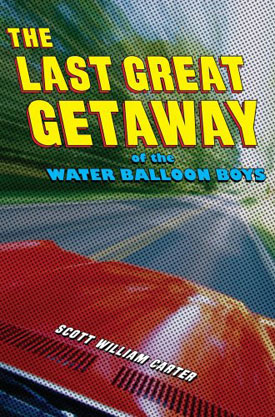
The Last Great Getaway of the Water Balloon Boys

by Scott William Carter
Simon & Schuster  2010 

Two boys hit the road in a stolen car on a journey to both run away from and confront their parental relationships.  It's practically a teenage Roger Corman film from the 1960s, except it isn't.

Sensitive artist Charlie can't believe his mom is about to marry her stiff accountant boyfriend, while at school he's being menaced by bully Leo because he dared to ask Leo's girlfriend to the prom.  He's about to take a pounding after school when Charlie's ex-best friend turned bad boy Jake pulls up in a stolen car (the principal's) and takes them on an unplanned road trip that leads to a dead kid four states away.

The book opens with Charlie explaining that he has to backtrack a few days to tell you how he ended up killing this kid, which becomes the hook that drags the reader the rest of the way.  Who is this kid that gets killed?  Why and how does he do it?  What happened during those three days that made this inevitable?  Read on, read on... 

Charlie really is a straight laced bit of worrywart, and Jake has clearly become a loose cannon since the days when the boys would pall around beaning people with water balloons.  Jake smokes, steals cars, makes out with girls casually, and generally is the sort of kid Charlie would have to be warned to stay away from.  But when Jake comes to his rescue Charlie can't shake that somewhere beneath this tough boy act is the same kid he used to call a friend.  Being weak-willed, Charlie goes for the ride as they outrun cops, hitch a ride with a suicidal girl they meet on the road, and try to make things right even in the midst of screwing things up with every turn. 

That Charlie, the "good" one of the two, manages to be the one who pulls the trigger (it's self defense, but the boys aren't in the right) underscores the point that if he were truly good he had dozens of opportunities to get out of the car and away from Jake.  Of course, Jake the "bad" one has good reasons for his actions, even if he masks them behind his arrogant braggadocio.  In the end it's a frantic, unplanned, twisted road trip of two teen boys working out their father issues and the unfinished business that broke their friendship.

The story breezes like a screenplay for a two-teens-on-the-run type of story.  It doesn't seem promising when it opens with the typical trouble-at-home, trouble-at-school scenario, but it quickly burns rubber from these scenes and turned out to be better than I had expected.  I don't know what I expected.

Maybe it has to with the title.  The Last Great Getaway would be fine of there were other getaways prior to this, but it's all one, long, single getaway so that seems misleading.  It's also pretty generic sounding, so I understand adding of the Water Balloon Boys, except for the fact that it suddenly makes the story sound a lot more juvenile than it really is.  The first half of the title could be Raymond Chandler and the second half Neil Simon.

Friday, March 26

The Boys

by Jeff Newman 
Simon and Schuster  2010

A Mid-Century Modern picture book valentine to the nature of boys at play, both young and old. 


On Monday the new kid moves to town.  On Tuesday he sets out to the park with his bat and ball to mingle with the kids of his new neighborhood but can't bring himself to join in.  He shuffles over to a park bench full of a quartet of old men who don't quite understand what's up with the kid.  On Wednesday the kid goes back to the park to feed the pigeons on the bench with the old boys who feel a little awkward that the kid has adopted them as his social group.  Then on Thursday the kid arrives wearing obnoxious plaid retiree pants and his hair slicked back and the old boys realize it's time to get this kid back on track.  Suddenly the kid is the grumpy old man on the bench yelling at the obnoxious old guys who are chasing the pigeons away on their bikes and making a ruckus at the playground.  In the end it is a game of baseball that integrates the kid with his peers and gives the old men someplace else to sit than the park bench.

That all of this is done without words is a good part of its charm. The mood on these pages is easily readable at a glance, very much character driven and clearly understandable.  This ability to portray emotions and tell stories with simple illustrations is key for younger readers to understand how to "read" pictures.  This is a key value in wordless picture books because being able to decode the language of illustrations and illustrated stories is as necessary as sight reading.  It also happens to be the element I find lacking in a lot of graphic novels put out by publishers of children's books, but that's a rant for another day.  

Newman's style of watercolor - the broad brush strokes that suggest more than they define, the bold swaths of muted color - would almost fit in with the style of the independent cartoons produced by the UPA in the 40s and 50s; cartoons like Gerald McBoing Boing.  Almost, not quite.  I think there are times Newman's brush is a little too large in the scene and distracting from the more controlled character work, but it isn't a deal killer.

Tuesday, May 13

Little Boy


by Alison McGhee
illustrated by Peter Reynolds
Atheneum / Simon 2008

This Father's Day, when a Hallmark just won't cut it but $20 seems like too much to spend, why not give this little gem?

Generously borrowing from William Carlos William's poem "The Red Wheelbarrow," each of the rhymed sections in this picture book begins with the phrase "Little Boy, so much depends on..." to inventory the innocent mischief, imaginative play, and rituals of what it means to be a boy. All that and a big cardboard box. Reynolds illustrations are as precious as McGhee's cadences are measured, which is to say they are calculated with great care.

This is the father-and-son companion to Someday, the book about the mother-daughter bond that reads like a snake eating its own tail. With both books I can't imagine what sort of child they are intended for. Grown children? Adults with children who want an American Greeting Card memory of a time that never really existed except in a post-martini haze? Seriously, with Little Boy I can see maybe half a reading of this before the little boy being read to wants to go find a cardboard box of his own to play with rather than finish this non-story.

Beyond that, the book is a keepsake, a contemporary Norman Rockwell portrait of boyhood. Grandparents will love it, so might some parents, but it's not for children.

Wednesday, March 5

Oops!


Poems by Alan Katz
Drawings by Edward Koren
Margaret K. McElderry / Simon & Schuster 2008

Okay, once again just to make sure we're all on the same page: do not give your book a title that can be used against you in a review. You would think editors would be the first to understand the rules of making a book review-proof. Of course, it's also a good idea to make sure the content followed the same rules, not just the title.

Katz is no Shel Silverstein (he's not even Jack Prelutsky), but so much about this book feels like that's what the guilty parties were trying for. It's 179 pages of short, silly poetry accompanied by line drawings is squarely aimed at those who have worn out their copies of Where the Sidewalk Ends and It's Raining Pigs and Noodles.

All the usual topics are covered -- too much TV, failing grades, turns of phrases, wordplay -- but so much of it falls flat. Rhymes and near-rhymes have the feel of having being culled from a reference book with the rest of the poem built awkwardly around them. There are ways to break the meter within a poem, and then there are just broken feet. And some of these poems seemed designed to deliver a punchline but don't have the substance to prop them up. I think there's a picture-book's-worth of poems here that are good -- maybe a couple dozen or so -- and the rest reads like contractual filler.

I know kids in their poetry phase can't ever get enough of the humorous verse, and this will easily break up the monotony of rereading the same six or seven books for this crowd, but I don't suspect it will get the same level of repeat readings.

Question: where are the women poets who write volumes of humorous poetry? Is nonsense considered the province of male poets, and is this why boys stop reading poetry?

Tuesday, January 29

A Taste of Colored Water


written and illustrated by Matt Faulkner
Simon and Schuster 2008

LuLu and Jelly can't believe that Abbey saw a fountain in town that bubbled colored water; they have to see this for themselves. When their Uncle Jack needs to make a run into town the kids beg to go with so they can investigate.

Oh, but this is the Deep South, and it's mid 1960's, and the town is crowded with freedom riders and picket-carrying activists and officers of the peace wearing gas masks and toting vicious attack dogs.

Yeah, way to make childhood innocence serve an educational purpose there, Faulkner.

I think there's a valid premise in showing kids having to face certain adult realities and misinterpreting the world they find themselves in. Kids know it's not polite to stare but the first time they encounter, say, a legless war veteran or someone with palsy they actually have to make hard connections and cement the memories that make the concept relevant. Likewise, any child raised ignorant of segregation and racial bias isn't going to understand a concept like a sign over a fountain that says "colored" until they see it all in context.

What Faulkner is attempting here is a dual lesson on segregation with a dash of Civil Rights Movement. While the town is in chaos, the kids wander off to investigate the fountain, leaving the ensuing riot to play in the background, just off-stage. A sheltered country kid (and these kids are pretty dang sheltered) going into town is going to be more enraptured by the hubbub and leave the fountain to another time. Something big is happening in this town with buses and protesters and police everywhere and we're supposed to accept that these kids would rather run up a hill to see what color the water is that comes from the bubbler?

Then, as LuLu and Jelly discover the fountain is no different than any other drinking fountain (except for the word colored hanging on a sign above it), they witness the protesters (what they call a parade) getting hosed by the fire department and they finally (!) feel moved to the point of shouting and feeling dizzy. (I guess there's no guilt quite like latent white childhood guilt to make a point about race relations in this country.) Finally a cop with an attack dog tells them they need to leave and off they run to the safety of their Uncle Jack who's worried about where them dang kids ran off to.

Honestly, I think there is a genuine story here in the innocence of childhood and in not understanding the segregated ways of adults. But in order for a child to understand what's at play here you have to explain to them (or assume they already know) the use of the term colored, the contentiousness of the Civil Rights Movement in the south, and then explain why no adult in the end of the story bothers to explain to LuLu and Jelly what it was they witnessed. With the exception of discovering that colored water is exactly the same as regular "white" water (duh) the kids ain't haven't learned themselves nothing.

In the lengthy afterword (note to publishers: if a picture book requires a lengthy afterword for the adults edification, or to filter and share with children, then the message of your book has failed) Faulkner explains how this book didn't come from his own experience, having grown up in a Northern town. He goes on to speculate about how his child-self might have questioned his Southern world as filtered through his growing Northern consciousness. It's as if he's saying "I wasn't one of these kids, but if I were I would have done things differently, I'd have asked some hard questions!" The fault in this thinking -- which ultimately explains the lack of understanding that informs the book - is that if Faulkner had grown up with these kids in the sticks he wouldn't have had his fancy Northern knowing that would have allowed for such questioning. Short of saying he knows what it's like to be black person during the 1960s because he was once excluded from a game of dodgeball as a kid, I think Faulkner's afterword turns a slightly flawed book into an arrogant reductionist view of a crucial problem in this nation's history.

I didn't start this review hating this book, but now I do.

Friday, January 11

The Race of the Century

"retold" and "illustrated" by Barry Downard
Simon & Schuster

Put. The Photoshop. Down.

Seriously, this is one of the most atrociously illustrated books I've seen in a stretch.

Retelling the Aesop Tortoise and Hare fable what we have goes beyond the usual anthropomorphic animals, it actually grafts human features like eyes, lips, hair and teeth onto the animals to create a creepy Island of Dr. Moreau Special Animal Olympics. Tortoise remains on all fours with his toffee brown eyes and toothy grin but hare has his rabbit head and tale plopped onto the toned body of an aerobics instructor. Equally disturbing is the fact that the images are rendered in a spectrum of gray-muted colors resembling the mystery meat platter from an industrial cafeteria.

Grotesque.

Sunday, July 22

No Talking


by Andrew Clements
Simon and Schuster 2007

It's boys versus girls in a 48 hour dare to see who can talk the least.

The agreement is made during lunch when Dave, who had gone the entire morning without speaking as an experiment, reaches his boiling point when Lynsey blathers on and on about a sweater at the mall. "Don't you ever shut up," he effectively says, prompting the inevitable argument over which gender talks the most. Finally Dave throws down the gauntlet, betting the girls that they couldn't go two whole days without talking. One handshake later the contest is on.

The rules are simple: beginning at lunch the next day, and for the following 48 hours, the fifth graders at Laketon Elementary will not talk. An exception is made for school where they are permitted only to answer a direct question from the school faculty and staff and they can only answer in three-word sentences. Additional words uttered beyond the first three are marked down as demerits, the side with the least being the winner. And since the contest extends outside of school this includes the school bus and home. Overnight infractions incurred out of earshot of other students are reported on the honor system to their respective captains Dave and Lynsey the following day.

Early on there are a couple of accidental outbursts from students who clearly were acting in the moment but quickly the students adapt and adjust. In the classroom the teachers are a little confused by their student's inability to express themselves in anything other than broken or fragment sentences, and they are even more baffled to find the halls absolutely silent during the passing period. While one teachers is frustrated that the kids seem to be playing a game with her another finds the exercise perfect fodder for his masters thesis in the way communication, language and education fit together. The science teacher intercepts a note between students that explains the situation and after considering informing the other faculty decides instead to let them figure it out on their own.

After a de facto faculty meeting to discuss the situation the principal elects to hold an assembly the next day and inform the students that the game or contest or whatever has officially ended, citing the disruption in school. And it appears that the students are going along with her decision but in the end they are determined not to let it go. The inevitable showdown occurs in the lunchroom when the principal figures out Danny is the ringleader, best to use in her divide-and-conquer attack. When pushed to defend himself he exceeds his three word limit by looking at his fellow students and shouting defiantly You have the right to remain silent! Stunned, the principal returns to her office to rethink both her position and her strategy.

Do I have to tell you how it ends? Do you think one side wins over the other? Even if you can guess the inevitable outcome readers will enjoy seeing how it all plays out, though I'm not convinced the target audience will buy the sudden solidarity among the boys and girls that comes as a result.

Clements gets off to a rough start in the book, using a couple of chapters with shifting time lines to hook readers. I found it a bit confusing and finally gave up trying to figure out what events took place when hoping for the best. A few chapters in it chugs along and holds pretty true to a straight narrative. I know I kept thinking "C'mon, let's get the story rolling" and wondered if less sturdy readers would get as confused and give up before getting to what is an otherwise fun little ride.

Can I also say a little Hooray! for a cover that doesn't follow in the style of the Clements' covers previously illustrated by Brian Sleznick? You know, the kid holding something at arms' distance partially covering their face? Yeah, gone. It makes it hard for kids to recognize a Clements book on site -- Ooo, look! Another book by that Frindle guy! -- but at the same time it opens up the book to readers who might have shied away from those other titles because they'd feel like they were a series and had to start from the beginning. That's one of those questions of brand, where you want readers to recognize a book on sight but you have to be careful you aren't making them look too serial.

That's all I got on this one. It's got humor, Gandhi, a battle of the sexes, and adults making asses of themselves. What more could a kid want in a light read?

Saturday, July 14

Ned's New Friend


By David Ezra Stein
Simon and Schuster 2007

I'm not going to pretend I wasn't disappointed, but you can only be disappointed if you have expectations. The problem is that I really liked Stein's first outing with Cowboy Ned and Andy and it was hard not to want more of the same.

This time around Cowboy Ned and his faithful horse Andy have hit the end of the dusty trail in Abilene. After a clean shirt for Ned and oiled hooves for Andy they are about to enjoy a couple of well-deserved root beer floats when...

SHE walks by.

Clementine. Oh. My. Darlin'.

One look at this creature of beauty and Ned is frozen, tripping off the boardwalk and tumbling into the streets of Abilene along with the root beer floats. She offers the fallen gent a hankie to clean up with and lets him know he can return it the next day at her place on the edge of town. Mr. Horse does not like, no sir, he does not. For one thing he's out a root beer float and for another thing that scented hankie wields some sort of power over Cowboy Ned that aims to lose him his best friend in the whole wild west. Andy knows it's serious when Ned actually takes a bath in preparation for returning the hankie the next day.

That night, after a dream of Cowboy Ned and Clementine drifting into the clouds in a balloon leaving him behind, Andy plots to dispose of the hankie Ned has placed for safekeeping under his pillow. But the perfume causes Andy to sneeze, sending the hankie out onto the street. A dimwit robber tries to use the hankie as a bandanna but the perfume tickles his nose as well and gets him caught. Eventually the hankie drifts into Clementine's rose bushes where it remains lodged for the night.

Cowboy Ned and Andy arrive at Clementine's the next day but Ned is despondent at having lost the lovely lady's hankie. Andy sees the hankie in the bushes and realizes that it's more important that his friend be happy so he retrieves it and all is well. At the door Clementine sees that Ned's brought his horse with him and she invites them both in for cookies.

And then all three of them are shown flying off in a balloon of bliss.

If you think I have a problem with Ned going soft at the sight of a twig-thin damsel you'd be part right. If you think I have problems with a jealous horse, well, no, I don't have a problem with that.

What really bothered me was that this book is visual, it lacks the previous books boldness of color. Compared with the open plains and nighttime skies, the town of Abilene is rendered in a sort of inky clutter that doesn't register well with the eye. The loose, practically dry brush effect from Stein's previous book here looks almost sloppy. The sitting room at Clementine's place has a wall paper pattern and carpet so busy, and at the same time so splotchy, that I wondered if had been created by the same author. From page to page each version of Cowboy Ned was different enough -- a little thin here, a bit rotund there, moustache too big or some weird caterpillar shape -- I had a problem with that for some reason. Not unlike the problem I had with Edwardo a while back.

If Babar or Curious George looked different from book to book and page to page would these books have been popular or still be the classics they are today? I'm not suggesting there's a connection between consistency of image and a books place in the pantheon of children's literature, but at some basic level don't readers want to be able to identify the characters on the page?

Am I being too cranky about this?

Sunday, April 1

Today at the Bluebird Cafe

A Branchful of Birds
by Deborah Ruddell
illustrated by Joan Rankin
Margaret K. McElderry Books/Simon & Schuster 2007


It's all-you--can-eat at the Bluebird Cafe,
a grasshopper-katydid-cricket buffet,
with berries and snails and bluebottle fly,
a sip of the lake and a bite of the sky.
Oh, but it starts off so promising.

This collection of poems about birds could have been swell if it hadn't suffered from that common malady of uneven rhymes and herky-jerky meter.

If I'm repeating myself, forgive me, but if you're going to write rhyming poetry it needs to have a natural rhythm. I'm not going to be a stickler for meter unless you start out a poem with it but drop it when it becomes inconvenient half way through the poem. If you are going to hold to the meter it still needs to sound natural.

I call it the read-aloud test, it needs to have a read-aloud rhythm. That is, a child with reading fluency should be able to pick up the poem and read it cold and capture the rhythm. They can falter in the first line or two as they get the hang of things, but it shouldn't be catching them off-guard along the way. The fun in reading poetry for kids is in the wordplay, it's in the cleverness of the beat where they (as readers or listeners) can follow along. The words need to roll off the tongue or dance in their head.

Not sound like the equivalent of a teen driver leaning how to drive a stick.

The names we know, they know the rules and they know how to bend them. Shel Silverstien and Jerry Moss understood this, and no surprise both were also lyricists; Karla Kuskin gets it; Edward Lear even in his most forced verse gets it; Maurice Sendak, certainly; Prelutsy, Florian and Stevenson all grok the rhythm. And yet book after book of rhyming text -- poetry and picture book -- roll off the presses with awkward phrasing and broken meter and all the prettiest pictures in the world won't save them.

Why? Why, if compelled to write in verse, wouldn't a writer want to make their verse the best it could possibly be? There's no sin in striving to become classic, why settle? What is the point of the exercise if the only concern is the rhyme? What's the reason?

Seminar after seminar, listing after listing in the Writer's Market, editors beg and scream: Please! No rhyming texts! And yet, these same publishers are the guiltiest of parties. I won't place all the blame on the writers.

Another book of poems, trashed;
Another round of hopes, dashed.

Saturday, March 31

If

A Fathers Advice to His Son
by Rudyard Kipling
photographs by Charles R. Smith, Jr.
Atheneum/Simon and Schuster 2007


If you can keep your head when all about you
Are losing theirs and blaming it on you...
It's hard to read these opening lines of the familiar Kipling poem without hearing the voice of a manic Dennis Hopper as a wigged out photographer in the movie Apocalypse Now.

Moving beyond that what struck me is just how accessible the original poem is in terms of laying down an almost Buddhist philosophy about how one should move through the world with humility, grace and compassion while still remaining strong.

To that end I find what photographer Smith sets out to do admirable but I find the final result a letdown.

Every passage in the book is illustrated with a saturated boiled-grain photograph of boys at play in various sports. The overall effect, as suggested in the tacked-on subtitle (to underscore Kiplin's intent, for those who cannot be bothered to read to the end of the poem), is to offer a strong, guiding father's advice to a son in relation to his becoming a better athlete, as opposed to being a better person. That's my take-away.

And that's where I take issue. It may be that we could use more poetry-spouting fathers on the sidelines giving their sons a larger picture of the world vis-a-vis lessons they can learn through sports, but why do we need to perpetrate the issue of the father-son bond as being sports related?

Page after page, sport after sport, the images connect only in the mind of the individual because the text doesn't support the concepts presented specifically as sports-based. The weakest example may be of a shot taken from behind (we do not see the faces of the boys at sport) of a boy taking aim at a target at an archery range, accompanied by the text
If you can think-- and not make thoughts your aim
Well, you have to take the "aim" part literally to connect with the image, but that's not what Kipling is saying, is it? He's talking about active thinking, about rational thought-based behavior, that one should not use thinking for thought's sake. This is good advice, but how does it relate to a boy taking aim with an arrow? How is a boy supposed to interpret that concept when the illustration suggests such a literal idea?

There are more like that, more literal illustrations, and they raise my hackles. Can we not teach these concepts to boys, father to sons, with examples that include the arts and sciences? When we "meet with Triumph and Disaster/And treat those two imposters just the same" can we not suggest that Community Service in the face of, say, a Hurricane-devastated area would serve as a better example of how to live in the world rather than show a soccer team huddled together?

I suppose I should be grateful anyone is considering father-to-son poetry at all these days, or that someone finds Kipling worth introducing to kids. I just wish we could get over the whole idea that the only way to captivate boys' attentions is through sports.

Thursday, February 8

The Higher Power of Lucky


by Susan Patron
illustrations by Matt Phelan
Simon & Schuster 2006

I'm just not feeling this one.

What is it Chekhov famously never said: If there's a scrotum in the first act it had better pay off in the third?

People are falling all over themselves with this book, generating all kinds of comment and opinion and flame wars on blogs, and in that sense perhaps the Newbery committee was right in choosing it. Perhaps. I'm not convinced yet because I'm still working on the honor books.

I'm not going to present a summary here, just some thoughts I had, things that have been gnawing away at me for the last couple of weeks.

My problem with Lucky is that the pieces don't add up for me. Lucky appears to have sprung out of the Mojave fully formed. That she never saw her father growing up, okay, I can understand why she didn't recognize him. But she was old enough to have memories of her mother, old enough to know what she had, yet she makes little to no mention of those memories and those would be the compelling fixtures that would be keeping her from letting go of her mother.

All this Higher Power business is little girl shorthand, but for what? I'm all for letting readers put together the various pieces but we aren't really given the whole puzzle to work with here. I can see Lucky's insecurity in her survival kit, but the catalyst that causes her to run away is her fear that her guardian Beatrice is going to leave her. That ought to dredge up some fears and memories, tap into some of the more repressed anxieties. Has Lucky's attachment to Beatrice supplanted memories of her mother, and if so, why is so quickly to release her mother's ashes before fully understanding Beatrice's desire to formally adopt her?

And that's another thing, that Beatrice. From Lucky's point of view all Beatrice does is complain about the situation she has gotten herself into, with nary an indication of any warmth that isn't token toward Lucky. She misses France, she hates the desert, she wants to see the California that is Los Angeles, a mere 45 minutes away but cannot and hasn't. How does a person so close to the beaches of Southern California not have the ambition to take Lucky on a trip to the beach but can muster an on-line culinary degree and set up a restaurant in a dead-end desert town? And with her ex-husband's (Lucky's dad's) money?

That's when it all fell apart for me. The guy pays for the funeral and hands Lucky the ashes but doesn't introduce himself. Okay. He sends Beatrice child support and helps her to legally adopt Lucky and lends her the money to set up the restaurant... so, what, he'll make sure that his daughter from one marriage and his ex-wife from another are taken care of so long as they remain in the desert far away from him? What kind of a message is that?

Here's the thing, I didn't start out hating the book from the word scrotum, as many others have. A few chapters in I was looking for a Saroyan My Name is Aram sort of thing, a bunch of collected vignettes of a small community hung together with a thread named Lucky. I'd take the quirky characters and situations and in the end I'd get a crazy quilt of an experience that left me feeling as if I'd drifted in and out of Lucky's little world.

Nope. No such luck.

Vignettes gave way to chapters and a story rose off the asphalt like bug-killing heat. As I tried to corral and assemble the fragments I felt like I was sorting through Lucky's bug collection -- haphazard and randomly assorted with missing information and incorrect assumptions. And when it was over, yeah, that scrotum reference hit me as an odd framing device especially when it didn't really add any meaning or texture to the story. If the story had included more odd and colorful (but not obscene) language I might have felt better about what some refer to as mood-setting language.

As for the Newbery, it's probably best to view it much like any horse race, like the Oscars or the Grammys or the Tonys. The test of time is the ultimate award. My only hope: they repackage it with a different cover when it comes out in paperbook to look a little less Lucky's Higher Power isn't the award itself.