by Nathan Hale
Amulet 2017
He's a one-trick pony
One trick is all that horse can do
~Paul Simon
The future of Earth looks pretty grim here. Humans have reverted back to their near hunter-gatherer state, though in a relatively short period of time as they are still away of the sort of technology we are looking at in our not so distant future -- things like sentient robots, and space shuttles that the robots know how to pilot. The problem is that there are probes out there, called pipers, collecting all the metals and technologies they can find, gobbling their way across the planet like massive termites, putting bubbles around valuable minerals and metals and sending them to the sky to... well, they're gone.
The story starts with a trio of forgers who are hunting for anything the pipers might have missed, members of a caravan of massive vehicles that contain and entire community and are serving as an ark to help rebuild mankind. Strata, a headstrong girl, discovers something buried in the sand in a cave, something the pipers missed: a full-sized robot horse named Kleidi. Strata's contact seems to have awakened the horse and set up a bonding between them. Freeing Kelidi from the sands they discover a whole technology center underground full of robots that had previously been powered down, and when powered up their electronic signals alert local pipers who come to capture as much as they can.
But Strata, Kelidi, and the others escape. Barely. Barely escaping is what they do best throughout the book.
Saying much more is probably too much, and more than I knew going in.
There's a side tale of the Pied Piper that is used to explain the pipers here, but it's a McGuffin, a ruse, and a clever one at that because the reality of what is going on has nothing to do with what the survivors understand to be the truth.
And what of that pony and it's one trick?
Ah, well, what that trick is comes pretty quick, and it occasionally has something to do with the many close calls our heroes has, but can that one trick save the day?
About half way through this book I wasn't sure it was going to end satisfactorily. I was actually saddened to think I was either going to abandon the book or write a negative review. Actually, my biggest concern was that it was a set-up for a series (which it still could be) that ended without a resolution. But no, the story arc works, and given that machines are involved, a little deus ex machina isn't a bad thing here.
Hale is known to many for his nonfiction Hazardous Tales series of
graphic novel history, but when he steps away from that (Rapunzel's
Revenge, Calamity Jack, both with Shannon Hale) he leans in hard on the
fantasy. Here, the dystopic sci-fi agrees with his style, so much so
that the pipers initially reminded me of the work of the late French
artist Moebius, and the muted one-color palate gives the world he's
created a slightly grimy metal feel, as it should.
Adults worried that it might be too intense for younger readers should let the readers decide. As with all books really. I'd think a 5th or 6th grader into sci-fi (as I was into Bradbury at that age) would dig this pony. And they wouldn't think twice about the fact that the main characters are a girl and her horse.
Thursday, March 30
Thursday, March 16
triangle
by Mac Barnett &
Jon Klassen
Candlewick 2017
Triangle,
an equilateral with a pair of eyes that look like painted white rocks and
legs like burnt matchsticks, lives in his triangle house on the triangle
side of his world. He goes out his triangle door one day, past where
Triangleville becomes the Land of Shapes With No Name, into the
Squaresville, where Triangle's friend Square lives.
"Now," said Triangle, "I will play my sneaky trick."
Triangle's
sneaky trick is to hiss like a snake -- because Square HATES snakes --
until Square is so afraid that Triangle is doubled over in laughter and
cannot hiss anymore. Once Square realizes he has been tricked the chase
is on. Past Squaresville, the Land of Shapes With No Name, and finally
into Triangleville where Triangle runs into the safety of his triangle
home.
And where Square, too wide for the shape of the doorway, becomes stuck.
And then it is dark, and Triangle is afraid of the dark.
And Square claims it was his plan all along to play his sneaky trick on Trinagle.
But was it planned?
It's
a punchline story, a chase cartoon with a simple ending and no
real resolution, but completely within the realm of how children play.
Klassen and Burnett have teamed up before with the existential Sam and
Dave Dig a Hole and old world magic charm of Extra Yarn, but the depth
of those stories is lacking here.
Maybe
that's as it should be, as this board book on steroids with its heavy
board cover and the simplicity of something intended for readers still
young enough to chew their books. This is the opening salvo for a
series of beginning readers -- Square and Circle will follow -- and I would hope that future stores had a little
more meat to their rocky bones. As it stands it's cute, in a
borrow-don't-buy sort of way.
Labels:
2017,
candlewick,
jon klassen,
mac barnett,
series,
shapes,
triangle
Tuesday, September 1
a funny thing happened on the way to school
by Davide Cali
illustrated by Benjamin Chaud
Chronicle Books 2015
Excuses, excuses, but it's the SIZE of the lies that impresses here.
When asked why he was late for school a boy goes into a lengthy, imaginative journey into all the obstacles in his path. From a story perspective it's exactly what one teacher once described as "one dang thing after another," and the twist on the last page isn't all that noteworthy unless the reader has had no experience with picture books at all. The best example of this type of story is Remy Charlip's Fortunately; unfortunately this book isn't in that sphere of clever.
But what I found most charming, even refreshing, was the size of the book itself. Slightly smaller than 6"x9" it is satisfying to hold and the smaller page seems to better convey the chaos on the page. Sometimes I look at a picture book with it's gloriously huge flatscreen-sized pages with so much dead space -- excuse me, "atmospheric space" -- and wonder why the book needs to be the size that it is. One look at the picture book section of a library or bookstore and you can see that there doesn't seem to be a standard trim size, but certainly not all of these books can justify their out-sized ego. Bigger isn't always better.
So, way to go, Chronicle! More quality books with smaller hands in mind!
illustrated by Benjamin Chaud
Chronicle Books 2015
Excuses, excuses, but it's the SIZE of the lies that impresses here.
When asked why he was late for school a boy goes into a lengthy, imaginative journey into all the obstacles in his path. From a story perspective it's exactly what one teacher once described as "one dang thing after another," and the twist on the last page isn't all that noteworthy unless the reader has had no experience with picture books at all. The best example of this type of story is Remy Charlip's Fortunately; unfortunately this book isn't in that sphere of clever.
But what I found most charming, even refreshing, was the size of the book itself. Slightly smaller than 6"x9" it is satisfying to hold and the smaller page seems to better convey the chaos on the page. Sometimes I look at a picture book with it's gloriously huge flatscreen-sized pages with so much dead space -- excuse me, "atmospheric space" -- and wonder why the book needs to be the size that it is. One look at the picture book section of a library or bookstore and you can see that there doesn't seem to be a standard trim size, but certainly not all of these books can justify their out-sized ego. Bigger isn't always better.
So, way to go, Chronicle! More quality books with smaller hands in mind!
Labels:
'15,
benjamin chaud,
chronicle,
cumulative tales,
davide cali,
lies,
picture book
Monday, September 22
abandoned: taken
by David Massey
Chicken House / Scholastic 2014
Teens in peril. That's where you lose me.
I try to read books as "blind" as possible, knowing as little as I can going in so I can let the freshness of the story carry me. Sometimes, though, I get a sense early in a book that it's going to piss me off. In the past when I was a younger man and felt like I had a lifetime to read everything I'd finish every book out of a sense of respect for the author and the craft. But I'm older now, aware that I will never get to read everything I want to, and some backs don't earn that right to be read to the end.
Here's the short version: I have no patience for books that put teens in extreme peril.
That sounds absurd. Peril, imminent danger, kids at the mercy of extremely dangerous adults, this is practically everywhere. Maybe I'm just getting tired of it.
Taken starts with a young woman meeting up with a group of young war veterans -- barely adults themselves -- getting ready to sail around the world for charity. Because the crew are themselves disabled their insurance requires an able-bodied hand named Rio, who is our narrator. There's some tension among personalities, resentment over having Rio as a babysitter, and as they set sail I suddenly get a hinky feeling.
This is called Taken. What, or who, gets taken?
See, I could get behind an adventure where a crew of new adults has to deal with the elements, a damaged boat, a clash of cultures and miscommunication, a trial of character. I can't resist. I flip the cover over and discover they are hijacked by pirates, held by a militant warlord, prisoners of war. There is an image of a fourteen year old girl clutching a machine gun with a necklace made of human teeth.
I'm out.
The news is full of kids in peril. A teen girl beaten and raped for protesting the public beating of her father. Women, girls, and boys abducted by militants, adding to the hundreds of others already gone missing. Terrorists using video games to recruit teens to their efforts. This is news, not something to be reduced to "ripped from today's headlines" sensationalized entertainment.
People can write what they want, people can read what they want.
I've got plenty of other books to read.
Chicken House / Scholastic 2014
Teens in peril. That's where you lose me.
I try to read books as "blind" as possible, knowing as little as I can going in so I can let the freshness of the story carry me. Sometimes, though, I get a sense early in a book that it's going to piss me off. In the past when I was a younger man and felt like I had a lifetime to read everything I'd finish every book out of a sense of respect for the author and the craft. But I'm older now, aware that I will never get to read everything I want to, and some backs don't earn that right to be read to the end.
Here's the short version: I have no patience for books that put teens in extreme peril.
That sounds absurd. Peril, imminent danger, kids at the mercy of extremely dangerous adults, this is practically everywhere. Maybe I'm just getting tired of it.
Taken starts with a young woman meeting up with a group of young war veterans -- barely adults themselves -- getting ready to sail around the world for charity. Because the crew are themselves disabled their insurance requires an able-bodied hand named Rio, who is our narrator. There's some tension among personalities, resentment over having Rio as a babysitter, and as they set sail I suddenly get a hinky feeling.
This is called Taken. What, or who, gets taken?
See, I could get behind an adventure where a crew of new adults has to deal with the elements, a damaged boat, a clash of cultures and miscommunication, a trial of character. I can't resist. I flip the cover over and discover they are hijacked by pirates, held by a militant warlord, prisoners of war. There is an image of a fourteen year old girl clutching a machine gun with a necklace made of human teeth.
I'm out.
The news is full of kids in peril. A teen girl beaten and raped for protesting the public beating of her father. Women, girls, and boys abducted by militants, adding to the hundreds of others already gone missing. Terrorists using video games to recruit teens to their efforts. This is news, not something to be reduced to "ripped from today's headlines" sensationalized entertainment.
People can write what they want, people can read what they want.
I've got plenty of other books to read.
Labels:
'14,
abandoned,
david massey,
disabilities,
piracy,
sailing,
teen,
war,
warlords,
YA
Saturday, September 13
goodnight brew
by Ann E. Briated
illustrated by Allie Ogg
Bailiwick Press 2014
No. Wrong. Sorry. Not for kids. Terrible parody with no redeeming qualities. Seriously.
You would be hard pressed to find a parody of a children's classic more tone deaf and misguided as this. The idea of a children's book parody should have echoes of childhood skewered with a winking eye. Goodnight Brew seems to labor under the assumption that a not-so-clever title reworking aimed at craft brew-loving hipster parents is going to be the next Go The F*ck To Sleep.
It isn't.
Unfunny, unclever, unbelievably dull, and with no plot to it. And for those who might be quick to point out that the source material, Goodnight Moon, equally lacks a plot I would say... yeah, okay, so it's a little thin. But it is satisfying, it has a lullaby quality to designed for bedtime reading. It has a purpose and for that purpose it does it's job well. Goodnight Brew is so relentlessly vapid that it cannot even muster a yawn out of a casual adult. At best, it might be just a tad above a bender following a suitcase of cheep, evil-smelling beer in the lost brain cells department, although this might still be giving it too much credit.
I don't have a problem with parodies of children's books, but if you're going to do it they better be stellar. I thought The Very Hungry Zombie book that came out last year was beneath contempt, but alongside Goodnight Brew it at least has some redeeming qualities.
Just don't ask me what they were because I've already forgotten it, which is what I suggest we all do with Goodnight Brew as well.
illustrated by Allie Ogg
Bailiwick Press 2014
No. Wrong. Sorry. Not for kids. Terrible parody with no redeeming qualities. Seriously.
You would be hard pressed to find a parody of a children's classic more tone deaf and misguided as this. The idea of a children's book parody should have echoes of childhood skewered with a winking eye. Goodnight Brew seems to labor under the assumption that a not-so-clever title reworking aimed at craft brew-loving hipster parents is going to be the next Go The F*ck To Sleep.
It isn't.
Unfunny, unclever, unbelievably dull, and with no plot to it. And for those who might be quick to point out that the source material, Goodnight Moon, equally lacks a plot I would say... yeah, okay, so it's a little thin. But it is satisfying, it has a lullaby quality to designed for bedtime reading. It has a purpose and for that purpose it does it's job well. Goodnight Brew is so relentlessly vapid that it cannot even muster a yawn out of a casual adult. At best, it might be just a tad above a bender following a suitcase of cheep, evil-smelling beer in the lost brain cells department, although this might still be giving it too much credit.
I don't have a problem with parodies of children's books, but if you're going to do it they better be stellar. I thought The Very Hungry Zombie book that came out last year was beneath contempt, but alongside Goodnight Brew it at least has some redeeming qualities.
Just don't ask me what they were because I've already forgotten it, which is what I suggest we all do with Goodnight Brew as well.
Labels:
'14,
adult books,
allie ogg,
ann briated,
bailiwick press,
beer,
crap,
goodnight moon,
parodies,
unfunny
Friday, September 12
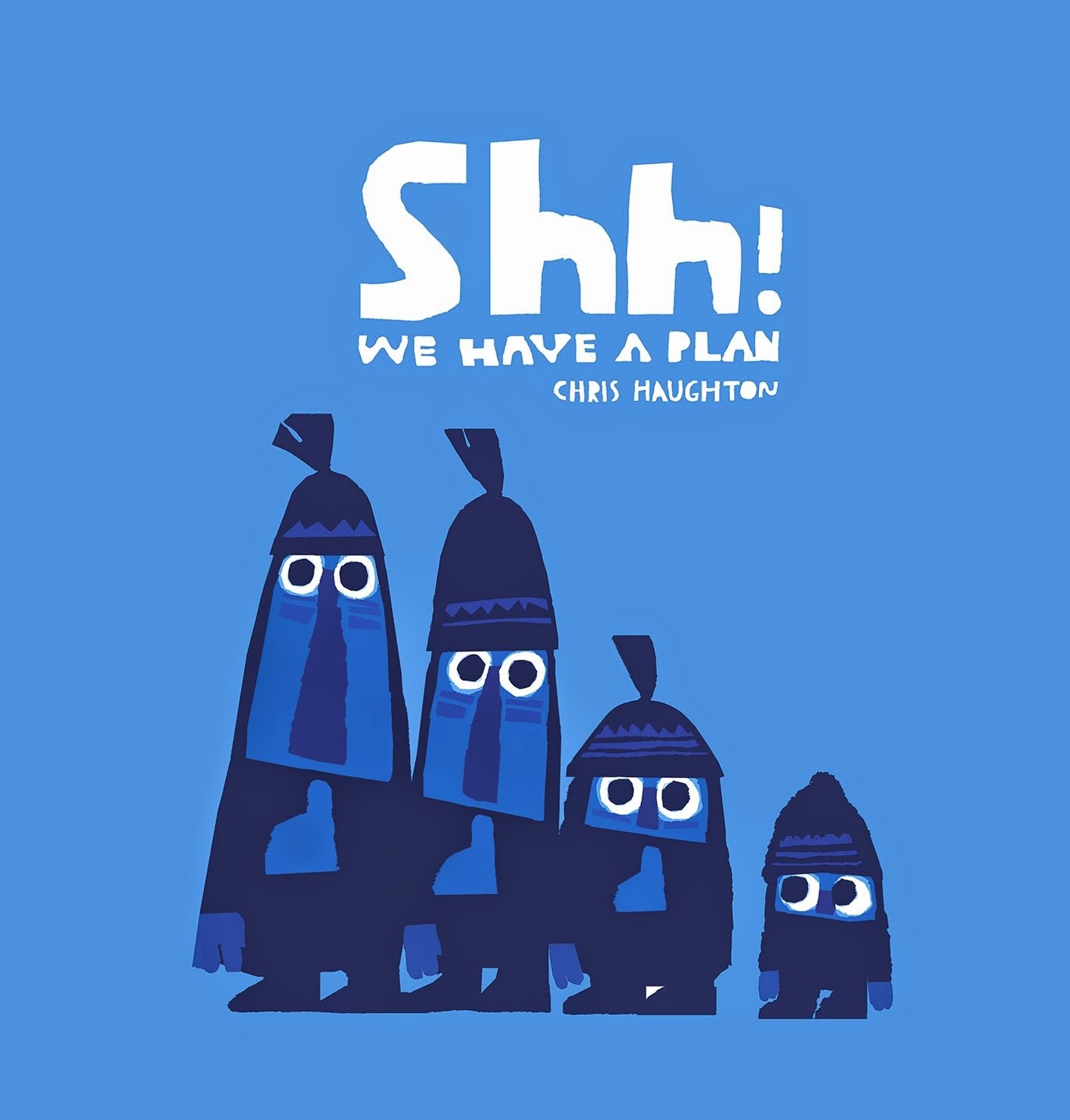
shh! we have a plan
by Chris Haughton
Candlewick 2014
Four black-ops solders take on an impossible night mission with little hope of success. Just kidding!
In the depths of a purple-blue night four night stalkers our out with their nets in hopes of coming across something to catch. Actually only three of the stalkers have nets, the smallest seems to be tagging along. When they come across a bird the Little One cannot help but call out "Hello, Birdie" but is quickly hushed. "Shh! We have a plan."
Following the Rule of Threes the older trio creep stealthily upon the bird on the ground, in a tree, and out on a frozen pond, always failing to catch their prey. At last the Little One offers up some bread crumbs and they stalkers are suddenly surrounded by many birds. With the birds so close it seems as if catching them will easy until they realize they are outnumbers and outsized and off the run.
When they see a squirrel they turn to Little One. "Shh. We have a plan." And thus we end back where we started, with the stalkers unwilling to accept the truth and Little One shrugging at the reader.
Is it a lesson in respecting and protecting small creatures? The triumph of innocence over mischievous adventures? A subtle anti-hunting tract?
How about kids being kids?
Kids getting a notion in their head and proceeding with what they believe is a well-considered plan only to have it fail due, in part, to their own limited understanding of the real world.
Okay, I'll get out of the deep end now.
Stylistically, Shh! We Have a Plan is dark, but it's the darkness of night, the darkness of woods where even the light of the moon only makes things look various shades of blue. The human characters have a ragged torn-paper look to their edges while the natural elements have a cleaner simplicity to their shapes. The animals in particular, with their bright reds and greens and geometric shapes, are reminiscent of Alexander Girard without mimicry. A hat-tip in general to mid-century modern in both design and storytelling is owed here from Haughton who, it seems, has a genuine affinity for the naif.
Candlewick 2014
Four black-ops solders take on an impossible night mission with little hope of success. Just kidding!
In the depths of a purple-blue night four night stalkers our out with their nets in hopes of coming across something to catch. Actually only three of the stalkers have nets, the smallest seems to be tagging along. When they come across a bird the Little One cannot help but call out "Hello, Birdie" but is quickly hushed. "Shh! We have a plan."
Following the Rule of Threes the older trio creep stealthily upon the bird on the ground, in a tree, and out on a frozen pond, always failing to catch their prey. At last the Little One offers up some bread crumbs and they stalkers are suddenly surrounded by many birds. With the birds so close it seems as if catching them will easy until they realize they are outnumbers and outsized and off the run.
When they see a squirrel they turn to Little One. "Shh. We have a plan." And thus we end back where we started, with the stalkers unwilling to accept the truth and Little One shrugging at the reader.
Is it a lesson in respecting and protecting small creatures? The triumph of innocence over mischievous adventures? A subtle anti-hunting tract?
How about kids being kids?
Kids getting a notion in their head and proceeding with what they believe is a well-considered plan only to have it fail due, in part, to their own limited understanding of the real world.
Okay, I'll get out of the deep end now.
Stylistically, Shh! We Have a Plan is dark, but it's the darkness of night, the darkness of woods where even the light of the moon only makes things look various shades of blue. The human characters have a ragged torn-paper look to their edges while the natural elements have a cleaner simplicity to their shapes. The animals in particular, with their bright reds and greens and geometric shapes, are reminiscent of Alexander Girard without mimicry. A hat-tip in general to mid-century modern in both design and storytelling is owed here from Haughton who, it seems, has a genuine affinity for the naif.
Labels:
'14,
candlewick,
chris haughton,
hunting,
midcentury modern,
night,
picture book
Thursday, September 11
richard scarry's best lowly worm book ever
by Richard Scarry (mostly)
Golden Books 2014
A recently discovered Scarry manuscript is unearthed... and out pops Lowly Worm!
Weird-but-true, and totally irrelevant, anecdote about a Richard Scary book. Once while working in the bookstore a woman came in, furious, to return one of those cute little critter books because of its "gratuitous use of meat." Specifically, she was offended by a picture of a pig in a hot air balloon in which the balloon was in the shape of (or perhaps in some loopy sort of logic was actually) a giant sausage.
It's not hard to get off on weird tangents like this with Richard Scarry because his books, with their anthropomorphic animals and vehicles can be, at times... odd. Garbage trucks with toothy mouths painted on their backsides like they're about to gobble garbage furiously. A rasher of mice riding around inside a roadster made from a single pencil, implying either rather tiny mice or enormous pencils...
And in this most recent title, loosely following a day in the life of beloved Lowly Worm, there is a page simply titles "This is me" where Worm is drawn the size of a garden snake with all his accoutrement's laid out and labeled around him. That he has a head the size of a kitten, an eye as big as a grape, with a foot-shaped tail isn't as alarming as the fact that he's naked save for his underpant (singular) wrapped around his middle like a diaper. That's when you realize that Richard Scarry spent some time seriously considering Lowly Worm's attire. There's a trouser (again singular, as pants are plural for us bipeds), a shirt collar, a bow tie, and a shoe. A shoe for a worm that, in Scarry's word, often stands upright. From there anything goes.
All the Scarry cast of characters are here. The cat family, including Huckle, the pigs and bears and bunnies, all of them doing the things people do. This day-in-the-life was recently discovered by Scarry's son who finished the artwork in his father's signature style. It feels both old and new, and in a way it truly is both. It's a throwback to the timelessness that makes classics feel like they've always been there.
But if, like that one customer on mine, you find gratuitous meat a problem, you might want to skip this one. The page where Worm collects eggs for Farmer Cat for their breakfast might cause fits of apoplexy. Kids, on the other hand, will love it.
Golden Books 2014
A recently discovered Scarry manuscript is unearthed... and out pops Lowly Worm!
Weird-but-true, and totally irrelevant, anecdote about a Richard Scary book. Once while working in the bookstore a woman came in, furious, to return one of those cute little critter books because of its "gratuitous use of meat." Specifically, she was offended by a picture of a pig in a hot air balloon in which the balloon was in the shape of (or perhaps in some loopy sort of logic was actually) a giant sausage.
It's not hard to get off on weird tangents like this with Richard Scarry because his books, with their anthropomorphic animals and vehicles can be, at times... odd. Garbage trucks with toothy mouths painted on their backsides like they're about to gobble garbage furiously. A rasher of mice riding around inside a roadster made from a single pencil, implying either rather tiny mice or enormous pencils...
And in this most recent title, loosely following a day in the life of beloved Lowly Worm, there is a page simply titles "This is me" where Worm is drawn the size of a garden snake with all his accoutrement's laid out and labeled around him. That he has a head the size of a kitten, an eye as big as a grape, with a foot-shaped tail isn't as alarming as the fact that he's naked save for his underpant (singular) wrapped around his middle like a diaper. That's when you realize that Richard Scarry spent some time seriously considering Lowly Worm's attire. There's a trouser (again singular, as pants are plural for us bipeds), a shirt collar, a bow tie, and a shoe. A shoe for a worm that, in Scarry's word, often stands upright. From there anything goes.
All the Scarry cast of characters are here. The cat family, including Huckle, the pigs and bears and bunnies, all of them doing the things people do. This day-in-the-life was recently discovered by Scarry's son who finished the artwork in his father's signature style. It feels both old and new, and in a way it truly is both. It's a throwback to the timelessness that makes classics feel like they've always been there.
But if, like that one customer on mine, you find gratuitous meat a problem, you might want to skip this one. The page where Worm collects eggs for Farmer Cat for their breakfast might cause fits of apoplexy. Kids, on the other hand, will love it.
Labels:
'14,
animals,
golden books,
lowly worm,
richard scarry
Wednesday, July 9
jack the castaway
by Lisa Doan
Darby Creek / Lerner 2014
Smart kid, dumb parents, and a menacing whale shark! What more could a kid want from a book?
Jack is a sheltered kid on the cusp of puberty living with his Aunt Julia safely in Pennsylvania. Or at least he was living safely until his Aunt met with misfortune and Jack was forced to call his world-traveling parents home from their latest scheme, panning for gold in the Amazon. Jack's parents are everything Jack isn't: reckless, thoughtless, careless dreamers with no grounding in reality. Since abandoning Jack with his Aunt they have gone from one dead-end business to another but now they are forced back to raise a son who has more sense than they do collectively.
So begins Lisa Doan's Jack the Castaway, the first in a series aimed squarely at the emerging, struggling, or reluctant middle grade reader looking for an adventure series with humor and a sturdy story. Playing off the trope of kids being smarter than the adults that surround them, Doan has amped up this discord by giving Jack all the typical traits of a worry-wort adult and made his parents the equivalent of hyperactive teens. Where his parents wouldn't never even think of making a list or a plan before setting out on an adventure, Jack prefers the logical order of his life and would rather spend his time in school. Reunited as a family, Jack's parents think it only natural to bring their risk-adverse son with them to a tropical island where they intend to open a snorkeling enterprise, despite having no experience. But before long Jack finds himself alone on the water, then shipwrecked on a tropical island and... is that a shark keeping watch on him from the shore?
There are many ways a story like this could go wrong, but Doan keeps a fine balance between humor and adventure, particularly when dealing with Jack's brief experience alone on a tropical island. Where many readers might find the prospect of being alone to do nothing, away from the school and responsibilities that Jack craves, it's Jack's practicality that allows him to stay calm and survive. Where Jack errs on the side of caution the reader is allowed to guess that he is overreacting, removing any real danger that would otherwise make the story too dark.
And while I wouldn't say I was much like Jack when I was young I will confess that he and I share a certain blood-chilling close encounter with a large, benign sea creature. Both Jack and I survived to laugh about it in retrospect.
There's a lot of summer reading out there that kids are having foisted on them, and while much of it is good I strongly believe that there's room for lighter, well-crafted fare. I realize this might skew a bit younger than most of what lands on Guys Lit Wire but sometimes boys need to catch the reading bug at a younger age to ensure they continue into the goods we reviewers dig up for the older teens. Put Jack the Castaway in the back seat on a long road trip and see if it isn't devoured in one single gulp.
This review also appeared at Guys Lit Wire, in case you thought you saw it somewhere else.
Also, as a matter of full disclosure, I received a review copy of this book from the author who, like myself, is a graduate of the Vermont College of Fine Arts' Writing for Children and Young Adults program. If you find this troubling, email me, I'll be more than happy to put your mind at ease.
~d.e.
Darby Creek / Lerner 2014
Smart kid, dumb parents, and a menacing whale shark! What more could a kid want from a book?
Jack is a sheltered kid on the cusp of puberty living with his Aunt Julia safely in Pennsylvania. Or at least he was living safely until his Aunt met with misfortune and Jack was forced to call his world-traveling parents home from their latest scheme, panning for gold in the Amazon. Jack's parents are everything Jack isn't: reckless, thoughtless, careless dreamers with no grounding in reality. Since abandoning Jack with his Aunt they have gone from one dead-end business to another but now they are forced back to raise a son who has more sense than they do collectively.
So begins Lisa Doan's Jack the Castaway, the first in a series aimed squarely at the emerging, struggling, or reluctant middle grade reader looking for an adventure series with humor and a sturdy story. Playing off the trope of kids being smarter than the adults that surround them, Doan has amped up this discord by giving Jack all the typical traits of a worry-wort adult and made his parents the equivalent of hyperactive teens. Where his parents wouldn't never even think of making a list or a plan before setting out on an adventure, Jack prefers the logical order of his life and would rather spend his time in school. Reunited as a family, Jack's parents think it only natural to bring their risk-adverse son with them to a tropical island where they intend to open a snorkeling enterprise, despite having no experience. But before long Jack finds himself alone on the water, then shipwrecked on a tropical island and... is that a shark keeping watch on him from the shore?
There are many ways a story like this could go wrong, but Doan keeps a fine balance between humor and adventure, particularly when dealing with Jack's brief experience alone on a tropical island. Where many readers might find the prospect of being alone to do nothing, away from the school and responsibilities that Jack craves, it's Jack's practicality that allows him to stay calm and survive. Where Jack errs on the side of caution the reader is allowed to guess that he is overreacting, removing any real danger that would otherwise make the story too dark.
And while I wouldn't say I was much like Jack when I was young I will confess that he and I share a certain blood-chilling close encounter with a large, benign sea creature. Both Jack and I survived to laugh about it in retrospect.
There's a lot of summer reading out there that kids are having foisted on them, and while much of it is good I strongly believe that there's room for lighter, well-crafted fare. I realize this might skew a bit younger than most of what lands on Guys Lit Wire but sometimes boys need to catch the reading bug at a younger age to ensure they continue into the goods we reviewers dig up for the older teens. Put Jack the Castaway in the back seat on a long road trip and see if it isn't devoured in one single gulp.
This review also appeared at Guys Lit Wire, in case you thought you saw it somewhere else.
Also, as a matter of full disclosure, I received a review copy of this book from the author who, like myself, is a graduate of the Vermont College of Fine Arts' Writing for Children and Young Adults program. If you find this troubling, email me, I'll be more than happy to put your mind at ease.
~d.e.
Labels:
'14,
adventure,
castaway,
darby creek,
emerging reader,
humor,
lerner,
lisa doan,
reluctant reader,
shark,
shipwreck,
whale
Tuesday, June 17
I Am Rosa Parks
I am Rosa Parks
By Brad Meltzer
Illustrated by Christopher Eliopoulos
A whitewashed (ahem) picture book biography of the famed
Civil Rights icon. Parson Weems would be proud.
Now that we have Phillip Hoose’s Claudette Colvin: Twice
Toward Justice out in the world I feel it is incumbent on anyone treading
toward teaching kids about the Civil Rights do so with a more open
understanding of history.
Rosa Parks was chosen as the symbol for a bus boycott, and
sometimes what you need is a symbol to make history, but you need a balanced
and more nuanced hand to tell history, especially to kids.
Parson Weems is responsible for the story of George
Washington and the cherry tree, a myth so prevalent that kids know it almost
without being taught. For Weems, writing over 100 years ago, the idea of
mythologizing American heroes was a conscious effort meant to galvanize a
national pride. But we’re smarter than that now, right?
Apparently not.
Meltzer – better know to adults as a writer of adult
thrillers – spends a great deal of the this book painting Rosa Parks as a child
who always stood up for herself, leading to her taking a stand on that famous
bus seat. This is well and good, but then we jump ahead to the Civil Rights and
her meeting MLK and a happy little ending about how important it all was that she stood up for herself.
But she wasn't the first.
Don’t kids deserve to also know about the young
Claudette Colvin who preceded Rosa Parks by a full 9 months, the first person
to actually be arrested for protesting the segregation of public busses? Certainly there
are ways to skip the messier parts of Colvin’s story, or to include them within
context, but to ignore that part of history altogether? Well, that's just inconvenient toward the narrative.
This book is part of a series “Ordinary People Change the
World” which is a great idea in theory, but the other people in this series
include Lincoln, and Amelia Earhart, neither of whom were really that ordinary
when you think about it. I’m not trying to take anything away from Rosa Parks
or from kids knowing who she was historically, but when it comes to teaching
kids history there is a responsibility to get it right, to tell it right.
Some source material at the end of a biography would be nice
as well. Unless, you know, it’s all just a storybook and not a history at all.
And maybe, just maybe, it could be written by someone who
wasn’t white.
Labels:
'14,
biography,
civil rights,
history,
picture book,
rosa parks
Thursday, July 25
The Skeleton Pirate
by David Lucas Candlewick Press 2012
The unbeaten Skeleton Pirate who refuses to accept defeat is beaten not once but twice in this quirky picture book.
The Skeleton Pirate knows one thing: that he will never be beaten, and will fight to the, uh, death to prove it. But when a band of pirates chains him up and throws him over board... he still will not accept defeat. rescued by a Mermaid he is free for but a moment when they are both swallowed by a whale. Still refusing to accept his plight the Mermaid has a plan to help them get out of the whale, which succeeds, and sends them both sailing into a golden sunset on a gold-filled ship made of gold, where the Skeleton Pirate looks into those Mermaiden eyes and accepts he has finally been beaten... by love!
While the title might sound on the scary side, younger readers aren't going to be put off by the stylized Skeleton Pirate Lucas has created. Looking for all the world like he might actually be made of balsa wood, he's so far from reality that no child would even consider asking the really big "adult" questions like: Why does he only wear pants? and; "If he's a skeleton, isn't he already dead?" and; "Why is he so cranky?" In truth, I missed the biggest clue of all on the title page where the Skeleton Pirate appears to be emerging from the wreckage of his own ship. Not to read too deeply here, the Skeleton Pirate is a lost soul doing the only thing he knew how to do until something (or rather, someone) came along to show him the truth.
Love beats fighting, any day.
Lucas is very crafty in not letting the romance show up until the final image and gives up a goofy tale in the process. Lucas has a thing for whales, and the sea, and this time around his watercolor palate feels much bolder. I'm a fan.
Labels:
12,
candlewick,
david lucas,
love,
mermaids,
picture books,
pirates,
skeletons,
whale
Friday, May 10
if you want to see a whale
words by julie fogliano
pictures by erin e. stead.
roaring brook press 2013
a very old school picture book
poetic in word and image
now this is what i’m talking about.
the title is the premise
a set of instructions for what you need to do
in order to see a whale
it starts with a window
and quickly moves to a landscape
of the mind
the text and instructions
more of a tone poem
told legato
you must look closely
and rule out those things that aren’t a whale
avoid the distractions
stay alert to the possibilities
and then
when you have done all that
as if by magic
you will see a whale
the text
all lower-case and sans punctuation
reinforces the poetic quality
he illustrations of
a boy
and his dog
and the world of his imagination
are often set against sparse
monochromatic backgrounds
that allow for the focus
on unspoken elements in the text
and there are whales throughout
if you look for them
which is what the picture book
is all about~
seeing and making connections
with what is and isn’t there
i hate to use the word
perfect
but even the size of the book
a manageable seven-by-nine inches
not only fits the hands of smaller explorers
but echoes the picture books of old
like the original sendak-krauss collaborations
it reminds us
that small readers
don’t require larger pages
to get lost in
and
that bigger
doesn’t always mean
better
even if it’s a book about
spotting a whale
Labels:
13,
erin e stead,
imagination,
julie fogliano,
picture book,
poetry,
roaring brook,
whale
Thursday, April 18
status not so quo
There's reading, and there's writing, and there's blogging about reading and writing.
I haven't been doing enough of any of these lately.
Actually, I have been reading. Quite a lot, and much of it kidlit. I keep meaning to come here to the ol' blog-a-roo and load up what I've been reading but...
And while I've been incredibly busy with a number of writing projects I still don't feel like I'm getting enough done...
But blogging? That just fell off the face of the earth.
So I'm gearing up for a soft relaunch here at the excelsior file and am looking forward to getting back in the groove.
Feel that? That energy in the air? That's my groove. I'm working on the harness so I can get that groove back on.
For those of you still out there, reading; soon.
I haven't been doing enough of any of these lately.
Actually, I have been reading. Quite a lot, and much of it kidlit. I keep meaning to come here to the ol' blog-a-roo and load up what I've been reading but...
And while I've been incredibly busy with a number of writing projects I still don't feel like I'm getting enough done...
But blogging? That just fell off the face of the earth.
So I'm gearing up for a soft relaunch here at the excelsior file and am looking forward to getting back in the groove.
Feel that? That energy in the air? That's my groove. I'm working on the harness so I can get that groove back on.
For those of you still out there, reading; soon.
Tuesday, April 2
A Little Book of Sloth
by Lucy Cooke
Margaret K. McElderry Books 2013
This non-fiction book, ostensibly for kids, should forever change the synonym for sloth from "lazy" to "cute."
Many decades ago when I first learned about sloths and their sloth-like behavior they seemed to me a perfect insult. Calling someone a slug was up there but there was nothing that rolled off the tongue quite like "move it, you sloth!" All I knew of sloths were that they were slow, tree-dwelling, and, uh, slow.
But how slow? I couldn't tell you. And when you think of something as 'slow' there's also that connotation that they might not be as quick-witted as other creatures as well, but was that true of the sloth? I also assumed that the reason they were green was because they were too lazy to groom themselves, but it turns out that there's a very good reason NOT to groom away that algae in their fur.
Who knew?
I know now, and I think many adults will learn quite a bit from this book as they read it to their little ones.
There is a place called Slothville in Costa Rica that is a sanctuary for orphaned and injured sloths. As pictures from this book reveal, even a creature that looks like a cross between a kitten, a piglet and a hedgehog that's been stretched out can be awfully cute. They appear to be the most mellow of jungle creatures, sleeping 70% of their lives away (though no one knows how long that lifespan really is), chowing down on green beans and hibiscus flowers, and hugging, hugging, hugging.
Oh, and I now know that a full-speed they top out at fifteen feet per minute.
And the images make this book. Cooke's fondness for sloths is equally matched by their cute-overload behavior. Hugging stuffed animals, hugging each other, their odd (and equally slow) bathroom routines, and three words that really ought to become a catchphrase for something: bucket of sloth.
Sloths for the win!
Margaret K. McElderry Books 2013
This non-fiction book, ostensibly for kids, should forever change the synonym for sloth from "lazy" to "cute."
Many decades ago when I first learned about sloths and their sloth-like behavior they seemed to me a perfect insult. Calling someone a slug was up there but there was nothing that rolled off the tongue quite like "move it, you sloth!" All I knew of sloths were that they were slow, tree-dwelling, and, uh, slow.
But how slow? I couldn't tell you. And when you think of something as 'slow' there's also that connotation that they might not be as quick-witted as other creatures as well, but was that true of the sloth? I also assumed that the reason they were green was because they were too lazy to groom themselves, but it turns out that there's a very good reason NOT to groom away that algae in their fur.
Who knew?
I know now, and I think many adults will learn quite a bit from this book as they read it to their little ones.
There is a place called Slothville in Costa Rica that is a sanctuary for orphaned and injured sloths. As pictures from this book reveal, even a creature that looks like a cross between a kitten, a piglet and a hedgehog that's been stretched out can be awfully cute. They appear to be the most mellow of jungle creatures, sleeping 70% of their lives away (though no one knows how long that lifespan really is), chowing down on green beans and hibiscus flowers, and hugging, hugging, hugging.
Oh, and I now know that a full-speed they top out at fifteen feet per minute.
And the images make this book. Cooke's fondness for sloths is equally matched by their cute-overload behavior. Hugging stuffed animals, hugging each other, their odd (and equally slow) bathroom routines, and three words that really ought to become a catchphrase for something: bucket of sloth.
Sloths for the win!
Labels:
13,
animals,
lucy cooke,
mcelderry,
nonfiction,
picture book,
sloths
Thursday, March 7
Happy Harry's Cafe
by Michael Rosen
illustrated by Richard Holland
Candlewick 2013
Harry makes great soup, or so we are told.
Harry is a Bear.
He work's at a cafe that bears his name.
Harry's friends are birds and cats and other animals.
Harry's friends love his soup so much they come running before it runs out.
But on this day Matt the cat does not like the soup.
Because he hasn't tried it.
Because he has no spoon.
Once Matt has a spoon and tries the soup.
He is so moved he sings a song about the soup that sums up the story.
And everyone joined in and they were all happy.
In the world of children, this story makes sense.
Or rather, it makes up a certain non-sense that is a part of the way kids make up stories.
But it is not a real story.
It is like soup without a spoon.
There is nothing to taste,
and worse,
it is like everyone around you telling you how good the soup is.
But unless you can taste it it isn't very good soup.
Happy Harry's Cafe is told in a very simple way.
Even the youngest lap-sitters will be entertained.
They can watch the animals in Harry's cafe laughing and having a good time,
and then they can retell the story themselves
because it requires very little of them to remember.
On the book flap we are told that Michael Rosen is an award winning author.
And illustrator Richard Holland has illustrated many books
including books that inspired him to develop the collage style he used here,
a mixture of simple cut shapes and suggestive sketching.
They both live in England.
There is nothing bad to be said about them here
except that this particular soup they created
like it's sparse storytelling and muted palate
is pretty bland.
illustrated by Richard Holland
Candlewick 2013
Harry makes great soup, or so we are told.
Harry is a Bear.
He work's at a cafe that bears his name.
Harry's friends are birds and cats and other animals.
Harry's friends love his soup so much they come running before it runs out.
But on this day Matt the cat does not like the soup.
Because he hasn't tried it.
Because he has no spoon.
Once Matt has a spoon and tries the soup.
He is so moved he sings a song about the soup that sums up the story.
And everyone joined in and they were all happy.
In the world of children, this story makes sense.
Or rather, it makes up a certain non-sense that is a part of the way kids make up stories.
But it is not a real story.
It is like soup without a spoon.
There is nothing to taste,
and worse,
it is like everyone around you telling you how good the soup is.
But unless you can taste it it isn't very good soup.
Happy Harry's Cafe is told in a very simple way.
Even the youngest lap-sitters will be entertained.
They can watch the animals in Harry's cafe laughing and having a good time,
and then they can retell the story themselves
because it requires very little of them to remember.
On the book flap we are told that Michael Rosen is an award winning author.
And illustrator Richard Holland has illustrated many books
including books that inspired him to develop the collage style he used here,
a mixture of simple cut shapes and suggestive sketching.
They both live in England.
There is nothing bad to be said about them here
except that this particular soup they created
like it's sparse storytelling and muted palate
is pretty bland.
Labels:
12,
candlewick,
michael rosen,
picture book,
richard holland
Monday, March 4
Marathon
by Boaz Yakin
illustrated by Joe Infurnari
2012
Some Greek guy runs from one place to another. And for this a race is named after him.
Have you ever seen a movie storyboard? At its most basic, it's a collection of images with key dialog or actions described beneath the sketches to help communicate what the final film sequence should look like. It is a way for the director to communicate to the cinematographer how to frame a shot, for an editor to get a feel for the tempo of a scene, for a producer to understand what exactly they're paying for. If it were good enough to stand on its own it wouldn't need to cost millions of dollars and countless resources to make, you could simply publish the results and call it a day.
Marathon, written by filmmaker Boaz Yakin (The Punisher, The Rookie, Remember the Titans) and illustrated by Joe Infurnari, reads like a storyboard, one with only the barest of dialog attached and very little story development. You get the jist of scenes, or emotions, of impulses and motivations, and some very direct and unsubtle dialog to help you along, but a large portion of this book is action scenes. Sketchy, difficult-to-make-out action scenes, scenes so hard to follow sometimes you wish they had decided to give every character a different neon color so you could follow what was going on. Because at the center of this book what is going on is a story not often told.
The Olympic sport of marathon was the result of a the Greek legend of Pheidippidies, the messenger sent from the battle at Marathon (a place) to Athens to announce the Persians had been defeated. He made this run after having fought in the Battle of Marathon itself and was so exhausted that after giving his message he died. Buried in the myth is the idea that the god Pan aided the Athenians, and some misguided military decisions based on the favorable placement of the moon. Toss in a little backstory about Pheidippidy-do's being a slave whose family was first spared then killed when he was a boy, and his wife making an offering to the god Pan, and now we've got ourselves a movie.
But not a readable graphic novel.
I get how this could make a compelling action film, and there are hints of that buried in Marathon, but the owing to Infurnari's loose, sketchy nature of the art and Yakin's seemingly tacked on human interest elements, the book simply falls flat.
This was a finalist for the Cybils Award and, quite frankly, I'm curious to know how this got past the first round of judging.
illustrated by Joe Infurnari
2012
Some Greek guy runs from one place to another. And for this a race is named after him.
Have you ever seen a movie storyboard? At its most basic, it's a collection of images with key dialog or actions described beneath the sketches to help communicate what the final film sequence should look like. It is a way for the director to communicate to the cinematographer how to frame a shot, for an editor to get a feel for the tempo of a scene, for a producer to understand what exactly they're paying for. If it were good enough to stand on its own it wouldn't need to cost millions of dollars and countless resources to make, you could simply publish the results and call it a day.
Marathon, written by filmmaker Boaz Yakin (The Punisher, The Rookie, Remember the Titans) and illustrated by Joe Infurnari, reads like a storyboard, one with only the barest of dialog attached and very little story development. You get the jist of scenes, or emotions, of impulses and motivations, and some very direct and unsubtle dialog to help you along, but a large portion of this book is action scenes. Sketchy, difficult-to-make-out action scenes, scenes so hard to follow sometimes you wish they had decided to give every character a different neon color so you could follow what was going on. Because at the center of this book what is going on is a story not often told.
The Olympic sport of marathon was the result of a the Greek legend of Pheidippidies, the messenger sent from the battle at Marathon (a place) to Athens to announce the Persians had been defeated. He made this run after having fought in the Battle of Marathon itself and was so exhausted that after giving his message he died. Buried in the myth is the idea that the god Pan aided the Athenians, and some misguided military decisions based on the favorable placement of the moon. Toss in a little backstory about Pheidippidy-do's being a slave whose family was first spared then killed when he was a boy, and his wife making an offering to the god Pan, and now we've got ourselves a movie.
But not a readable graphic novel.
I get how this could make a compelling action film, and there are hints of that buried in Marathon, but the owing to Infurnari's loose, sketchy nature of the art and Yakin's seemingly tacked on human interest elements, the book simply falls flat.
This was a finalist for the Cybils Award and, quite frankly, I'm curious to know how this got past the first round of judging.
Labels:
12,
boaz yakin,
first second,
graphic novel,
greek,
joe infurni,
legends,
YA
Thursday, October 25
13 Days of Halloween: Flesh & Bone
by Jonathan Maberry
Simon & Schuster 2012
Benny and his friends continue on their quest to find what's left of civilization before the zombies and death cults get to them first. Third in a (seemingly) endless series.
Why is it so hard for writers, agents, editors and publishers to know when a story has gone on too long and jumped the shark?
Long-time readers here at the excelsior file might remember how much I loved the first book in this series, Rot & Ruin. In it I thought Maberry had followed the time-honored tradition of using a known genre to explore some aspect of society, to provide a touch of social commentary among the horror. In that particular book I thought he'd touched on an allegory to our own times with zombies acting as a focus of xenophobic fear. There was a sense of "zombies were people, too" that underscored the ignorance of those who would simply choose to fear outsiders and live a life sheltered from the world at large. I thought Rot & Ruin might stand up over time as the beginning of a truly unique series.
The second book, Dust and Decay, was a little more of a hero's journey, the dark passage where Benny would become the merciful zombie silencer all the while working his way through the wilderness on a path toward finding the origins of a jet he once saw, his hope for a rebuilt civilization. In a sort of mash-up of influences there was a bit of a samurai movie that eventually gave way to a Thunderdome-esque ending that threatened to sink the entire story. There was also a hint of a new religion sprouting up from the decay, an apocalyptic death cult that was possibly more organized than Benny and company ever imagined.
Now comes Flesh and Bone, and in the anti-spoiler alert of the year, Benny and his friends don't end up any closer to finding that jet. Perhaps it was something in me that expected the story to come to some conclusion with this third book but it is so clear half way through (and confirmed in the end) that there is a great battle looming in an as-yet-published fourth book that I started feeling bored. How sad, to have felt such great promise in the beginning only to not really care enough by the end of the third book to even want to read the fourth.
I am not against the notion of epic tales, but when I look at a trilogy like Lord of the Rings and see what was accomplished in three books I tend to question whether lengthy series can actually justify their length. I also begin to wonder of the idea of television series, with their seemingly endless storylines, have conditioned readers to amble along until interest drops and then things get hastily wrapped up. Story arcs have multiplied and become so elastic and I don't always think that it serves the best interest of fiction in the end.
So Benny and Nix and Lilah and Chong continue on, with an army of mutated zombies and a war-hungry death cult and escaped zoo animals all venturing into the wastelands of North America. If any traces of civilization survived that civil world has clearly been outnumbered by the rot and decay to the point where this reader asks "What's the point?"
But if your taste runs towards a small band of heroes facing off against zoms, Flesh and Bone's got your number.
Simon & Schuster 2012
Benny and his friends continue on their quest to find what's left of civilization before the zombies and death cults get to them first. Third in a (seemingly) endless series.
Why is it so hard for writers, agents, editors and publishers to know when a story has gone on too long and jumped the shark?
Long-time readers here at the excelsior file might remember how much I loved the first book in this series, Rot & Ruin. In it I thought Maberry had followed the time-honored tradition of using a known genre to explore some aspect of society, to provide a touch of social commentary among the horror. In that particular book I thought he'd touched on an allegory to our own times with zombies acting as a focus of xenophobic fear. There was a sense of "zombies were people, too" that underscored the ignorance of those who would simply choose to fear outsiders and live a life sheltered from the world at large. I thought Rot & Ruin might stand up over time as the beginning of a truly unique series.
The second book, Dust and Decay, was a little more of a hero's journey, the dark passage where Benny would become the merciful zombie silencer all the while working his way through the wilderness on a path toward finding the origins of a jet he once saw, his hope for a rebuilt civilization. In a sort of mash-up of influences there was a bit of a samurai movie that eventually gave way to a Thunderdome-esque ending that threatened to sink the entire story. There was also a hint of a new religion sprouting up from the decay, an apocalyptic death cult that was possibly more organized than Benny and company ever imagined.
Now comes Flesh and Bone, and in the anti-spoiler alert of the year, Benny and his friends don't end up any closer to finding that jet. Perhaps it was something in me that expected the story to come to some conclusion with this third book but it is so clear half way through (and confirmed in the end) that there is a great battle looming in an as-yet-published fourth book that I started feeling bored. How sad, to have felt such great promise in the beginning only to not really care enough by the end of the third book to even want to read the fourth.
I am not against the notion of epic tales, but when I look at a trilogy like Lord of the Rings and see what was accomplished in three books I tend to question whether lengthy series can actually justify their length. I also begin to wonder of the idea of television series, with their seemingly endless storylines, have conditioned readers to amble along until interest drops and then things get hastily wrapped up. Story arcs have multiplied and become so elastic and I don't always think that it serves the best interest of fiction in the end.
So Benny and Nix and Lilah and Chong continue on, with an army of mutated zombies and a war-hungry death cult and escaped zoo animals all venturing into the wastelands of North America. If any traces of civilization survived that civil world has clearly been outnumbered by the rot and decay to the point where this reader asks "What's the point?"
But if your taste runs towards a small band of heroes facing off against zoms, Flesh and Bone's got your number.
Labels:
12,
halloween,
horror,
jonathan maberry,
LOTR,
sequel,
simon and schuster,
YA,
zombies
Wednesday, October 24
13 Days of Halloween: The Gashlycrumb Tinies
Or, After the Outing
by Edward Gorey
Simon & Schuster 1963
A ghastly little abecedarian for hip little children... who might just happen to be teens or adults with a sense of humor.
I think this one is best explained by example.
You can probably figure out how the rest of this plays out. Twenty-six children, each with their own half of a dactylic couplet to explain their demise. With his signature illustration style and Victorian sensibilities, Gorey's alphabet poked a sarcastic finger through the overly-protective world of childhood where everything was still see-spot-run and friendly neighbors just down the street and around the corner in classroom readers. It might also be worth noting that the year this was originally published, 1963, was also the same year that brought us Where the Wild Things Are. Change and revolution was in the air and children's books were poised to enter a new era.
It's interesting to think that a book like this would hardly raise a fuss if released today. Picture books are full of subversive humor and tacit violence – ahem, I Want My Hat Back – but Gorey's approach is the reverse of what we see. Where we might have text and image imply some unsavory off-stage happenings Gorey is quite content to lay out precisely what has happened to the poor children and managed to capture them at the moment just before they realized their demise was at hand.
In the late 1970s and early 1980s a high school bedroom or college dorm wall was as likely to have a poster version of The Gashlycrumb Tinies (still very much available, and inexpensive) as it might a Kliban cat, Bo Derek, or A Clockwork Orange poster. Where popular culture continues to march on,leaving some detritus in its wake, I think the resurgence (or recent dominance) of darkness in entertainment makes a Gorey renaissance inevitable. And why not?
by Edward Gorey
Simon & Schuster 1963
A ghastly little abecedarian for hip little children... who might just happen to be teens or adults with a sense of humor.
I think this one is best explained by example.
You can probably figure out how the rest of this plays out. Twenty-six children, each with their own half of a dactylic couplet to explain their demise. With his signature illustration style and Victorian sensibilities, Gorey's alphabet poked a sarcastic finger through the overly-protective world of childhood where everything was still see-spot-run and friendly neighbors just down the street and around the corner in classroom readers. It might also be worth noting that the year this was originally published, 1963, was also the same year that brought us Where the Wild Things Are. Change and revolution was in the air and children's books were poised to enter a new era.
It's interesting to think that a book like this would hardly raise a fuss if released today. Picture books are full of subversive humor and tacit violence – ahem, I Want My Hat Back – but Gorey's approach is the reverse of what we see. Where we might have text and image imply some unsavory off-stage happenings Gorey is quite content to lay out precisely what has happened to the poor children and managed to capture them at the moment just before they realized their demise was at hand.
In the late 1970s and early 1980s a high school bedroom or college dorm wall was as likely to have a poster version of The Gashlycrumb Tinies (still very much available, and inexpensive) as it might a Kliban cat, Bo Derek, or A Clockwork Orange poster. Where popular culture continues to march on,leaving some detritus in its wake, I think the resurgence (or recent dominance) of darkness in entertainment makes a Gorey renaissance inevitable. And why not?
Labels:
60s,
abc,
edward gorey,
picture book,
simon and schuster,
victorian
Tuesday, October 23
13 Days of Halloween: The Monster's Monster
by Patrick McDonnell
Little, Brown 2012
Three little monsters decide to create a much bigger monster who, it turns out, teaches them that you don't HAVE to be a monster, just because you're a monster.
Horned Grouch, hairy Grump, and two-headed Doom 'n' Gloom live in a castle atop a hill where their antics cause the villagers no end of fear. They smash and bash things, get upset over nothing, and their ten favorite words are all 'no.' One day they set out to Frankenstein themselves an ultimate monster but things don't go as plan when Monster turns out to be full of politeness and child-like wonder. Oh, the horror! as Monster teaches them to say Thank You (actually "Dank You" sounding like the late Alex Karras playing Mongo in a Mel Brooks movie), brings them powdered donuts to share, and takes them to the beach to watch the sunrise. Turns out all the little monsters needed was a good role model.
There's something disarmingly cute about this. While thin on character development and motive there seems to be at the core a message about an accepted loss of civility. Or maybe a larger idea about transcending who we think by being shown what we can become. Or maybe it's just a twist on the Frankenstein narrative that suggests our collective "creations" can be larger and better than individual selves.
Or sometimes, a story about monsters is just a story about monsters.
McDonnell's art is breezy and cute in his typical style, though lacking the finer subtleties found in Me, Jane where character expressions on a stuffed animal did as much storytelling as the text. Here, the illustrations are all surface, leaving no real memorable images in their wake as the pages turn. That, coupled with the slight text, makes The Monster's Monster read like a light between-meal snack; more of a rice cracker than a cookie, and essentially calorie-free.
Still, for little monsters who might want a Halloween treat that isn't too scary, this would suffice.
Little, Brown 2012
Three little monsters decide to create a much bigger monster who, it turns out, teaches them that you don't HAVE to be a monster, just because you're a monster.
Horned Grouch, hairy Grump, and two-headed Doom 'n' Gloom live in a castle atop a hill where their antics cause the villagers no end of fear. They smash and bash things, get upset over nothing, and their ten favorite words are all 'no.' One day they set out to Frankenstein themselves an ultimate monster but things don't go as plan when Monster turns out to be full of politeness and child-like wonder. Oh, the horror! as Monster teaches them to say Thank You (actually "Dank You" sounding like the late Alex Karras playing Mongo in a Mel Brooks movie), brings them powdered donuts to share, and takes them to the beach to watch the sunrise. Turns out all the little monsters needed was a good role model.
There's something disarmingly cute about this. While thin on character development and motive there seems to be at the core a message about an accepted loss of civility. Or maybe a larger idea about transcending who we think by being shown what we can become. Or maybe it's just a twist on the Frankenstein narrative that suggests our collective "creations" can be larger and better than individual selves.
Or sometimes, a story about monsters is just a story about monsters.
McDonnell's art is breezy and cute in his typical style, though lacking the finer subtleties found in Me, Jane where character expressions on a stuffed animal did as much storytelling as the text. Here, the illustrations are all surface, leaving no real memorable images in their wake as the pages turn. That, coupled with the slight text, makes The Monster's Monster read like a light between-meal snack; more of a rice cracker than a cookie, and essentially calorie-free.
Still, for little monsters who might want a Halloween treat that isn't too scary, this would suffice.
Labels:
12,
halloween,
little brown,
monsters,
patrick mcdonnell,
picture book
Monday, October 22
13 Days of Halloween: Creepy Carrots
words by Aaron Reynolds
pictures by Peter Brown
Simon & Schuster 2012
Jasper Rabbit loves carrots but they're starting to creep him out. Kids everywhere will cheer - they now have a real reason for hating carrots! They're creepy! But is there a deeper message here about the haves and the have-nots?
Cute Little Jasper loves carrots, and how could he resist the temptation of Crackenhopper Field where they grow fat, crisp, and free? He can't. Then one day his little bunny ears twitch and he is sure he's being followed. Soon enough he is seeing creepy carrots everywhere he looks. The creepy carrots looking at him in the mirror? Those are orange-colored items on the edge of the bathtub. And in the closet? More orange carrot-shaped items.
But after a week Jasper can't help but see those creepy carrots everywhere he looks. Finally Jasper hatches a plan and spends a Saturday enclosing Crackenhopper Field with a fence, surrounded by a moat full of alligators. There was no way any creepy carrot was ever going to escape and haunt Jasper again.
And inside the fence the carrots rejoiced. Their plan had worked!
It's easy to see this as Jasper's story – after all, he's the one being haunted at every turn – but the title of this (literally) dark picture book tells us who the story is really about. These poor, sentient carrots, passive in their existence, have had to deal with the horror of being yanked from the ground and consumed by a bunny with little concern than his own consumption. Is this a story of rabid consumerism? Perhaps, but then would that make the carrots the 99% who haunt in protest for their own rights to exist free of a predatory 1% who think nothing beyond the scope of their own desires.
Reading too much into a picture book again? Maybe the problem is we don't read deep enough.
As haunting as the carrots my be, they are merely creepy as an act of survival, and the ends justify the means as they find themselves in a gated community built on their behalf. That may seem workable for the moment, but how like the social welfare and housing programs of the past where well-intentioned governments (and some ill-intentioned ones as well) construct housing projects and artificial neighborhoods to protect the underclass.
Okay, okay, it's just a story about a rabbit haunted by carrots who are tired of watching kith and kin being eaten before their very carrot eyes. The illustrations in black, grey, and orange deliberately play off the Halloween theme of horror, a little trick-and-treat mixture of cute and creepy. The young'uns will eat it up, but not like carrots. More like candy corn I'd say.
pictures by Peter Brown
Simon & Schuster 2012
Jasper Rabbit loves carrots but they're starting to creep him out. Kids everywhere will cheer - they now have a real reason for hating carrots! They're creepy! But is there a deeper message here about the haves and the have-nots?
Cute Little Jasper loves carrots, and how could he resist the temptation of Crackenhopper Field where they grow fat, crisp, and free? He can't. Then one day his little bunny ears twitch and he is sure he's being followed. Soon enough he is seeing creepy carrots everywhere he looks. The creepy carrots looking at him in the mirror? Those are orange-colored items on the edge of the bathtub. And in the closet? More orange carrot-shaped items.
But after a week Jasper can't help but see those creepy carrots everywhere he looks. Finally Jasper hatches a plan and spends a Saturday enclosing Crackenhopper Field with a fence, surrounded by a moat full of alligators. There was no way any creepy carrot was ever going to escape and haunt Jasper again.
And inside the fence the carrots rejoiced. Their plan had worked!
It's easy to see this as Jasper's story – after all, he's the one being haunted at every turn – but the title of this (literally) dark picture book tells us who the story is really about. These poor, sentient carrots, passive in their existence, have had to deal with the horror of being yanked from the ground and consumed by a bunny with little concern than his own consumption. Is this a story of rabid consumerism? Perhaps, but then would that make the carrots the 99% who haunt in protest for their own rights to exist free of a predatory 1% who think nothing beyond the scope of their own desires.
Reading too much into a picture book again? Maybe the problem is we don't read deep enough.
As haunting as the carrots my be, they are merely creepy as an act of survival, and the ends justify the means as they find themselves in a gated community built on their behalf. That may seem workable for the moment, but how like the social welfare and housing programs of the past where well-intentioned governments (and some ill-intentioned ones as well) construct housing projects and artificial neighborhoods to protect the underclass.
Okay, okay, it's just a story about a rabbit haunted by carrots who are tired of watching kith and kin being eaten before their very carrot eyes. The illustrations in black, grey, and orange deliberately play off the Halloween theme of horror, a little trick-and-treat mixture of cute and creepy. The young'uns will eat it up, but not like carrots. More like candy corn I'd say.
Labels:
12,
aaron reynolds,
bunnies,
carrots,
halloween,
haunting,
peter brown,
picture book,
simon and schuster
Sunday, October 21
13 Days of Halloween: In a Glass Grimmly
by Adam Gidwitz
Dutton 2012
Jack and Jill (and a Frog) went up a beanstalk to fetch a magic mirror. Along the way they outwit Giants, Goblins, a fire-breathing salamander named Eddie, and their parents. A companion to 2010's A Tale Dark and Grimm.
Lately I've been wondering if we do more harm than good by making childhood too safe. I'm not thinking about car seats or non-toxic flame-retardant materials, but a sort of intellectual safety that prevents curiosity and the development of common sense more than it protects. We would prefer to believe it is more important to teach children to fear strangers than to develop an internal sense of knowing when and whom to fear.
The problem (for those who find it a problem) is that without a hard and fast set of rules we have the dual issue of teaching the difficult (intuition) coupled with an unacknowledged root source (adult responsibility, or lack thereof). The sad thing is that there is a solution, its been with us for hundreds of years, and we take it for granted: storytelling. There's a lot that can be learned in a story, and they don't have to be overly moralistic or didactic, and they can occasionally be quite fun. Horrifying, gory, disagreeable and yet unexplainable good fun.
And the best part is that kids really like it.
For those who haven't gleaned it from the title, In A Glass Grimmly, Adam Gidwitz's "companion" to A Tale Dark and Grimm, takes as its source the folk and fairy tales once told to children back when people lived closer to a world full of inexplicable horror. Lacking medicine, much less the concept of hygiene, there were invisible things far scarier than the shadows that dwell in the nearby woods, ah, but what wonderful stories could be constructed from those shadows. As a result, though these tales were as full of the sort of caution we might dole out to our own kids these days it was done with a great deal of adventure, magic, and humorous absurdity as well.
Gidwitz begins with parallel stories about a pair of children, a boy named Jack who is a bit dim and unpopular with other boys, and Jill who is being reared to be as shallow and cruel as her mother. Actually, no, Gidwitz starts with the story of a frog, a hapless amphibian who falls in love with a vain princess, is gifted with ability to speak, and suffers for believing the princess's promises of friendship in exchange for his assistance. These three stories, variants of "The Frog Prince," "The Emperor's New Clothes," and "Jack and the Beanstalk" – all with quite a bit of modification – bind our trio of adventurers out to learn the harsh cruelties the world has to offer in exchange for obtaining the thing each wants most.
The astute reader can find within this tale any frame of reference they bring with them. Even those who might not recognize the original tales Gidwitz creates within his framework will nonetheless recognize the various hero's journeys found in other tales. There's as much Wizard of Oz as there is Lord of the Rings with all the blood and guts and foolishness of the true fairy tales of old. Meant to shock or call attention to the peril, the violence in these stories can be easy to dismiss as "once upon a time" but the cruelty, the psychological terror and abuse adults inflict on these children (and a hapless frog) are still very much real for many readers. If there can be advantage found in stories that reflect contemporary "issues" then I would argue the same for a carefully constructed epic fairy tale like In A Glass Grimmly.
But here's the biggest draw for me: it's fun to read. It's fun and it breezes by, pages flying with unbelievable twists, recognizing old tales and looking for the moments they diverge from their more traditional tellings. Gidwitz likes to break in occasionally (less than in the previous book, which was too bad, because I enjoyed those digressions) and warn the reader of what's to come. There's a wink and a nod because, as much as he's prepared us, the true horrors have nothing to do with the acts of violence about transpire. He's smart enough to trust the reader will know the purpose of these warnings is to break (or increase) tension and playfully knock the reader off balance. It makes the experience interactive, conspiratorial, and, as I said, a kick to read.
Finally, if there is a sense that readers have of "growing out of" fairy tales, as these stories being for more younger children, I'd like to suggest that the real problem comes from a progressive sanitation of these stories over time. It is easy to grow weary of happy endings that come with no larger lesson. The frog isn't turned into a prince by a kiss in the original, he is flung against the wall by the princess in a deliberate attempt to kill him, and when he is revealed to be a prince the princess is so humiliated she spends the rest of her days in his servitude. I daresay things for Frog are much worse here, though in the end he ends up the hero in a way he never was in any fairy tale previously written. If a teen guy were to give this book a chance they might find that they really do still like fairy tales.
(This review originally appeared over at Guys Lit Wire on October 10, 2012)
Dutton 2012
Jack and Jill (and a Frog) went up a beanstalk to fetch a magic mirror. Along the way they outwit Giants, Goblins, a fire-breathing salamander named Eddie, and their parents. A companion to 2010's A Tale Dark and Grimm.
Lately I've been wondering if we do more harm than good by making childhood too safe. I'm not thinking about car seats or non-toxic flame-retardant materials, but a sort of intellectual safety that prevents curiosity and the development of common sense more than it protects. We would prefer to believe it is more important to teach children to fear strangers than to develop an internal sense of knowing when and whom to fear.
The problem (for those who find it a problem) is that without a hard and fast set of rules we have the dual issue of teaching the difficult (intuition) coupled with an unacknowledged root source (adult responsibility, or lack thereof). The sad thing is that there is a solution, its been with us for hundreds of years, and we take it for granted: storytelling. There's a lot that can be learned in a story, and they don't have to be overly moralistic or didactic, and they can occasionally be quite fun. Horrifying, gory, disagreeable and yet unexplainable good fun.
And the best part is that kids really like it.
For those who haven't gleaned it from the title, In A Glass Grimmly, Adam Gidwitz's "companion" to A Tale Dark and Grimm, takes as its source the folk and fairy tales once told to children back when people lived closer to a world full of inexplicable horror. Lacking medicine, much less the concept of hygiene, there were invisible things far scarier than the shadows that dwell in the nearby woods, ah, but what wonderful stories could be constructed from those shadows. As a result, though these tales were as full of the sort of caution we might dole out to our own kids these days it was done with a great deal of adventure, magic, and humorous absurdity as well.
Gidwitz begins with parallel stories about a pair of children, a boy named Jack who is a bit dim and unpopular with other boys, and Jill who is being reared to be as shallow and cruel as her mother. Actually, no, Gidwitz starts with the story of a frog, a hapless amphibian who falls in love with a vain princess, is gifted with ability to speak, and suffers for believing the princess's promises of friendship in exchange for his assistance. These three stories, variants of "The Frog Prince," "The Emperor's New Clothes," and "Jack and the Beanstalk" – all with quite a bit of modification – bind our trio of adventurers out to learn the harsh cruelties the world has to offer in exchange for obtaining the thing each wants most.
The astute reader can find within this tale any frame of reference they bring with them. Even those who might not recognize the original tales Gidwitz creates within his framework will nonetheless recognize the various hero's journeys found in other tales. There's as much Wizard of Oz as there is Lord of the Rings with all the blood and guts and foolishness of the true fairy tales of old. Meant to shock or call attention to the peril, the violence in these stories can be easy to dismiss as "once upon a time" but the cruelty, the psychological terror and abuse adults inflict on these children (and a hapless frog) are still very much real for many readers. If there can be advantage found in stories that reflect contemporary "issues" then I would argue the same for a carefully constructed epic fairy tale like In A Glass Grimmly.
But here's the biggest draw for me: it's fun to read. It's fun and it breezes by, pages flying with unbelievable twists, recognizing old tales and looking for the moments they diverge from their more traditional tellings. Gidwitz likes to break in occasionally (less than in the previous book, which was too bad, because I enjoyed those digressions) and warn the reader of what's to come. There's a wink and a nod because, as much as he's prepared us, the true horrors have nothing to do with the acts of violence about transpire. He's smart enough to trust the reader will know the purpose of these warnings is to break (or increase) tension and playfully knock the reader off balance. It makes the experience interactive, conspiratorial, and, as I said, a kick to read.
Finally, if there is a sense that readers have of "growing out of" fairy tales, as these stories being for more younger children, I'd like to suggest that the real problem comes from a progressive sanitation of these stories over time. It is easy to grow weary of happy endings that come with no larger lesson. The frog isn't turned into a prince by a kiss in the original, he is flung against the wall by the princess in a deliberate attempt to kill him, and when he is revealed to be a prince the princess is so humiliated she spends the rest of her days in his servitude. I daresay things for Frog are much worse here, though in the end he ends up the hero in a way he never was in any fairy tale previously written. If a teen guy were to give this book a chance they might find that they really do still like fairy tales.
(This review originally appeared over at Guys Lit Wire on October 10, 2012)
Labels:
12,
adam gidwitz,
brothers grimm,
dutton,
fairy tales,
gore,
horror,
middle grade,
teen,
YA
Subscribe to:
Posts (Atom)