Showing posts with label zoo. Show all posts

Tuesday, October 25

Where's Walrus

by Steven Savage
Scholastic 2011

After escaping from the zoo a Walrus find "ingenious" ways to remain hidden in plain sight from the zookeeper. Complete with "twist" ending!

I have to call this one the way I see it: It's Where's Waldo meets Goodnight Gorilla. Also: this is a board book disguised as a picture book.

One afternoon while the zookeeper naps nearby a Walrus, in what looks like an above ground swimming pool, simply waddles out the gates of the zoo and into the big city. In scene by wordless scene the Walrus hides in plain sight by blending in. Here he is a statue in the fountain. There he is a fireman working a hose. It often takes little more than a hat and a few props to elude the zookeeper, who besides working at one of the poorest designed zoos in the world is clearly a dolt himself. Finally the Walrus hides at a diving competition (performing a "twist," if you will, off the high dive) where he is not only spotted by the zookeeper but wins a gold medal. This gives the zookeeper an idea and in the end Walrus has a new and more humane pool with a diving board to perform for the public.


Obviously, younger pre-readers are going to enjoy pointing out where the Walrus is on every page while laughing at the buffoon of a zookeeper for missing him. The simplified graphics on a picture book-size page seem like a waste; their flat tones and bold shapes would not only reduce well to a smaller sized board book they might actually look better for not taking up so much space.

As for the "twist" at the end, where Walrus's diving feats impress the zookeeper and provide him with a new home, well, that sort of speaks to why Walrus ran away in the first place. The story isn't just about a mischevious Walrus, it's about an animal in a pool so small that it has no way to entertain itself and must go in search of fun elsewhere. It not only answers the unasked question "Why did the Walrus escape from the zoo?" but underscores one of the larger issues surrounding the idea of capturing wild animals in the first place; is a zoo really the most humane way to appreciate wild animals? In the end Walrus isn't just a captured animal, he's an exploited one, putting on shows to draw people to the zoo.
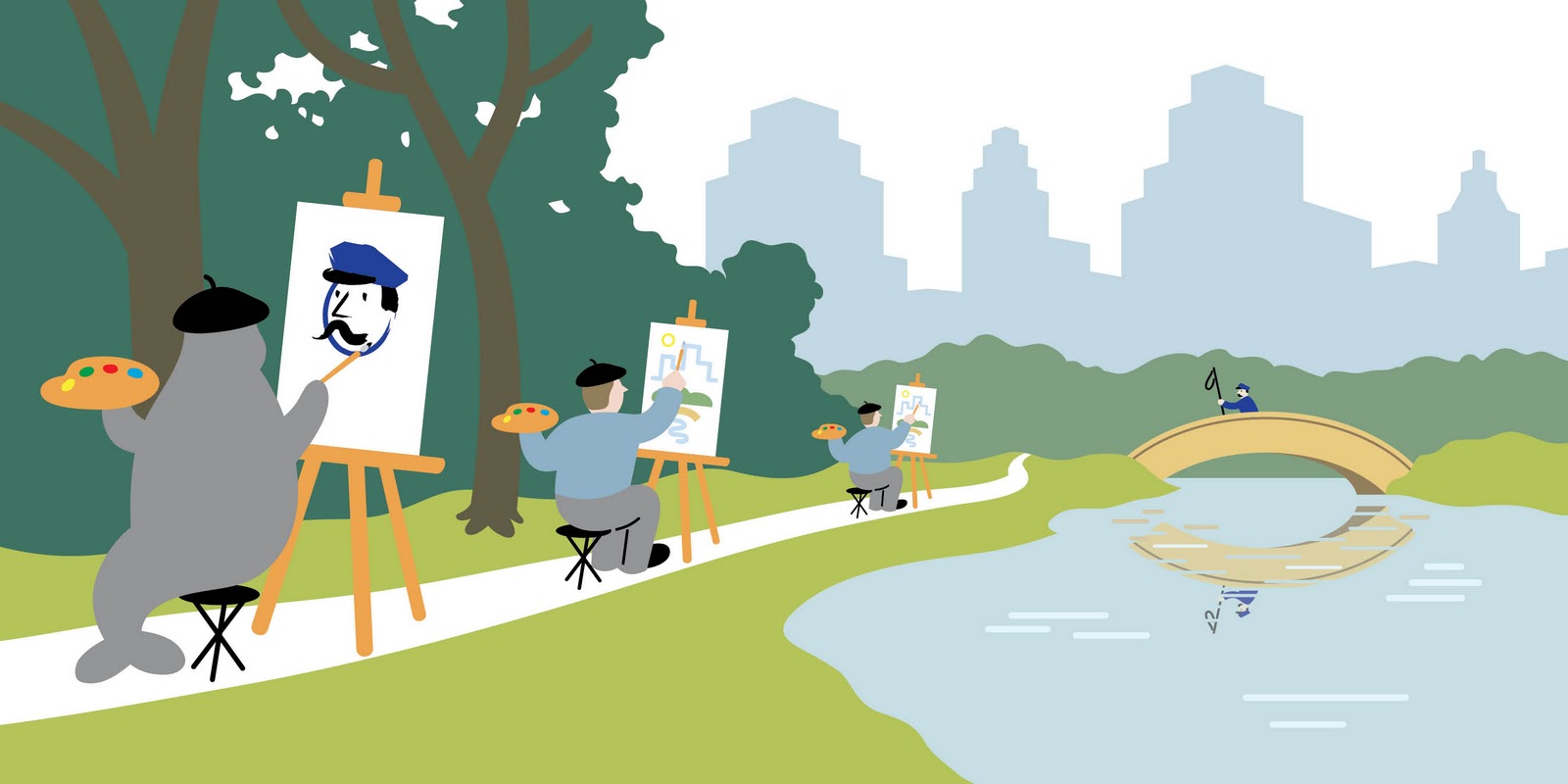
Overthinking the book, am I? With a cute concept and easy-to-scan illustrations it can be easy to miss the imagery presented to young readers matter-of-factly. The treatment of animals in zoos and aquariums varies, and even where animals are well treated there is still the idea of our presenting animals in faux environments under the guise of their being educational. Many a time I've been to a zoo and seen a depressed animal in an enclosure – if you can read emotions in humans you can do it in animals equally well – and overheard parents tells young ones "Oh, they're just tired from running around all morning" or something equally dismissive. Go to the big cat house during feeding time and hear those lions and tigers roar with such ferocity that the sound penetrates your body and you appreciate the bars that separate you while at the same time realize that, perhaps, this is not the way things should be.

So despite my misgivings about the casual representation of zoos to small children, I think the book is fine for what it is. I don't know why this didn't go straight-to-board-book because I have a hard time understanding the justification for its size. If it were a truly Where's Waldo situation where you had to pour over the details of a page for hours to find the hidden elements I would understand it. As it is, Walrus is large, impossible to miss, and the humor of the zookeeper not finding him wears thin even for the few pages that it takes place in the story.

Friday, May 28

Belly Up

by Stuart Gibbs
Simon and Schuster  2010

When the recently-deceased hippo mascot of a zoo turns out to have been murdered it falls to a 12 year old boy to solve the mystery none of the adults seem to be able to, but not without the help of a girl. 

Did that sound cynical?  Huh, I wonder why.

Could it be another mystery (albeit with an unusual victim) solved by a kid where no adult seems able to get to the bottom of things?  Could it be that the boy, who is all action and no thought, absolutely could not have solved anything without the help of the girl whose father own the zoo?  Could it be because it's impossible to imagine such an immense zoo run by so many incompetent adults?

And don't get me started about ANOTHER book where the boy needs a smart girl to solve the mystery.  

I was trying to understand why this bothered me so much, why there's such a line in sand between smart kids and dumb adults in fiction, and I think it's a misreading of what kids want.  To a kid's perspective everything adults do, they way they think and behave, comes with a set of knowledge that was developed over time.  The world of a kid runs by its own rules and the conflict comes when what they think bumps against the harsh reality.  It's the struggle of trying to puzzle out the world. 

But the way this gets represented in books is that there is an external problem to be solved and only the kids care enough to take it, only the kids are smart enough to get to the bottom of things.  The adults are obstacles meant to complicate plot but not to represent a real conflict between kid-think and adult-think.

So in Belly Up, when Teddy Fitzroy decides he needs to report the FunJungle mascot, Henry the Hippo, has been murdered the police right him off with all the gruff derision of a b-movie cop.  Large Marge, the beat security guard, is physically just a mountain to outrun.  The zoo director Martin del Gato is a Snidley villain to glower (and one can imagine twirling a mustache) and make people's lives miserable because his life is miserable.  The only reason Teddy is smarter than the adults is because he is surrounded by stereotypes and not adults. 

This is no less true in Hiassen's Hoot or Sacher's Holes, though both of those books are better at this sort of game because they bother to develop characters in the process.  For Hiassen there is a dynamic between recent transplant Roy, runaway Mullet Fingers, and his bruiser of a sister Beatrice that underscores their very different personalities and upbringings.  For Sacher there is a layer of magical realism in both Stanley's family history and in locale.  Gibbs tries, I think, to give Teddy a concerned wildlife researcher for a mother that feeds the boy's desire to see justice done over a murdered hippo, but if his mother was really that concerned she would have actually done more to stop the building of this farcical zoo before it ever opened.  I don't buy the "she was promised to supervise that it was done right" argument because principled individuals are wary of too-good-to-be-true offers like this, especially from wealthy industrialists who build mammoth zoos on a whim for the sake of their young daughters. 

Gibbs does write with insider's knowledge of zoos, showing the ugly underbelly of what it means to "educate" and entertain people with exotic animals, but its not enough to pull the book out of the realm of perfect-for-TV-movie-adaptation.

Monday, August 27

Pssst!


by Adam Rex
Harcourt 2007

I get it now. I wasn't sure before when I first came across Adam Rex's Frankenstein Makes a Sandwich last year but after seeing this there's no doubt in my mind:

Adam Rex is making picture books for adults.

Sure, they can be enjoyed on certain levels by kids but the reality is that there's just too much packed into his illustrations for these to be for children. I wonder if his publishers and editors have figured it out. I bet the art department has and they're just keeping it to themselves.

A girl goes the the zoo and one by one different animals call her over for a little private chat. "Psst! Can you get me some tires?" the gorilla asks. "Why?" Isolated panel of a tire swing, the tire ripped from the rope. The girl promises to try. Next exhibit the bats want flashlights, not for them but for the hippo that they share a cave with. The peccary wants trash cans for all their trash. The penguins want paint because they can't stand all the white of their exhibit space. The sloths need helmets because they're falling out of trees and landing on their heads. Reasonable requests all.

Finally the animals give her money to make the various purchases ("The peacock collected the coins from the fountains.") and she's off to the hardware and supply store across the street from the zoo where everything beginning with the letter T is on sale for half off. Too bad she doesn't need a tiki or timber.

Each of the pages where the girl converses with the animals is presented like a one-page panel comic, buffered with spread where the girl is making her way around the zoo. It's in the spreads -- done in a pencil-draft style compared to the full color of the conversations -- where Rex includes lots of strange little details that might not register with younger readers. First a fawn and later a rhino are shown free-wheeling around the zoo in clear plastic balls. Trash cans topped with animal heads suggest a place to put trash in their mouth but later a panda-headed can is labeled "bamboo" and a tiger-head can is labeled "steak". Near the bat cave an elderly gentleman in a Batman suit is sitting, most likely the original 1930's Batman retired to the edges of the zoo.

It's the punchline of the book that sold me on the idea that there was a different audience for this book than the one I assumed. Once the animals have what they need the girl hopes their all happy and goes about her way. Turn the page and you see what they've done with their new toys: they've built an Ed "Big Daddy" Roth hot rod circa 1966 to ride around the zoo at night.


(For the kids out there who don't know who Ed "Big Daddy" Roth is and what grew out of the mid-1960's hot rod culture)

Do I believe there are books out there that children and adults can enjoy together, conceived as a piece of mutual entertainment much the same way that Pixar includes jokes and sight gags for the captive adult audience? Yes. Do I think that Pssst! is equally enjoyable to young and old with each getting different things from it? Naturally.

But I still maintain that I think Adam Rex is putting one over on the publishers.