Showing posts with label board book. Show all posts

Tuesday, October 25

Where's Walrus

by Steven Savage
Scholastic 2011

After escaping from the zoo a Walrus find "ingenious" ways to remain hidden in plain sight from the zookeeper. Complete with "twist" ending!

I have to call this one the way I see it: It's Where's Waldo meets Goodnight Gorilla. Also: this is a board book disguised as a picture book.

One afternoon while the zookeeper naps nearby a Walrus, in what looks like an above ground swimming pool, simply waddles out the gates of the zoo and into the big city. In scene by wordless scene the Walrus hides in plain sight by blending in. Here he is a statue in the fountain. There he is a fireman working a hose. It often takes little more than a hat and a few props to elude the zookeeper, who besides working at one of the poorest designed zoos in the world is clearly a dolt himself. Finally the Walrus hides at a diving competition (performing a "twist," if you will, off the high dive) where he is not only spotted by the zookeeper but wins a gold medal. This gives the zookeeper an idea and in the end Walrus has a new and more humane pool with a diving board to perform for the public.


Obviously, younger pre-readers are going to enjoy pointing out where the Walrus is on every page while laughing at the buffoon of a zookeeper for missing him. The simplified graphics on a picture book-size page seem like a waste; their flat tones and bold shapes would not only reduce well to a smaller sized board book they might actually look better for not taking up so much space.

As for the "twist" at the end, where Walrus's diving feats impress the zookeeper and provide him with a new home, well, that sort of speaks to why Walrus ran away in the first place. The story isn't just about a mischevious Walrus, it's about an animal in a pool so small that it has no way to entertain itself and must go in search of fun elsewhere. It not only answers the unasked question "Why did the Walrus escape from the zoo?" but underscores one of the larger issues surrounding the idea of capturing wild animals in the first place; is a zoo really the most humane way to appreciate wild animals? In the end Walrus isn't just a captured animal, he's an exploited one, putting on shows to draw people to the zoo.
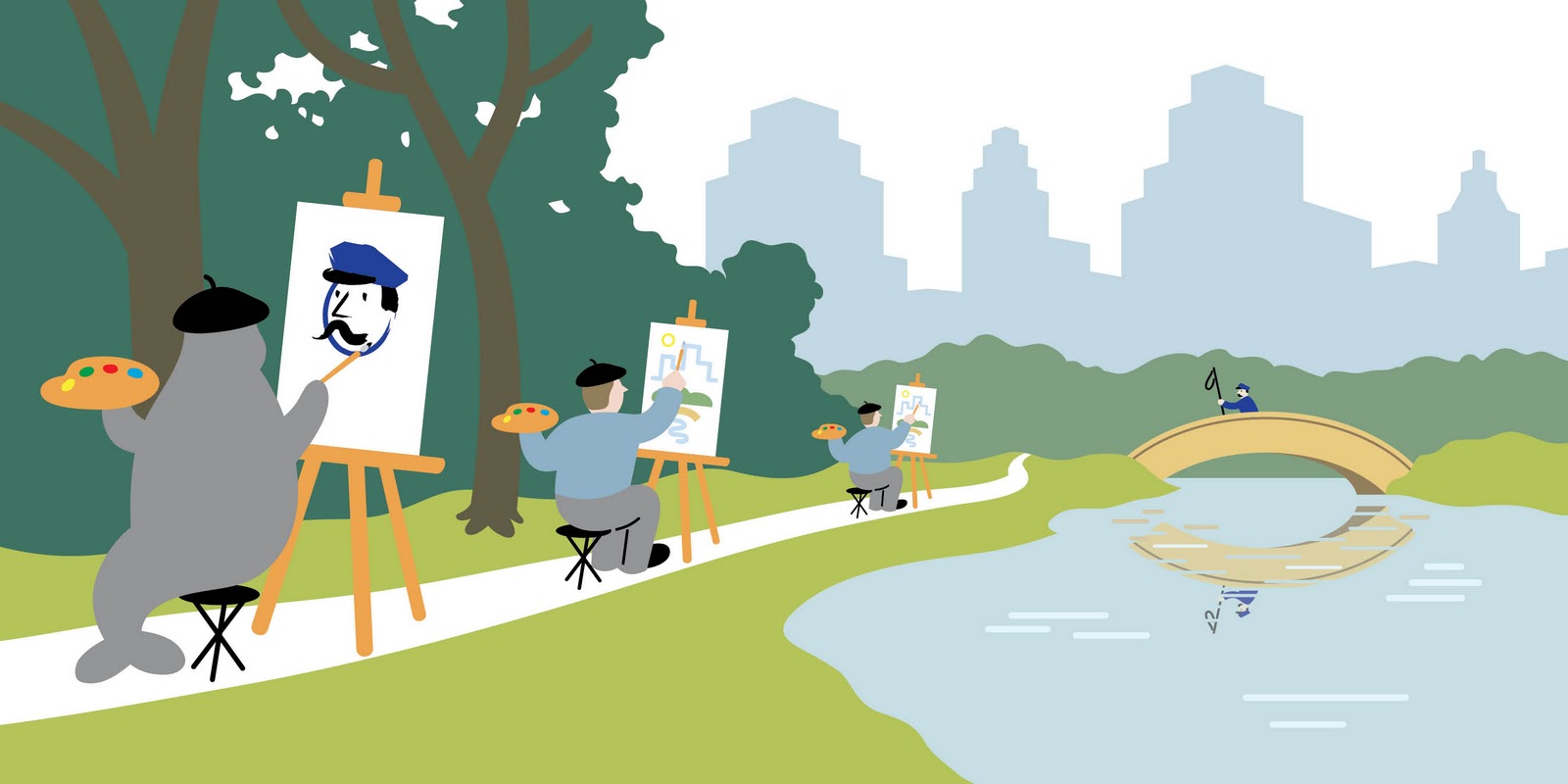
Overthinking the book, am I? With a cute concept and easy-to-scan illustrations it can be easy to miss the imagery presented to young readers matter-of-factly. The treatment of animals in zoos and aquariums varies, and even where animals are well treated there is still the idea of our presenting animals in faux environments under the guise of their being educational. Many a time I've been to a zoo and seen a depressed animal in an enclosure – if you can read emotions in humans you can do it in animals equally well – and overheard parents tells young ones "Oh, they're just tired from running around all morning" or something equally dismissive. Go to the big cat house during feeding time and hear those lions and tigers roar with such ferocity that the sound penetrates your body and you appreciate the bars that separate you while at the same time realize that, perhaps, this is not the way things should be.

So despite my misgivings about the casual representation of zoos to small children, I think the book is fine for what it is. I don't know why this didn't go straight-to-board-book because I have a hard time understanding the justification for its size. If it were a truly Where's Waldo situation where you had to pour over the details of a page for hours to find the hidden elements I would understand it. As it is, Walrus is large, impossible to miss, and the humor of the zookeeper not finding him wears thin even for the few pages that it takes place in the story.

Wednesday, October 14

When It Rains.. It Rains


by Bill Martin, Jr.
with pictures by Emanuele Luzzati
Holt, Rinehart and Winston 1970

Much like last week's Martin/Luzzati collaboration, When It Rains.. It Rains is another small book that deals with repetition and familiarity to hold a young reader's attention. It didn't occur to me before, but these small books with their childlike illustrations and simple texts were precursors to the board books of today.

Here the pattern is established in the title. Each spread deals with a different type of meteorological event like rain, snow, and fog before moving into the emotional territory of age and temper. There is more of an attempt to bring in images of non-white children which speaks to its age, though their representation tends toward the Small World variety of stereotypes: a white-turbaned Indian boy beneath a palm tree in the heat, a Mexican boy in a sombrero and blanket poncho. Nothing too egregeous for the modern age, but as with Whistle, Mary Whistle, probably enough to keep it from ever being reprinted.

But, again, my draw to these books was the illustration. The pictures contain the same innocent qualities of another Martin collaborator, Eric Carle, with a warm use of vibrant color. Luzzati, along with Nicolas Sidjakov, The Provensens, Mary Blair, and M. Sasek all have that mid-century modern look illustrators had that I'm just a sucker for. Inky outlines and loose crayon against solid blocks of color. There are a few modern practitioners (who might be surprised to be considered part of this group) like David Ezra Stein and... well, now I'm drawing a blank. I think Jeremy Tankard is doing some great work in digital that is along the same lines in terms of boldness of color and naivete of spirit. And there is an artist I've been following since she was a student in animation school (on her blog, I'm no stalker!) named Lorelay Bove who has landed a job illustrating Disney's newest Golden Books and whose work reminds me so much of Mary Blair.

What was I saying? Oh yeah.

Taking a couple more looks at this it slides in nicely alongside Bill Martin's other books. No more and no less sophisticated than Brown Bear, Brown Bear, What Do You See? and its ilk.

Monday, May 21

Andy Warhol's Colors / Counting with Wayne Thiebuad


both by Susan Goldman Rubin
Chronicle 2007

Board books are funny things. On the one hand they make perfect sense if you are trying to get kids used to the idea of books and reading at a very early age. They have sturdy coated cardboard pages that withstand throwing, food spills and the gnawing and chewing that comes from young pups.

But board books didn't always exist. They were invented, much like the term teenager was invented to suggest a difference between child and adult, probably more like the way the tween demographic was identified by markers and advertisers in order to better capture income from a growing consumer demographic. Somewhere in between the social science of presenting kids books at the earliest possible age and the capitalist goal to build a loyalty and brand recognition from the cradle, that is soupy mire from which board books arise.

Board books are not evil but there is a whole lot of cute mixed in with the good. It saddens me, for example, that publishers make board book versions of classic picture books, often abridging texts or images to fit the format. And there are those books that have "cute" spred all over their intents, proving that their true market is parents and grandparents for whom the book is going to have a greater appeal; they aren't buying for the child so much as they're hoping to impress their opinion of what is cute onto soft minds.

But sometimes people get that a board book can be more, and here we have two examples. Author Goldman presents classic Andy Warhol illustrations from the 1950's and 60's with short bits of rhyming text that are linked to their predominant colors. For those who only know Warhol's iconic factory-produced screenprints these fresh ink and watercolor illustrations may prove that, when he wanted to be, Andy was a talented artist. Featuring a typical assortment of animals -- cat, butterfly, lion, monkey, &c. -- Rubin fuses the color concept board book with a mini primer on a modern art master.

In the Thiebaud book Rubin offers us some of the artist's food paintings with a counting rhyme. That Thiebaud's paintings are done in a very thick application that makes them look as if they'd been composed with cake frosting is an added benefit. Consisting mostly of deserts -- pie, ice cream cones, cupcakes, candied apples -- the fact that they are well-known paintings from a still-living master is almost completely overshadowed by their tempting yumminess. Yes, I said that. The counting aspect of this book is practically lost but not in a bad way. It feels more a casual counting book, among a collection of food illustrations that, oh, just happen to be famous paintings hanging in museums.

Yes, okay, so these books are intended to appeal to adults on some level (did I not say yumminess?) but for those, parent and child alike, who might not be as familiar with these artists or their works, what a delightful little introduction. I noticed that there's no modern art master alphabet book from Chronicle but I hope they're considering it. In fact, I think this sort of art history could make for a very good series of board books.

After all, if Major League Baseball can produce board books (building that brand/team loyalty in the cradle again) then why not do more of the same for the arts and sciences? Just a thought.