Showing posts with label picture book. Show all posts

Tuesday, September 1

a funny thing happened on the way to school

by Davide Cali
illustrated by Benjamin Chaud
Chronicle Books 2015

Excuses, excuses, but it's the SIZE of the lies that impresses here.

When asked why he was late for school a boy goes into a lengthy, imaginative journey into all the obstacles in his path. From a story perspective it's exactly what one teacher once described as "one dang thing after another," and the twist on the last page isn't all that noteworthy unless the reader has had no experience with picture books at all. The best example of this type of story is Remy Charlip's Fortunately; unfortunately this book isn't in that sphere of clever.

But what I found most charming, even refreshing, was the size of the book itself. Slightly smaller than 6"x9" it is satisfying to hold and the smaller page seems to better convey the chaos on the page. Sometimes I look at a picture book with it's gloriously huge flatscreen-sized pages with so much dead space -- excuse me, "atmospheric space" -- and wonder why the book needs to be the size that it is. One look at the picture book section of a library or bookstore and you can see that there doesn't seem to be a standard trim size, but certainly not all of these books can justify their out-sized ego. Bigger isn't always better.

So, way to go, Chronicle! More quality books with smaller hands in mind!

Friday, September 12

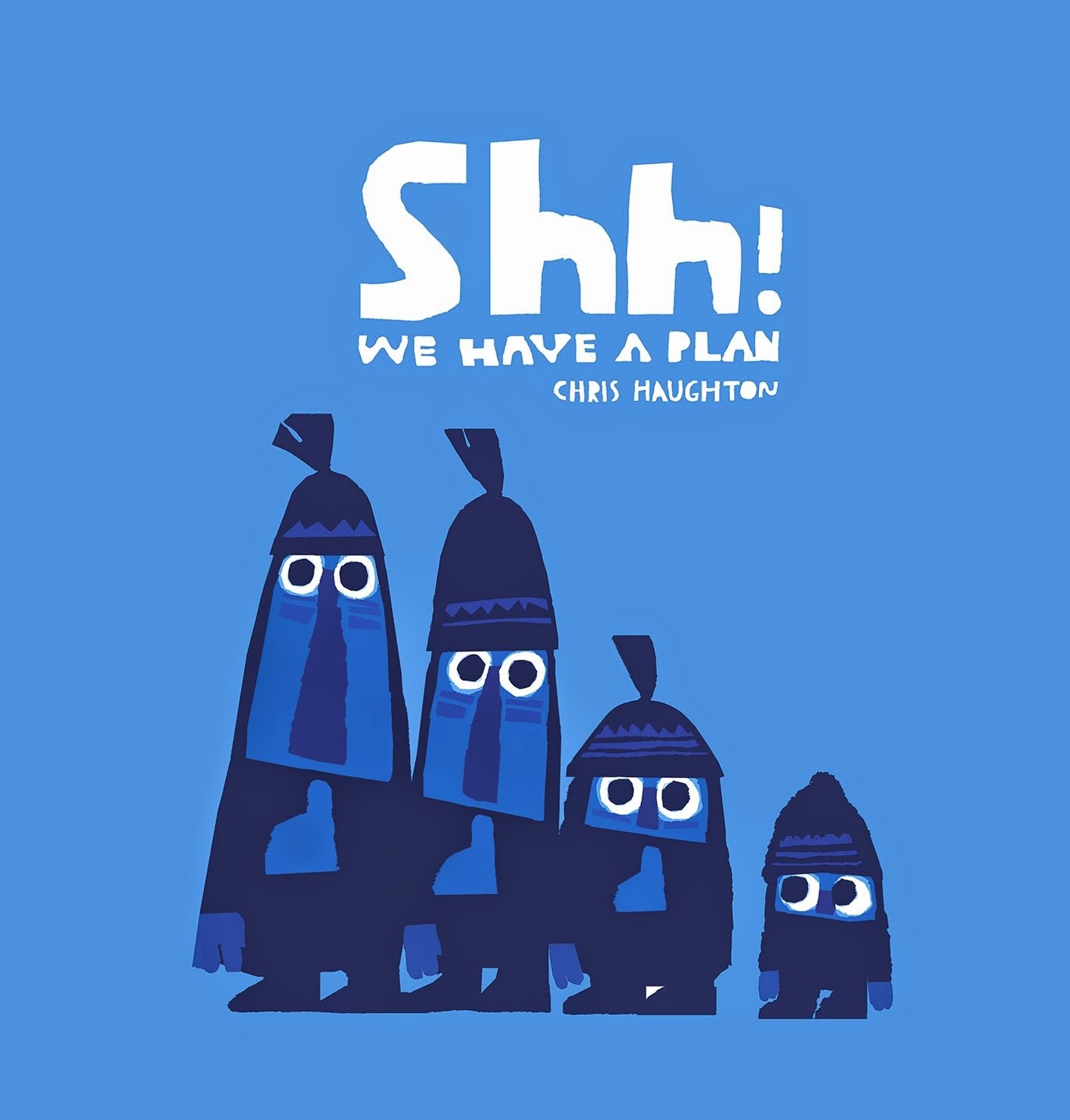
shh! we have a plan

by Chris Haughton
Candlewick  2014

Four black-ops solders take on an impossible night mission with little hope of success. Just kidding!

In the depths of a purple-blue night four night stalkers our out with their nets in hopes of coming across something to catch. Actually only three of the stalkers have nets, the smallest seems to be tagging along. When they come across a bird the Little One cannot help but call out "Hello, Birdie" but is quickly hushed. "Shh! We have a plan."

Following the Rule of Threes the older trio creep stealthily upon the bird on the ground, in a tree, and out on a frozen pond, always failing to catch their prey. At last the Little One offers up some bread crumbs and they stalkers are suddenly surrounded by many birds. With the birds so close it seems as if catching them will easy until they realize they are outnumbers and outsized and off the run.

When they see a squirrel they turn to Little One. "Shh. We have a plan." And thus we end back where we started, with the stalkers unwilling to accept the truth and Little One shrugging at the reader.

Is it a lesson in respecting and protecting small creatures? The triumph of innocence over mischievous adventures? A subtle anti-hunting tract?

How about kids being kids?
Kids getting a notion in their head and proceeding with what they believe is a well-considered plan only to have it fail due, in part, to their own limited understanding of the real world.

Okay, I'll get out of the deep end now.


Stylistically, Shh! We Have a Plan is dark, but it's the darkness of night, the darkness of woods where even the light of the moon only makes things look various shades of blue. The human characters have a ragged torn-paper look to their edges while the natural elements have a cleaner simplicity to their shapes. The animals in particular, with their bright reds and greens and geometric shapes, are reminiscent of Alexander Girard without mimicry. A hat-tip in general to mid-century modern in both design and storytelling is owed here from Haughton who, it seems, has a genuine affinity for the naif.

Tuesday, June 17

I Am Rosa Parks

I am Rosa Parks
By Brad Meltzer
Illustrated by Christopher Eliopoulos

A whitewashed (ahem) picture book biography of the famed Civil Rights icon. Parson Weems would be proud.

Now that we have Phillip Hoose’s Claudette Colvin: Twice Toward Justice out in the world I feel it is incumbent on anyone treading toward teaching kids about the Civil Rights do so with a more open understanding of history.

Rosa Parks was chosen as the symbol for a bus boycott, and sometimes what you need is a symbol to make history, but you need a balanced and more nuanced hand to tell history, especially to kids.

Parson Weems is responsible for the story of George Washington and the cherry tree, a myth so prevalent that kids know it almost without being taught. For Weems, writing over 100 years ago, the idea of mythologizing American heroes was a conscious effort meant to galvanize a national pride. But we’re smarter than that now, right?

Apparently not.

Meltzer – better know to adults as a writer of adult thrillers – spends a great deal of the this book painting Rosa Parks as a child who always stood up for herself, leading to her taking a stand on that famous bus seat. This is well and good, but then we jump ahead to the Civil Rights and her meeting MLK and a happy little ending about how important it all was that she stood up for herself.

But she wasn't the first.

Don’t kids deserve to also know about the young Claudette Colvin who preceded Rosa Parks by a full 9 months, the first person to actually be arrested for protesting the segregation of public busses? Certainly there are ways to skip the messier parts of Colvin’s story, or to include them within context, but to ignore that part of history altogether? Well, that's just inconvenient toward the narrative.

This book is part of a series “Ordinary People Change the World” which is a great idea in theory, but the other people in this series include Lincoln, and Amelia Earhart, neither of whom were really that ordinary when you think about it. I’m not trying to take anything away from Rosa Parks or from kids knowing who she was historically, but when it comes to teaching kids history there is a responsibility to get it right, to tell it right.

Some source material at the end of a biography would be nice as well. Unless, you know, it’s all just a storybook and not a history at all.

And maybe, just maybe, it could be written by someone who wasn’t white.


Friday, May 10

if you want to see a whale


words by julie fogliano
pictures by erin e. stead.
roaring brook press 2013

a very old school picture book
poetic in word and image

now this is what i’m talking about.

the title is the premise
a set of instructions for what you need to do
in order to see a whale

it starts with a window
and quickly moves to a landscape
of the mind
the text and instructions
more of a tone poem
told legato

you must look closely
and rule out those things that aren’t a whale
avoid the distractions
stay alert to the possibilities

and then
when you have done all that
as if by magic
you will see a whale

the text
all lower-case and sans punctuation
reinforces the poetic quality

he illustrations of
a boy
and his dog
and the world of his imagination
are often set against sparse
monochromatic backgrounds
that allow for the focus
on unspoken elements in the text

and there are whales throughout
if you look for them
which is what the picture book
is all about~

seeing and making connections
with what is and isn’t there

i hate to use the word
perfect 
but even the size of the book

a manageable seven-by-nine inches

not only fits the hands of smaller explorers
but echoes the picture books of old
like the original sendak-krauss collaborations

it reminds us
that small readers
don’t require larger pages
to get lost in
and
that bigger
doesn’t always mean
better

even if it’s a book about
spotting a whale

Tuesday, April 2

A Little Book of Sloth

by Lucy Cooke
Margaret K. McElderry Books 2013

This non-fiction book, ostensibly for kids, should forever change the synonym for sloth from "lazy" to "cute."

Many decades ago when I first learned about sloths and their sloth-like behavior they seemed to me a perfect insult. Calling someone a slug was up there but there was nothing that rolled off the tongue quite like "move it, you sloth!" All I knew of sloths were that they were slow, tree-dwelling, and, uh, slow.

But how slow? I couldn't tell you. And when you think of something as 'slow' there's also that connotation that they might not be as quick-witted as other creatures as well, but was that true of the sloth? I also assumed that the reason they were green was because they were too lazy to groom themselves, but it turns out that there's a very good reason NOT to groom away that algae in their fur.

Who knew?

I know now, and I think many adults will learn quite a bit from this book as they read it to their little ones.

There is a place called Slothville in Costa Rica that is a sanctuary for orphaned and injured sloths. As pictures from this book reveal, even a creature that looks like a cross between a kitten, a piglet and a hedgehog that's been stretched out can be awfully cute. They appear to be the most mellow of jungle creatures, sleeping 70% of their lives away (though no one knows how long that lifespan really is), chowing down on green beans and hibiscus flowers, and hugging, hugging, hugging.

Oh, and I now know that a full-speed they top out at fifteen feet per minute.

And the images make this book. Cooke's fondness for sloths is equally matched by their cute-overload behavior. Hugging stuffed animals, hugging each other, their odd (and equally slow) bathroom routines, and three words that really ought to become a catchphrase for something: bucket of sloth.

Sloths for the win!

Thursday, March 7

Happy Harry's Cafe

by Michael Rosen
illustrated by Richard Holland
Candlewick 2013

Harry makes great soup, or so we are told.

Harry is a Bear.
He work's at a cafe that bears his name.
Harry's friends are birds and cats and other animals.
Harry's friends love his soup so much they come running before it runs out.

But on this day Matt the cat does not like the soup.
Because he hasn't tried it.
Because he has no spoon.

Once Matt has a spoon and tries the soup.
He is so moved he sings a song about the soup that sums up the story.
And everyone joined in and they were all happy.

In the world of children, this story makes sense.
Or rather, it makes up a certain non-sense that is a part of the way kids make up stories.

But it is not a real story.

It is like soup without a spoon.
There is nothing to taste,
and worse,
it is like everyone around you telling you how good the soup is.
But unless you can taste it it isn't very good soup.

Happy Harry's Cafe is told in a very simple way.
Even the youngest lap-sitters will be entertained.
They can watch the animals in Harry's cafe laughing and having a good time,
and then they can retell the story themselves
because it requires very little of them to remember.

On the book flap we are told that Michael Rosen is an award winning author.
And illustrator Richard Holland has illustrated many books
including books that inspired him to develop the collage style he used here,
a mixture of simple cut shapes and suggestive sketching.

They both live in England.

There is nothing bad to be said about them here
except that this particular soup they created
like it's sparse storytelling and muted palate
is pretty bland.

Wednesday, October 24

13 Days of Halloween: The Gashlycrumb Tinies

Or, After the Outing  
by Edward Gorey
Simon & Schuster 1963 

A ghastly little abecedarian for hip little children... who might just happen to be teens or adults with a sense of humor.

I think this one is best explained by example.


You can probably figure out how the rest of this plays out. Twenty-six children, each with their own half of a dactylic couplet to explain their demise. With his signature illustration style and Victorian sensibilities, Gorey's alphabet poked a sarcastic finger through the overly-protective world of childhood where everything was still see-spot-run and friendly neighbors just down the street and around the corner in classroom readers. It might also be worth noting that the year this was originally published, 1963, was also the same year that brought us Where the Wild Things Are. Change and revolution was in the air and children's books were poised to enter a new era.

It's interesting to think that a book like this would hardly raise a fuss if released today. Picture books are full of subversive humor and tacit violence – ahem, I Want My Hat Back – but Gorey's approach is the reverse of what we see. Where we might have text and image imply some unsavory off-stage happenings Gorey is quite content to lay out precisely what has happened to the poor children and managed to capture them at the moment just before they realized their demise was at hand.

In the late 1970s and early 1980s a high school bedroom or college dorm wall was as likely to have a poster version of The Gashlycrumb Tinies (still very much available, and inexpensive) as it might a Kliban cat, Bo Derek, or A Clockwork Orange poster. Where popular culture continues to march on,leaving some detritus in its wake, I think the resurgence (or recent dominance) of darkness in entertainment makes a Gorey renaissance inevitable. And why not?

Tuesday, October 23

13 Days of Halloween: The Monster's Monster

by Patrick McDonnell 
Little, Brown 2012 

Three little monsters decide to create a much bigger monster who, it turns out, teaches them that you don't HAVE to be a monster, just because you're a monster.  

Horned Grouch, hairy Grump, and two-headed Doom 'n' Gloom live in a castle atop a hill where their antics cause the villagers no end of fear. They smash and bash things, get upset over nothing, and their ten favorite words are all 'no.' One day they set out to Frankenstein themselves an ultimate monster but things don't go as plan when Monster turns out to be full of politeness and child-like wonder. Oh, the horror! as Monster teaches them to say Thank You (actually "Dank You" sounding like the late Alex Karras playing Mongo in a Mel Brooks movie), brings them powdered donuts to share, and takes them to the beach to watch the sunrise. Turns out all the little monsters needed was a good role model. 

There's something disarmingly cute about this. While thin on character development and motive there seems to be at the core a message about an accepted loss of civility. Or maybe a larger idea about transcending who we think by being shown what we can become. Or maybe it's just a twist on the Frankenstein narrative that suggests our collective "creations" can be larger and better than individual selves.

Or sometimes, a story about monsters is just a story about monsters.

McDonnell's art is breezy and cute in his typical style, though lacking the finer subtleties found in Me, Jane where character expressions on a stuffed animal did as much storytelling as the text. Here, the illustrations are all surface, leaving no real memorable images in their wake as the pages turn. That, coupled with the slight text, makes The Monster's Monster read like a light between-meal snack; more of a rice cracker than a cookie, and essentially calorie-free.

Still, for little monsters who might want a Halloween treat that isn't too scary, this would suffice.

Monday, October 22

13 Days of Halloween: Creepy Carrots

words by Aaron Reynolds 
pictures by Peter Brown  
Simon & Schuster 2012 

Jasper Rabbit loves carrots but they're starting to creep him out. Kids everywhere will cheer - they now have a real reason for hating carrots! They're creepy! But is there a deeper message here about the haves and the have-nots? 

Cute Little Jasper loves carrots, and how could he resist the temptation of Crackenhopper Field where they grow fat, crisp, and free? He can't. Then one day his little bunny ears twitch and he is sure he's being followed. Soon enough he is seeing creepy carrots everywhere he looks. The creepy carrots looking at him in the mirror? Those are orange-colored items on the edge of the bathtub. And in the closet? More orange carrot-shaped items.  

But after a week Jasper can't help but see those creepy carrots everywhere he looks. Finally Jasper hatches a plan and spends a Saturday enclosing Crackenhopper Field with a fence, surrounded by a moat full of alligators. There was no way any creepy carrot was ever going to escape and haunt Jasper again. 

And inside the fence the carrots rejoiced. Their plan had worked!  

It's easy to see this as Jasper's story – after all, he's the one being haunted at every turn – but the title of this (literally) dark picture book tells us who the story is really about. These poor, sentient carrots, passive in their existence, have had to deal with the horror of being yanked from the ground and consumed by a bunny with little concern than his own consumption. Is this a story of rabid consumerism? Perhaps, but then would that make the carrots the 99% who haunt in protest for their own rights to exist free of a predatory 1% who think nothing beyond the scope of their own desires.

Reading too much into a picture book again? Maybe the problem is we don't read deep enough.

As haunting as the carrots my be, they are merely creepy as an act of survival, and the ends justify the means as they find themselves in a gated community built on their behalf. That may seem workable for the moment, but how like the social welfare and housing programs of the past where well-intentioned governments (and some ill-intentioned ones as well) construct housing projects and artificial neighborhoods to protect the underclass.

Okay, okay, it's just a story about a rabbit haunted by carrots who are tired of watching kith and kin being eaten before their very carrot eyes. The illustrations in black, grey, and orange deliberately play off the Halloween theme of horror, a little trick-and-treat mixture of cute and creepy. The young'uns will eat it up, but not like carrots. More like candy corn I'd say.

Friday, October 19

13 Days of Halloween: Zombie in Love

Zombie in Love
by Kelly DiPucchio
illustrated by Scott Campbell 
Atheneum Books 2011  

A picture book about a zombie looking for love?  

Mortimer is, to be blunt, a bit clueless. He's looking for love in all the wrong places, scaring the pants off too many faces.  Does he not realize he's a zombie? Does he not understand that the living fear the living dead? In the end, it takes a personal ad (talk about a dead end) to bring Mortimer the one girl who cab return his putrefied affections. At a prom.

Granted, it's got cute moments, but its one of those picture books that make me wonder who the audience is: goth teens looking for a cute Valentine's Day gift? Tweens caught between being too old to trick-or-treat but still clinging to their younger days with newly jaundiced perspectives? Elementary school kids who are already fretting about finding a date for the prom?

The story feels too sophisticated for newly independent readers, full of too much mushy love stuff or too much gore-filled humor, and honestly just seems out of place among other picture books. It's like a zombie-themed valentine on steroids. 

I have to say, I was pleased to see a cheerful zombie picture book, but I wished it had been about something other than finding a mate. That's Frankenstein's territory.

Monday, September 24

Oh, Rats!

The Story of Rats and People 
by Albert Marrin 
illustrated by C.B. Mordan 
Dutton / Penguin 2006 

Is there any pet more widely considered vermin? The nonfiction picture book examines the facts and myths surrounding the rodent people love to hate.  

Stating with a tale from his own life, Marrin recounts how he was playing in a wood pile as a kid when he first came face-to-face with rats. Out his fear his father offered this wisdom: "Learn about them: you'll feel better."

With that we embark on a journey to learn everything we can about rats. We learn their history and evolution, their ratty ways and how they've interacted with people (and the ways people have interacted with them), we learn how they are pesky and how they are yummy, their eradication and their cause in spreading the plague, and even how they have been used (inadvertently as well as deliberately) in scientific research. It's seemingly very thorough for a book that could serve as a first serious introduction to a child learning about – or how to get over their fear of – rats.  

One of the elements that takes the edge off the book is the fact that it is illustrated with woodcut-like illustrations, similar in style to the work of Barry Moser. This one-step removal from actual photographs makes the rats seem less threatening though the detail on their faces and the red spot color on the mostly black-and-white images gives them a bit of realism that may still make some queasy. I would have preferred a little more interplay between images an texts – as opposed to small inset circles and sidebar illustrations – but as presented the images and text are still handsomely laid out and designed. 

Occasionally the text felt like it drifted between different aged readers. The chapter on rats and the plague seemed to trade on the reader's knowledge of a higher vocabulary and reading sophistication while other chapters contained text that bordered on condescension. Take

Yersina pestis is a bacillus belonging to the family of bacteria shaped like thin rods. Visible only under a microscope, a single plague bacillus is 1/10,000th of an inch in length.
compared with

The famous Larousse cookbook includes one for "Grilled Rat Bordeaux Style. Bordeaux is a famous place. 

Indeed, Bordeaux is a famous place, but a sentence like that has no meaning without context, and even the description of the wine cellars that follows fails to explain the significance of Bordeaux, the cookbook, and what it being famous has to do with rats. Do the rats know Bordeaux is more famous than other wine regions? Does Bordeaux somehow attract more than the usual amount of rats to its cellars? When contrasted with the chapter on the science of the plague and how the rats transmitted the disease, the text in the cooking chapter and elsewhere wavers between reducing facts to their simplest book report factoids and deeper explanations worthy of a kid deeply interested in the subject. 

There are other moments where it feels like information has been simplified or facts generally lumped together for the sake of simplicity. There are, according to this book, only two families of rats, though many types of rats are grouped together on the generic terms "black rats" and "brown rats." Any reader clearly interested in rats would want to know these differences in families, just as they would with subjects like snakes, sharks, bees, and so on.

These points aside, I love this book for not shying away from touchier elements, such as people eating rats and details concerning scientific experimentation. It is reasonably well-rounded and keeps its balance between the earnest, respectful, and gross elements that a subject like rats arouses in readers. 

Wednesday, September 19

Moby Dick

Chasing the Great White Whale  
by Eric Kimmel
illustrated by Andrew Glass 
Feiwel & Friends 2012 

Finally! A version of Melville's classic I can actually finish! In one sitting! With pictures even! 

So, up front, I'm no fan of Moby Dick. I have tried and tried and simply cannot traverse the literary muck and mire of Melville's meandering meditation. I get about 60 or 70 pages in and I start to entertain notions of gnawing off my own leg. Then I realize I can put the book down and walk away, and I do. I have done this five or six times now and I just. cannot. read it.

What does it say about me that I love this picture book adaptation, told in well-crafted rhyme, with its details artfully smeared across the illustrations? Does it say I'm lazy, or that I have no patience, or is it simply that I find this to be the most accessible, tastefully done adaptation from classic literature I've seen in picture book form in a long time.

Yeah, you're right, it's probably a combination of all those things. 

Looking at it from the perspective of the intended audience, a child with an interest in pirates or sailing or whales, this book probably stands out above many others simply because the main characters are neither children or animal stand-ins. It's a curious thing that we tend to think a picture book as something that reflects the child or their world when, outside of books, their interest extends far beyond those small world limitations. I often wonder if we don't do children a disservice by presenting them books where adults are non-existent or merely two-dimensional foils for a child-like fantasy. How can we expect children to know how to interact with adults if they are constantly told adults are inconsequential?

This book doesn't address this issue, but it does faithfully (in its own way) hold true to Melville's tale (I know it, I just haven't read it) of Ishmael setting out on a whaling vessel with an obsessed captain, the lone survivor to tell the tale to the reader. There's just enough in the verse and images to get a feel for the grittiness of life on the seas once-upon-a-day, the adventure and the peril, and that hint of madness that you can sense even before you've learned the name for it. Kids see plenty of adults, and their behavior scares them, so perhaps they recognize more of the adult world than we give them credit for.

Kimmel and Glass don't shy away from this madness, or death for that matter. Ahab, his eyes wide, holds aloft the dubbloon he offers for the first man who sights the whale, drawn from a perspective both low and foreshortened so that he appears to be coming toward the reader. It's that in-your-face, impossible-to-ignore obsession that reads exactly as it should without belaboring the point in the text. And to an unfamiliar reader, the mention of Queequeg's coffin must seems like a random and bizarre detail until it becomes a de facto life raft when the ship has been smashed to bits. It registers as dark humor, that coffin as a life preserver, and the kind that introduces the picture book reader to the concept of foreshadowing and irony as part of their visual literacy. 

To be honest, when I first heard about this, I scoffed. I thought, What next, Anna Karenina? Sinclair's The Jungle? But after chuckling at the first couple pages I realized I was more interested in this telling than I ever was with the original.

That's the power of a good picture book: it can make you like something you thought you'd hate.

Tuesday, February 7

Me... Jane

by Patrick McDonnell  
Little Brown  2011  

A picture book biography that's more picture book than biography. And that's not a bad thing.  

A little girl named Jane is given a stuffed chimpanzee which she names Jubilee. She treasure Jubilee and takes him with her wherever her boundless curiosity leads. Together they climb trees and observe chickens and take a full interest in all the natural sciences a girl can explore in her own yard. Through the books she reads she dreams of far away places and helping animals in the jungles. And at the end of the day when she tucks Jubilee into bed with her she dreams all these things, and when she wakes up she is Dr. Jane Goodall, living among the primates of Africa, her dream come true.  

While there are biographies for all ages I would propose that the trickiest is the picture book biography. There is an old tradition of birth-to-death biography that attempts to use childhood as a sort of blueprint for explaining how events shaped the subject as an adult but this isn't without problems. Occasionally a subject's life doesn't have a cohesive progression where life elements can be tied together to tell a story. This will lead to a loose buffet of events that forward a narrative agenda but do disservice to the overall accuracy. Another approach is to appeal to the younger reader through telling the subject's story of who they were as young people, assuming a reader will automatically be more interested in the character of the subject by seeing them as youngsters. The problem with this slice-of-life approach is that the facts need to be molded to match the perception of the adult as a subject. A middle grade biography of Ben Franklin might include his industry, his bent toward invention, and the cruelty he experienced as a journeyman working for his older brother while neatly skirting the issue of his being a runaway or attempting to steal his best friend's girl because these muddy our preconceptions of how a founding father should have behaved.  

Huh, how did I get all the way up here on this soap box?

In Me... Jane what we get, technically, is a slice-of-life biography of a girl who loves zoology. McDonnell captures Jane's carefree childhood in a way that is free of period detail which makes it feel universal. There are subtle clues that Jane's story reflects back to an older time – broken text (Old Bookman?) printed over faint images from the 19th and early 20th century books Jane would have read – but the effect is almost too subtle to register. It give the story a different feel but not necessarily a sense of events taking place at an earlier time. This isn't really a problem, just not as effective as I think it was intended.

In the end the two things I'm going to take away from this book will be McDonnell's depiction of Jubilee and the ending where the story jumps from young Jane going to bed to dream and the reality of her dream come true. There is a certain talent required to make a stuffed animal come to life in a drawing which I don't think every artist or illustrator can do. I don't know if this will somehow revoke my MFA but Winnie the Pooh and all his friends always looks to me like a diorama of paper doll cutouts. I don't care how old you are, if you want to buy into the stuffed animal as a living, breathing creature then you have to find a way to convey that sense of life while remaining true to the nature of an expressionless doll. I've always loved, for example, how Bill Waterson managed to draw Calvin's companion Hobbes as both a lifeless toy and a vibrant tiger. Waterson's conceit was that we could see both the adult and the child's view of Hobbes, how that tiger knew when to play possum and how to deliver a punchline when no one else was around to hear it. McDonnell, on the other hand, finds ways to pose Jubilee that he appears to exhibit expressions and life without defying the physical laws that make up a stuffed chimp. Jubilee's permanent smile can appear focused, inquisitive, and expressive simply by the way he is placed within the scene. He becomes more than a companion, he becomes a reflection of Jane's innocence and wonder, and is really a brilliant little detail I think a lot of young illustrators could learn from.  

The ending, the jump from young Jane to contemporary Jane, wakes us from her illustrated childhood to a full color photo which, in doing, wakes us from the dreamtime of Jane's childhood dream into a "dreams come true" reality. It's an effective, judicious use of a single photo to underscore the link between childhood and adulthood without belaboring the point. In doing so McDonnell also manages to take a slice-of-life biography and turn it, with two flips of a page, into a near-full-life story by simply suggesting that the details between point A and B are inconsequential. And they are, as they should be, to a picture book audience.  

Although I'm late to the party on this review, I understand now why people were abuzz when this came out.

Friday, February 3

Blackout

by John Rocco  
Disney / Hyperion 2011

On a hot summer night New York City encounters a blackout, bringing out the best in people. A far cry from the blackouts a few decades back!  

All the little girl (or long-haired boy) wants to do is play a board game with her family. His/her sister is too busy talking on the phone. His/her dad is up to his elbows in oven mitts in the kitchen. His/her mom is on the computer, all of them too busy for a game. Then the lights go out, everywhere. Without electricity the boy/girl is frightened but soon realizes there is nothing to be afraid of. They head to the roof where they discover the stars, almost always obscured by city light, as well as people bringing their hot summer lives to the rooftops. They head down to the streets where others are taking advantage of free ice cream and opened fire hydrants. In a single moment the city is turned from sweltering misery into a massive block party.  

When the lights come back on everyone returns to their normal lives, but not everyone: keeping the spirit of the blackout alive the little boy/girl's family leaves the lights off and plays a board game together by candlelight.  

There is a grand tradition in picture books to address and capitalize on childhood fears. Being afraid of the dark is common, but by focusing on a blackout this fear becomes much larger. After all, a child afraid of the dark can be placated by a nightlight or an open door with hallway light streaming through. But to have an entire metropolitan area go to totally dark could seem like the end of the world. Rocco minimizes the fear by highlighting all the better parts of what can happen in this scenario -- after all, if a blackout meant the neighborhood ice cream shop starts giving away ice cream, as happens here, how bad could things be? In fact, given the positive experience I could see some readers anxiously awaiting summer for the hope of free ice cream and game night with the family. Also, if the book gives some parents pause in considering the need for an emergency kit, all the better to be prepared.  

As with a true blackout there is also a sense of out-of-sight, out-of-mind involved here. The particular block in Brooklyn depicted here will likely enjoy a much better blackout experience than those neighborhoods that might be more economically depressed. But then, with the blackout, who would know? Televisions wouldn't be transmitting reports and aside from a few battery powered radios (do people own radios anymore?) the blackout people experienced would be the only blackout people would know.  

I don't fault Rocco for giving us a rosy picture of a blackout, or for the message that younger readers should not be scared of such things. My only hope would be that it doesn't take this book, or a similar event, to trigger a family to consider more quality time or better appreciate the stars obscured overhead.

Tuesday, November 29

Neville

by Norton Juster
illustrated by G. Brian Karas
Schwartz & Wade / Random House 2011  

Moving to a new neighborhood is tough. How do you find and make new friends? One boy has an interesting solution...

It's move-in day, and there's little for a boy to do while his parents begin unloading boxes and setting up the house. Mom can see that he's upset, she knows that it's hard to be the new kid in town, and suggests that maybe he should take a walk around the neighborhood. Maybe he'll make some new friends. "Yeah, sure," he says.

At the end of the block he shouts out "NEVILLE!" and is surprised when he's joined by another boy who tells him he's not loud enough. Soon the two boys are joined by a girl who tells them they aren't doing it correctly. Soon, a whole neighborhood of kids is shouting out for Neville and asking who this mystery boy is. As the sun sets and the kids return home they are convinced that this Neville must be a  pretty cool kid, and his friend isn't so bad either. As the boy returns home Neville himself has to admit to admit that his walk around the neighborhood wasn't so bad.

The astute young reader will figure out pretty quickly that the unnamed boy is Neville and that he's accidentally stumbled into a pretty clever way to make new friends. Whether this will ring as true to kids today as it did for me I would be curious to know. Growing up it wasn't uncommon for us kids to wander in the general area of where we knew certain kids lived and just shouted out their names. Goofuses on the roofuses, hollering our heads off so to speak. Phones were for adults, and it always seemed we only ever sort of knew where our friends lived. It also wasn't unusual for parents to roam the streets calling for their kids to come home either. That cacophony of neighborhood life, another victim of better manners and the age of cell phones.

Karas's illustrations are inviting and softly rendered with a very child-like quality to them. At times there are images where the children are drawn small on the page, almost too small; I think at this point in publishing every picture book needs to take best advantage of the page's canvas. I'm not saying a page can't include white space or needs to be crowded and busy but that traditionally printed picture books can hardly make their case against a digital world if they aren't making the most of their real estate.

Simply written and cleanly told, Neville is a pleasant take on the new-kid-in-town story.


Monday, November 28

The Day the Cow Sneezed

by James Flora
Harcourt, Brace & World 1957
reprinted by Enchanted Lion 2010

Noted Mid-century Modern illustrator tells a shaggy dog story. Not all illustrators are meant to be seen and heard.

"I bet your cow never sneezed a hole in the schoolhouse wall," begins The Day the Cow Sneezed, and truth be told, the cow in the story didn't either. Through a chain reaction like Rube Goldberg on steroids, the cow's sneeze precipitates a series of events that leads to a number of animals on progressively larger runaway vehicles doing much mayhem to country, town, school, zoo, and carnival rides. And when it was all over, and the world neatly set to right almost as quickly as it had been destroyed, little Fletcher (the boy whose neglect allowed the cow to catch a cold in the first place) is dragged off to the barn by his ear for a little good old-fashioned country discipline by Papa.

But you know what, forget the story. Don't even read it. It's a cumulative story that builds one preposterous whopper on top of another simply to provide Flora a canvas on which to draw this wild anarchy. It's like putting up with a few minutes of boring movie expository in order to get to the explosions. I really don't have a problem sometimes with dropping the whole set-up and starting with the second act in medias res.

Without the story – whose text is a tad tedious – the story makes a perfect madcap storyboard for a cartoon. It isn't sophisticated, but it isn't really much different from any other children's book in the mid 1950s, and the bold shapes and colors Flora employs show us just how tame most attempts at a retro style really are these days.  

His influence at the time is nothing to be, ahem, sneezed at either. As the graphic designer for Columbia Records in the 40s and 50s Flora's work is iconically linked with hundreds of jazz recordings. It's a style you can recognize by sight, one that many hip parents back in the day might have been drawn to without even realizing the connection.

Having said that, it is understandable that the text might fall a little flat. Many great illustrators are able to convey good stories through images without really being able to do the same thing with text. Paul Rand was a genius of graphic design – logos for IBM, ABC, and UPS among others – but no matter how visually modern or stunning, few would call his Little 1 a great children's book. I'm not about to attempt to tar every graphic designer with the same brush and say none of them should write, but there are many, today even, who design and illustrate books they should not be writing themselves. I think sometimes illustrators are giving a pass because they can visually wow an editor that perhaps might intimidate them or make them fear they might lose a good book by suggesting that perhaps they should stick to pictures. It's hard to know for certain, and I admit I may be shooting in the dark here, but I do tend to find that the better picture books come from teams and not individuals.

Now watch, the next dozen books or so I read will completely prove me wrong.


Tuesday, November 22

Babar and Zephir

by Jean de Brunhoff
translated from the French by Merle S. Haas
Random House  1937

Babar's little monkey friend goes home for summer vacation. All hell breaks loose.

It is the end of the school year and time for Babar the elephant to bid his monkey friend Zephir farewell for the summer. His friends wave goodbye to him as his train passes them by the river, and it is impossible to wonder if Zephir isn't partially relived to be leaving his colonial oppressors behind him.

Arriving at Monkeyville, Zephir throws himself into his mother's arms though he cannot help but marvel at how capitalist his old home town has become. Though he puts on a happy face for his family Zephir secretly wonders if he wasn't better off back in Celesteville.

Arriving at his home Zephir climbs the rope ladder to his home and instantly realizes that Monkeyville is inaccessible and discriminatory toward the obese, like his friend Babar. While entertaining his younger sibling, Zephir catches the smells of his mother cooking bananas and chocolate, her French cuisine another colonial influence in their lives.

Zephir wakes in the middle of the night to the realization that he has made a mistake, that he should never have come home. Unable to sleep he sits and stares blankly into the darkness until dawn when he receives word from an early bird that a package has arrived for him at the train station. His hope that it is a piano, but this conceals the fact that he secretly wishes for a piano crate in which he can ship himself someplace else. Anyplace by Monkeyville.

The next morning he discovers the package from his friend Babar contains a small boat. This only confirms that he is not the only one who believes he should escape from the suffocating jungle of his youth. Nearby, Princess Isabelle takes note of Zephir's ambition and realizes that this might be time for escape as well.

Taking the boat out for its maiden voyage Zephir goes fishing in the hopes of catching a decent meal when his line ensnares a sea harpy named Eleanore. Believing briefly that he is in an fairy tale Zephir insists the sea harpy will grant him any wish for setting her free. Eleanore promises to return the favor any way she can though, honestly, how could she? If she had any power at all she would have avoided getting caught in the first place.

When Zephir arrives back on shore Monkeyville is jumping with news that Princess Isabelle has gone missing. The little monkey is not surprised. At this moment he conceives of a scheme by which he, too, can escape. He spreads a rumor among the younger monkeys that a green cloud has taken Isabelle and hidden her somewhere in Monkeyville. This sends the adult monkey's frantically searching all over the land while Zephir returns to his boat to check on a hunch.

On the water, Zephir calls out to Eleanore the sea harpy who confirms that Isabelle has indeed made her escape. She agrees to lead Zephir to the cage of an old water witch who is known for harboring runaways.

The water witch explains that Isabelle showed up to trade some of her royal jewels for passage to another land but was lured away by Polomoche, a monster who collects orphans and strays for his own amusements. Many who go with Polomoche are never heard from again. Despite being sympathetic for her need to escape Zephir is a monkey of the world and knows Iasbelle is in over her head and must be rescued.

Arriving at Polomoche's private island he is alarmed at the number of stone piles surrounding the land. They resemble nothing short of burial cairns, sending a chill up Zephir's spine as he thinks of all the missing children beneath them. Zephir knows that if he is to succeed he must keep his wits about him.

Sneaking into Polomoche's stone home at the top of the island, Zephir's fears are confirmed when he sees Polomoche entertaining a number of his friends with his latest find, Isabelle. The Princess cries, for now she knows that the amusement he promised was for her to "entertain" his guests in a most vile and humiliating manner. Polomoche whispers that if she doesn't come to her senses she'll soon find herself literally between some rocks and a hard place.

Zephir enters and startles Polomoche and his company with an offer to entertain them in Isabelle's place. As one runaway is as good as the next, they agree, and Zephir sets about distracting them by telling tales of things he has seen during his days in Clelesteville. Of course, Zephir embellishes his tales, adding layers of debauchery and immorality enough to whet their appetites. During this time Isabelle hides herself away, unsure of what to do next.

Clever monkey that he is, Zephir next gets up and plays the clown. Singing and dancing he seems so innocent and pure, arousing dark thoughts among Polomoche and his friends. Then, unseen to them all, Zephir delivers a potent drug to their beverages which cause them to act giddy and gay until they pass out. This, of course, is neither shown or mentioned in the text, but clearly this is what happened.

Once back to Zephir's boat he offers the Princess the choice to either return home or escape with him. He is disappointed when she says she wants to return home, but is encouraged by her promise to see that he is rewarded handsomely. With enough money Zephir could legitimately travel without it looking like he was running away himself. They are greeted at the shores of Monkeyville like returning heroes. Zephir smiles through it all, though deep down he despises cheap idolatry in all its forms.

At a ceremony in his honor Zephir is given his reward: Princess Isabelle is his to marry when they are of age and ready. Zephir visibly sags in disappointment and Isabelle is too smitten and simpleminded to even notice. Even back at home Zephir cannot bring himself to admit his disappointment to his family and goes along with the charade of happiness that he is home safe and sound, a hero of Monkeyville.

The rest of his summer drags on, an endless cascade of days full of mind-numbing boredom. He vows that when he returns to school in Celesteville he will find a job or some other excuse to prevent him from ever returning home during school breaks. Princess Isabelle will just have to find some other monkey to marry. Colonial oppression never looked so good.

===

This, of course, is not the actual summary of Babar and Zephir. This lesser-known and often out-of-print book in the Babar series is, I found, truly bizarre. Perhaps all the Babar books were a little it strange, but Zephir's tale seems exceptionally so. In choosing to "read the pictures" the way a child might, I found it interesting that I could access such a dark undercurrent. I wasn't trying to find darkness, I was simply looking for ways to build on what was there, scene by scene.

In the text, Zephir does return home for the summer, gets a boat as a gift, and rescues the Princess from an evil monster who has abducted her for his own amusement. The fact that it's monkeys and monsters (and mermaids) might add a layer of separation from the anxiety of child abduction, but that story thread is clearly there. It seems so innocent at first, and so simply child-like, that you can almost forget what is really going on. It's just a cute story about a commoner rescuing a princess in the end, right? Just like any fairy tale.

But the story is also lacking in quality. Something I noticed was that de Brunhoff often would describe or explain the pictures, including details that added nothing to the story. On a page where Zephir is thanking his mermaid friend for helping him find Polomoche's island we get this paragraph:

After a good crossing, Eleonore and Zephir land without being seen by the Gogottes. The country looks bleak. They are now silently taking leave of each other. Zephir holds his friend's little hand in his own.

Do we need to know it was a good sea crossing? Would we have expected something else without being told? They land without being seen tells, again, rather than shows but the place looks deserted to begin with. The landscape itself may be considered bleak because of a lack of vegetation, but unexplained is the connection a reader must make (if they can) that the rocks of the surrounding hillside are the actual victims of Polomoche who, we've been told, turned them into stone. Finally, Zephir and Eleanore's farewell sounds like someone describing a silent movie to a blind person.

Written in 1937 it would be easy to forgive Babar and Zephir for its transgressions. Last reprinted in 2002, I found the book still readily available in my local library. For fans of Babar himself the title is misleading – he is merely a speck in the book's first illustration and never returns again – and for that alone the book is probably least enjoyed in the series. As a stand-alone title I find this one sags a bit.

Unless you make up your own story for the pictures, you know, the way some kids do.

Tuesday, November 15

Grandpa Green

by Lane Smith  
Roaring Brook Press  2011  

A boy fondly remembers his great-grandfather through the topiary garden he has built over the years.  

There's something missing here, something I can't quite put my finger on. Or maybe something off.

We have a boy, ostensibly the main character, going through the garden and explaining the meaning behind all the various animals and objects his great-grandpa has created. We see something unusual in picture books these days, a life-to-death story of a character... but not the boy. No, instead we are told the life story of Grandpa Green who doesn't appear until the very end, when history has caught up with him, and then... he is gone? As the boy models for an elaborate tableau of a knight fighting a dragon there is a sense that we have finally come to the present day, but then there is a final page turn where the boy has taken over and is sculpting an image of his grandpa. I think this is open-ended enough that readers (and their parents who read to them) can decide whether the boy is taking up the family trade or, indeed, is happily clipping a memorial to his late progenitor.

That's not even the missing part for me. What is missing is an arc, I realize. Grandpa Green's life may have a beginning, middle, and end, but are the linear events of a life enough of a story to satisfy as a "story?" Is it enough to say "He lived a full life, and now his great-grandson is taking over?" And even if it is a story about remembrance, about generational bonds, does the story really require a traditional narrative arc, or are the memories enough of a starting point to engender conversation? There's a telling statement toward the end – "He used to remember everything" – suggesting that much of what grandpa created no longer reminds him of the events they portray. It's almost be touching to imagine that grandpa creates the topiary as a replacement for his slowly vanishing memory, but that requires some effort even for an adult to read into it, much less a child.


Lane Smith, whose books I tend to love without reservation, has created a richly-textured study in green. The topiary on the page are just as marvelous as if they had been clipped and shaped from hedges, simply shaped and yet full of dynamic visual tension. There is a whole story in that chicken with a hatchling beneath its tail, and a certain muted sexiness in the scene where grandpa met his future wife at a cafe in Paris. To that end the book begins to take shape in my mind as a picture book for adults. Placed somewhere in mid-life, an adult reader can be taken by the hand as the boy ushers them through a certain nostalgia of their own childhood, their own grandparents' stories of war time and family building. Our narrator refers to himself as a great- grandchild but the book calls him grandpa, squaring up that this is a portrait of an adult parent's own grandfather as seen through the eyes of their own children.

Grandpa Green is a quiet, lovely book, the kind one gives to adults the way one gives Dr. Seuss' Oh The Places You'll Go! to high school and college grads and You're Only Old Once! to adults as a cautionary tale about life post-retirement.

Friday, November 11

I Want My Hat Back

by Jon Klassen
Candlewick  2011

Bear has lost his hat, have you seen it?

They say that in this day of limited attention spans (and I'm talking about adults, not kids) shorter is better when it comes to picture books. I have a theory about this, but let me talk about the book first.

Bear has lost his hat. It is red and pointy. He asks various animals if they have seen it but they have not. Depressed, Bear despairs of ever seeing his beloved hat again until Deer asks him what it looked like. As he describes it both Bear and the astute reader will realize they have seen the hat before, atop the head of Rabbit who, when queried, was suspiciously nervous in his response. Bear retraces his steps back to Rabbit, calls him out as a liar and...

Well, now, this is interesting. We normally see talking animals in picture books as human stand-ins. They talk and we accept it as a fantasy world because in a book anything is possible. What we don't expect when animals behave as humans is to see them revert to their animal ways suddenly. This becomes the twist as Bear is next seen sitting where Rabbit once sat, wearing his hat finally, making the same sort of nervous pronouncements about not knowing where Rabbit went to. In his denial he even goes so far as to spell out what has happened between the page turns: Bear has eaten Rabbit out of anger.

Whew!

This is funny?

Yes.

It's funny because it is unexpected and yet totally natural at the same time. Like the punchline to a joke (and it bears a resemblance to the story of the wide-mouthed frog, if you know that one), the expectation is that Bear will find his hat and that there might be some tension in the resolution but certainly the law of nature never seems to come into view because, up to this moment, it hasn't been there at all. Like an unexpurgated fairy tale there are consequences and despite how we humans might resolve such issues in the wild things are handled much differently. Hello, kiddo, the animal world isn't all fluffy and cute!

Now, about those short-attention-span adults (a short rant)...

When an adult enters a book store looking for something for a child – whether their own or as a gift – the last thing they want to do is read. That's been my experience at least. "I'm looking for something for my five year old niece/granddaughter/son, something good and not too long." When it comes to picture books what this tends to mean is that they are looking for something they (the adult) won't tire of on multiple reads but is short enough to not turn a book at bedtime into a lengthy routine. You wouldn't think it would be hard to sell an adult on George and Martha but... "You mean to tell me there are FIVE stories in here?!"

So here's how it used to go. Adult walks in, has a child in mind, a type of book, and preferably something new because the kid is eating up books faster than they can check them out from the library (never mind that the reason they have to check out so many is because they are all so slight of text). These adults expect you to put three to five books in their hand from which they will make a selection within five minutes. Like an impatient child they will flip through the pages and make a judgment about the art first. If the art doesn't appeal, out it goes, the end, pfft! Next comes the story. Most of the time they will flip through the pages and read as if they are skimming for difficult or objectionable words – they can't possibly comprehend what the story is about. If it looks "wordy" after a couple of pages they may, unashamedly, turn as ask "What's this one about." If it cannot be summarized in a sentence of fifteen words or less out it goes. At that point whatever is left, if there is more than one book, simply comes down to a recommendation by the bookseller. If I wanted to push a particular book all I had to say was cute and it was chosen.

This push for shorter books – five years ago 500 words or less was the goal, today it's closer to 300 or less – makes titles like I Want My Hat Back more popular despite their being slight on text. And while it is possible to write shorter books it isn't easy to do well, much less create something that might one day survive as a classic. Personally, I thoroughly enjoyed I Want My Hat Back for the same reasons I liked Kevin Sherry's I'm The Biggest Thing In The Ocean: both books had a simple premise with an unexpected twist ending that made me laugh. And both books will make some (but not all) like-minded kids laugh. But despite landing on the New York Times list of Best Illustrated books for 2011 I hardly see I Want My Hat Back becoming the sort of book that kindles nostalgia or endures to become a classic.

Tuesday, October 25

Where's Walrus

by Steven Savage
Scholastic 2011

After escaping from the zoo a Walrus find "ingenious" ways to remain hidden in plain sight from the zookeeper. Complete with "twist" ending!

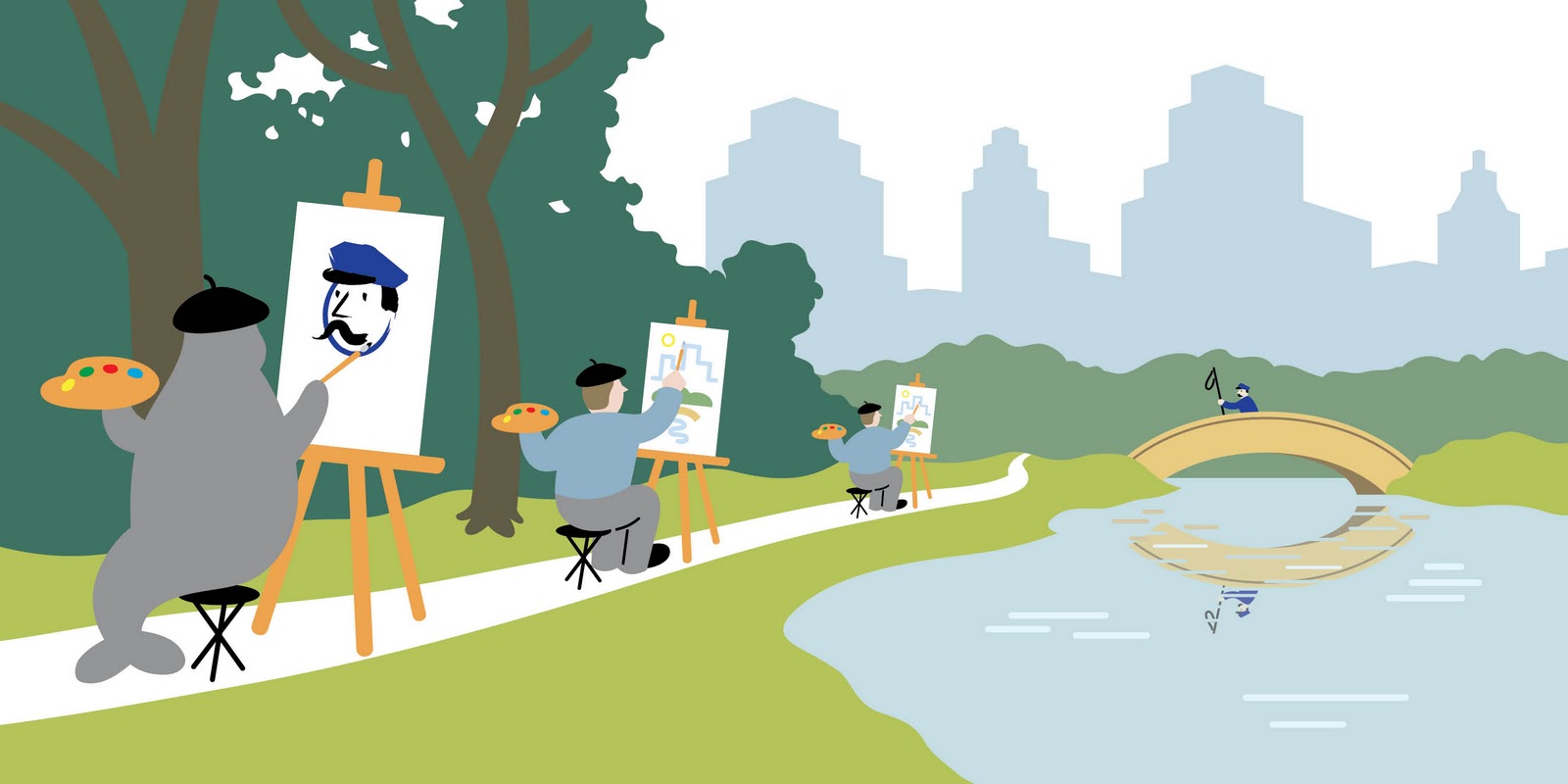
I have to call this one the way I see it: It's Where's Waldo meets Goodnight Gorilla. Also: this is a board book disguised as a picture book.

One afternoon while the zookeeper naps nearby a Walrus, in what looks like an above ground swimming pool, simply waddles out the gates of the zoo and into the big city. In scene by wordless scene the Walrus hides in plain sight by blending in. Here he is a statue in the fountain. There he is a fireman working a hose. It often takes little more than a hat and a few props to elude the zookeeper, who besides working at one of the poorest designed zoos in the world is clearly a dolt himself. Finally the Walrus hides at a diving competition (performing a "twist," if you will, off the high dive) where he is not only spotted by the zookeeper but wins a gold medal. This gives the zookeeper an idea and in the end Walrus has a new and more humane pool with a diving board to perform for the public.


Obviously, younger pre-readers are going to enjoy pointing out where the Walrus is on every page while laughing at the buffoon of a zookeeper for missing him. The simplified graphics on a picture book-size page seem like a waste; their flat tones and bold shapes would not only reduce well to a smaller sized board book they might actually look better for not taking up so much space.

As for the "twist" at the end, where Walrus's diving feats impress the zookeeper and provide him with a new home, well, that sort of speaks to why Walrus ran away in the first place. The story isn't just about a mischevious Walrus, it's about an animal in a pool so small that it has no way to entertain itself and must go in search of fun elsewhere. It not only answers the unasked question "Why did the Walrus escape from the zoo?" but underscores one of the larger issues surrounding the idea of capturing wild animals in the first place; is a zoo really the most humane way to appreciate wild animals? In the end Walrus isn't just a captured animal, he's an exploited one, putting on shows to draw people to the zoo.

Overthinking the book, am I? With a cute concept and easy-to-scan illustrations it can be easy to miss the imagery presented to young readers matter-of-factly. The treatment of animals in zoos and aquariums varies, and even where animals are well treated there is still the idea of our presenting animals in faux environments under the guise of their being educational. Many a time I've been to a zoo and seen a depressed animal in an enclosure – if you can read emotions in humans you can do it in animals equally well – and overheard parents tells young ones "Oh, they're just tired from running around all morning" or something equally dismissive. Go to the big cat house during feeding time and hear those lions and tigers roar with such ferocity that the sound penetrates your body and you appreciate the bars that separate you while at the same time realize that, perhaps, this is not the way things should be.

So despite my misgivings about the casual representation of zoos to small children, I think the book is fine for what it is. I don't know why this didn't go straight-to-board-book because I have a hard time understanding the justification for its size. If it were a truly Where's Waldo situation where you had to pour over the details of a page for hours to find the hidden elements I would understand it. As it is, Walrus is large, impossible to miss, and the humor of the zookeeper not finding him wears thin even for the few pages that it takes place in the story.