Showing posts with label biography. Show all posts

Tuesday, June 17

I Am Rosa Parks

I am Rosa Parks
By Brad Meltzer
Illustrated by Christopher Eliopoulos

A whitewashed (ahem) picture book biography of the famed Civil Rights icon. Parson Weems would be proud.

Now that we have Phillip Hoose’s Claudette Colvin: Twice Toward Justice out in the world I feel it is incumbent on anyone treading toward teaching kids about the Civil Rights do so with a more open understanding of history.

Rosa Parks was chosen as the symbol for a bus boycott, and sometimes what you need is a symbol to make history, but you need a balanced and more nuanced hand to tell history, especially to kids.

Parson Weems is responsible for the story of George Washington and the cherry tree, a myth so prevalent that kids know it almost without being taught. For Weems, writing over 100 years ago, the idea of mythologizing American heroes was a conscious effort meant to galvanize a national pride. But we’re smarter than that now, right?

Apparently not.

Meltzer – better know to adults as a writer of adult thrillers – spends a great deal of the this book painting Rosa Parks as a child who always stood up for herself, leading to her taking a stand on that famous bus seat. This is well and good, but then we jump ahead to the Civil Rights and her meeting MLK and a happy little ending about how important it all was that she stood up for herself.

But she wasn't the first.

Don’t kids deserve to also know about the young Claudette Colvin who preceded Rosa Parks by a full 9 months, the first person to actually be arrested for protesting the segregation of public busses? Certainly there are ways to skip the messier parts of Colvin’s story, or to include them within context, but to ignore that part of history altogether? Well, that's just inconvenient toward the narrative.

This book is part of a series “Ordinary People Change the World” which is a great idea in theory, but the other people in this series include Lincoln, and Amelia Earhart, neither of whom were really that ordinary when you think about it. I’m not trying to take anything away from Rosa Parks or from kids knowing who she was historically, but when it comes to teaching kids history there is a responsibility to get it right, to tell it right.

Some source material at the end of a biography would be nice as well. Unless, you know, it’s all just a storybook and not a history at all.

And maybe, just maybe, it could be written by someone who wasn’t white.


Tuesday, February 7

Me... Jane

by Patrick McDonnell  
Little Brown  2011  

A picture book biography that's more picture book than biography. And that's not a bad thing.  

A little girl named Jane is given a stuffed chimpanzee which she names Jubilee. She treasure Jubilee and takes him with her wherever her boundless curiosity leads. Together they climb trees and observe chickens and take a full interest in all the natural sciences a girl can explore in her own yard. Through the books she reads she dreams of far away places and helping animals in the jungles. And at the end of the day when she tucks Jubilee into bed with her she dreams all these things, and when she wakes up she is Dr. Jane Goodall, living among the primates of Africa, her dream come true.  

While there are biographies for all ages I would propose that the trickiest is the picture book biography. There is an old tradition of birth-to-death biography that attempts to use childhood as a sort of blueprint for explaining how events shaped the subject as an adult but this isn't without problems. Occasionally a subject's life doesn't have a cohesive progression where life elements can be tied together to tell a story. This will lead to a loose buffet of events that forward a narrative agenda but do disservice to the overall accuracy. Another approach is to appeal to the younger reader through telling the subject's story of who they were as young people, assuming a reader will automatically be more interested in the character of the subject by seeing them as youngsters. The problem with this slice-of-life approach is that the facts need to be molded to match the perception of the adult as a subject. A middle grade biography of Ben Franklin might include his industry, his bent toward invention, and the cruelty he experienced as a journeyman working for his older brother while neatly skirting the issue of his being a runaway or attempting to steal his best friend's girl because these muddy our preconceptions of how a founding father should have behaved.  

Huh, how did I get all the way up here on this soap box?

In Me... Jane what we get, technically, is a slice-of-life biography of a girl who loves zoology. McDonnell captures Jane's carefree childhood in a way that is free of period detail which makes it feel universal. There are subtle clues that Jane's story reflects back to an older time – broken text (Old Bookman?) printed over faint images from the 19th and early 20th century books Jane would have read – but the effect is almost too subtle to register. It give the story a different feel but not necessarily a sense of events taking place at an earlier time. This isn't really a problem, just not as effective as I think it was intended.

In the end the two things I'm going to take away from this book will be McDonnell's depiction of Jubilee and the ending where the story jumps from young Jane going to bed to dream and the reality of her dream come true. There is a certain talent required to make a stuffed animal come to life in a drawing which I don't think every artist or illustrator can do. I don't know if this will somehow revoke my MFA but Winnie the Pooh and all his friends always looks to me like a diorama of paper doll cutouts. I don't care how old you are, if you want to buy into the stuffed animal as a living, breathing creature then you have to find a way to convey that sense of life while remaining true to the nature of an expressionless doll. I've always loved, for example, how Bill Waterson managed to draw Calvin's companion Hobbes as both a lifeless toy and a vibrant tiger. Waterson's conceit was that we could see both the adult and the child's view of Hobbes, how that tiger knew when to play possum and how to deliver a punchline when no one else was around to hear it. McDonnell, on the other hand, finds ways to pose Jubilee that he appears to exhibit expressions and life without defying the physical laws that make up a stuffed chimp. Jubilee's permanent smile can appear focused, inquisitive, and expressive simply by the way he is placed within the scene. He becomes more than a companion, he becomes a reflection of Jane's innocence and wonder, and is really a brilliant little detail I think a lot of young illustrators could learn from.  

The ending, the jump from young Jane to contemporary Jane, wakes us from her illustrated childhood to a full color photo which, in doing, wakes us from the dreamtime of Jane's childhood dream into a "dreams come true" reality. It's an effective, judicious use of a single photo to underscore the link between childhood and adulthood without belaboring the point. In doing so McDonnell also manages to take a slice-of-life biography and turn it, with two flips of a page, into a near-full-life story by simply suggesting that the details between point A and B are inconsequential. And they are, as they should be, to a picture book audience.  

Although I'm late to the party on this review, I understand now why people were abuzz when this came out.

Monday, March 28

Dave the Potter

Artist, Poet, Slave 
by Laban Carrick Hill 
illustrated by Bryan Collier 
Little Brown  2010

A picture book biography of a 19th century African American pot maker who was also a poet, and apparently a slave. 

I don't think anyone's going to let that summary slide without my saying something about it first.  When I look at a picture book biography I have to step back and read it through the eyes of the intended audience, or try to at least.  When the subtitle promises to tell me three things about the subject, and text only conveys two of those three effectively, it leaves me feeling something is missing. That Dave is depicted as an artist making pots comes across in both the detailed verse describing the process and the well-researched images. But all we see of Dave is him at work in his shop and maybe a few details the convey the general era of the story and nothing, text or image, that necessarily informs us of Dave's slavery. 

Does it have to?  Can we simply put the word 'slave' on the cover and assume the reader will understand what is necessary for the context of the story?  Here's my problem then with the text – we learn in the back matter that Dave's profession was unusual for a slave, which I think is safe to assume because what we tend to hear about slaves in the American South leans toward house and field. The fact that he's an artisan is an important distinction, but I instantly want to know: who does a slave potter make his pots for?  Were they commissioned by his owners to be sold locally?  Did his make them for his master's house?  In the back matter we are told one of the earliest records is of 17 year old Dave looking to get a loan for a house – was this for his business?  Was he freed?  So many questions around his identity as a slave which are important only in so far as they help us understand who he was creating his pots for. He doesn't begin to write poems on his pots until he's in his 30s as far as we know – another clue, he's been educated and has a facility with rhyme – which might suggest that his stature had been secured as a local artist that he didn't fear his pots would be rejected for having been inscribed by a slave.  So many things I wish I understood about this aspect of Dave's life.  

Is it right to want so much from a picture book?  Perhaps not, but again, if it's important enough to put on the cover of the book I think it isn't unreasonable to have it addressed within the main text.  This becomes part of my problem with back matter in nonfiction picture books. So much information is jumped to the back after the main text that it begins to feel like everything that proceeds it is like the carrot before the stick, and the reader is going to get both. Yes, sometimes the details aren't going to fit the narrative flow of a story, which is perhaps why we should question this method of delivering nonfiction to younger readers because if we are presenting fact in the guise of fiction we risk readers walking away with only half the story. Out of context of the narrative – literally, separated from the text – the back matter is easily ignored by a reader who wants the gist of the story and only reads the main portion.  And in Dave the Potter there is little in that main text to explain enough of Dave's story to justify the word 'slave' on the cover or in the subtitle.

Having said all that, Hill does a nice job of giving us the process involved in 19th century pottery.  It's a very close narrative, told in verse, an extremely tactile and physical study of what it meant to be literally a man of the earth. Hill captures that sense of what it means to be an artist, working along, knowing only what the artist can about how such things look like during their creation.  The dedication, the shaping, the pride of craftsmanship, much of what is written can be applied to any art or craft. On the poetic front I might have liked to see more of Dave's little couplets incorporated into the story as opposed to the back matter, but it can equally be argued that there is poetry in his craft.  I can't think of a more appropriate approach to a poet's life than to write in verse, as Hill does here, so bonus points for that.

Ignore my misgivings; I think the book deserves its Caldecott Honor and Coretta Scott King awards.  Dave the Potter is a well-told examination of a craftsman's life in the early 19th century, beautifully illustrated and carefully researched, and a fine portrait of an African American plying a trade few did during that particular time in history. I simply wish I had a better sense of the subject in that time. 

Friday, March 25

Surfer of the Century

The Life of Duke Kahanamoku   
by Ellie Crowe
illustrations by Richard Waldrep
Lee and Low  2007
 
A bit of bait-and-switch on this picture book biography of the father of modern surfing as it focuses more on his accomplishments as a swimmer.  

As a kid, "Duke" wasn't much for school, but he loved the water.  He loved swimming and surfing, riding the waves at Waikiki Beach on 100-plus pound long board made of koa wood that was twice as long as he was tall.  He was a strong and powerful swimmer and he even developed his own way of kicking through the water in a way that has been adapted by swimmers since.  He caught the eye of a local lawyer who offered to train Duke for competition and he eventually made his way to the Olympics where he took gold and silver medals in 1912, 1920, and 1924.  He did some time as a bit player in Hollywood, was sheriff of Honolulu for 13 consecutive terms.  Oh, and did all he could to promote surfing as a sport.

No doubt Kahanamoku lived a rich and full life, diverse and interesting and a good topic for a biography, but I felt a little cheated when I turned the last page.  Duke's title as Surfer of the Century was thirty years posthumous, and while he was active in the sport its inclusion in this biography felt almost more obligatory than key to the subject.  For a generation of post-war surfers, particularly those who competed in the 1960s, Duke was revered as the father of surfing and he saw himself as more of a world-wide ambassador.  A search of videos on YouTube will turn up a brief interview where he's asked which was better, winning five Olympic medals over a twenty year period or swimming the great waves off Castle Surf, and while he initially plays diplomatic and says they were equally great he does finally admit that surfing was a greater thrill.

I realize I've once again compared a book as written against the book I wanted to read, but can I make a case for being led on?  With a title like Surfer of the Century is it wrong to expect a story to be more about surfing that swimming?  By highlighting his swimming achievements – which are nothing to scoff, he did break Olympic records that stood nearly two decades until broken by Johnny Weissmuller – I almost feel like they are treated as more legitimate as a result of their international stature.  I wanted to know more about the status of surfing, its history, and how it began and changed over time.  None of that is here.  I wanted to know why Duke was held in such high esteem by the surfing crowd -- there is mention of his legendary two-mile ride of one long wave, but no context for understanding how remarkable that accomplishment was and remains.  I don't think it's wrong to imagine that few younger readers wouldn't be interested to know more about surfing, and about a legend among surfers, who would be equally disappointed to find a biography full of so much non-surfing detail.

Or maybe what's missing are the sort of stories that really make a character stand out.  We get the story of Duke's rescuing fisherman whose boat had capsized and how it would lead to beach lifeguards keeping rescue boards on the beaches.  That's good.  What is perhaps not fitting a "gentle" biography is the fact that on another occasion, while training for the Olympics in the Pacific Ocean off Long Beach, Duke battled a ten-foot eel, losing his finger in the battle and calling into question his ability to swim again (he did). We read that Duke was sheriff for over 25 years and no mention of whether or not he surfed during that time, no mention that this was before, during, and after WWII, he just sort of drops away from the story then.  I'll grant that when creating a limited biography, as the picture book biography is by necessity, one must pick and choose details, but again I keep wondering where the father of surfing is during these gaps.  If it turns out that his surfing legends were from his boyhood days, and his title and admiration are mostly honorary and ceremonial, then perhaps a different title is in order.  Or at the very least a better explanation as to why the focus of his life tends to veer toward the non-surfing side of things.  

On the one hand, I feel horrible; there aren't enough picture book biographies on minorities and I cannot think of another about a Hawaiian, much less any other Pacific Islander that isn't fiction.  But when there is an opportunity to cross a child's interest in a sport like surfing in addition to a biography about a previously unknown biographical subject who also happens to be a lesser-seen minority, it seems a shame to not deliver on that promise. 

Thursday, March 3

The Extraordinary Mark Twain (According to Susy)

by Barbara Kerley  
illustrated by Edwin Fotheringham  

In an everything-old-is-new-again twist we get a biographical picture book portrait of Samuel Langhorne Clemens from a fresh pair of eyes... his daughter's.  

"According to Susy, people were... well, just plain wrong about her papa."  And so begins both the story of and about Mark Twain's oldest daughter's attempt to capture the man she knew in her own journal when she was thirteen years old. 

What we are treated to is a sort of dual biography of Twain told by dual narrators.  Susy begins her biography of her father in secret but continues on once her parents discover the journal, at which point Twain becomes, and acknowledges, an unreliable subject.  Knowing his daughter is taking notes he deliberately makes scenes to be recorded, but Susy is quick to note they are manufactured.  She also succeeds in recording his routines and unguarded moments.  These don't necessarily contradict our general impression of who Twain was but rounds out more of his life as a working family man, a humorist who his young daughter saw more as a philosopher when not in public.  

Both Kerley and Susy manage to keep the focus on Twain, giving is a more balanced view of the subject.  We see so little of Susy beyond the part of her journal that include her in family outings, but she gives us a glimpse now and then. We sense that daughter who longed to set the record straight about her Papa, and who felt the need to preserve a certain unvarnished truth about a man the public saw only in one or two dimensions. In the backmatter, Kerely includes a single page of instructions for how the reader can write a biography about a member of the family, using Suzy's approach to gathering and presenting material.  I found it instantly fascinating how well both Kerley and Susy could draw a rounded picture of their subject by following these guidelines... and how much they underscore what we don't know about Susy Clemens herself. It's only natural that we see Twain and his family during the brief year Susy is taking note, and limited to those passages that illuminate the portrait provided, but I did finish the book wanting to know more about Susy.  

The text itself co-mingles actual quotes with original narrative and highlights the quoted material in a way that makes it stand out on the page.  This is something I have actually advocated for in picture book biographies as a quick, visual way to clue the reader in on which words can be documented and which are authorial summary.  What I hadn't expected, and hat shows up occasionally here, are fragments of sentences and phrases that end up strung together in a Zagat restaurant review sort of format.  Here, Kerley is describing where Twain found his daughter's journal with his biography inside: 

He examined the book with "deep pleasure," delighting in Suzy's "frequently desperate" spelling. He approved of how she didn't "cover up one's deficiencies but gave them equal showing with one's handsomer qualities."   

While these sentences read cleanly aloud, they take on an awkward quality on the page that I hadn't previously considered. I was first drawn to this problem of highlighted attribution with Jeanette Winter's My Name is Georgia where quoted material was not only italicized but mixed with narrative written in the first person. By avoiding the first person -- and by including whole chunks of Susy's journal in tact as inserts throughout the book -- Kerley instead juggles three voices in the text: Susy's journal, Twain's observations after the fact, and her own. It's a fairly sophisticated approach and what it might lack in visual cleanliness it more than makes up for in its sturdy, well told narrative. 


This is the second time Kerley has been paired up with Fotheringham and I think it makes for a winning combination.  In What To Do About Alice I made note that I thought Fotheringham's  illustrations weren't up to his usual standard, but that isn't the case here.  Using a rich set of tones that at once nostalgic yet modern, Fotheringham juxtaposes sturdy caricature illustrations of Twain and his family alongside more impressionistic details of buildings and animals for a layering effect that makes the focus of each spread pop.  And throughout words, either spoken or written, fly about the pages like filigree curlicues from a fountain pen.  It's a nice abstract touch that adds a sense of animation to illustrations.   

Kereley once again sets a standard for picture book biographies with a fresh approach and solid research.

(Whoa, that ended up sounding a little too blurb-y.) 

Wednesday, September 15

Jimi: Sounds Like A Rainbow

A Story of the Young Jimi Hendrix 
by Gary Golio 
illustrated by Javaka Steptoe
Clarion  2010


A picture book storyography of the 60's icon's early years told with an unusual objective that isn't obtrusive or moralistic. Or is it?  

Okay, a picture book about Jimi makes me wonder two things before I even open the book: how do you convey the sense of person who would come to change the way rock and roll was approached, and how do you deal with the fact that he died from an overdose.  On the musical front the one thing I find myself thinking is that no book is ever going to be able to fully convey the music, and this is true of jazz and country and any other genre of popular music.  And I presumed that the point of focusing on Jimi's early days was a way around dealing with, what the British might have called back then "death by misadventure."  

From and early age Jimi has got the music in him.  He's pucking out a rhythm against the rain, he's playing the mouth trumpet to amuse his friends, he's rockin' a mean air guitar to Chuck Berry and Elvis.  It's only a matter of time and fate that would land Jimi and his peripatetic father in a boarding house where the landlady's son will part with his worn guitar for five bucks.  Soon Jimi's playing songs on the radio note for note, then getting a job with bands, and finally hooking up with a low-end electric guitar and learning how to bend notes and pitch feedback.  We leave Jimi at the crest of his creative wave, ready to shower the world with his rainbow of music... then onto the back matter. 

It was while soaking in this book that the phrase bait-and-switch came to mind.  The current trend in picture book bibliographies (or storyographies, those books that don't tell a whole life but instead lean on creating a narrative tone poem) is to cover the stories that would most appeal to a young reader and then cover the bases with more complete info in the back, either to inform more curious readers or to give the adults a chance to weigh what is worth sharing to the children in their charge.  For some of these books, this back matter is a sort of "out" for playing fast and loose with the subject's story, an opportunity to lay down the facts in a straightforward if not exciting way.  But in some books, and Jimi: Sounds Like a Rainbow being one of them, this back matter offers an interesting perspective on the subject that underscore the purpose of the narrative's approach.  

First, we get a "More about Jimi Hendrix" spread that does the traditional birth-to-death overview that speaks in the specifics the storyography didn't cover.  Golio chooses to paint a picture of Jimi's childhood as a carefree series of musical encounters that spill over with color and sound, often making slight references to some of Jimi's lyrics.  There's almost a subliminal quality to the phrasing, as I imagine an impressionable reader one day hearing Jimi for the first time having a light bulb moment without realizing where it came from.  Then, as mentioned, the back matter that covers the bases in terms of where and when. 

But then Golio does an interesting thing with the author's note.  He dedicates this space to discussing Jimi's accidental overdose at the age of 27, mentioning the experimental drug use of the day, following it up with a sympathetic entreaty the problems of alcohol and substance abuse, including websites and reference books for further exploration.  Suddenly I find myself going back and seeing the narrative with new eyes.  Golio wasn't putting a gloss over the darker moments in Jimi's life, or deliberately sheltering readers from a harsh reality, he's showing readers that Jimi lived for the music and didn't hide within it.  There may be a presupposition that Jimi was abusing drugs at a time when there was widespread experimentation, and that the "emotional abuse, and depression of childhood poverty" was at play in Jimi's life, so while I applaud the frank and direct discussion of Jimi's death I'm a little put off at the thought of adults using this book as channel for opening up conversations about substance abuse.  Especially given that none of this emotional turmoil or depression are even hinted at in the narrative. 

And don't think that just because Jimi wrote a song called "Manic Depression" that he was writing autobiographically.  The phrase was given to him by his manager during a press conference and Jimi introduced the song as being about a guy who was frustrated because he wanted to make love to music.  Well, maybe that was Jimi a little bit, but he wasn't clinically depressed as far as anyone can tell. 

On the illustrations, Steptoe decides to go with collages made from layered plywood.  Yes, plywood.  In looking for a material that would mirror Jimi's music he went with wood, the same material used in the guitars Jimi manipulated for his art.  Chunky at times, rough-hewn and weathered-looking, I'm not quite sure it best conveys either the essence of Jimi or his music, but then I think there's always a problem in trying to show or express what is generally best left heard.

In the end, as Elvis Costello said (or Martin Mull, they're both credited but neither one is owning up to it) "writing about music is like dancing about architecture."  I think books about musicians ought to include music, especially so for kids.  You can't see Jimi's rainbow, you have to hear it.  Or as Jimi might have insisted, you'd have to experience it.

Wednesday, May 26

Sparky

The Life and Art of Charles Schulz 
by Beverly Gherman 
Chronicle Books  2010 

A well-told and nicely-presented biography of the man who created the most loved comic strip of the 20th century

Reading this biography of Charles Schulz I found myself feeling as if I knew most of this story from previous sources.  I knew about his first published drawing being in a Ripley's Believe It Or Not panel, about his early drawing exercises, about the real names behind the characters names.  Here and there I found a tidbit I wasn't as clear about – that he won a Reuben award for his Peanuts strip, yes, but not that he actually accepted the award from its namesake Rube Goldberg – and the occasional detail that might have been shielded from my younger eyes in the past (divorce and remarriage weren't the kinds of things that used to be in biographies for children). 

This time, amid the narrative that gambols casually through time and not always 100% linearly, what I was most struck with was how incredibly lucky Schulz life had been.  I'm not saying he didn't have talent or skills, but for as socially awkward as he was and for as insecure he never really had to suffer.  He had his early years in the wilderness immediately following his career in the Army after WWII, but when he landed his first syndicated cartoon strip, it was Peanuts and he spent the next fifty years doing it.  After those first ten years he produced a Christmas special that became an iconic tradition.  Second probably to Mickey Mouse, Snoopy may be the the most identifiable character the world over, and the man never had a full studio or a theme park to make it happen. 

It seems impossible that Schulz could have walked any other path in his life, that he was called to do this one thing and he nailed it.  He didn't dream any of it, so he can't be said to have followed the usual "do what you love" sort of thinking we often impress upon children that leads them to long for stardom.  He had a talent, he knew the job, he sat down and executed it the best he could.

This message isn't overtly stated, and I'm not sure how much that is by design.  I think that biographies ought to strive to present information in a way that allows the reader to draw conclusions while providing a clear picture of the individual being portrayed.  Gherman does that here, and while there are probably few young readers who know the comic strip but might know the TV specials, this book could provide a perfect introduction to the man and invite further investigation.

Monday, March 15

All Star!

Honus Wagner and the Most Famous Baseball Card Ever
by Jane Yolen
illustrated by Jim Burke
Philomel  2010

This picture book biography of the early baseball legend reads a little too much like a book report.

I've read this every day for a week now and can't quite figure out what isn't working for me.  Is it because the language and telling of the story feels flat?  Because I don't actually get a sense of what made Honus Wagner a great player, despite all the examples?  Is it because I expected more of a story behind the The Most Famous Baseball Card Ever?

The story of the Honus Wagner baseball card is that when Wagner realized the card was to be included with cigarette packages he demanded they be removed – think of the children! –  making the existing cards rare but not the rarest of collectables.  That much can be gleaned here in Yolen's telling (which, it must be noted, is only explained on one spread in the book, despite the card's promenance in the subtitle).  What isn't discussed is how a person could agree to appear on a card produced by the American Tobacco Company and not think it would be tied to the product.  Some believe the real issue was compensation, which would actually make Wagner not unlike his contemporaries.

Many have said in the past that Wagner, an all-around great player, was the greatest shortstop of all time.  But it's a funny thing about sports legends and their mythology: "greats" are not the same thing as "firsts," because they aren't as easily measurable.  Would the greatest shortstop of 1909 be as good at his position if he were on the field today?  This is the danger in idolization, where the myth can never be stripped because time has made it untouchable.  In the last 100 years there have been no less than 14 different athletes who have been dubbed "The World's Fastest Man," each new record stripping the title from all others based on measurable speed.  A runner's hall of fame might include all these men but there would be no disputing that, at the time of their achievement, they were the fastest runner documented.  Has the game of baseball, and the men who play it, changed so little in 100 years that one of its earliest participants can still hold the title of "greatest" in an area as subjective as a position on a team?

So I wonder if there is a risk in continuing to perpetrate the greatness of sports legends outside of what is factual.  In All Star! we're told Wagner played on five different teams in three states in order to make a living at baseball.  It's a throw-away bit of detail, but far more interesting that a lot of the information surrounding it.  Was this typical of a lot of players during that era, or was Wagner unique?  We don't learn that here, and this brief tidbit is left to stand in a way that suggests to a reader that this made him exceptional. Once again, the casual treatment of factual information in a picture book biography leaves open the possibility of misinformation. But he's an American legend, and we're not supposed to question (much less think about) the facts, right?

I guess my lasting impression of All Star! is that it feels very much like a journeyman effort from a well-respected author in the field of children's writing.  The story is flat, there's no real sense of what made Wagner tick beyond his love of the game, and opportunities to expand and explore what would make this biography unique are abandoned in favor of a tepid birth-to-just-before-death biography style of another century.

If I were being cynical I would say that, as the "prologue" to All Star! states, a Honus Wagner card was sold at auction in 2007 and a picture book author read about it in the paper and thought it might make for a good story.  That being the entire pitch, and the author being who she is within the industry, a publisher said "yes!" without further question and the final manuscript was tossed off after a week's worth of research.  If that isn't what happened here that's at least what it feels like.

Friday, February 26

abandoned: A Dangerous Engine


Benjamin Franklin from Scientist to Diplomat
by Joan Dash
pictures by Dusan Petricic
Francis Foster / FSG 2006

It seems impossible to make any part of Franklin's life as dull and lifeless as it is here. But I liked the pictures.

You don't tend to find newer biographies among the books available at library sales, especially about characters from history who seem to be evergreen for younger readers. Franklin's life story – even the parts he himself may have exaggerated – makes for an improbably great read, and when coupled with the loose and lively line drawings of Petricic I assumed this book would be irresistible.

Somehow I managed to resist finishing it. What happened here?

First, with a title like that, you have to open with at least a hint of either what the engine is or what the danger is. You have to. The title is a promise to the reader and when it is as concrete as this one you can't start off with a wimpy static electricity demonstration Franklin once saw. That discovery and understanding of static electricity may ultimately have lead to something that was either dangerous or machine-like, but as it stands the title is a tease that misses the opportunity to hook a reader on the first page. Or the first chapter even.

I had heard that Dash had a "flair for history and technology" (The New York Times Book Review) but I found the opening chapters a slog, and I tried to imagine what they would do to a young reader who hadn't encountered the Franklin that I had come to know through his own words. With proper guidance there is little reason for most students to venture beyond Franklin's own autobiography and published writing. Certainly not with a book that only covers half his life and yet is longer than Franklin's own account of his entire life.

That Franklin was more than one of the Founding Fathers, that he was a businessman who retired early and spent a great deal of time experimenting in science and dabbling in inventions, is certainly appropriate, but there's no reason to turn readers away at the door.

I originally suspected that I knew too much to see the book fresh, that I had read plenty of adult biographies and wasn't able to read this book without the influence of those that came before. But then that hasn't been the case in the past where I picked up biographies of figures I already knew and devoured the new angles, the new storytelling, the new approaches. And then I looked at the publication date and noticed that a book that was barely 4 years old was wedged among the discards of biographies published in the 1940s and 50s. This book had been as thoroughly ignored as books decades its senior. We can talk all we want about knowing what children should read but the bottom line is you cannot fool a kid. They know what bores them and they aren't about to check out or read a book that doesn't grab or hold their attention.

For that matter, neither will I.

Wednesday, February 24

Bad News For Outlaws


The Remarkable Life of Bass Reeves,
Deputy U.S. Marshal
by Vaunda Micheaux Nelson
illustrations by R. Gregory Christie
Carolrhoda Books 2009

A picture book biography, done right, of the African American lawman who was feared in his day but nearly lost to history.

This book starts off the way many good books do, and should, especially biographies: with a solid action sequence that pulls the reader in and sets the tone of what the story that follows is about. In Bad News for Outlaws this sequence is a showdown between Reeves and Jim Webb that ends with the lawman shooting his quarry but gaining the man's respect at the same time. There's the action of a chase, a mini lesson in right and wrong, and the theme that will carry throughout that Reeves was as honest and true a man as the West ever created.

Following this scene there is a short entr'acte that demonstrates Reeves physical strength, what life was like in the Oklahoma Territory, and that he was also respected by all, good and bad, black and white. From there the story of Reeves' life runs fairly chronological, beginning when he was a Southern slave and covering his more than thirty years as a U.S Marshal. It makes for great story that even Nelson admits at the end has all the earmarks of a tall tale, though she has striven to tell it as true as possible.

To that end the facts of the story seem straightforward and difficult to imagine being doctored. There are a couple quotes attributed to "a white sharecropper" and a "sharpshooter" that I don't doubt are sourced, but the generic nature of their attribution left me a little conflicted. On the one hand, their comments help underscore Reeves' character, but at the same time when other quotes used are attributed to specific historical individuals they stand out the same as those in other biographies I've read as coming from questionable sources. It's such a minor quibble – okay, those quotes and some of the colloquial cliches that crop up – that I almost hesitate to mention them.

So why mention them?

Because far too often it seems I run into life stories that fall short, either in quality, storytelling, or accuracy, that I felt obliged to point out a solid example of a picture book biography that comes closest I've seen to being perfect. It's open, and honest, and like it's subject not beyond a minor flaw in character, but nothing that detracts from the overall effect. Handsomely illustrated as well.

Friday, November 20

The Great and Only Barnum


The Tremendous, Stupendous Life of Showman P.T. Barnum
by Candace Fleming
Random House 2009

Assuming you've read nothing about his life, what do you know of P.T. Barnum? That he was a huckster and a flim-flam man? That his name was the first name in three-ring circuses for a good portion of the 20th century? That he said "There's a sucker born every minute?

That's about as much as I knew – or thought I knew – going into this biography, coupled with a skepticism that was little more than a glorified snake oil salesman. Nothing like a well-written biography intended for middle grade readers (and up) to clear the air.

First, the quote: Barnum never said it, one of his competitors did, apparently cheesed that Barnum was able to corner the market on drawing a crowd. The circuses came later in his career, built from a combination of his showmanship and the desire to mix the curiosities from his "museum" with a traveling show full of animal acts and clowns. In between there was his American Museum of alleged artifacts from history (many of them fake) and the type of human curiosities generally associated with traveling freak shows.

If Barnum's life seems like the natural extension of Professor Harold Hill's fast-talking salesmanship it's clear Barnum was born for the life he led. As a boy he was successful in drawing a crowd and making money from them. And what's most surprising is how genial he seems, how he never regarded the public as the "suckers" despite the importance of making money from their gullibility. He had a genuine regard for what we would probably call low entertainment and discovered that the general public didn't mind "harmless" hoaxes.

Fleming makes this a breezy read, well-documented with a strong narrative thread, and actually fun. Makes me wish there were more biographies like this when I was a kid.

Monday, October 19

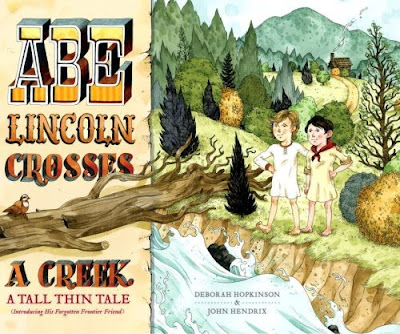
Abe Lincoln Crosses a Creek


A Tall, Thin Tale
(Introducing His Forgotten Frontier Friend)
by Deborah Hopkinson
picture by John Hendrix
Schwartz & Wade / Random House 2008


If in 2007 a book appeared by a 90 year old author claiming to have been a boyhood friend of JFK, relating an experience where the two as boys nearly drowned in the Charles River of Boston one summer day, where the author saved the young JFK's life and thus played an important role in our nation's history (who would have defeated Nixon in 1960 if JFK weren't even alive?), and there was no one alive who could refute it...

Did it really happen? And would we tell the story as a picture book?

Abe Lincoln Crosses a Creek tells a similar story concerning Abraham Lincoln's Kentucky neighbor Austin Gollaher, about how the the two as young boys attempted to cross a creek, and how Austin rescued Lincoln which allowed him to live and, eventually, become our 16th president. The book attempts to tie up this story with the moral that "what we do matters, even if we don't end up in history books."

That's all well and good, but who's to say it happened? Hopkinson sites at the beginning of the book two titles that quote Gollagher from 1898 and 1921 and a third from 1922 that confirms the story, probably taken from the same sources. Given all the biographical scholarship on Lincoln done in the past 90 years it seems odd that more recent references couldn't be cited.

Unless the story couldn't be proven to modern standards.

Here, again, we see another recent example of the "storyography," the biographical recounting that place story before biography and, in this case, the anecdotal above the known. Hopkinson covers her bases by saying "The events described in this story, so far as this author can determine... did, in fact, take place..." Yes, well, short of Lincoln's personal account, or a third party's account, what we have is, as the subtitle indicates, a tall tale concerning a real individual from history. And since it is a tall tale is there really any reason to lend the story a level of legitimacy by pointing out sources? Does the fact that Lincoln is a character require this level of explanation?

And, as always, shouldn't this information be spelled out to the reader in the text and not placed in tiny type on the Library of Congress page intended for adults who won't be as nearly confused about the legitimacy of the story as the intended reader?

Actually, Hopkinson does attempt to alert the reader in the text that the story contains some questionable details. At the point when Lincoln falls into the creek a giant, incongruous caution warning splashes across the illustration announcing "I want to make sure we get this right. Because maybe it didn't happen like that." The narrative then proceeds with an alternative version of the event in question because, as Hopkinson later suggests, "For that's the thing about history – if you weren't there, you can't know for sure."

Ah, I see. Because we were not there, because the source of the story is perhaps an interested party who could profit from the attention of having been the late president's boyhood friend, because no one can say for sure it didn't happen we can proceed to tell this story as if it did.

A book is a powerful thing. It represents the labors of a lot of people – writers and illustrators, editors and publishers and printers – and when presented by adults like parents, librarians, and teachers takes on the weight of authority in a young reader's eyes. They would not have gone through all this trouble if the story weren't true, would they? When a child is handed Abe Lincoln Crosses a Creek and reads the text only, do they have any reason to doubt the story happened as described, or at all? Do we teach young readers how and when to question historical events and to vet them for accuracy? No, of course not. They accept what they are given because they trust adults to be honest with them.

That said I do not suggest that Abe Lincoln Crosses a Creek should not have been written, and that other books that attempt to tell historical anecdotes from the childhood of historical figures cannot be retold, only that it be clearly and directly related to the reader that such stories might not be factually accurate. There should no question in a reader's mind about the story they have just been told, nor should they confuse that story for history if there is any question.

I have an unusual perspective in this area, having been researching Lincoln's life from the period just after the events in this book. Earlier biographies contain second and third hand accounts of events that do not hold water in biographies written after the 1920s. In fact, I could write a few similar picture books concerning the pre-teen life of Lincoln that, while entertaining, would not be considered accurate by modern Lincoln scholars.

For the past decade we've seen a number of biographical picture books that seem to escape the rigor and expectations we would apply to books intended for older readers. This is a mistake, because (and I think I've said this many times before) that this young age is when we do the most damage in terms of misinformation. Children today STILL have heard the story of Washington chopping down a cherry tree when we now know that the story was a fabrication of Washington's childhood neighbors, told to their children as a morality story, recounted to biographer Parson Weems as gospel truth. It is not true and yet the power of this misinformation still courses through our national psyche.

Accuracy should not suffer at the hands of entertainment, not in the books we present to picture book readers. "What we do matters."

Exactly.

Monday, September 28

The Day-Glo Brothers


The True Story of Bob and Joe Switzer's Bright Ideas and Brand New Colors
by Chris Barton
illustrated by Tony Persiani

The picture book biography of the two brothers who developed, by accident mostly, the process by which hippies were able to enjoy black light posters and the military was able to signal aircraft from great distances. Okay, that's a bit flip, but while the subject is unique what is more fascinating is that, as far as I can tell, this is the first biography on the Switzer brothers outside of a self-published book written by a Swtizer family friend. I am hard-pressed to think of one other biography written specifically for a picture book audience that wasn't based on secondary source material; Barton's book reflects his own primary research.

Not realizing that at the start I found myself feeling like the narrative was missing some details about the brother's early lives. But, of course, if the only way to tell the story is by interviewing the Swtizer's living relatives and colleagues then of course background is going to be limited. We know how they came to discover and then develop their daylight fluorescent paints but was it really just as simple as picking up some books at the library and playing around in the basement? Wasn't anyone else working on something similar somewhere else in the world? Had the military never considered developing something similar prior to the Day-Glo brothers? My curiosity is piqued with Barton's book, but unlike other biographies I have nowhere else to go for such answers without doing the research, and possibly writing my own book.

Don't get me wrong, this is a great book on a fascinating subject that I think would have a lot of appeal, especially for boys. And I know the limitations of a picture book might be part of the problem here, but I'm left wanting more. In a good way.

Wednesday, September 16

Fariste

An Explosively Funny, Mostly True Story
by Kathleen Krull and Paul Brewer
illustrated by Boris Kulikov
Simon & Schuster 2008

I had such great hopes for this story, but in the end the book fails me due to a pair of fatal miscalculations.

The story of the Joseph Pujol, known also as Le Petomane, is a natural for kids though perhaps mostly boys. we are talking about a man whose notoriety and (yes) fame came from his ability to control his lower abdominal muscles in such a way that she could produce, on demand, posterior winds to such effect that he could "whistle" tunes and perform feats of skill.

The man could fart. On command, with precisions, and with such control as to be able to play recognizable tunes. And he did it on stage for paying customers.

This alone is enough to attract a readership, and Pujol's story is a fascinating one to tell, which is why it is odd that the authors decided the book needed to be told in rhyme. This is it's first great mistake, because in choosing to make the story fit its rhyme scheme detracts from the impact. When Pujol makes his way to the stage of the Moulin Rouge for his debut we get this set of verses:

Up on the stage was this tall dashing guy–
Long red coat with tails, white shirt and a tie.
His black satin pants had a very strange shape,
With a hole in the back for the air to escape.

Solemn and calm, not a sign of stage fright,
Joe fired off noises most impolite
Announcing a sound, with a face oh so serious,
Performing it straightaway – Mysterious! Delirious!


Somewhat clever, if flawed, the verse sells the audience short by falling back on rhyme to make an already interesting story seem more interesting. Its as if the authors were afraid that telling the story seriously would somehow turn away an audience. Comedy is a very serious business, and this act is a novelty that is all the more funny for the seriousness with which it was presented to people – on a stage, in front of the well-dressed, treated as a true talent – loses its humor to cloying rhymes.

The second miscalculation comes in the end notes. Now typical of picture book biographies, the authors give a full accounting of Pujol's life as a way of perhaps legitimizing the story they have just presented. The problem here is that the straightforward narrative is far more interesting than the book's actual text. It would have been a much better book, to my thinking, to have illustrated the details in the end notes that were left out of the story. The origin of his nickname, for example, or the true story about how he discovered his talents rather than the oblique and slightly deceptive version that opens the book.

Both miscalculations I think condescend and it is unfortunate because otherwise I think this could have been a great book. It's a natural (or unnatural as the case may be) subject of interest for readers and sad to see it treated so poorly.

Wednesday, July 29

The Dinosaurs of Waterhouse Hawkins


An Illuminating History of Mr. Waterhouse Hawkins,
Artist and Lecturer
by Barbara Kerley
illustrations by Brian Selznick
Scholastic 2001

The story of Waterhouse Hawkins is one of those odd ducks that are at once as fascinating as they are forgetable. Waterhouse (as he apparently preferred to be known) was a (self-taught?) naturalist artist who (somehow) managed to find himself commissioned to make life-sized models from the fractured, (incorrectly) recreated fossils of dinosaur bones that had been discovered at the end of the 19th century. Working with the scientist Richard Owen, renowned for his ability to reconstruct animal physiology with only the slightest of fragments, Waterhouse was able to present to the public their first glimpse at the creatures who once populated the planet.

Kerely does an interesting (not necessarily positive) thing here and separates Waterhouse's saga into three parts: London of the 1850s, America in the 1870s, then back to London. It's an unusual story arc because Kerley isn't telling a life story or a biography so much as she's highlighting the years of Waterhouse's fame. His proverbial fifteen minutes of fame, you might say. While this isn't necessarily a problem it does leave us with a story whose narrative arc is based entirely on this nebulous rising and falling of Waterhouse's fame.

Additionally, the "climax" of the narrative arc culminates in Waterhouse upsetting Boss Tweed in New York where he is at work building a palace to house a new collection of dinosaurs. Pissing off Tweed in a public forum, Waterhouse returns to his workshop to find his works in progress smashed to ruins and carted away where they were buried in Central Park. Waterhouse then returns to London for his final act which, at least here, consists of reflecting on new knowledge that renders his creations inaccurate, pondering what great new discoveries might be on the horizon.

While this isn't quite a "history" of an individual, as promised in the subtitle, we do have a drawn out vignette of a Mr. Waterhouse Hawkins. The "illuminating" aspect might be defined simply as presenting the reader with a rough sketch of a minor player in the history of anthropology. Going back over this, I'm surprised by how little I actually learn about the subject. I also don't find myself caring whether or not he gets funding to make his sculptures, or find I'm involved enough with his American undertaking to feel horrified at the destruction carried out in his workshop.

The information provided does, however, suggest answers to these problems.

I think I would have preferred the book not be about Waterhouse as an individual, but about the process that led to the creation of these sculptures. I would rather have seen a story about how Waterhouse and Owen came together, worked together, with a little comparison between the scientist and the artist and how their fields inform each other. Seeing their struggle to recreate what had never been seen or recorded would make for a nice triumph that would naturally lead Waterhouse to America, as it did.

From there, some background on Boss Tweed and political corruption in New York, along with some public sentiment either way about the dinosaurs, so we can get a feel for the showdown to come. Then, big showdown, work crushed, Waterhouse returns to England, complete with coda about how his statues are there to this day.

I know, I know, a review isn't supposed to rewrite or tell the author how they should have written their book. But in trying to understand why this didn't work for me I had to try and envision a way in which the story could have worked. Sometimes I don't think it's enough to say "this didn't work, and here's why" without offering an alternate possibility. Clearly my suggestion isn't the book Kerley set out to write, but the book, as written, is only a mildly entertaining and easily forgettable tale.

Monday, March 2

Piano Starts Here


The Young Art Tatum
by Robert Andrew Parker
Schwartz & Wade / Random House 2008

This year's winner of the American Library Association's Schneider Family Book Award is a picture book biography of legendary jazz pianist Art Tatum' early days. It follows Tatum as a young prodigy who can barely reach the keys of the family piano up to his days as a young man when he starts to make a name for himself and move out into the world on his own. Rendered in Parker's loose watercolor illustrations, the book has the cozy feel of American nostalgia, the warm fuzzies of a bygone childhood era free of strife and fear.

That isn't entirely a sarcastic summary, but there are may things about this book that stick in my craw the wrong way.

Let's talk about first-person for a moment. The book opens with Tatum introducing us to the house he was born in, to his father the mechanic and his mother the church singer, and the room where the piano is located. In these first four pages author Parker accompanies narrator Tatum's tour of his early days in simple language and images that are placed on the page like snapshots in a photo album. The initial feeling is that of sitting in the room looking at the images as Tatum stands over your shoulder explaining what you're looking at.

But then there's a shift, and a young Tatum is shown on tip-toe plunking away at that piano as he explains in the text how one day he just started playing. His mother enjoys his etudes than suggests he go outside and play while there's still light.

But because of my bad eyes, day and night, dark and light, don't really matter to me.

Because Tatum had cataracts in his eyes from an early age, was blind in one eye and could barely see out the other. That information isn't in the text, and coming five pages in on the picture book I'm suddenly struck with the question: How could Tatum be narrating what I'm looking at if he can't even see himself? If day and night mean nothing to him, how can this narrator explain that I'm looking at the house he was born in. And with a young Tatum's appearance in the illustrations we jump out of the detached viewpoint and into a more observational mode. It's an odd shift, and this change of perspective goes toward a lot of my confusion over this book.

Only in childen's books do we see stared reviews for biographies written in the first person; in the adult world we call his "historical fiction" no matter how well researched. To have Parker, speaking in Tatum's voice, describing to us what Tatum himself could not have seen calls to question a great deal of authenticity. We are being shown the world through Tatum's eyes, which is a pretty good feat for a nearly blind man.

Now I'm an adult (by age at least) and I can tell when to send up the flashing warning signs, but the young readers this book is aimed at aren't necessarily going to have the same abilities to question what they are being shown. They'll understand the difference between an illustration and an photo of a house, but not that the first-person voice is a construct of an author to tell a story. It may be accurate to a degree, but not factual in the sense we would normally expect from a biography.

I jump to the back of the book at this point, hoping to find that the author is quoting Tatum from his own autobiography. Nope. Parker lists over half a dozen titles, only one specifically about Tatum, and leaves us no clue as to whether or not he's paraphrasing other's research or rephrasing Tatum's own words for the audience. I'm on guard now.

Two pages later Tatum talks about a summer night being too hot to turn on the lights, about playing the piano while the neighborhood kids go around catching lightning bugs in bottles. For a kid who can barely see I find it curious that from his distanced perch inside the house, at night, he can see their jars grow lighter as they continue to catch the luminous insects. I've seen my share of lightning bugs, and I'm having a hard time believing a nearly blind boy can see the glow of these bugs growing from a distance.

I get what Parker is doing, He's showing us a slice of Tatum's early days, about how he was segregated from a normal childhood, listing the titles of songs he did (or might have) played on the piano during those years. But what does Tatum think about this, how does he feel? Does he wish he were out there running around, or has he found such a home and refuge in music that he no longer misses these magical moments. The image on the page isn't even of Tatum but of silhouettes black against the dark blue of night catching little flecks of gold. This is as it would look to normally sighted children, this magical nighttime scene, and the absence of Tatum from the illustration suggests his point of view. It becomes as deceptive as the authenticity of the narrative, it makes the cautious reader wary of every depiction. If nothing else the image and words convey an emotional weight that might not be accurate or honest. A reader could walk away from this book imagining Tatum happily playing the piano on a summer's eve, enjoying the magical glow of jars full of lightning bugs when the truth could be the exact opposite.

The story proceeds with some more troubling undertones that might escape a younger reader. Tatum's father and a friend take the boy to a nearby bar where he performs songs he has learned by ear. There are coins stuffed in the boy's pockets and late at night they have to sneak in so as not to wake Tatum's sleeping mother. Clearly what Tatum's father is doing wouldn't meet with his mother's approval, and in fact might be more exploitative that the text lets on. Even if he didn't object -- and many young boys might have found it exciting to perform in bars for adults -- we still have no idea what Tatum thinks about any of this. Did he resent these clandestine performances, did he suspect his father taking a cut of the money, would his mother have put a stop to it if she found out? It was as if Parker, in showing us the world through Tatum's eyes, has extrapolated the boy's blindness to include his thoughts and feelings.

Another curious omission comes between Tatum's barroom days and his performance on local radio. During that time Tatum attended a school for the blind and was given structured musical training. As depicted in the book Parker would have the reader believe that Tatum merely progressed to larger and larger venues. Even if Tatum's developed his unique style on his own it is impossible to know how much of an influence this musical training had on him. Even if he rejected what he learned -- and that he learned it from another visually impaired black musician named Overton Rainey -- his style would be informed by what he learned or rejected.

Yes, a picture book is limited, and concessions need to be made, stories need to be condensed for the audience. But for a book set in the 1920's and 30's I would think that readers would be interested to know that there were schools for the blind with instructors who were African American. And speaking of history, I think I'd like to know that this story took place in the Toledo of the 1920's and 30's; without and real points of reference this story could have been set in the rural parts of the South during the 1960's. Both eras might seem long ago and far away to today's readers, but there's a world of difference between the two and there's no reason for the reader to be kept in the dark.

The American Library Association says "The Schneider Family Book Awards honor an author or illustrator for a book that embodies an artistic expression of the disability experience for child and adolescent audiences." I'm left wondering if the "artistic expression" of Tatum's experience, as depicted by Parker, trumps the authentic emotional aspects of the subject's life. I question whether young Art Tatum's life as warm and, as depicted by Parker, innocently carefree, and if that's really an honest expression of the disability experience.

Friday, January 30

My Name is Georgia


a portrait
by Jeanette Winter
Harcourt 1998

Out of the darkness I emerge, and the next few weeks are going to be heavy with picture book biographies and graphic novels. Not that any of you are keeping tabs, just what I've been soaking in for the past couple of weeks while visiting the island of Incommunicado.

For this intimate look at the painter Georgia O'Keeffe, Winter has chosen to tell not so much a life story as a sort of emotional growth of an artist. We do get the requisite facts of her life as a person -- birth, death, early childhood -- but most of what Winter has built this book on are the words that O'Keeffe uses to express her feelings. What emerges isn't so much a description of how art spoke to her, but how she seemed to be answering a calling that was difficult to articulate outside of her art. The distance was always calling me, O'Keeffe says, and Winter uses these moments to build an emotional arc to a story that shows us the inner life of an artist.

Aside from the opening and closing images that plainly state O'Keeffe's dates of birth and death, the book is told in a first-person viewpoint. To achieve this, Winter has taken select phrases quoted from various biographies about O'Keeffe and built narrative bridges to fill in the gaps that otherwise would have been described by traditional biographers. Winter sets the stage and situations and then allows O'Keeffe's words to fill in the feelings surrounding them.

I went to the Texas plains,
the Wild West of my childhood books.
...you have never seen SKY--
It is wonderful.

Rather than break the flow of the narrative with quotes or attributions, Winter simply offsets O'Keeffe's quotes in italics. For the younger reader these statements probably read more as emphasis, but for older readers (and adults) this serves as an elegant solution to the dilemma that arises when a picture book author writes about someone else in the first person.

It's an interesting point (and one I have been exploring a lot lately, so it's likely to show up again) that nowhere else but in children's books do we find biographies written in first-person narration. Any adult author that dared to write about an historical personage in the first person, their book would be labeled as fiction, but here and in many others like this the Library of Congress has categorized this book in the traditional non-fiction category of Biography.

In carefully choosing O'Keeffe's words Winter is able to present the reader with a sense of how the artist thought and felt. Whether or not this is an accurate portrait it would take an art historian to sort out, and taken by themselves I'm not so sure I would draw the same conclusions on character that is implied here in this book. But Winter is smart in calling this a portrait and not a biography, understanding the artist's use of the word to mean "a likeness" with all the leeway it provides. An artist, painting a portrait, has the delicate task of finding the best way to represent their subject while at the same time inserting their own style to the process. I have no doubt that Winter has "painted" a portrait of Georgia O'Keeffe, but is it an accurate one?

As Winter portrays O'Keeffe, she is a woman driven by the landscape, compelled to paint it, to find her peace within it, to commune with this space in an almost religious sense. It isn't hard to believe this was what O'Keeffe was like, what she felt, and it's a fairly sophisticated idea to communicate to a picture book audience. Where the biography is lacking in he type of information one might look for in a report -- why she made the decisions to move to New York, her relationship with the photographer Alfred Steiglitz, how old she was at any of these ventures -- Winter does manage to convey a sense of time passing and the emotional growth of the artist.

As for the illustrations Winter has said she wanted to give her impression of O'Keeffe's work and in this area I feel she falls flat. Winter's style is unique in and of itself and I am sure I could recognize any illustration from any book of hers on sight. O'Keeffe painted small things very large to make people notice them (as is pointed out in the text itself) but Winter paints the large things very small, surrounding her images on each page with a lot of white space. O'Keeffe was drawn to the large openness, the faraway she calls it, but here it looks so contained, so tiny.

Still, for a biography that looks at first blush to be very slight, this book is contains a great deal that is felt more than it tells.

Monday, December 1

The Trouble Begins at 8


A Life of Mark Twain in the Wild, Wild West
by Sid Fleischman
Greenwillow / HarperCollins 2008

Mark Twain was a self-made man. Fleishman acknowledges this when he beings this biography of the writer's early years by laying his birth date as some time in the fall of 1865. This, of course, is around the time that the man from Hannibal, Missouri officially used the pen name Mark Twain while writing travelogues during the California Gold Rush. For this point Fleishman backtracks a bit to sketch in the life of Sam Clemens up to that moment he became Mark Twain and then continues forward from there to when Twain first became famous as a humorist on the lecture circuit.

It's an entertaining and breezy read though at times it falls flat in the telling. It seems at times that Fleishman is attempting to give the text a folksy patina, perhaps an homage in imitation to Twain's narrative style, but it seems long-winded at best and feels unsourced at worst. Not that Fleishman hasn't done his research and claimed his sources - no, no, it's all there in the appendices - but that the narrative flourishes almost beg challenge.

Still, Sam felt himself to have entered a paradise of solitude and untouched scenery and deliverance from care. The greatest human achievement to behold was the breathless glimpse of the lone and unarmed Pony Express rider, carrying mail through Indian country on his eight-day dash across eighteen hundred miles of the wild West to Sacramento.

The young boy in me reading that passage says "Oh, come on!" while the adult me wonders whether it was Twain who found the Pony Express the greatest human achievement or Fleishman editorializing in his own breathless text. Yes, there's a lot of text like that, and were Twain's life any less entertaining the book would immediately bog down in the swirl of it all.

Still, for the middle grader reader looking for a little more depth than most biographies on Twain aimed at their level, or for the younger reader reading up, this is a serviceable overview of how Twain came to be Twain.

Wednesday, November 19

Knucklehead


Tall Tales & Mostly True Stories About Growing Up Scieszka
by Jon Scieszka
Viking 2008

I totally dig that Jon Scieszka had the kind of wigged-out childhood that makes for good kid biographies, but I would hate to see the report some kid would write using this as their source material. Or maybe I wouldn't hate it. Maybe it's what some poor unsuspecting teacher deserves.

In 38 brief and amusing chapters the author of The Stinky Cheese Man and our current National Ambassador of Young People's Literature by the Library of Congress digs up the kind of family dirt that most people try to hide. From pee fights, to fundraising in order to name starving pagan babies in Africa, to threatening to have younger brothers hauled away for misbehaving -- this book is chock-full of all the things that naturally occur in a household of five boys.

This book hardly needs any recommendation. Boys who know the name Scieszka will pick it up and know what to expect. Mostly. If they haven't done similar things recounted in this book they probably thought them. And if they never thought them, then this book will inspire them. Word of mouth will ensure that boys pass this along and read these impossible to forget stories.

Reading, getting boys to read. A steady of diet of this stuff would kill anyone, but boys deserve a treat everyone once in a while. Oh, and for the adult boys out there who might have forgotten what it was like to be 8 or 10 or 12 years old, I'm sure there are a few memories kindled by these accounts.

As for these stories being either tall tales or "mostly true" all I can say is, having once been a boy, a disclaimer like that was probably some editor's idea. I can't imagine any true boy denying any of this as anything but the whole truth.

Monday, October 27

J. Edgar Hoover


A Graphic Biography
by Rick Geary
Hill and Wang 2008

Just what the world was waiting for, the life of J. Edgar Hoover as a graphic novel. Actually, in a way, I was. Sort of. I mean, I think there any number of political and cultural figures from the 20th century who could use some better coverage than might appeal to a younger audience.

Geary in many ways is a perfect choice for Hoover. His mannered crosshatch style almost bespeaks a certain Victoriana that suits the man who built and ran the FBI for over 50 years. Using almost no dialog but plenty of narrative text, he recounts Hoover's rise and fall with carefully staged scenes and expressions. The effect is almost like a Ken Burns documentary in graphic novel format, which isn't a bad thing. You can practically hear the period music as the narration methodically connects the dots in Hoover's life, from his low days as an average government worker to one of the most powerful unelected figures in American politics.

I joked with friends that I was a little upset that Geary stayed clear of gossip and rumor -- though there is a single panel suggesting what Hoover looked like if the rumor of his attending a party in drag was true -- there is also only the lightest gloss on his one man war against those he felt were his and the nation's enemies. In some ways, the chapter on the Kennedy's could be a book unto itself, as could the chapter on his secret surveillance war on MLK and John Lennon, but these events are passed over and given none of he weight I personally felt they deserved.

I also worry that a reader getting all their information on Hoover from this book might not fully understand that he wasn't really all that good for the country. If that sounds a little biased then it balances the book's non-committal position of Hoover as a politically neutral man who ran his office with an iron fist. he ran more than his office with that fist, and ruined a great many lives, and none of that comes through.

I love Geary's work in general, and hope he does more of these books in Hill and Wang's series of biographical graphic novels.