Wednesday, January 31

The Music of Dolphins


by Karen Hesse
Scholastic 1996

A teen-aged girl, a wild child, is found on an island off the coast of Florida. Named Mila by the Coast Guard crew who discover her, she is quickly handed over to a small group of scientists for further study. Unlike other feral children Mila exhibits a quick intelligence and the apparent ability to understand, if not communicate with, dolphins. There's a reason for this, as Mila explains how she was raised by a pod of dolphins who rescued her at the age of four when the boat carrying her and her mother was capsized.

Not that any of this information comes out so clearly. From the beginning Mila needs to be taught human speech and language, she learns to use a computer to keep a diary, and piece by piece she acquires the vocabulary necessary to communicate to the scientists around her. Early journal entries are in large type and stilted sentences, though her thought process and ideas are pushing to make her verbal skills catch up. She clearly thinks and knows more than she can say.

The more Mila learns, and the more she learns about terrestrial humans, the less she understands. Moved to a safe study house in Boston she doesn't understand why she can't swim the Charles River naked whenever she feels like it, why she must remain locked up in the house. She is happy to "perform" the tests and tasks asked of her, finds a common language in music and the song of the dolphins and whales, so much so that a creeping melancholy begins to take hold. It is clear that as time goes on she becomes less enchanted with her life on land and homesick for her life among the dolphins.

There are other complications as well. The lead scientist, Doctor Beck, hopes to use Mila as a link between communicating with dolphins, to learn the language of the cetacean world. Dr. Beck's son Justin, a teen himself, disagrees with his mother's motives and tries to answer some of the social questions Mila doesn't quite understand. In Justin Mila senses a stirring that causes her to think about mating and her family in the sea and the confusion between knowing her place in the world. Her journal entries begin to decrease, Mila becomes defiant, finally she begins to regress into a depression. In the end there is little else to do but return Mila to the sea... but can they?

At first blush using Mila's voice to tell the story Hesse draws comparison with Flowers for Algernon. As Charlie Gordon's voice and vocabulary grows in Daniel Keyes's story, so does Mila's but with one important difference; From the first page Mila is shown as having knowledge and vocabulary of her life among the dolphins, an almost poetic song similar to those of the cetaceans she's lived with. Mila's struggle isn't about a shift in intelligence but acquiring a new language with which to communicate. It's also about the struggle of trying to understand human emotions and behavior after having almost no contact with humans for most of her life.

To make the distinction clearer Hesse has included Mila in a small study area with Shay, another feral child, a small girl who was discovered locked away in a dark closet for all of her short life. Having no exposure to any nurturing during her short life Shay never makes any progress while Mila always seems to exceed the expectations of her minders. Mila makes it clear in her various journal entries that the dolphin community is much stronger than even most humans experience and that appears to make all the difference. It is also the underlying reason why Mila could never be happy on land.

The question in the end is whether the most responsible thing is to return Mila to her dolphin pod or force her to adopt and adapt to the ways of her species. After reading The Music of Dolphins the answer is obvious, but it's unsettling to think about. Which makes it near perfect to these eyes.

Sunday, January 28

The Story of Cherry the Pig


by Utako Yamada
Kane/Miller Books 2007

Cherry the Pig loves to bake. One day she makes an apple cake, doting on each step of the process to make the tastiest cake she can. Enjoying a cup of tea while the cake cools she hears from the kitchen "It's incredible!" Dashing in she finds a family of mice nibbling at her cake and shoos them away.

Did they say her cake was incredible? They're right! And with that Cherry the Pig sets about to enter her apple cake in the bake-off at coming the Harvest Festival.

Festival time comes and Cherry is as proud as a pig can be when entering her cake in the contest. Then she once again overhears a conversation, the family of mice again. "Why would she enter that incredibly awful cake in the competition?" Could it be? Had she misheard the mice the first time? Perhaps they were right, and perhaps she was making a fool of herself. But it's too late, the competition has already begun and the judges have begin their announcements.

Sitting in the shade there is little left for Cherry to do but wait until the competition is over and take her cake home. Needless to say she is surprised when the winner of the Golden Whisk is announced and it's for Cherry and her apple cake!

Flush with the praise of all the judges Cherry the Pig is moved to open her own bakery. On her way home she discovers a bag of snacks where the mice had been sitting. Cherry tries them and to her amazement they turn out to be biscuits, very salty and very cheesy biscuits. Cherry
then understands everything, that mice with a preference for hard, salty, crusty biscuits would never find a sweet scrumptious apple cake delicious. Once she has opened her bakery and served all her delectable items to others she sets about making one last item, biscuits perfect for discerning mice.

Much of the summary of this story is between the lines. The story and dialog are very direct and easy to understand and charming in an innocent sort of way. The book is deliberately paced is a way that is reminiscent of books several decades older yet still feels fresh. In fact, the entire look of the book speaks to picture books of the past. The four-color illustrations in crayon and spot color, bright and cheery in yellow, green, brown and that peachy-red seem to have been borrowed from 1964. There is a sense of nostalgia, a very palpable link between past and present that makes the book feel timeless without trying. It's a bit of Mary Blair filling in a Golden Books pastry. Quite a concoction.

According to her biography on the Kane Miller website it appears this was
Utako Yamada's first book, that she has illustrated other books, and that she has been the proprietor of a tea house (named Karel Capek, which speaks volumes in and of itself) and a dessert shop in Japan. It also says she's illustrated at least 20 other books. If they're anything like this -- and the smattering of translated web pages I was able to hunt down with her work on it -- then I'll look forward to seeing those down the road.

As publishers have been dipping into their archives to revive anniversary editions of older books (Anatole and The Happy Lion, for example) it is nice to see that satisfying books can be made that slide in easily along side these classics. More like this, please; More warm and inviting stories with illustrations that match, and a little less of the cold, harsh workmanlike wanking of books whose titles will not be mentioned here.

Saturday, January 27

Fourth Grade Rats


by Jerry Spinelli
Scholastic 1991

"First grade babies!
Second grade cats!
Third grade angels!
Fourth grade . . . RRRRRATS!"


So goes the old playground chant, setting up the story of Spud and his pal Joey as they begin their first weeks of fourth grade. While Spud views the idea of being a rat something less than desirable Joey is proud of the possibilities. Being a rat to Joey means pushing smaller kids off the swings, making a mess of his room, defying his mother, trading peanut butter and jelly for bologna sandwiches, and bathing once a month. To Joey, being a rat is the first step toward being a man.

Spud is dubious, he's not really sure he's cut out to be a rat. Spud also has a crush on Judy Billings who doesn't even give him a second glance. But one day Joey allows a bee not only to crawl all over his arm but sting him and instantly he's a magnet for the attention of girls, including Judy Billings. And if that's what it takes to get her attention, then Spud's going to become a rat.

The going isn't easy for Spud. To prove he's no longer a crybaby he has to watch his video of E.T. and not cry. He has to dump his baby-ish lunchbox and start using a paper sack. He has to climb out onto the roof of his house and get over his fear of heights. And, according to Joey, he has to stand up to his mother and refuse to clean his room. Then Spud screws up his courage and tries to sit with Judy at lunch. When she rebuffs him, and when the school bully pulls the chair out from under him, he goes on a true rat-worthy rampage. He smashes a younger kid's face into his cake, he tosses kids off the swings with abandon, in short order he becomes the king rat.

Impressed, Judy wants to walk to school with him. Along the way she dares him to pick up and carry a spider to school, allowing it to crawl all over him, which vaults Spud into the third grade spotlight. But when Judy needs Spud to climb a tree and retrieve her cat his machismo falters as his fear of heights returns and he remains trapped in the tree until he can be rescued by his parents. Joey's own rattitude takes a sudden turn when his mother finally decides enough is enough. In the end, Spud learns his first steps toward becoming a man has little to do with acting mean and impressing girls and more to do with accepting himself for who he is.

That's quite a bit to cram into 80 pages, and Spinelli does it with the breezy economy that appeals to middle grade readers. It's interesting that Spinelli goes for the fourth graders moving from underdog to top dog because it is clear even in this book that the true top dogs are the barely-mentioned sixth graders. In that respect I think the book serves as a cautionary tale for younger readers who might be looking forward to moving into the top slots, a reminder that age is better served by humility and wisdom not bullying and bravado.

I stumbled onto this book recently after doing some research on playground folklore and anthropology. Although the "fourth grade rats" line is traditional for rhymes ending at fourth grade, versions that go all the way though middle school are slightly different.

First grade babies,

Second grade tots,

Third grade angels,

Fourth grade snots,

Fifth grade peaches,

Sixth grade plums,

Seventh grade ladies,

Eighth grade bums.
There are all sorts of slight regional variations, but none of those that go beyond fourth grade call them rats. I'm not quite sure how seventh grade boys feel about being ladies, or how eighth grade girls feel about being bums, but I can see why a fourth grader might prefer being a rat to a snot.

Thursday, January 25

Cured


This is turning out to be my one-stop mood-lifter. John Green and his brother Hank are exchanging video blog posts. Today John answers Hanks' questionnaire and follows up with the "In Your Pants" game of book title suffixes. John singing his version of a Carter Family favorite just threw me back into the world of the living.

John, I don't know you, but you totally rawk.

Back On the Horse

I've been in a strange funk all this week without reason. I don't know if it's Seasonal Affective Disorder or the lack of snow this winter or just a random case of the blahs. Anyway, late last night I came to the conclusion that I hadn't been blogging enough lately, so here goes a little blog therapy.

I have tired, daily, to post some sort of commentary on the idea of the graphic novel as literature. Part of me feels like I'm trying to reinvent the wheel with my ideas while another part feels like I'm trying to build a hybrid car with Lincoln Logs and Tinker Toys. I've gone through several "drafts" of a blog post and I find myself saying "They're just your opinions, it's only a blog!" every time I get bogged down. But I think before I jump back into that I need to read and review some more books. Y'know, to clear the palate.

Meanwhile, over at the Lisa Yee blog they've announced the winners in the Bodacious Book Title Contest and while I neither won nor took honors I was pleased to see that my entry was one of Lisa's favorites. I am the anonymous party responsible for Pop on Hop.
After suffering the back-breaking abuse of his young cubs using him for a trampoline, Papa Bear becomes a heroin addict.

You know, even when I was a kid I wondered about all that abuse poor Pop took. I had younger sibling and we would occasionally pigpile each other (dogpile to some of you) and that was bad enough. If memory serves we also used to follow up our rough-housing with a game of pretending we were feeble and old and needed to go to a hospital. Ah, childhood.

Monday, January 22

Rejected

I could just as easily titled this post Blue Monday, in honor of it being the most depressing day of the year. But it's such a day of mixed feelings that I thought Rejected better spoke to my mood.

It's never good to get that envelope back from a publisher, especially when it looks recycled and has the previous address covered with a sticker and other bits and pieces covered over with a fat felt-tipped marker. I'm no Kreskin, but the envelope had all the markings of a sloppy, harried intern. I won't say which publisher or which editor's name was attached, only that it was a little sad to get back the manuscript with nary a comment in sight.

I didn't even get a terse little form letter.

But all is not lost. Before the mail came I was able to toss out 13 lucky manuscript pages that, raw as they are, feel a whole lot better than the manuscript that came home with it's tail between it's legs. Granted, we're talking apples and oranges here -- picture book versus YA -- but it was still nice to be able to get something out ahead of the influence of otherwise bad news.

Oh yeah, and the ALA made some sort of announcements today about some kind of awards. All I really have to say is that as much as I like Flotsam I was pretty sure it would be passed over for something like Adele and Simon. Time will tell whether American Born Chinese really is the best that graphic novels have to offer. I have issues with graphic novels, and it's all about the disconnect between the history and tradition of the form and whether or not the librarians and booksellers really are up to speed with understanding what makes a truly good graphic novel. I'm still stewing over a post about this. Some day...

A parting shout out to Vonnegut, who first introduced me to the phrase Goodbye Blue Monday and saved me from myself back in 8th grade when I was a pubescent mess.

Sunday, January 14

Polo: The Runaway Book


by Regis Faller
Roaring Book Press 2007

"When a smiley face steals his book, Polo goes on another fabulous adventure to retrieve it."

That was the note I made to myself. You can tell I used to summarize movies. Badly, at times.

In what amounts to a graphic novel for the picture book set (and for those of us who enjoy a good, lengthy visual story) this follow-up to Polo's last adventure deals in the same sort of flights of fantasy where the unexplainable is quite natural. Along the way Polo confronts, visits or enlists the help of a variety of creatures and beings who are equally at home in their little worlds -- the genie in the desert, the princess pig in the land of clouds, the chicken flying a balloon craft over the ocean, the cloud people whose boxing ring becomes a dance stage, the penguin whose knitting unravels and becomes the sort of living line that was the stock and trade of Harold and his purple crayon, all jumping from one fantastic setting to then next.

Faller's book doesn't fall into the traditional category of "European" (the book was originally published in France) in that the illustration is immediately approachable. What does feel non-American about it is the scope of the story, it's length, and episodic nature of Polo's adventures. It's a question of trusting the attention span of young readers, I fear, that and the attitude European audiences have toward graphic novels. I have already heard adults refer to this book as a comic book because of its multi-panel format -- lumping it generically and with total ignorance into the same camp as Superman, The Archies and Peanuts gang -- writing it off as something lesser than a traditional picture book. Which is a shame.

If a pre-reading child can sit for 30 minutes and watch, and follow, a television program they deserve enough credit to be given a book with 80 pages that manages to transport them to half dozen worlds of fantasy and adventure. And they only need to know two words to follow along, a phrase only uttered twice in the entire story.

"My book!"

Saturday, January 13

Marly's Ghost


by David Levithan
with spot illustrations by Brian Selznick
Dial 2006

The premise sounds less than promising: Take Dickens' A Christmas Carol and update it to present day, change the holiday to Valentine's Day, and turn Scrooge into a 16 year old boy hardened and embittered against all things romantic after having lost the love of his life.

(Spoilers, such as they are, follow).

Marly is the young girl Ben (short for Ebenezer) has lost to an unnamed cancer, the chains binding her to the living are a charm bracelet filled with memories and mementos her Ben holds so dear they keep both of them from moving on. The three spirits who visit Ben are of Valentine's Day's past, present and future giving him glimpses into who he was, is and could be. The diminutive waif Tiny Tim here becomes a gay couple, Tiny and Tim, who first feel the brunt of Ben's anger and frustration only to see him turn and become their biggest supporters.

It's quite a feat to update Dickens and make it relevant to a teen audience and the effort here is admirable, if flawed. The book calls itself a remix as opposed to a retelling because Levithan has attempted to retain as much of Dickens's original text and dialog wherever appropriate. The effect is that the narrative is woven with odd little bits that never quite seem to mesh with the story being told. There's almost a sense of the archaic in some of the speech, particularly when Ben communicates with the spirits.

I'm also a little confused about the message. Is it that Ben shouldn't grieve the loss, or simply that he's gone too far in wallowing in his grief. With Dickens it is understood that Scrooge had hardened himself over a great many years and his heart hardened over so that his conversion required divine intervention. But the idea here is that Ben has succumbed so quickly that it appears no one has tried to provide the boy any sort of grief counseling at all. Granted, it removes the story from it's flow to look too deeply beyond the simplicity of its origins but it also distracts from the believability of Ben's conversion to suggest that all he needs is an extra-terrestrial reminder of what he's become (and a glimpse at being dead by age 19) to send him to the other side of the emotional spectrum. I'm not a big advocate of psychotherapudic pharmaceuticals but a low dose and a little counseling would have helped Ben a whole better than his conversion into an exuberant pro-love apostle out to spread the good word.

When I was a teen and reading rock and roll criticism seriously there was a review for something that the critic derided snidely as "perfect for 14 year olds in love". Well, I was 14 at the time, in love, and didn't understand why that was such a bad thing. This would have been the perfect book for me back then.

Wednesday, January 10

Remy Charlip

This is Remy.
He was born on this day in 1929. I met him when I was a boy, sometime around when he would have been 40 years old, around the age he was in this picture.

I don't fully remember the circumstances, the time or place, it's all part of the dreaminess of childhood. It was a large room, filled with kids, and this free-spirited man who must have come across like a whirlwind. Could it have been at the L.A. County Museum of Fine Art? Perhaps. The space had the large, open feeling of an empty gallery, but more finished and refined than a dance studio or performance space. There was music and singing and dancing, all of it very unconventional. Imaginary Dances, I believe he called them. We were kids, we didn't care what they were called, we just did our little interpretive wriggling and posturing and had a lot of fun.

He wrote and illustrated children's books as well. One of my favorites was a hodge podge collection of illustrated jokes, poems, puns, songs and other playful amalgamations of word and image. It was called Arm in Arm and is, occasionally, still available.

Another book of his that was a favorite is the kind of book that has seeped deeply into the subconscious of many people I have met. Strangely, while many are familiar with the book -- and the sort of word game it engenders between budding wordsmiths and their parents -- few can name it's author. Perhaps you are familiar with Fortunately.

Fortunately, Ned was invited to a surprise party.
Unfortunately, the party was a thousand miles away.

Fortunately, a friend loaned Ned an airplane.
Unfortunately, the motor exploded.
Fortunately, there was a parachute in the airplane.
Unfortunately, there was a hole in the parachute....


Once I got the rhythm of this in my head as a child I could never let it go. For the rest of my days, whenever I heard someone make a declarative statement beginning with either the word fortunately or unfortunately I would find myself (often in my own head, for my own amusement) countering with a humorous rejoinder. And I have heard the call and response of parent and child making up their own fortunately/unfortunately dialog so I know I'm not the only one.

He wrote and illustrated many other books. The circular playfulness of I Love You. The silhouetted gothic of Mother, Mother, I Feel Sick; Send for the Doctor, Quick, Quick, Quick. The gentle care in illustrating the lesson of Margaret Wise Brown's The Dead Bird. The anonymous beasty of Four Fur Feet. They endure because they reach into a vast well of understatement that promotes and celebrates the power and beauty of a child-like imagination. They bare the unmistakable mark of a poet choreographer whose fondness for sharing his exuberance with children was evident in all he did.

Remy suffered a stroke a few years back and has been slowly on the mend. Before the stroke he finished work on a children's book called A Perfect Day to be released in May of this year by HarperCollins. The summary of the book:

A parent and child spend a perfect day together, from sunrise to nightfall.

Though I'm sure it's an accurate summation, somehow I doubt it's as simple as all that.

Monday, January 8

Not a Box


by Antoinette Portis
HarperCollins 2006

Jules over at Seven Impossible Things has managed to basically say everything (and then some) that I would have wanted to say about this book.

So I'm just going to stand here and nod while you go visit her and read for yourself. Go on, I'll be here when you get back.

* * * !

Excuse me. Sorry, just finishing up some holiday candy. Welcome back.

One of the things this book did was rekindle a memory from my younger days, shortly after I discovered MAD magazine. Dave Berg was a regular contributor who provided cartoon strips grouped around a single subject. The cartoons always felt dated, like an old man from the 1950's giving the younger generation (the 1970's) a jaundiced look. To be fair he took shots across all generations and exposed all for the folly of their thinking.

While I read his cartoons every issue I felt they really said little that wasn't either obvious or cliched. Then One day he did a cartoon centered around Christmas. The house has been ravaged by a trio of kids tearing through their presents, the parents are frazzled, the toys lay scattered all around. But where are the kids? Outside, playing with the oversized cardboard boxes their presents came in.

Which is how Dave Berg fits into all this.

I don't know an adult who at one time or another didn't find more fun with a cardboard box than anything it could have contained. My girls squeal in agony whenever we throw out an empty box, even a shoe box, because they can always see "project" potential in each of them. As a packrat personality (and a messy desk genius) I totally understand; somewhere around her I have a cigar box that I've been holding onto for nearly 15 years and just last week found the perfect project for it. All I have to do now is carve out the time to work on it. That should add another five years to the life of the box before it's either lost, destroyed or repurposed.

The thing about Not a Box is that it's one of those perfect books that makes people slap their heads and go Right! Why didn't I think of this?

And why didn't I?

Wednesday, January 3

On Notice 2007


Just a few of the people and things that ought to be on notice.
Subject to change. Daily.

Tuesday, January 2

The Homework Machine


by Dan Gutman
Simon and Schuster 2006

There's a lot going on in this little book, and a summary would probably take more words than are in the original book.

Basically four 5th grade misfits find themselves in a heap of trouble when the nerdiest among them uses his computer mastery to invent -- that's right -- a homework machine capable of scanning an assignment sheet and spitting it out complete with answers that mimic their handwriting. The troubles ought to stem from the homework machine itself, but in the cockeyed world Dan Gutman's created it isn't until the kids panic and destroy the computer by tossing it into the Grand Canyon that they even get caught.

Their real troubles come out in the course of things. Snik is the brash loudmouth whose Air Force dad gets deployed to the Middle East. Kelsey lost her dad long ago and has been clamping down on her emotions ever since. Judy's just an effortless brainiac who is longing for something a little more social than hours of homework. And Brenton is the tie-wearing computer whiz who created the homework machine and inadvertently became the coolest kid around by not being cool at all.

That four kids with nothing in common but a large dose of distaste for one another find themselves bound together tighter than most life-long friends is part of this book's larger charm. Leave aside the implausibility of a psycho-stalking marketeer looking to exploit the quad's ability to set trends nationwide, or the willful ignorance of their teacher to follow up on her suspicion that the kids might be cheating, and you're left with the kind of fantasy world 5th graders love to delve into. What could be better than thinking you and your friends could build a homework machine? What could be better than thinking the world is full of adults who haven't got a clue?

Is this a perfect book? Is this a great work of literature for children? No, it is neither, but it's a lot more entertaining than a lot of what I've been reading lately.

It's funny, I've seen some interest in this book by kids but adults who want nothing to do with it once I start in on details. One parent thought it was "dreadful" that a children's book would contain a reference to the current war in the Middle East. Another used the world "distasteful" to describe a book with a main character whose father had died. Almost all thought the idea of the homework machine itself preposterous.

Exactly. Adults don't get it and the kids do, which is why I don't think a vast majority of adults should be buying their kids books. Alas, they make the money, they control the purse strings.

(On the flip side, I witnessed a mother recently supporting her little Billy as he bought an entire shelf of Deltora titles with the justification that "as long as he's reading, I'm happy." Yeah, and you could feed him nothing but cheese sandwiches three times a day because that's all he likes and just as easily say "as long as he's eating, I'm happy", but that would make you an irresponsible parent. Variety being the spice of life and all, I'd rather a kid read 20 different junk titles and learn how to discern good stories and writing from bad. They become better readers that way, as opposed to intolerant binge readers.)

I guess what I enjoyed most about The Homework Machine is that it's the perfect kind of summer read for the 5th grade set when they get tired of Where the Red Fern Grows or wish to shift gears after Number the Stars.

Monday, January 1

Paid.

A few days ago I received a check in the mail. I had assumed my days for getting paid to write were still in a foggy future. Apparently "paid upon publication" now includes electronic sneak peaks and so I find myself here.

I cannot actually see which of my little brickbats and bouquets are actually available on line but it looks like there's a baker's dozen of them.

Now, what's up with those picture book queries I sent out a while back...

Sunday, December 17

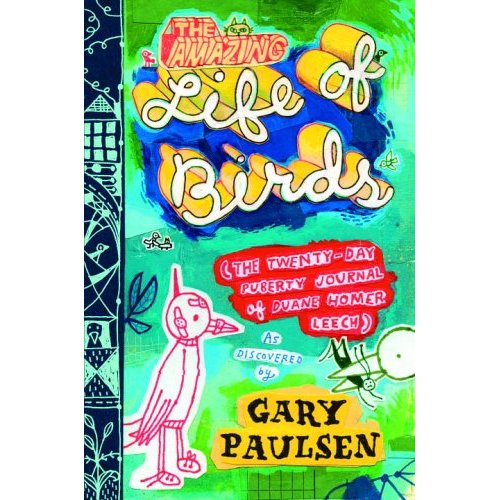
The Amazing Life of Birds


(The Twenty-Day Puberty Journal of Duane Homer Leech)
as discovered by Gary Paulsen
Wendy Lamb Books/Random House 2006

Male puberty in all it's onset glory. The zits. The changing voice. The embarrassment of having to force yourself to think of something because the rest of your body thinks you want sex that instant. The unexplainable attraction to girls. All of it, just as I remembered, and just as I don't remember it, all at once.

Were it not for the construct of the journal it is likely Duane wouldn't remember any of this as well. Filled with moment after moment of harsh human developmental reality, I believe most of us forget these details of the early onset either by choice or design. Living so close to the moment you're sure a major zit or repeated episodes of clumsiness last forever, year upon year, but as the journal points out in a nice but oblique way, what's twenty days in the grand scheme of things?

Unlike most boys going through a pubescent overhaul, few would have the opportunity to watch a hatchling bird on their windowsill go from newborn to adolescent during those same days. As Duane watches and records the baby bird's progress he is treated to an overview (of sorts) of his own life to that point. The early days of constant eating, the parental exasperation of child-rearing, weaning children away from their dependence and, eventually, tossing them from the nest to fly. For the most part Duane sees but does not observe. It isn't until he's taken a fell spills of his own that he understand what his best friend means when he tells Duane that you have to act like you're not surprised by any of it. Sure, you can't go around ignoring the possibility of embarrassing erection in public, but the stammering and other social missteps can easily be shrugged off as just another one of those things everyone goes through.

Paulsen's book is a breezy read, just perfect for a target audience that is, when you think about it, both small and limited. No boy going through puberty is going to want to read about Duane's exploits. No matter how extreme Duane's zits (or mistaken ringworm) are the book would scare the hell out of any kid in the throes of change. Boys that have already passed puberty aren't going to want to look back until they're long out of range, and younger boys might just be confused about just what exactly Duane is talking about when he mentions replacing the word ELBOW in his mind when thoughts of female anatomy suddenly spring forth.

So the book is squarely aimed at the boy within spitting distance of puberty... or, and this might be a little off, perhaps it's aimed at girls. While sex education will lay out the basics of what it means physically to go through puberty it does little to explain what is going on inside the mind. Perhaps this book then makes a better handbook for pubescent girls who are trying to understand things from the other side. Boys aren't likely to hunt down clues about girls -- when they get that interested they jump (or are forced by peer pressure) to the misinformation and misogyny provided by Maxim and FHM magazine -- but for any girl who's curious to know what the flip side of the menstrual equation looks like, this could be a good window into that world.

Not that there's any comparison, mind you.

Thursday, December 14

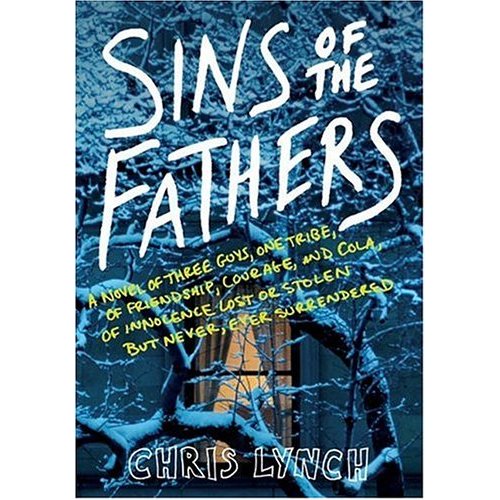
Sins of the Fathers


by Chris Lynch
HarperTeen 2006

Drew, Hector and Skitz are an inseparable trio who have known each other since they first started attending Catholic school. They're the kind of misfits who are drawn together: Hector the Good with anger management issues, Skitz the Human Dog lacking the ability to feel physical pain, and Drew the Glue that holds them together, their voice of reason, their collective conscious, and the story's narrator.

Entering their teens the boys are starting to skew off track. Hector's fits of rage and violence seem to grow proportionately with his rise as Alter Boy of the Year. Skitz seems to recognize that everyone considers him a lost cause so the increase in his irrational anti-social behavior goes practically unnoticed. At first blush Drew appears the most normal, but it's clear that the more he sees happening around him the more drawn he is toward repressing his own anger and disapproval. And all three of think nothing of sneaking out of their houses for a late-night meet up to down handfuls of St. Joseph's children's aspirin and RC cola, presumable for caffeine jolt.

The arrival of a street priest, a Jesuit nicknamed Father Mularky, jolts the boys out of their complacency as he appears to be unlike the interchangeable roster of priests they have seen over the years. He looks like a biker and is still hooked on 70's rock and roll -- on vinyl if you please -- and prefers things a little more worldly (like drinking beer) than the church might otherwise like. Monsignor Blarney runs the show with an iron fist so it's no surprise when tensions lead to a showdown between the two.

Everything comes to a head when Hector becomes ill and is hospitalized. Suffering from a stomach ulcer the boys think it's related to their aspirin and cola habits while the church spins it as the result of Hector's father ditching his family. The truth is more sinister as just below the surface of the narrative, hinted at but never said directly, Hector appears to be a victim of sexual abuse by one of the priests. Skitz has jumped from aspirin munching to glue sniffing and Drew is finally forced to take a stand against the priests, to pull his boys together and remain united and strong.

Lynch tells a story that seems familiar all the way through -- familiar characters, familiar scenes of weak families and weaker priests, familiar hang-outs and familiar conversations -- yet it all fits together in a way that still feels like you're reading about it for the first time. Actually, as I was reading I got the sense that Lynch was filling in the details left out of the news accounts, the sort of details investigative reporters would have included or reconstructed when writing up stories for Rolling Stone back when Rolling Stone was a relevant source of cultural reportage. There's no glorifying or demonizing of any character within the narrative beyond the thoughts and comments of those involved.

Except for the less-than-subtle title, of course.

The absence of fathers, or decent father-figure replacements, is the real indictment here and it's difficult to say whether or not Drew and his boys can actually break the cycle of disfunction that characterizes all their interactions. It would be nice to think that once the boys take their stand that they grow stronger, but the confrontation takes place literally on the last page and it's just as easy to imagine that they form one of those tight-knit units that defines their strength by the secrets that bond them.

One more chapter would have done it, one more chapter to let us know that the boys weren't just circling the wagons. Or would that have been providing the reader with too much hope?

Wednesday, December 13

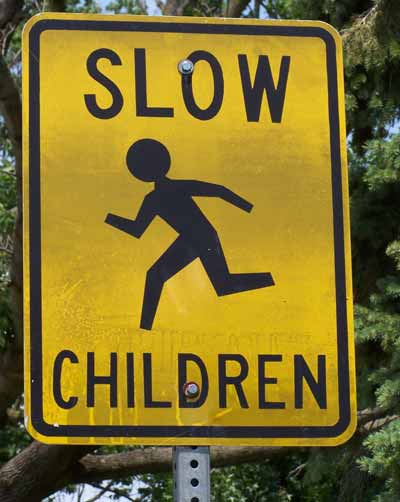
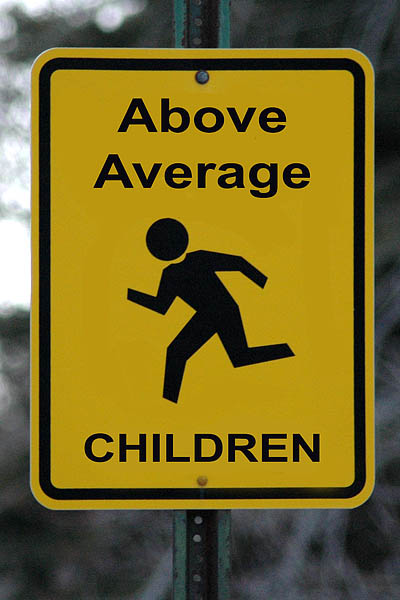
...And the Children Are All Above Average


It's the closing line Garrison Keillor uses whenever he delivers one of his homilies about his beloved Lake Wobegon. It's that idea that people often think higher of themselves (and their loved ones by extension) than is statistically possible. It even rates a Wikipedia entry, Lake Wobegon effect, with a couple of reasonable examples in support.

My favorite version is the oft reported story where around 18% of Americans polled believe they're in the top 1% tax bracket and the next 18% believe they're in the top 10%. So nearly 40% of polled Americans believe they're in the top 10%, which explains why talk of tax cuts for the upper income brackets is so embraced. It also supports the Great American Delusion that people are better off then previous generations. I know for a fact that my father earned a higher salary than I ever have -- that's not even adjusting for inflation -- and he never went to college.

But my least favorite version of the Lake Wobegon effect, and the more relevant one here, is actually the one Keillor uses. As a former teacher, and as a bookseller, the number of people who claim their children are above average would topple any bell curve you'd care to draw up.

Lately, working as a bookseller again and with the holidays upon us, the number of people with children reading "well above average" is staggering. Additionally, these children are "precocious", "sophisticated", and have interests far above most of the "mundane subject matter" that comprises most of the books available to kids their age.

Really?

So here are some questions these adults have been unable to answer about their above-average, precocious, sophisticated and clearly superior children when pressed.
  • What's the last book the child read and enjoyed?
  • What's the last book the child requested be purchased for them?
  • How many books a week (or month) do they read, on average?
  • Do they prefer realistic fiction or fantasy?
  • What's the last book they didn't enjoy, and what didn't they like about it?
  • What sort of books are they reading in school?
In short, exactly how well do you really know this child? It's amazing how many parents just stare blankly at me with any single one of these questions. It's a rare parent/adult who looks me in the eye and says "You know, that's a really good question. That would probably be useful information to know." Actually, the one parent who did say that left the store, came back a few days later and we set about getting their kids books they'll actually read.

What occurred to me recently is that with all these parental units -- caregivers and grandparents and other adults buying for children -- pushing more sophisticated, above grade level reading onto their kids, are we not seeing a partial cause to the problem of children growing up too fast? I'm thinking back to how Phillip Pullman's His Dark Materials books were originally shelved in with Sci-Fi and Fantasy in the larger bookstores, then migrated to the teen section, and now can be found as a boxed gift set with the middle grade readers. The argument for their shift in placement was the success of Harry Potter, and the interest in all things British and vaguely connected to sorcery, among the younger set.

But just because a ten year old can read those books, should they?

I often find myself biting my tongue when, after exhaustively suggesting over a dozen titles and having them rejected as either "too young" or "too lightweight" or as "already read", sending people up the street to the larger bookstore that carries adult titles. Clearly, if these kids are so sophisticated and so easily bored of books aimed at their age level then they really ought to delve into the real classics and build themselves a more solid literary foundation.

There comes a point for every child when what is written for them feels too much like pandering. It isn't that the books for their age level are no longer relevant, but that desire to start exploring the adult world becomes too strong a pull to ignore. Where parents may feel reluctant to delve into more mature ideas and themes in the home (or allow it in the literature) kids will go looking elsewhere. Occasionally this is referred to as "the street", as in "where did you get that information, on the street?" and is, in fact, as integral a part of a child's education and development as their formal schooling. To be book smart is well and good and necessary, but there comes a time when it has to work in the real world. Short of hitting the streets and learning the hard way, adult books can offer up a window into the real world situations without cutting them off from their last reaming years of childhood.

The trickiest part of this balancing act is not foisting a book onto a child that either reminds them of school or in any way smacks of education. A fourteen year old boy whose interest in reading has waned isn't really going to enjoy The Three Muskateers as much as he would some vintage Vonnegut. I'm speaking from experience on this one. Not that I wouldn't eventually come around to the French classic (and others, Victor Hugo especially) but that what I needed at the time was a cockeyed world reflected through a satirist's prism to comfort me and let me know that it was alright, that adults didn't really have all the answers, and that we're all in this together.

Yes, and after I read Breakfast of Champions I dove headlong into Portnoy's Complaint and Catch 22. And I don't recall my parents ever describing me as above average, precocious or sophisticated -- though I did have to hide what I was reading once they took a look through Vonnegut. Should I have been reading my Edgar Allen Poe and Mark Twain for school instead of these fine examples of mid-twentieth century American literature? Absolutely. Would I have wanted to be a writer if I have given up reading at age fourteen and started doing poorly in school? No. (Actually, the reading didn't improve my grades, but I did start to view school with new eyes once it became my social observation laboratory.)

My hope is that adults stop describing their children in terms that make them feel good about themselves when shopping for books. To be honest, the booksellers neither care, and rarely does it help in recommending a book for a child. If you absolutely must give a book as a gift, then do the only thing a child wants from you in the first place, whether they admit it or not: ask them outright. Children don't like to receive bad gifts any more than adults do, and in buying them what they want you reduce the risk of viewing the gift through adult eyes, with all the associated faults and pitfalls. If you honestly do know what they want by all means purchase that book, but if you need recommendations from a bookseller who's never met your child and whom you don't know personally, better do your homework.

As far as gift cards are concerned, if you're going to give one for a bookstore it should be in an amount equal to several average-priced hardcover books. I'm not saying that to boost sales, the fact is that kids with a short spending leash don't enjoy the process of trying to match their interests with a set price. You give them lots of freedom and not only will they be less stressed about the purchase but they may also feel the latitude to expand their horizons beyond the books they know. Better still, take them to the bookstore for a shopping spree (with a set limit of books, not dollars) and teach them how to utilize the help of booksellers, show them how to enlist the advice of total strangers and learn how to communicate their ideas and desires effectively with others.

Now that might help make them truly above average.

Tuesday, December 12

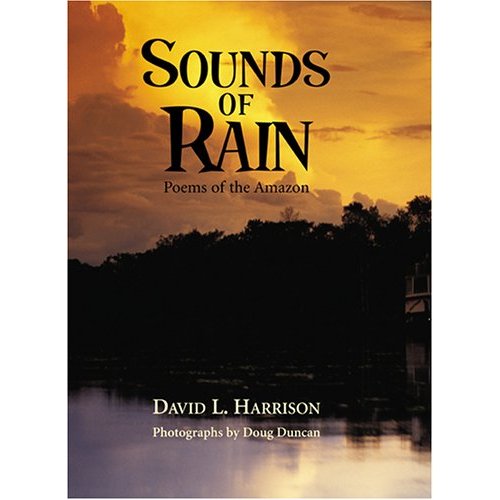
Sounds of Rain


Poems of the Amazon
by David L. Harrison
photographs by Doug Duncan
Boyds Mills 2006

Do you like to laugh at bad poetry? Do you want to turn children off to poetry? Do you like to hurl books across the room in fury?

Do you like to read poetry that fails to evoke any sense of its inspiration? Do you enjoy conflicting similes and simplistic observations? Perhaps you enjoy free verse as cold and tasteless as noodles made of sawdust, yes?

Do you hate the Amazon? Would you like to read poems about the Amazon that makes it seem like a Florida backwater? Honestly?

And do you like poor photography, grainy pictures of chickens taken from a distance so great they almost look like specters or heat shadows? And do you like photos of people happily floating in a river against a poem about a nocturnal predator? How about a photo of a splotch on a tree branch, meant to represent some unnamed and generically described Amazon River Basin animal, would you like to see that?

Do you like to be confused and perplexed, wondering aloud if there was any editorial oversight involved in the making of the book at hand? Do you like to thumb through 24 glossy pages of a hardback book of poetry wondering what semi-conscious being would enjoy what could easily be held up as the nadir of good taste?

Do you have enemies or relatives whom you would like to put on the spot by making them gush and thank you for putting such wonderful thought and consideration into such a lovely gift (though we all know better)?

If so, the this is the book for you!

Monday, December 11

Exploding Gravy


Poems to Make You Laugh
by X. J. Kennedy
illustrated by Joy Allen
Little Brown 2002

How and why this hasn't crossed my threshold before, I don't know. In out house we have an avid poetry reader (age 8) who has read and reread all of Shel Silverstien's oeuvre, most if not all Jack Prelutsky's offerings, a good deal of James Stevenson's corn, a much-loved Karla Kuskin collection, a handful of Douglas Florian's imaginings and a variety of others. Her love of a particular Silverstien poem - The Rain in my Head -- is bolstered by her having memorized it back in kindergarden and to this day is still her favorite poem to recite.

It would seem that in all of her scouring of the poetry shelves we'd have seen this offering by X. J. Kennedy. It has the same feel a Silverstien collection with poems designed to entertain and illustrations to match. The poems are grouped (some more loosely than others) by subjects kids generally enjoy: far-out families, giants and dinosaurs, unlikely doings, and so on.

I stumbled onto this while shopping for the holidays, so I'm hoping my 8 year old poetess hasn't already read it, but even if she has poetry are the books she returns to over and over. It's one of those things kids do that somehow gets lost in the transition into adulthood. It's one of those mysteries I ponder, why it is that we drink in poetry as kids when we know nothing of poetic forms and structure, but feel as adults that we can't "understand" poetry because we feel a certain need to appreciate it on some higher level. Same problem with art museums I fear, but I digress.

In reading through the book I was sold once I reached a poem called "Italian Noodles":
Whenever I
Eat ravioli
I fork it fast
And chew it slowli
The poem's other rhymes follow suit: spaghetti/rhetti, ziti/priti, pasta/fasta (and the less impressive lasanga/on ya) and it's that love of goofy language that flies well in this house.


Thursday, December 7

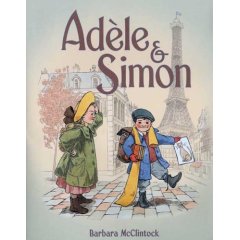
Adele & Simon


by Barbara McClintock
FSG/Francis Foster Books 2006

Adele's mission is to pick up her younger brother Simon and bring him home in tact, that is, without having misplaced his clothing and other personal items along the way. Naturally, as they drift through central Paris there are many distractions, and Simon manages to lose something at every stop. A drawing here, a scarf there, mittens and cap, arriving home unburdened nearly by half of what Simon possess on the cover of the book. In the end the items are delivered to their door by the friendly Parisians they met along the way who seem familiar with Simon's forgetful ways.

The look and feel of the book is pure mid-20th century, the soft watercolor glow of a Paris long gone. The double-page spreads of each locale are rich with detail begging the observant reader to try and locate Simon's misplaced items. The endpapers even provide a map of the city with each of Adele and Simon's stops numbered so you can follow their meandering route from school to home.

The nostalgia of the setting gives the book an air of unforced innocence, a balancing act that McClintock carries off with deceptive ease. It's a hard book not to like. Which is to say, I really enjoyed this little adventure.

Wednesday, December 6

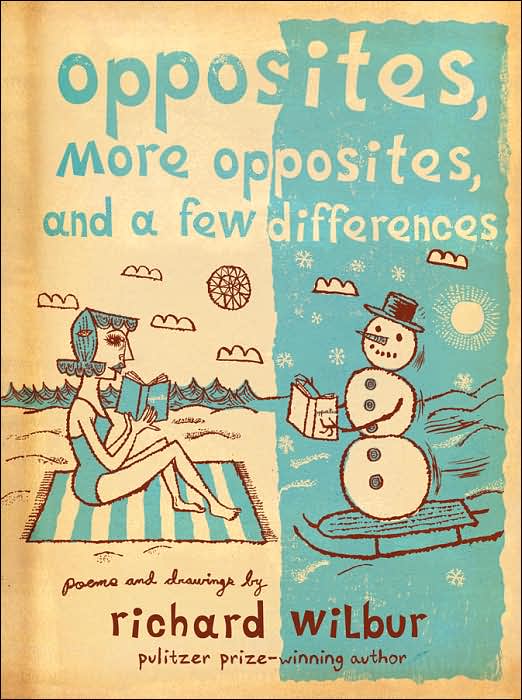
Opposites, More Opposites, and a Few Difference


poems and drawings by
Richard Wilbur
Harcourt 1973, 1991 & 2000

In fifth grade I discovered the Complete Book of Nonsense by Edward Lear and the world changed for me. It was the fattest book I had ever seen in the children's library at my school -- a squat little four-by-six hardcover with a bright yellow cover showing signs of grubby hands and corner drops. Despite being a book of poetry, mostly limericks, it was shelved among the humor books. I was probably looking for a book of jokes and the fattest book in the section looked promising.

I don't recall being surprised that I had stumbled onto a book of poetry, and perhaps I wasn't, but I do recall a certain feeling of having walked into a new door and being bathed in a sort of ethereal delight. These little five-lined poems, one to a page accompanied by an absurd and naive little drawing, sang to me. I don't think I came across the word cadence until high school, but I recognized it instantly in fifth grade.

The limerick is a kid-sized song, the kind that can be repeated over and over (because that's what kids do, that's how they learn to master language) with each of Lear's limericks a story unto itself, a seed for fantasy. Ischia. Rheims. Dargle. El Hums. Did the place names in these limericks really exist or where they the fancy of the poet fitting the rhyme? Did it matter?

Naturally, a discovery this huge required me to strike out on my own, to attempt my hand at the limerick. Inspiration was everywhere: classmates, teachers and school administrators all became citizens of strange lands invented to fit the punchlines of my bold rhymes (and I did see them as punchlines, I was looking for a joke book as you may recall). Just as naturally, when I shared my efforts with friends and led them my source book, my Rosetta Stone, a fad swept like a wildfire in dry Southern California scrub. I'm sure I wasn't the first as I'm sure every teacher at El Marino Elementary had witnessed that particular fad annually. Their bold little fifth grade language explorers had stumbled into the same linguistic jungle and claimed it for their own.

Occasionally I stumble across a book, story or poem whose wordplay catches the same spirit as those fifth grade days. Richard Wilbur's collection of two previously published books (and a few addenda marked as differences) is such a book. Each of the pages contains a poem, numbered as if each described set of opposites was a rule, and a small illustrative naive drawing. The poems themselves adhere to AABBCC rhyme patterns and vary in length. Decidedly not limerick, they are also far more sophisticated in their wordplay but simple enough to be appreciated by a child (or childlike adult) who enjoys letting words dance around the tongue and mouth.
19
Because what's present doesn't last,
The opposite of it is past.
Or if you choose to look ahead,
Future's the opposite instead.
Or look around to see what's here,
And absent things will not appear.
There's one more opposite of present
That's really almost too unpleasant:
It is when someone takes away
Something with which you like to play.

I would like to think that had I discovered the first of these collected poems in the early 1970's that I might have been equally inspired but I suspect I wouldn't have been as successful. Where limericks invite invention opposites demand precision, which runs counter to a lifelong struggle I've had with my own impatience. Still, It is fun to read through page after page of extremely clever examinations of what is essentially the yin and yang of the English language.
2
What is the opposite of flying?
For birds, it would be just not trying.
Perhaps the opposite for us
Would be to take a train or bus.

Lately I've felt that there's too much rhyming text in children's books, bad and unimaginative rhyming text, I should add. Yes, children respond to rhyme for a variety of reasons, the most basic of which is that they have a rhythm, a song, a chime that rings deep in the brain. But aside from that does the rhyming do more than entertain? I don't mean in the pedagogic sense -- I'm sure there are studies showing that rhyming text yields better readers, develops cognitive skills, &c. -- but is a book in rhyme an easier sell, to a publisher, to a parent, to a child devouring books?

My general feeling is that too often I find rhymed text that does little but sit limp on the page, perhaps dulling the senses of children who will grow up thinking that all poetry is rhyme, all rhyme is stagnant, and life's too short for stagnant reading. Clever rhyming poetry hardly seems to rhyme at all, the sonic parity is merely the icing on the cake; there isn't any sense in icing Brussels sprouts, which to my mind are the opposite of cake and about as unpleasant as poetry with forced rhyme and no soul.

No, I don't expect every poet writing for children to be a Pulitzer Prize-winning former U.S. poet laureate, as Richard Wilbur is, but I would hope that they don't suck all the fun and joy out of reading through mediocrity.