Showing posts with label movies. Show all posts

Saturday, February 9

Rumble Fish


by S. E. Hinton
Delacorte 1975

Did I really reread this? Did I need to? Man, this thing didn't age well.

Rusty-James thinks he's the the world on a string. Kid brother to the infamous Motorcycle Boy, RJ walks around honestly believe he has his older brother's smarts, looks and charisma to run the gangs of their midwest town. But RJ isn't any of those things, and where his brother used the gangs as a creative foil for his twisted genius, and then moved to disband them, RJ thinks he's inherited some sort of crown that allows him to be cock of the walk.

Motorcycle Boy left to see the sea, to expand his horizons, but two weeks later he's back. He saves RJ from a knife fight (probably not the first time he's bailed out the kid) and spends his days reading and drifting off into a half-deaf semi-trance. There's a local cop who doesn't like Moto Boy and threats all around that one of these days he's going to bring him down because the young punks in town look up to him. It doesn't matter which side you're on, when you see the Buddha on the road, kill it.

The book is framed with RJ on a beach in California running into an old friend Stevie from back in the day. They've both escaped the confines of their small town lives -- Stevie went to school and was planning on becoming a teacher, RJ fresh from the reformatory has finally made it to the beach his older brother never saw. In talking to Stevie RJ is forced to remember and relive those last days five years earlier when his brother was gunned down while setting free the animals in the pet shop. It was a last, desperate act of a person who was so smart he "could have done anything, but nothing interested him" as his drunken father points out. The curse of the big fish in the little pond (or in this case, the Siamese fighting fish in a separated tank). At the end, once RJ has recalled it all he tries desperately to forget. But he cannot, and that's the burden he carries.

Okay, aside from the dated references and slang, two things really stand out: first, the movie Francis Ford Coppola made out of this book is both brilliant and such a brilliant adaptation of this story that it practically eclipses it in relevance; second, are there any kids out there who are going to care about RJ enough to want to finish this book?

Seriously, RJ is a tragic figure in that he hasn't got a clue but he gives the reader all the clues they need to know that he's an idiot. The Motorcycle Boy is only mythic in the way he's viewed by his little brother; aside from being a pacifist with a death wish it's hard to get the read on his genius everyone else sees in him. As a picture of gang life in Tulsa the thing reads like a throwback to West Side Story, only without any social commentary. It's difficult to understand why this book has premained popular -- unless it's because it's short, has entered the YA cannon, and reluctant boy readers will read anything that has fighting as it's focal point.

That said, the movie that Coppola made out of this film almost justifies the book's continued existence. I could talk about this film for days because what FFC did was locate the horrible truth that lay at the heart of the book, that is the secret heart of all stagnant life in America. The movie is about time, wasted time, stopped time, putting in time, doing time, passing time, all the problems an active soul encounters when there is nothing but time. Rusty James feels his time has come, the Motorcycle Boy has come to the end of his time, and everyone else is traped in time but is too blind to notice. Coppola makes all this time with time-lapse photography of clouds passing, clocks that speed up, a giant clock face on a truck with no hands on it... one could argue that it isn't subtle, but it's so artfully shot (in black and white, to match the Moto Boy's colorblindness) and poetically rendered that it plays like a running gag in a city that time seems to have forgotten.

I never thought much of the book until I saw the movie, saw what was possible with Hinton's blank canvas, and now I canot read the book with those images burned into my head.
Movies can certainly color a reader's impression of a book they haven't read, but it takes one hell of a movie to supplant all previous images if the book was read first. I'm not about to suggest that the book shouldn't be read, despite my misgivings after this recent read, but I wonder if it's passed its relevancy phase and is moving on into period piece curio.

I know there are plenty of good books turned into good movies, and good books turned into bad movies, but are there any other films out there that turn sub-par books into cinematic masterpieces?

Monday, May 28

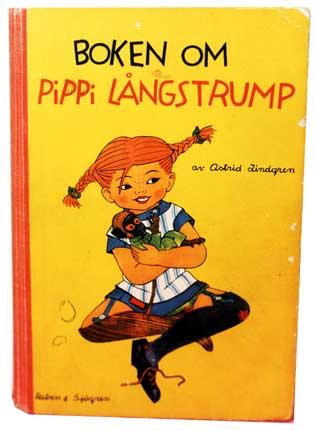
Pippi Longstocking

by Astrid Lindgren
Translated by Florence Lamborn
published in Sweden in 1944
Viking Press edition 1950


Pippi scared me when I was young. It had nothing to do with the books at all, and certainly nothing to do with some sort of threat to my prepubescent masculinity of this scrawny little Amazon, but it had everything to do with the 1960's movie based on the book.

Funny how memory is. I can see these images as part of my childhood vividly like they happened a few years ago, but I have to remind my kids that I first encountered Pippi back in the days before there were DVD's, before videos, and in this case even before my family owned a color television. In that blue-green cathode haze Pippi held a strange power that made me watch with my face half turned away in fear. I knew girls like Pippi, girls that could womp a baseball better than I ever would and wouldn't think twice about jumping down an open manhole cover, but they didn't scare me like this.

Because Pippi was the first movie I ever saw dubbed into English.

How and why did they talk like that? Their mouths and the sounds they made didn't sync up and worse; The way they were dubbed, stilted and forced like bad community theatre thespians trying to read Shakespeare into whimsy, had me feeling there was an invisible presence in the room that had turned down the sound and was making up the dialog for all the characters as they went along. And because of all this I never read Pippi Longstocking until I was a full-grown adult and felt I could handle it subject without the fear of those early memories rushing to accost me.

How nice it was to finally get Pippi in her correct form, a spunky and precocious 10 year old with a pet monkey and a horse that lives on the front porch. She lives by her own rules and with total abandon, and can foil crooks just as handily as Homer Price. That adults are dolts and can be outwitted by a wild child like Pippi is cake for a young reader . That Pippi actually doesn't even care about any adult besides her father is the icing.

Lindgren -- in a fashion that must be a genre unto itself by now -- originally wrote these tales for her own children. Writing to please children may seem obvious but many who try tend to fail because they impose their adult logic and adult world onto the proceedings. Logic alone is enough to kill a good story. Not that children don't long for and crave logic, because they do, but it's the logic they create that's important. When you think about what we do as developing humans, how we take raw data and information and learn to craft connecting ideas, thoughts into images into ideas into logic, the whole of it more impressive than anything we claim as adults. As adults we manipulate the hardware and the software of the brain to make sense of our world; As children we build the hardware and software from scratch and call it the world.

At the core of the Pippiverse are two innocents who serve as our grounding, Tommy and Anika. They provide the necessary balance that allows the Pippi books to endure because they counter the desire to "be good" with the twined desire to explore without rules. When challenged, even to the brink of hysterical danger, everything works out in the end because deep down Pippi has total unspoken faith that it will. I don't think it would take much to apply the lessons of Pippi into some warm-and-comfy self-help impulse item sitting on the counter at your local chain bookstore. Here's hoping no one thinks this is a good idea.

Many books for children feature troubled families and it's an odd comfort we find in seeing that others might have it worse than we readers do. I know I'm not the only person who felt like his family was severely dysfunctional while viewing other equally dysfunctional families as more "normal" than my own. That sense of "other" aside, what tripped me up while reading was that I didn't believe Pippi when she said her father, The Captain, would come home one day. I committed the adult sin of doubting a child. No matter how fictitious, I'm sure that as a child myself I would have taken Pippi at her word or at least given her the benefit of the doubt where my adult mind tried to force the story to conform to my own adult sense of what was "right". What a joy -- an honor, really -- to be bested by Pippi like all the other stubborn fools she's encountered.

Saturday, March 3

How To Get Suspended and Influence People


by Adam Selzer
Delacorte Press/Random House 2007

I really didn't want to like this. Actually, I didn't think I would like it first and that eventually led to me thinking that I didn't want to like it, because I was sure that I would hate it.

But I tell you what, I did like it. And probably for the same sort of reasons that it will appeal to smartass middle school boys if they ever get their hands on it: it has a delicate subversive streak in it that doesn't hit you over the head as you read it so much as it sidles up to you, asks you what you're reading, and then womps you before you can answer.

It starts lamely enough with Leon Noside Harris explaining his crazy middle name (Edison spelled backward), his crazy dad (inventing useless things) and his crazy mom (cooking and delighting in meals from cookbooks that use weird ingredients). It skitters like a crab into the beginning of the school where the usual assortment of misfits is settling into their various roles while Leon grows impatient for everyone to start acting up.

Then there's this shift, Leon and some of the other misfits are part of the gifted set, kids who get special treatment because while school recognizes their abilities they are at a true loss for ways to address them. It is decided that these eighth graders should utilize their talents and the school's multimedia equipment to update the various educational films to be shown to the sixth and seventh graders. If that doesn't sound like the ingredients for misguided thinking and elevated hi-jinx then you haven't been around eighth graders for a while.

Leon's got his eyes set on the sex ed films. He wants the younger kids to know, yeah, puberty gets weird, and things happen, and thoughts cannot be controlled, and it's all good. Naturally he's not going to be allowed to show any real nudity, and eventually the morality police (in the guise of one truly repressed teacher) will want to have final say over what Leon produces, but he's undaunted.

Hanging out with misfit kids means that eventually his girlcrush Anna is going to have to take him gently by the hand and give him some influence. He sees Fellini's La Dolce Vita. He sees the surrealist classic Un Chien Andalou. His sex ed film becomes the attempt to cross Italian neorealism with a sense of the absurd, something he calls Avant Garde but is really more akin to the experimental collage works that appeared in the 1960, something he titles La Dolce Pubert. I could mention the works of Bruce Conner, but that's probably going a bit too deep here. Besides, Leon never mentions other influences.

His big idea is to show nudity as portrayed in classic works of literature while a friend with a gift for satire turns Byronic odes into fell-good permissives about the joys of wanking off. An early idea to include an explosion of some sort -- never mind how or why it connects, Leon hasn't really figured it out himself -- is scotched due to a fear that Leon might harm himself. And when the big scene regarding the popular "it" couple of his band refuses to participate in his climactic kissing scene (something about it not being Marxist enough for the girl) Leon and Anna must stand in and then all heck breaks loose.

The rough edit of the film is seen and Leon is given in-house suspension. The film is seized and word travels that Leon is being censored. Teachers and students protest in support and even Leon's dad doesn't see the harm in it all. But Leon has the master print. A little final tweaking, plus some friends who are willing to post the film on the internet and burn hard copies to be shared, and Leon becomes a cause celebre. The principal backs down, the morality police elect to leave the sodomites to their sins, and future gifted classes are kept from making sex ed films. Leon and Anna plot a future of films where plots serve as excuses for more kissing.

I lived this story.

Okay, so I got suspended for cussing out a teacher who had wrongly punished me (by his own admission) to set an example, and the films we made were newscasts in the future full of sex and violence and sex. And a friend of mine and I wrote an update of Romeo and Juliet so that one of us (*ahem*) could have some kissing scenes with a secret crush. It would be another ten years before I'd see Fellini or know what surrealism really was but if I'd been shown them in junior high I'd have grokked my future a bit earlier. No matter.

What Selzer does is set you up with a typical smartass outsiders story that at its base has some real criticisms of the way "gifted" kids are treated and how anything outside the norm really isn't accepted no matter how much it's encouraged. He hints that a number of gifted kids may have been placed in the program because they were disciplinary problems and the extra attention would remove their disruptive influence from the classrooms, and I have to say I've seen plenty of proof to support that. As for encouraging gifted kids to push at the edges, but being afraid of the results and finally coming down on the conservative side of control, well, that's just the history of the Western World writ miniature to fit the little dioramas of educational fiefdoms.

There are elements of How to Get Suspended... that I could see keeping it from the grasp of its target audience -- specifically in the way of censorship from various adults. First, the title is a more a reference to Lenny Bruce's autobiographical How to Talk Dirty and Influence People than it is to Bruce's reference, Dale Carnegie's How to Win Friends and Influence People. Woe to the unwary who don't heed the cover illustration of a nude with a black bar across her breast! It isn't that there's anything too graphic or untoward, but Selzer appears to want to be frank with the readers in a way he knows would make some adults uncomfortable. Leon doesn't seem to have it bad but at least one of friends seems to intimate matter-of-factly daily masturbation. Let's also not ignore when one of the school coaches checks in with the suspended Leon and commiserates, explaining how when he was in college he was part of a free-speech group called freedom Under Charles Kerr.

"Think about the initials," the coach suggests. Indeed.

It's these little things that won me over, that pulled the book slowly from the mire of other, similar middle school-based books that try to get the kids to side with them. It suggests that the awkwardness of puberty is not only normal but makes for entertaining reading.

Tuesday, February 13

Hours of My Life I May Never Retrieve


It has been a long time since I've seen a movie that made me yearn, nay ached, to to have those precious lost minutes returned to me.

I watched The Devil Wears Prada two nights ago and I'm still feeling the loss.

Years ago when I was reviewing movies for fun and non-profit there were whole seasons filled with dread as Hollywood found ways to fill the calendar year with movies they could not justify throwing into the trash. The early months of January through March are a sort of wasteland while the industry readies itself for the annual gift of collective log rolling which is the Academy Awards. As spring comes into view movies tumble out of the festival circuits and into the movie houses where some writer-director's self-indulgent wanking gets confused with art. And foreign films, mustn't forget those, as they poke their heads up from behind the hedges hoping not to get slaughtered in the pre-summer movie blockbuster assault.

And when you're watching three to five new movies a week your bound to come across things committed to celluloid that could make you weep for those precious lost minutes. Much the same way you can occasionally pick up a book and weep for the tree that gave up its life for results that insult its memory.

Under most circumstances I would never have chosen to see The Devil Wears Prada. I did so with a reluctance that I cannot touch or name except to call it The Sixth Sense. The way a child sees dead people I can see a dead movie. I don't actually have to see the movie in question, in fact I can see as little as 30 seconds of a preview on television, or read the testimonials in a newspaper ad, and I know there's a little brown shark in the bath water.

I suppose, if pressed, I could say that I remember seeing the book in stores when it was first released and, after a glance at the cover art, could have predicted the premise if not the entire plot. So, yes, that could have prejudiced me against the movie. But the curiosity factor was still there, a clever device created by studios and casting directors whereby they lure actors into these movies specifically to fool people like me who should know better.

Why would Meryl Streep be in this movie if there wasn't something to it? And Stanley Tucci, he's never really done something strictly for the paycheck as far as I can remember...


Ah, but see how cleverly they have worked their Hollywood pixie dust! By cloaking Ms. Streep in fine Italian sheepskin they have created a situation where, indeed, she does seem Oscar worthy.

But only compared with the rest of that movie. She isn't even a candle's wisp against the raging gale force wind that is Helen Mirren or the class five hurricane that is Dame Judi Dench. A good actress, yes, but an Oscar nod for a one-note smolder? Please. My best guess is that the Academy felt a little funny not putting up at least one token American, but that goes into politics and would further take me off my already diversionary course.

Afterward there wasn't even the regret that I might have better used the time reading or cleaning my shower but an actual loss, an emotional depression.

And the next night I realized that after all these years it was time to finally give up on 24. Jack Bauer and the CTU gang have lost any pull they once had and I can no longer justify giving them the space of an hour a week. I had hopes that Aaron Sorkin's Studio 60 might serve as a soothing balm after 24, a nightcap as it were, but like that mislaid glass of champagne you find several hours after the party has started the show has quickly grown flat, tepid and leaves an aftertaste like Old Spice.

I never used to watch this much TV, in fact I went through most of the 1990's without using my television as anything more than a monitor for movie watching. Strangely, I didn't seem to miss much. I found I could keep in touch with popular culture through Entertainment Weekly and sound intelligent around the water cooler and at parties and no one was the wiser.

And I got a lot more reading done.

Perhaps, if I'm very lucky, over time I can recoup my losses through a strenuous regimen of reading. A minute here, another there, and slowly the essence of those missing minutes will be reconstituted into a rough approximation of time regathered. A leap day, as it were, as compensation for my industry and dedication.

Until the next ARC of a middling young adult novel crosses the transom, then it starts all over.