by Raina Telgemeier
Scholastic 2010
The memoir of the author's teen years told in graphic novel format focusing on her orthodontic adventures following a severe injury.
Everyone has a story tell about themselves, and in theory everyone has a reason for telling that story. We do this all the time in conversation when someone mentions a topic and our memories spark with a story, account, or anecdote that relates to the topic in question. In theory the story of ourselves we tell is also appropriate to the situation – when told, for example, about an elderly person's death after a fall we don't automatically launch into a humorous story about that one time we fell while carrying a gallon of mustard and ended up on the floor covered in it.
The memoir is very much like the stories we tell casually. Unlike a biography which is an attempt to get a story factually straight, or to understand better the person behind the story, the memoir is an elective tale told by the author toward a specific goal or to make a particular point. And as with any narrative it is presumed that the point of the memoir is the natural accumulation of the episodes depicted, a sort of realization that comes from the conflicts presented.
So we begin smiles with a sixth grade Raina who one day falls and lands on her face, accidentally knocking out her front two teeth. For the next six years (and 200+ pages) Raina goes through an elaborate series of dental surgeries, adjustments, and reconstructions that would naturally traumatize any teen. Her circumstances are unique in that she doesn't just need braces, she'll need to have her teeth shifted to fill the gaps, fix an overbite, and then correct for misalignment.
Along the way we learn about Raina's love of video games, her crushes on boys, her artistic temperament. As she gets older and moves on to high school she feels herself pull away from her friends, or rather, her friends are unchanged and she's moved on. She finds a new crowd to hang with and in the end is happy with the person she's become.
Initially Raina's friends make fun of her in various situations, mocking her for her "vampire teeth" and and for liking a younger boy, until finally Raina calls them out and walks away for disrespecting her. This lesson in self-esteem would seem to be the main message of Smile, and not entirely inconsistent with Raina's situation, but I found myself flipping to the last page saying "And?"
As a document in the orthodontic experience Telgemeier's book could serve as an introduction to children who are wondering what they are in for (and aren't easily scared) but these experiences don't fully integrate into the rest of the story. If the dental sections were removed the story of Raina and her life would remain coherent but the story would reveal itself to be rather weak. In that sense Smile is like a special effects movie with a weak story constructed to justify what's on the screen. It isn't necessarily bad, nor is it badly rendered, but the goal of this memoir is thin at best and takes a backseat to a play-by-play on what to expect when your teeth need correcting. I never really felt Raina's two worlds connected, and her anxieties are almost indistinguishable from the teen angst of kids who don't have such trauma, that I never really understood what the point of the story was throughout.
A more even balance between both stories, with emphasis on how the surgeries played into the character's esteem, could have made this a winner.
Showing posts with label memoir. Show all posts
Monday, October 4
Friday, January 15
Stitches

by David Small
Norton 2009
This graphic memoir about the illustrator reinforces the stereotype of the suffering artist, but does a fine job doing so.
Small recounts the major periods of his life that center around his having cancer as a child that developed to the point where he had to have glands in his neck and half his vocal chords removed. His father, a radiologist, and his emotionally closed mother created an atmosphere of silence in the house that was oppressive and forced Small and his brother to find other forms of escape. For his brother it was playing drums, for Small it was escapism through art. It isn't until the end when Small has begun to make his own life, after years of therapy, that his world opens up beyond the suffocating world of his family. As a portrait of an alienated childhood, coupled with the horror of misdiagnosis, it's a wrenching story that is also full of poignant moments.
Growing up there were always images and stories of people who suffered for their art. Comedians may be the only other profession I know of where suffering is practically a prerequisite. Sure, artists can suffer through elective poverty as well as adverse childhood circumstances, but other creatives seem only to have misery for their bread.
Graphic memoirs are curious in that they tend to present a more stark world of childhood than most fiction. I can't say this is true across the board for all memoirs though I know people who cannot or will not read fiction because it lacks this verisimiltude. What is interesting is how graphic memoirs fare with younger readers and whether they make the same distinctions or if realistic fiction is as real to them due to lack of experience.
What instantly came to mind with Stitches was Alison Bechdel's Fun Home which came out a few years ago. That book had people singing its praises right and left, and recommending it for mature teen readers (due to content issues), but it didn't work for me as a book for non-adults. I couldn't really articulate why until reading Stitches. Both stories feature closeted gay parents and the confusion of not understanding their parent's behavior until the narrator was older, but despite Small's more menacing treatment by his parents his self-portrait comes across better because he personalizes the narrative. Bechdel, a cartoonist, delivers a narrative that delivers a story but very little emotion; Small, an illustrator, conveys the emotions and deals more directly with the symbolism that comes from literally having no voice. Without understanding the child protagonist and their emotion we are left with a child's view of the adult world intended for adults to siphon meaning. Inexperienced younger readers are otherwise adrift in the experience.
I think we're still in the Wild West days of graphic novels for teens and younger readers. The medium grew up outside the world of children's publishing and has yet (if it ever will be) incorporated into the fold. Added to that, the graphic memoir is a form of creative non-fiction with its own set of rules that also tends to fall outside the purview of what is generally created specifically for children. Non-fiction for non-adults is still somewhat viewed as materials for instruction and not necessarily enjoyed in their own right. Graphic novels tend to have a higher profile because of their accessibility (i.e. they look like comics, which makes them an easier sell to kids) but I think this puts an unfair burden on them.
I also happen to believe that both Stitches and Fun House were latched onto as books suitable for a younger audience simply because their protagonists are children. Alice Sebold's The Lovely Bones features a teen girls who is raped and murdered and narrating from the beyond, but this book was never marketed for younger audiences; if it had been made into a graphic novel I'm fairly certain it would have been. This is an area that deserves more discussion. We either need to open up what we consider to be acceptable material for children, or we need to stop assuming that graphic novels with children as protagonists are automatically suitable because the are "cartoons."
Norton created a dust-up last fall by submitting Stitches for consideration of the National Book Award for Young Readers. Was it because, as some suggest, because they thought they had a better "in" by not competing with novels in the adult category? Because Americans do not take graphic novels seriously as literature? Because Small is primarily known as an illustrator of children's books? No matter, it was a shrewd move for the attention it received but it further muddied the waters of what is or should be considered a graphic novel for teens.
Labels:
09,
david small,
graphic novel,
memoir,
national book award,
norton
Thursday, October 11
The Magical Life of Long Tack Sam

An Illustrated Memoir
by Ann Marie Fleming
Riverhead Books / Penguin 2007
Ann Marie Fleming's great-grandfather was Long Tack Sam, one of the great international magicians of the late 19th and early 20th century. Growing up Marie had heard many casual references to her great-grandfather but there was little real information to go on. With members of her family spread across the world she would glean bits here and there until finally she decided to find out who he was and document the process in video.
This book is an outgrowth of that process, what Penguin calls a "graphic memoir," that on the cynical side could be seen as a very creative movie-tie in for the Fleming's award-winning documentary. I wasn't aware of it's origins when I started, and it isn't necessary to know that going in either, but I mention it because the reviews I have seen for the book only refer to it as a graphic novel. That was my initial reason for searching it out. I'm not so sure I agree with that label, but I'm pressing on with the review anyway.
If you've seen any magic in your life, chances are good you've seen something with Long Tack Sam's influence stamped into it. Seen anyone pull an endless strand of threaded needles from their mouth after having swallowed the needle and thread separately? How about a magician who could form ice from a bowl of tap water? Perhaps you saw that movie The Prestige about a pair of maniacal, battling magicians? There's a scene which mis-characterizes a famous trick where a Chinese magician makes a full goldfish bowl magically appear. All that comes from Long Tack Sam.
Fleming takes her time building the story, her stick figures standing in for herself as she makes her inquiries, with the majority of the book profusely illustrated with stills from her film and the various paper ephemera she dug up in the process. Interviewing family members and respected magicians and the keepers of their history Fleming manages to piece together no fewer that three official stories about her great-grandfather's early days. In one he was traded by his poor parents essentially for a sack of beans; another has him running away rather than face his father after shaming the family name. As the pieces come together what becomes clear is that, above all, Long Tack Sam was a born showman, a storyteller, a modern day shaman.
Snapshots from various family albums and handbills help paint the vaudeville era, which I'm beginning to see come more into vogue in children's non-fiction. (I hope to eventually review a picture book called Footwork that covers the same period as Long Tack Sam but follows the early days of Fred Astaire and his sister Adele.) Sam's travels take him around the world, eventually to Austria where he meets his wife. But Sam doesn't settle down, he keeps to the road, eventually deciding to incorporate his wife and daughters into his act in order to keep them together. Sam continues to wow audiences and becomes an official cultural ambassador for China. Sam and his family make friends in Hollywood, a place where many former vaudevillians are making big money. Sam's daughter screen test for the movie adaptation of The Good Earth but Sam puts his foot down, refusing to allow his daughters to tarnish the image he had spent many years building of beautiful, athletic Chinese people and culture; Hollywood was more interested in showcasing Chinese as dope smoking, murderous criminals. Mao seizes his chain of theatres in China as part of the reformation against Western influences. Racism and bigotry follow Sam and his family wherever they go; having married an Austrian forced them to leave behind their family home when the Nazis came to power. They flee to Italy under fascism scares them to America, then their visas expire and they are forced to go to Shanghai until the Japanese invade and...
If Long Tack Sam hadn't been as famous as he was he would never have lived this incredible globetrotting life. That said, the Long family endured what many around them endured -- the prejudices, the stereotypes, the demise of their livelihood as vaudeville was replaced by other media -- so that in an odd way The Magical Life of Long Tack Sam comes to be both a biography and a mirrored history of the early 20th century, an entirely fascinating document.
Labels:
fleming,
graphic novel,
magic,
memoir,
penguin,
riverhead,
vaudeville
Monday, May 28
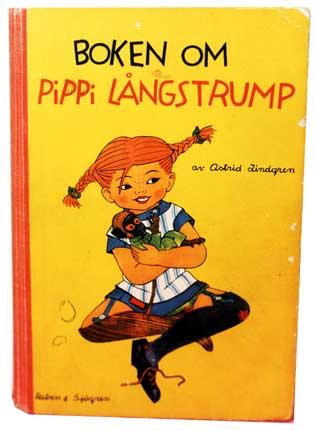
Pippi Longstocking
by Astrid LindgrenTranslated by Florence Lamborn
published in Sweden in 1944
Viking Press edition 1950
Pippi scared me when I was young. It had nothing to do with the books at all, and certainly nothing to do with some sort of threat to my prepubescent masculinity of this scrawny little Amazon, but it had everything to do with the 1960's movie based on the book.
Funny how memory is. I can see these images as part of my childhood vividly like they happened a few years ago, but I have to remind my kids that I first encountered Pippi back in the days before there were DVD's, before videos, and in this case even before my family owned a color television. In that blue-green cathode haze Pippi held a strange power that made me watch with my face half turned away in fear. I knew girls like Pippi, girls that could womp a baseball better than I ever would and wouldn't think twice about jumping down an open manhole cover, but they didn't scare me like this.
Because Pippi was the first movie I ever saw dubbed into English.
How and why did they talk like that? Their mouths and the sounds they made didn't sync up and worse; The way they were dubbed, stilted and forced like bad community theatre thespians trying to read Shakespeare into whimsy, had me feeling there was an invisible presence in the room that had turned down the sound and was making up the dialog for all the characters as they went along. And because of all this I never read Pippi Longstocking until I was a full-grown adult and felt I could handle it subject without the fear of those early memories rushing to accost me.How nice it was to finally get Pippi in her correct form, a spunky and precocious 10 year old with a pet monkey and a horse that lives on the front porch. She lives by her own rules and with total abandon, and can foil crooks just as handily as Homer Price. That adults are dolts and can be outwitted by a wild child like Pippi is cake for a young reader . That Pippi actually doesn't even care about any adult besides her father is the icing.
Lindgren -- in a fashion that must be a genre unto itself by now -- originally wrote these tales for her own children. Writing to please children may seem obvious but many who try tend to fail because they impose their adult logic and adult world onto the proceedings. Logic alone is enough to kill a good story. Not that children don't long for and crave logic, because they do, but it's the logic they create that's important. When you think about what we do as developing humans, how we take raw data and information and learn to craft connecting ideas, thoughts into images into ideas into logic, the whole of it more impressive than anything we claim as adults. As adults we manipulate the hardware and the software of the brain to make sense of our world; As children we build the hardware and software from scratch and call it the world.
At the core of the Pippiverse are two innocents who serve as our grounding, Tommy and Anika. They provide the necessary balance that allows the Pippi books to endure because they counter the desire to "be good" with the twined desire to explore without rules. When challenged, even to the brink of hysterical danger, everything works out in the end because deep down Pippi has total unspoken faith that it will. I don't think it would take much to apply the lessons of Pippi into some warm-and-comfy self-help impulse item sitting on the counter at your local chain bookstore. Here's hoping no one thinks this is a good idea.Many books for children feature troubled families and it's an odd comfort we find in seeing that others might have it worse than we readers do. I
know I'm not the only person who felt like his family was severely dysfunctional while viewing other equally dysfunctional families as more "normal" than my own. That sense of "other" aside, what tripped me up while reading was that I didn't believe Pippi when she said her father, The Captain, would come home one day. I committed the adult sin of doubting a child. No matter how fictitious, I'm sure that as a child myself I would have taken Pippi at her word or at least given her the benefit of the doubt where my adult mind tried to force the story to conform to my own adult sense of what was "right". What a joy -- an honor, really -- to be bested by Pippi like all the other stubborn fools she's encountered.
Labels:
essay,
lindgren,
memoir,
middle grade,
movies,
pippi,
viking,
wild child
Subscribe to:
Posts (Atom)