Friday, June 8

Summer Reading, Part Five: The Reader's Guide to Periodical Literature

Recently I went to my local library with an odd request: Did the Reader's Guide to Periodical Literature still exist, or had it been replaced by the Internet?

The reference librarian looked me over and sighed. It may still exist, she said, but the library hasn't purchased it since 2001 and few people have ever used it, or asked where it was kept. Once a massive multi-volume record of articles published by magazines and organized by subject, it's easy to see how this valuable research tool had been replaced by search engines, but it saddened me. It's one thing to do a Google search on the name Muhammad Ali and get 2.6 million results in 0.13 seconds but it would take you much longer, and more key words, to get, say, a specific selection of magazine articles from 1967 regarding his refusal to register for the draft during Vietnam. You'd still have to hunt those articles down but you'd have a better idea of what was recorded at the time in one quick glance.

The bane of many a school research paper -- now almost completely replaced by Wikipedia -- and no longer the source of much frustration in learning how to properly cite a reference work, I hereby dedicate this last segment on alternative summer reading to The Reader's Guide and to the idea that summer reading doesn't have to be about books.

newspapers

One of the best summers I ever had in terms of reading came the summer of the Watergate hearings in congress. I was thirteen and didn't have a clue what was going on but it all seemed very important. There was no discussion of politics in my house because (I only learned when I was an adult) my parents were of opposing political parties and kept silent to keep the peace.

Pity then, that I couldn't see what the world looked like from the mindset of the day; pity now, that it seems unlikely that people from opposite parties could live under the same roof.

That said, all this non-talk in the house of politics drove me to try and figure things out for myself and every day I had at my disposal the best tool available: The Los Angeles Times.

It is still very clear to me, all these years later, the memory of that first morning I commandeered the coffee table to make room for the entire newspaper. The newspaper was a book in my eyes, and I wanted to view the book as a whole. I distinctly remember how lost I felt at first, reading names and places and processes and procedures and feeling the intimidating weight of everything a newspaper had to offer. But I was determined.

I started with anything Watergate -- that's why I was there -- but quickly began to read about people and places I'd sort of heard about. A few years earlier our local paper put out a weekly digest edition of current events for classroom use so I had some familiarity with what a newspaper would contain, but I hadn't counted on their being so much news! And daily! Here's a section with letters and opinions and a political cartoon making fun of the president! This section talks about movies and music! Peanuts comics I had never seen in book form!

It might seem like I'm making fun, but I'm not. Before that first day I thought of the newspaper as something adults read, some boring part of adulthood. I never took the newspaper for granted after that.

A few years later I had a teacher who tried to get us to use our homeroom time to read the newspaper. She unabashedly had presidential campaign materials decorating one of her walls (Carter*Mondale placards outnumbered Ford*Dole signs 3 to 1) and she would clip interesting news stories among them. I was one of the few who read the newspaper during that time -- mostly to avoid homework, which my friends were busy doing last-minute, homework I would later hastily copy. Most of my friends found the news boring and I didn't see the point in trying to teach them otherwise.

With a little guidance, summer is the perfect time for younger minds to read the newspaper. If there isn't a current events assignment attached it might take a little more prodding than normal, or it might take less given that it's "free reading" without a test attached. I haven't checked out any Lexile or Flesch-Kincaid readability tests lately, but the last I heard the New York Times had a 7th grade reading level. Most papers fall at or below the NYT in readability, depending on readership and locale, and even within a newspaper there are various levels of readability. Good news for readers of the sports section: sports journalists tend to write at a higher level than the rest of the paper, pushing adjectives, similes and metaphors onto sports fans with greater frequency than an SAT prep course.

Walter Cronkite once wrote an article titled "How to Read a Newspaper." Some of the statistical information is a bit dated (I think fewer than 65% of the population gets their news from TV anymore), and many people under the age of 25 might never have even heard of the man who was once considered "the most trusted man in America", but the strategies for approaching a paper are solid even for the most dubious of news sources.

I'd also like to suggest a couple book titles that I think are essential not only to understanding the news in all its formats but in understanding the power of how media and the written word can be manipulated. The first is a handy little tome that's been in print for over 50 years now called How to Lie with Statistics by Darrell Huff. In it's breezy 80 or so pages it covers some of the ways information can be misused, including how simple charts can be manipulated to create certain effects (i.e. most infographics in USA Today) and how certain words can imply meaning that isn't necessarily or completely truthful. This book, along with it's equally slender partner The Elements of Style by Strunk & White (and perhaps the US Constitution) should be required materials in every high school backpack.

John Allen Paulos' A Mathematician Reads the Newspaper would be another highly recommended title for anyone who actually wants to understand the news. Middle grade and YA readers are consuming information all the time but understanding -- even questioning the quality of that information -- is given little attention. This book reaches into news stories and pulls out their numerical "facts" and plays around with them so show that how a number is stated often misleads or misrepresents the statistical information involved. it is nowhere near as dry as I'm making it sound here.

newsweeklies

In 7th grade my social studies teacher (ah, Mr. Grove) suggested we not limit ourselves to local newspapers and that we expand our horizons to include reading one of the prominent newsweeklies, either Time or Newsweek. It was very deliberate on my part when I caught my mother in a distracted moment and told her I need $12 for some school supplies and, oh, could you make it a check and leave it blank so I could fill it in? Four to six weeks later my mom met me at the door when I came home from school holding my first issue of Time magazine aloft, demanding to know when I subscribed. I explained it was for school and she scowled; I assumed it was because I hadn't been fully honest though I later suspected it was because Time was considered the more conservative party line newsweekly and my mom was decidedly more liberal.

I read Time magazine cover to cover. If I had read any of my class textbooks as religiously as I read that magazine I might have actually earned some good grades. I can barely remember what the heck the Treaty of Ghent was but I vividly remember to this day the special edition concerning CIA-taught torture methods used in Central America (this was in the late 1970's, which shows that torturing political prisoners abroad isn't a recent phenomenon). I even remember the specific names of some of the torture techniques, so vividly were they drawn and planted into my head.

Just a thought: What if, instead of textbooks, we published weekly magazines for students that contained materials and lessons for all their classes? They could keep the magazines and build a collection -- use their art class to build storage boxes and teach them how to bind volumes -- and have a growing library of all their studies! Naturally they would have to hold the same quality of commercially produced magazines, but the content could be solid and being produced on a weekly basis would allow for current (and relevant) events to be placed contextually alongside one another. Or is that just too radical an idea, to make educational materials fun, relevant and interesting?

By the time I hit high school I had switched to Newsweek and mailed in a "bill me later" subscription postcard for Rolling Stone magazine. I paid for RS with money from my first job and am proud to say I was a subscriber back in the 70's when it not only covered music but politics and popular culture and had staffers like Cameron Crowe, Hunter S. Thompson, Joe Klein, Greil Marcus, Lester Bangs, P.J. O'Roarke, among others. As I got older, RS seemed less hip and I ventured into Spin (for culture more than music, the first magazine that featured a monthly column on AIDS while the Reagan Administration denied its existence) and even later Options (for music that was way off the charts).

I sorta miss what those magazines did, and did for me, over the years and I don't know that there's anything really picking up that slack today -- maybe Mojo for the hardcore music purists out there. Most of what kids seem attracted to in magazines today is what they have been told to like, the crassly created advertisement delivery devices we recognize as Teen Vogue (or anything with the word Teen in the title), FHM (the triumphant return of misogyny), and, yes, Rolling Stone which has lost so much of its original backbone that it doesn't even rate as a cartilaginous fish much less the political shark it once was. It isn't that there aren't good magazines out there, it's just that the bad ones have got their alluring tentacles down to a science.

For the young set, yes, go to the library and check out Cricket and Cobblestone and all their relatives , and for the slightly older kids I'd say purchase a subscription to a newsweekly and a topic-specific magazine of their interest (Communication Arts, Sports Illustrated, Found, Premiere, ReadyMade...) in their name. Even if they end up reading them out of boredom at least they're reading, right?

tabloids

The Bat Boy. The Alien that predicts presidents. Elvis sightings. These and many other fine pieces of American journalism have all appeared in The Weekly World News the "mock tabloid" creation of those geniuses behind The National Enquirer. This gem appears in supermarkets all over the country and as much as I hate to admit it I don't think there's a humorous periodical that's been able to touch this since the collapse of Spy magazine.

It's hard to imagine a more perfect publication: it appeals to those who believe it's every fiction and to those who "get" the joke and feel all the more superior for it. I have seen the WWN's rival, The Sun, and there's just no comparison. And what else can you buy that provides this much entertainment for a buck. You practically can't get a candy bar these days for a dollar.

But is it quality reading? About ten years ago I read an article about how journalism graduates were having a tough time finding jobs because newsrooms were downsizing and papers were consolidating and one of the best paying jobs were at the tabloids. So, despite their lowbrow sensibilities, you've got Berkeley and Columbia and Northwestern grads pretending to be redneck Americans complaining about liberals and creating detailed histories of the appearance of Jesus on foodstuffs. It might all be crap but it's well-written crap. Bring one home every once in a while and see if it doesn't replace a night of television.

'zines

I'm sure they're still out there but not like they used to be. To some extent, you're reading one. These days what many people put on the Internet in the form of web sites and blogs is exactly the sort of things one finds in zines. Opinions, how-to articles, factoids, more opinions, computer generated designs or cut-n-paste masterpieces, whether fan- or hobby-based or thematically connected, the zine was a first step toward the democratization of the individual voice that is now the given hallmark of the Internet. DIY (do it yourself) was the mantra, born out of the punk movement, and is as alive today as the nearest photocopy store.

Instead of suggesting readers go in search of zines, I'm saying they should get out there and produce a zine of their own! Why? Because it's fun, because it involves writing (which requires reading), because it is an activity that staves off summer boredom, because in a rule-filled world it offers an escape from rules and expectations. Did I mention fun?

I mean it. I've created a few zines in my day and despite never turning legit and running a media empire I did manage to get my zine picked up for distribution and actually sold a few copies to strangers in places as exotic as Singapore and Portland, Oregon. It was always a financial loss but I never did it for the money.

Having gone to art school I learned quite a bit in a formal setting about layout and design, printing and binding processes so I didn't need much in the way of instruction. But in this post-print age kids might need some visual inspiration and instruction and for that -- yes, you guessed it -- I have a couple books to recommend. Whatcha Mean, What's a Zine? The Art of Making Zines and Mini-Comics by Mark Todd and Esther Pearl Watson is a great sloppy mess of an instruction manual for the serious and casual zinester alike. It covers the full range of topics, from what to write about, how to lay it out, printing types and styles, even resources for conventions and libraries that collect and display zines. This book can be read in a day and used as a spring board to produce several issues of a zine throughout a single summer; everything in this book took me years, and a lot of trial and error, to learn on my own.

For more of a read about a zine, with a bit of how-to thrown in, try Zine: How I Spent Six Years of My Life in the Underground and Finally...Found Myself...I Think by Pagan Kennedy. Kennedy reprints the eight issues of her zine and gives explanations and historical background for her personal zine, which brings up another great point about zines. Many zines out there were personal narratives, observations through the individual eye on a particular subject or interest. Even if the zines were little more than expanded diary entries or summaries of what happened at different music club shows the zine somehow managed to elevate the personal life into something slightly more meaningful.

I would totally be remiss if I failed to mention Francesca Lia Block and Hilary Charlip's book Zine Scene: The Do It Yourself Guide to Zines. In addition to being co-penned by the slinkster-cool Ms. Block this book has a very grrl power feel to it, but a totally suburban-acceptable grrl power. A gay friendly, totally suburban, grrl power vibe. Like zines, books about them take on their own personalities and choosing the right book makes all the difference. Boys will probably want the Whatcha Mean... title while girls would do well with any two of the above. There's also plenty of zine info on the Internet, of all places.

I'm not trying to suggest that zines have the power to act as a form of therapy, morale boost or increase a zinester's sense of self-worth... although they can. As the saying has been hacked to death, the journey is the destination, and a zinester's journey no less so. With a little financial backing (and the promise not to meddle) plenty of bored summer readers could become, overnight, content providers for their friends in need of some good summer reading, if not future media moguls.

Let a thousand zines bloom!

* * * * *

I'm pooped. A little over six weeks ago I conceived this idea of suggesting alternatives to summer reading and, as with most of my projects, bit off way more than I could chew. To meet my own expectations I probably should have started six months ago, but that's not when I originally conceived the idea.

After each of the five posts in this series I usually had a couple other ideas that I realized could have fit, a couple more titles, some better worded suggestions. That's just the nature of the beast, isn't it? I joked with myself that I should probably start collecting these leftover ideas for another installment about summer reading next year.

Next year. A year ago I hadn't even started blogging about kidlit, I couldn't have conceived where I would be this year. Perhaps by this time next year I will have an entirely different approach to summer reading to share. Perhaps not. We'll see.

Thanks to those of you who have checked in, both in the comments and those who have lurked in silence. If this has been a help to you or a reader in your life, if you found any of these ideas successful (especially if you have any success stories) I would love to hear about them. I am also considering some back-to-school ideas for a post at the end of the summer, taking suggestions for essential reading that might be a bit off the beaten path. Feel free to drop me a line at delzey (at) gmail (dot) com.

Thursday, June 7

Redefining the Classics

Children's bookstore. A woman enters carrying her dog, four year old son in tow. All are wearing designer clothes. The sales associate greets them.

"Do you have any classic Peter Pan?" The woman asks.

The woman follows the sales associate but pauses as they reach the books in a spinner rack. The associate continues on toward the Classics section. She looks at the several editions available, some complete and some abridged with glossy pages and nicely illustrated.

"Oh," she says flatly, "Nothing a four year old can read on his own?"

The sales associate apologizes for the misunderstanding. The woman backtracks to the spinner rack and holds up The Berenstain Bears and the Green-Eyed Monster. "Something classic, like this," she says.

The sales associate suggest that perhaps Disney has an adaptation in that format, but it isn't carried in the store.

"Well, how's a four year old boy supposed to learn about Peter Pan?" she whines.

"I know parents that have read the story to their children," the sales associate says.

"Really," says the woman, leaving the store thirty degrees colder than when she entered it.

Little Louie Takes Off


written and illustrated by Toby Morrison
Walker Books 2007

Little Louie is a bird who hasn't yet learned to fly, though not for lack of trying. It isn't that flight scares him, he just hasn't got the knack of it. And he loves to sit and watch all the planes fly around in the sky. When it comes time for his family to migrate poor Louie still hasn't learned how to fly and he is forced to take a plane and meet up with his family later.

But taking the plane means Louie arrives before the rest of his flock and for those few days he's on his own and lonely. One day while waiting his ticket for his return flight blows off the roof of the building where he is staying. Panicked, he jumps after it, suddenly realizing that he can fly. The ticket lands in the enclosure of a penguin who Louie quickly befriends.

Louie meets up with his family who are happy to see him, and that he's learned to fly. When it comes time to return home Louie passes his return ticket on to his new friend so that she may finally know what it means to fly.

Everything old is new again, and this time it's a very 1950's feeling book. It isn't only the Continental blues and pastel reds and sleek streamline moderne lines of Morrison's illustrations but in the story, the easy-leisure pace of the story that doesn't feel forced or obvious. Where other books I've seen have tried to capture the feel of the mid-century picture book I had to keep checking to make sure I wasn't looking at a reprint with this one. If I were giving awards for Most Retro-Looking Picture Book (seeing as everyone has an award these days, why not create yet another?) I'd have to say it would be a tie between this and Cherry the Pig.

I'm really crossing my fingers and hoping this is a trend -- and a trend picked up by talented artists and writers and not a trend picked up and hammered into submission by publishers or arrogant graphic designers who don't understand story -- because I think there is a lot to be said for the old storytelling ways, the old picture books, which makes them classic and evergreen. I am seeing dozens of new picture books and so few that seem able to rise about their self-conscious gooey-ness, their animal cuteness or smarmy graphic superiority. Modern stories can be told, and new graphic approaches are welcome, but so much out there feels tired right out of the box, so many dead trees in hardbound limbo waiting for the grim pulper. Really, is it any wonder picture book sales are soft when there are so many flaccid offerings?

But not this one, no sir, no ma'am.

Wednesday, June 6

Heat Wave


by Eileen Spinelli
illustrated by Betsy Lewin
Harcourt 2007

Lumberville is headed for a heat wave. Small changes are made to accommodate the small town's citizens -- the Sunday sermon is shortened, the movie theatre (before the days of air conditioning) is closed. But day by day as the heat wave lingers the people of the town cope as best they can. Kids sell lemonade but eventually resort to selling ice. Fanning oneself gives way to multiple showers a day. Men and women strip down to the barest of clothing and take refuge in the shade. Beards are shorn. By week's end people are sleeping outside, on fire escapes and rooftops and eventually many in the town congregate at the river to sleep in the cool coming off the water.

And just before the heat wave breaks they all share the same dream while they sleep: they dream of cool rain. And just as abruptly as a heat wave, the book is over.

In both text and image the story recalls a by-gone era of small town life. There is a quaint nostalgia in a time before the modern comforts of the climate-controlled malls, for communities that would still rally around their commonalities even in discomfort. Subtle details in the illustrations speak to the early part of the 20th century -- a wood stove in the basement, two spinster sisters keeping their perfume in an ice box, an old dome-shaped parlor radio -- but many others (squirting each other with hoses, sleeping in hammocks) remain contemporary.

Lewin's breezy watercolors with their lose sumi ink outlines capture the wilted, wavy quality of the heat where her warm palate (and occasionally relief from cool blue highlights) sets Lumberville glowing in the heat. That's a flowery way to say that the pictures capture the loose, slightly uncomfortable feel of the heat wave while at the same time remain fluid and fresh.

No one asked me, but were I editing this book I think I would have ended with a wordless coda showing the townsfolk of Lumberville about their business in cooler times, just a simple city scene in cooler tones of color (I was starved for green!) to offset the heat wave and give a glimpse into what things looked like when they weren't so hot. It can be a tricky proposition to know when to end a story, or to even suggest when a story needs more information. I don't think the book is flawed as it stand, I would have enjoyed a bit of balance, a breather after all those pages of heat (and a dabble of cool) to feel refreshed.

Monday, June 4

Summer Reading, Part Four: Shorts

Warm weather, the dog days of summer, time to break out the shorts. Nothing more refreshing and cooler than lounging about, unencumbered, with plenty of free time to lounge and let the mind flicker an wander. The perfect time to snack on short stories and other collected short works.

I am opening this one to the floor because while I feel I could cover this topic myself I've found myself more and more wondering how others would answer the following question:

What collections of short stories, sudden fiction, or essay collections would you recommend to a summer reader as a nice, occasional pick-me-up?

I already feel that regular readers know that were it not for my discovery of Kurt Vonnegut's short story collection Welcome to the Monkey House when I was in my early teens I might not have been the reader I am today. But that wasn't my first brush with the single-author short story collection. No, that honor goes to Ray Bradbury's The Golden Apples of the Sun, a book I remember toting around with me in the fifth or sixth grade. I couldn't tell you where it came from or honestly say I remember the stories it contained (although many of the titles are deeply familiar in some way) and this book is among others on my NTR (Need to Re-read) list.

(Speaking of Mr. Bradbury, apparently we got it all wrong when we've read Fahrenheit 451 as an anti-censorship book; looks like it's an attack on television. Add another book to the NTR pile...)

There are, of course, collections aimed at middle grade and young readers that aren't half a century old that are widely available and enjoyed by kids. Alvin Schwartz's Scary Stories to Tell in the Dark (and its sequels) is only a quarter century old! Schwartz is a collector of folklore and his tales represent those that are often told aloud and by necessity short enough to be memorized. I would consider these stories essential for campfires and slumber parties -- in fact I remember many of them from campfires when I was young, a testament to their lasting power. The stories themselves don't scare the reader as much as they might a listener as a large number include directions at the end for grabbing someone while screaming the last crucial line.

On the quieter side of things there's Cynthia Rylant's collection Every Living Thing gathers a dozen short stories where an animal plays an integral part in changing a person's life. I have to admit that the stories caught me a little off guard at first because they have an almost "adult" feel to them. "Planting Things" tells of an older retired couple, a man who likes to work the garden for the joy of it while his wife is housebound with illness. A jay makes a nest in one of his flower pots on the porch and while he delights in watching the fledglings grow and leave the nest his wife is content to stay in her bed and hear his second-hand tales. When the birds have flown off he collects the nest with the intention of setting it out the following spring to "grow" another family of birds.

And when I finished I couldn't help wondering "What would a kid make of that story?" Indeed, what do young readers make of stories that don't exists to push a happy ending or solve a particular riddle but instead celebrate small, changing moments in life. It's thoughts like this that lead me down a trail of optimism that the revival of the short story is immanent.

Another fine collection aimed at the middle grade reader is Richard Peck's Past Perfect, Present Tense, a brilliant title for a short story collection if ever there was one. Peck's collection begins with an introduction that briefly explains how short stories work. He then provides an introduction to his first-ever published short story including what his assignment was and how he approached it. Many young writers will appreciate the insight as much as they will the humorous story that came out of his thinking. Like many good teachers, Peck shows and tells giving his voice authority without scaring readers away. Each of the books sections contains an introduction that explains their grouping or origins. I wish there were more books like this.

Or are there?

This is where I wanted to open up the floor for discussion. What I like, what I am attracted to, are stories by a single author because I can see the breadth and variety of the author's thinking. If I like an author's style I'll want to read more, and while I understand the benefit of a story collection by many hands if a particular story doesn't catch me I might not search out that author to see if something else does.

Additionally, I am curious to know if anyone out there can recommend essay collections for children. I have seen in the past chain bookstore attempting to push David Sedaris' Me Talk Pretty One Day on their Teen Beach Reads table and scratched my head. In the beginning, Sedaris' essays were funny but they don't leave a lasting impression and I never said to myself "Teens would really love this!" Still, as I said, I am curious to know if anyone has encountered collections of essays that would be enjoyed by younger audiences.

I will add that as far as non-fiction goes I think there could be better coverage of collections on music, politics and general interest. The Best American Magazine Writing, Best American Non-required Reading, and the Da Capo Best Music Writing anthologies, among others, are totally acceptable for teens but what's out there for the younger reader, the pre-teen who might be interested in general non-fiction topics but wants something more substantial than a collection of factoids? Any ideas?

* * * * *

Our story thus far...
Episode One - Low Humor
Episode Two - Non-fiction?
Episode Three - Trash
Episode Four - Shorts
Stay tuned for the final episode in the series: Part Five - The Index to Periodical Literature

Thursday, May 31

Memo to Acquisitions Re: Superhero Fiction

Stop. Immediately.

Hollywood may be awash in all sorts of superheros, spies and pirates but attempting to ride their gravy train in publishing has been a huge mistake. And from the looks of the titles in my review stack there are many editors who just don't get it, especially with the superhero stuff.

I am referring to stories about the boy (always a boy) whose powers are lesser, or non-existent, yet another underdog defeating the cardboard adult villain who has never been successfully felled by other adult superheroes. Or those series where the superhero is a sidekick who tells us flat out that were it not for his (always his) intervention the main hero would not have triumphed in the end.

While we're at it, why do these books always tell us how they will end in advance? Are you afraid that the reader will abandon the book unless they know up front how it will end? And once they know, what on earth could be the reason for wanting to actually continue?

No, they are not humorous. No matter how many references to butts or flatulence or belching or body odor. The witty repartee is more hackneyed than the worst Hollywood movie, far from being clever or witty, farther still from being humorous. Dav Pilkey "got away with it" because he was performing a meta parody on the superhero, comics and gross-out prankster boy genres. Dav Pilkey's Captain Underpants series is clever despite it's potty humor not because of it. Dav Pilkey gets it and he gets it right.

Listen, I can understand that you want to try and capitalize on the latest trends in pop culture, and competing with Hollywood is a major factor. But if you do not fully understand what they are doing you can't begin to hope to catch a glimmer of that lightning in a bottle. Hollywood didn't pluck random screenplays out of the slush pile, or purchase pitches from some hot new talent with a well-connected agent, they went with franchise material that's several decades old. They hired name actors and screenwriters and directors with proven records and sank tons of money, time and pre-production into making them blockbusters out the gate.

But where's the money in purchasing someone else's franchise? Why would any book publisher actively attempt a novel form of a comic book character that already exists in a printed format? They wouldn't, which puts you, publishers and editors, at a disadvantage when it comes to the genre. How, then, to capitalize (as we are capitalists here, yes?) on the superhero genre without looking derivative?

You don't. Spandex-clad superheroes have their place and appeal but it isn't in fiction, otherwise why didn't it originate there? The popular comic superhero has been with us since the 1930's but only in recent years have we seen original fiction concerning caped crusaders that didn't previously exist. This isn't a question of a dormant, untapped market, it's a simple fact that superhero fiction doesn't work. It doesn't work because the artifice of the world it inhabits begs for visuals, and once you begin to introduce visuals you might as well be making a graphic novel or a straight-up comic book.

So do us a favor, Dear Acquisitions Person: If you (or your boss, house, or division) are clamoring to try and capture the superhero market, and you find a worthy manuscript, push like you've never pushed before to have it converted into a graphic novel. If that makes you uncomfortable, if you don't think it'll work in an illustrated format, if it's just too long or you can't imagine the market for such a book, then perhaps it doesn't work as fiction either. If you (your boss, house, or division) are not committed to doing comic-formatted works, then perhaps you shouldn't be pushing the superhero genre.

Personal note to the geniuses at HarperCollins Children's Books:


What possessed you to make a "storybook" version of the new Spider-man 3 movie? The film is rated PG-13, the text of the book talks about "acing college classes" and job security and sexual jealousy and revenge, and yet you think this is appropriate for kids as young as 3 years old? For you I say: Double-plus Stop.

Monday, May 28

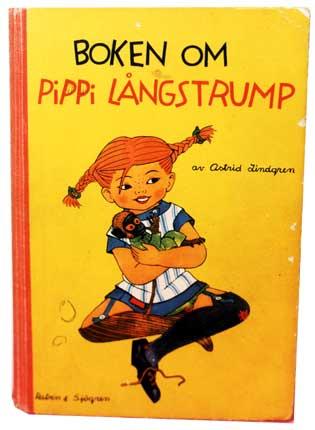
Pippi Longstocking

by Astrid Lindgren
Translated by Florence Lamborn
published in Sweden in 1944
Viking Press edition 1950


Pippi scared me when I was young. It had nothing to do with the books at all, and certainly nothing to do with some sort of threat to my prepubescent masculinity of this scrawny little Amazon, but it had everything to do with the 1960's movie based on the book.

Funny how memory is. I can see these images as part of my childhood vividly like they happened a few years ago, but I have to remind my kids that I first encountered Pippi back in the days before there were DVD's, before videos, and in this case even before my family owned a color television. In that blue-green cathode haze Pippi held a strange power that made me watch with my face half turned away in fear. I knew girls like Pippi, girls that could womp a baseball better than I ever would and wouldn't think twice about jumping down an open manhole cover, but they didn't scare me like this.

Because Pippi was the first movie I ever saw dubbed into English.

How and why did they talk like that? Their mouths and the sounds they made didn't sync up and worse; The way they were dubbed, stilted and forced like bad community theatre thespians trying to read Shakespeare into whimsy, had me feeling there was an invisible presence in the room that had turned down the sound and was making up the dialog for all the characters as they went along. And because of all this I never read Pippi Longstocking until I was a full-grown adult and felt I could handle it subject without the fear of those early memories rushing to accost me.

How nice it was to finally get Pippi in her correct form, a spunky and precocious 10 year old with a pet monkey and a horse that lives on the front porch. She lives by her own rules and with total abandon, and can foil crooks just as handily as Homer Price. That adults are dolts and can be outwitted by a wild child like Pippi is cake for a young reader . That Pippi actually doesn't even care about any adult besides her father is the icing.

Lindgren -- in a fashion that must be a genre unto itself by now -- originally wrote these tales for her own children. Writing to please children may seem obvious but many who try tend to fail because they impose their adult logic and adult world onto the proceedings. Logic alone is enough to kill a good story. Not that children don't long for and crave logic, because they do, but it's the logic they create that's important. When you think about what we do as developing humans, how we take raw data and information and learn to craft connecting ideas, thoughts into images into ideas into logic, the whole of it more impressive than anything we claim as adults. As adults we manipulate the hardware and the software of the brain to make sense of our world; As children we build the hardware and software from scratch and call it the world.

At the core of the Pippiverse are two innocents who serve as our grounding, Tommy and Anika. They provide the necessary balance that allows the Pippi books to endure because they counter the desire to "be good" with the twined desire to explore without rules. When challenged, even to the brink of hysterical danger, everything works out in the end because deep down Pippi has total unspoken faith that it will. I don't think it would take much to apply the lessons of Pippi into some warm-and-comfy self-help impulse item sitting on the counter at your local chain bookstore. Here's hoping no one thinks this is a good idea.

Many books for children feature troubled families and it's an odd comfort we find in seeing that others might have it worse than we readers do. I know I'm not the only person who felt like his family was severely dysfunctional while viewing other equally dysfunctional families as more "normal" than my own. That sense of "other" aside, what tripped me up while reading was that I didn't believe Pippi when she said her father, The Captain, would come home one day. I committed the adult sin of doubting a child. No matter how fictitious, I'm sure that as a child myself I would have taken Pippi at her word or at least given her the benefit of the doubt where my adult mind tried to force the story to conform to my own adult sense of what was "right". What a joy -- an honor, really -- to be bested by Pippi like all the other stubborn fools she's encountered.

The Shark God


by Rafe Martin
illustrated by David Shannon
Scholastic / Arthur A. Levine Books 2001

In this adaptation of a native tale from Hawaii, two children, a boy and a girl, find a shark tangled in netting on the shore. Their attempts to get adults to help them are met with derision so the decide to free the shark themselves. The shark can sense the children mean to help and once freed gives them a bit of a nod of thanks before disappearing into the ocean.

Jubilant at their rescue, the children run through the edges of the jungle, stumbling on the king's sacred drum. In their excitement they long to sound the drum, to announce their achievement to the world, but to do so would be kapu (forbidden). But they're kids, they lightly tap the drum anyway, under the watchful smirk of the king who sees it all. Having waited until they have hit the drum the king then calls out his guards to seize the children and have them held for punishment.

Their parents plea to the king, hoping to appeal to his softer side, but his heart has grown cold to the entreaties of his people. Likewise, appeals to the other members of the community are cold and the parents decide that they must make their case elsewhere.

Seeking out the cave of the Shark God they place their lives on the line as the mountain-sized god swoops them up for a snack. After hearing their story the Shark God agrees to help and sends the parents home with instructions to prepare a canoe filled with goods and to wait for a sign.

The Shark God brings about a massive wave that floods the village and frees the children from their cells. The parents, having seen the sign they were waiting for, launched their canoe before the wave hit and were well at sea when their old village was destroyed. They quickly found their children (with the aid of a friendly shark) and the king's drum and with it sail to anew island where they hoped to find (or start) a new community, one with an open heart.

The author points out in an afterword the differences between the original folk tale and the modifications made for this version. The differences mentioned appear slight and motivational and make a good case for maintaining the essence of the original. A little casual Internet research shows that this story has many variations across the South Pacific and not all of them pleasant. In one, "Kauhuhu, The Shark God of Molokai," the children belong to a priest and they are killed for beating on the drums when the chief is away, no mention of freeing a shark. There are greater details about the ordeal necessary for avenging the children's deaths and the wave brings a hoard of sharks who feast on the cold-hearted villagers.

So on the one hand we have these tales collected by a couple of German brothers that are filled with all sorts of strange dismemberings and transformations and gore, and despite there being no solid evidence they were meant for children we consider them as such. On the other hand when we get a story from a non-Western culture we see a need to make it more palatable and perhaps soften the rougher edges? True, many a Grimm tale are themselves softened to the point of innocence though they are far from their original spirit and, for the most part, have been co-opted by Disnefication. But where we have the original tales in translation for ready comparison such isn't always the case and a lesser-known tale like The Shark God, without research, becomes practically gutted and filleted from the original to a piece of nicely presented same at a sushi bar.

In the end, I'm not taking a stand on this book either way. No, really. I read it knowing nothing about its origin and enjoyed it. Had there not be the author's afterword I might not have gone searching for the original story and not known what had been changed. I think I would prefer that when we introduce stories from another culture to children -- especially if there is little to suggest they will one day be taught it's true origins -- then I guess I'd like that "one shot" to be an accurate one. I wouldn't want any child drawing all their knowledge of ancient Egypt from watching mummy movies and don't like the thought of children learning about the culture of our island state in such a sanitized manner.

Sunday, May 27

Johnathan Livingston Seagul

by Richard Back
photographs by Russel Munson
Macmillan 1970

Is this a book for children?

I received this book as a gift when I was a boy, I believe as a birthday present, possibly from a family friend who was also a librarian. I might have been twelve, the memory is hazy, but I didn't remember reading it.

So I read it.

Jonathan is a seagull unlike the others in that he would prefer to perfect and test the limits of flying over scrounging for food and fighting among the flock. His unique spirit and singular focus upsets the elders in the flock and as he reaches the physical limits of his speed diving experiments he is cast out of the flock.

Free of his societal constraints he flies off alone, only to be joined by two ethereal gulls who guide him to another place, a place where he will be understood and embraced.

"So this is heaven," Jonathan thinks, having found the home of gulls who have freed themselves of weight of the physical world. He meets another gull named Sullivan who becomes his flight instructor and guide, showing him the levels of perfection he had previously only dreamed of. Quickly Jonathan learns and surpasses his instructor to the point where he is introduced to the new flock's elder, a gull named Chiang. Chiang may be the eldest but he has so perfected his abilities that he can actually transport himself through time and space without flight, the ultimate in enlightenment. He takes on Jonathan as his pupil and in short order Jonathan has become a master in his own right.

Because he is still young and idealistic Jonathan decides that mastering flight isn't enough, that he hears a higher calling. Despite the confusion of his new flock he decides to return to the old world, to his old flock, and to show them the way and the light. The elders of his old flock are not impressed and insist that those who even speak with Jonathan will themselves be outcast. But Johnathan's message and abilities are too powerful and soon he has taken on disciples and begun to teach him what he knows. They even go so far as to call him the Son of the Great Gull. Once his followers have all the knowledge he could impart Jonathan turns the teaching over to them, to spread the word and continue to seek out a life without limits.

Wow. What a mess. Who gives this kind of a book to a boy, and what are they expecting from him when they give it?

I'm glad I never read it then, or abandoned it, or whatever I did to block it from my mind. The story is a mess of theologies, a veritable smorgasbord of free-wheeling 70's pop-psych and religious cherry-picking. Jonathan's aesthetic of flight-for-flight's-sake reads a bit like a zen novice attempting to reach nirvana the hard way. Shut out of society, he takes the mythological night journey to the shaman flock where he is given rudimentary training in preparation for (or as prerequisite to) meeting his master. The master finds Jonathan an eager student and puts him through his paces toward total enlightenment. But like Jesus learning at the feet of the Eastern ascetics he realizes that his people need to be guided from their darkness more than his own needs and returns to become their rabbi. In time he has gathered his disciples (including a lone female gull) and, his lessons finished, leaves them to explore the possibilities of an enlightened existence.

There's just enough ideas strewn throughout to suggest that Bach might have been trying to appease all crowds. Depending on the reader's personal philosophies one could find some sort of comfort in the message. The outsider as the ultimate insider, the spiritual found in the purity of action, the student becoming the master... all that was missing was a true Death and Resurrection Show to make the shaman's circle complete.

This was another one of those 25 cent library sale finds that also qualifies as a part of rebuilding my childhood library, which becomes my justification for dropping a quarter. I am forever in love with libraries for any number of reasons, but rebuilding my own childhood library from their detritus has been one of the best.

I'm glad I finally read this, and I am probably the right age for it now. Back when I was twelve I probably wrote it off as a stupid book about a seagull. I know it was a hugely popular book when it came out and that every household had an obligatory copy (ours sat next to some of my mom's collections of Rod McKuen poetry) I only wonder what it was about me that caused someone to think I would have enjoyed it.

Feathers

Jacqueline Woodson
Putnam 2007

I've been floundering with this book for over a week now, trying to figure out what exactly it is I want to say. Twice now my attempts to review the book have quickly become examinations of the 1970's and why it feels like we're seeing more books set during that time and what, if any, relation all this has on our current political landscapes and whether younger readers really want to read about all this as "period" reading.

At it's simplest the story come from the wrong-side-of-the-tracks family. A boy with long hair transfers mid-year to the new school on the bad side of town, literally on the wrong side of the tracks. Being the new kid, the odd fish, makes him the easy target for the bullies and because he looks white and the other students are a rainbow of browns he is instantly viewed with suspicion. The Jesus Boy, nicknamed because of his hair and serenity in the face of his non-violent approach to life, causes unease because some of the kids begin to wonder if he isn't Jesus come back to test their faith. When finally pushed to the edge by Trevor, the class bully, JB finally lets lose a verbal assault that disarms Trevor but proves JB is like the rest of them, capable of cruelty and anger. JB's secret is that he was adopted by black parents who moved across the tracks because life wasn't any easier for them on the other side. Kids are egalitarian in their cruelty.

The story is told from the point of view of Frannie who, along with her deaf brother Sean, give us another perspective on being outsiders. Frannie doesn't feel she fits in with those around her who are more deeply connected to their church, and her brother Sean makes a connection between his deafness being a separate world that keeps disconnected. Frannie wants to believe as her friends do but she sees too many contradictions to settle her rational mind; Sean knows that no matter which side of the tracks he lives on he'll always be an outsider to the hearing world, a world he can never be a part of unlike his sister who can travel in his world through sign language.

The title comes from Frannie's book-long inquiry into a poem by Emily Dickinson which begins with the line "Hope is a thing with feathers." Indeed, it makes me wonder what Woodson herself hopes for both within the book and without.

Setting the story in the 1970's allows for a certain distancing from the idea of a segregated society, but the the ideas that lie beneath are as real today as they might have been 30 years ago. Somewhere between then and now American society has recreated new divisions and seems desperate to reclaim old one. Politics, religion and even music have moved to their respective sides of the track and don't take kindly to outsiders attempting to pass or blend in.

So why go there? Are we seeing an increase of writers who came of age during those times who feel the resonance so strongly with our current climate? The 70's are equally alive in Barbara Kerley's Greetings From Planet Earth so I'm wondering if this is a trend or a blip or just coincidence.

This perhaps moves outside the parameters of the review, but sometimes the universe sends a message and you have to puzzle it out the best you can. For a very long time now I've been wondering what to make of my particular generation, a shoulder generation who are alternately claimed as being either the tail end of the Boomers or the front end of Generation X. To my knowledge this generation is not formally recognized by marketers or the media and my experience has been that those born between 1958 and 1963 have a general sense of feeling left out. It was while I was at my wife's graduation ceremony this week that I had another old idea brought back to the surface. It was under the guise of referring to a graduating class as a karass, a term invented by Kurt Vonnegut, taken from Cat's Cradle (published in 1963 coincidentally), which is defined as "a team that do[es] God's Will without ever discovering what they are doing."

I'm beginning to feel as if my karass is making itself known in children's literature.

Friday, May 25

Summer Reading, Part Three: Trash

"Read the Dell paperback."

You have to be of a certain age to recall when those words would come at the end of a movie trailer. It was usually some genre film, something a little exploitative, a summer popcorn movie that was either based on the kind of paperback people would buy at the checkout stands in supermarkets or was written in haste between the editing of the film and the release date. I think half of these movies were produced by Roger Corman's American International Pictures because that was usually the first part of the announcer's sign-off: "An American International picture. Read the Dell paperback."

How many people bought those books? It's hard to say though there's a booming business of these titles on eBay. It's nice to know there was a time when major motion pictures and the venues that advertised them -- theatres and television -- once actually used to use summer as a time to promote reading, even if it was merely an attempt to wring every last penny of profit from their films.

Today I am singing the praises of that ghetto of fiction known as Trash, or sometimes Beach Reading, and almost always as Genre. I'm not necessarily digging into the actual trash mentioned above but that fiction which tends to get marginalized because of its connection to popular culture. I won't attempt an exhaustive list of titles or suggestions, instead I'm taking a look at some of the books that many of my friends and I read and passed around during the summers when we were teens. My goal is to suggest some older titles that are still around and just under the radar of most young adults. If some of these titles seem like classics of their genre, well, I can't pretend any of us knew or cared about what sort of shelf life these titles would assume when we first read them.

One of my first "adult" summer reads was Ian Flemming's Bond classic Diamonds Are Forever. I bought it at some yard sale, among the go-cart parts and old kitcheware, laid out on a blanket with a bunch of other trash. I was eleven and it cost all of a quarter. I had seen a couple of Bond movies prior to reading this book and I might have already seen the film version, but on a lazy July afternoon I picked this thing up and started to read.

It might sound obvious to say this, but at the time I remembered thinking the book was nothing like the movies. There was something way more adult about all this, the language was foreign to me, the pacing and storytelling alien. It was tough slog at first because I was still trying to marry the book and images from the movie into my still-developing cranium. And then there was all that narrative, all those points where the author explained Bonds thinking and rationale. Huh, there was actually some thinking going on behind all that action, some deep cover and intel gathering. He wasn't just a spy or a man of action but a trained agent in the British Secret Service. There were dimensions to his character and *pop* suddenly Bond is a bit more real. Oh, and here's a surprise: it was really about diamond smuggling, with no evil villain planning to send a laser into space to blow up parts of the world.

I had two other Bond books in my collection -- did I pick them up at the same time? -- but I don't recall reading them. And I've meant to go back and reread Diamonds Are Forever or any other Flemming that looked interesting to see what my adult mind makes of it all. A few years back they repackaged the covers of the books, upped them to trade paper size (mine were the smaller paperbacks), which I found appealing. I would need to reconfirm this, but readers deep into the Alex Rider series (or even the Young Bond series that's a few titles in) might enjoy a little old school cold war spy genre fiction. From here one could suggest some Robert Ludlum, John le Carre, or Len Deighton. I am a particular fan of Deighton's Harry Palmer books and equally of the movie adaptations which featured Michael Caine. It's Caine's spymaster turn that is the physical inspiration for Austin Powers which is better appreciated when you get the joke. You might even be able to introduce a spy fiction buff to the broccoli that is Graham Greene, especially Our Man in Havana which borders on parody of the genre.

The penultimate summer movie, the one that actually created the mold for all summer blockbuster movies, is Jaws. When it came out I felt compelled to read the book first. In fact, knowing it was a bestseller before a movie I almost felt a certain sense of indignation that a movie had been made from the book and that most people would see the movie and never actually read the books.

I was a teenage boy and self-righteous indignation, especially over things I knew little or nothing about, came naturally.

I don't remember how I came into possession of my paperback of Jaws but I do know that I lent it out twice before trying to read it myself. I just had a hard time getting started. I must have reread the first 20 pages a half dozen times before I sat down determined to bust my way through it. I gave myself a 50 page deadline and had finished twice as many pages before I thought to look at the page numbers. The rest of the book came easy and when I finally saw the movie... well, let's leave my views about Steven Spielberg for another time and forum.

Jaws, at its simplest, falls into the man-against-nature horror genre. Typically there is a thing that is out to get people and there's a lot of running around trying to sort out what the thing wants and how to kill or outwit it. Character plays second fiddle to the action, which requires the story to be populated either with people of average or lesser intelligence than the reader to luck into a resolution or, at best, a challenge of wills in which the strongest (protagonist/s) survives.

For somewhat similar books I don't imagine there's any harm in Michael Chrichton's Jurassic Park, though I think The Andromeda Strain is a lesser known story that teen readers might enjoy. Also Robin Cook's Coma, William Wharton's Birdy, William Goldman's Magic (skip the film, the adaptation is atrocious), and Benchley's post-Jaws follow-ups The Deep and The Island.

For many I knew growing up summer reading could be summed up in two word: Stephen King. Personally I had some problems with early Stephen King where the characters had a paranormal abilities that were referred to as "the push" (in Firestarter) or "the shining" and I couldn't fully grok King the way my friends had.

Until The Stand.

Much talk these days about apoca-lit in YA fiction, much talk about how kids really seem to dig the political, ethical and moral questions that arise when the world faces a destructive-yet-unifying cataclysm like a comet knocking the moon off course or a plague devouring humanity. But when you weld these elements together with the muscular fists of a writer like Stephen King you have the ultimate in summer reads. Biological weapon released, killing a vast majority of the population who are haunted by visions of either an old woman near a corn field or a handsome stranger in the desert, drawn to either one in a battle of good verses evil for the survival of mankind. I haven't even glanced at this book since it's original publication and I can still remember images clearly from the book, more so than things I have read in the past year. Rib-sticking, something that isn't going to leave you feeling empty, yet nothing that's going to show up on an SAT test.

I would say that any Stephen King would work but I haven't read them all and I have encountered some duds, especially in the 1990's. Stick with the classic King, the books that made his name, like Carrie, 'Salem's Lot, Firestarter or The Shining. If you've got a reader who's already run those books down why not give them a taste of Ira Levin's Rosemary's Baby, William Peter Blatty's The Exorcist, David Seltzer's The Omen, or Jay Anson's The Amityville Horror. These aren't exactly apoca-lit titles (I've got one coming up next) but they are still very sturdy reads.

I read another book the same summer I read The Stand and that was Lucifer's Hammer by Larry Niven and Jerry Pournelle. Now here was something fun: a newly discovered comet originally believed to pass Earth appears to be on a collision course. While the scientific community assures the public that impact isn't likely a televangelist fans the flames of fear and suddenly everyone's on a survivalist kick. The comet breaks up as it nears Earth and lands in various places across the planet, causing earthquakes, volcano eruptions and tsunamis-a-plenty. What's left of civilization is in ruins, fighting for survival among militant cannibals. Fun!

Larry Niven's name is probably familiar to science fiction fans for many books including the Ringworld series. I have tried to start other Niven/Pournelle collaborations but they just didn't click for me. That aside, what were talking about now is science-fiction which has steadily increased in its general approval since when I was a lad and is now (finally) practically respectable literature. Why, 30 years ago Phillip K. Dick might have had the word "wacko" in front of his name but now after Blade Runner, Total Recall, Minority Report and A Scanner Darkly -- films all made from Dick stories -- he is being embraced as a unique and genuine American voice. Blade Runner and Total Recall were not the names of Dick books (Do Androids Dream of Electric Sheep and the short story We Can Remember It For You Wholesale respectively) and it might be fun (in a devious way) to present the originals sans mention of their movie adaptations on the cover to a reader to see if they make the connection.

A younger reader with a hunger for actual science fiction or fantasy may have already discovered the Douglas Adams Hitchhiker series, or the Anne McCaffrey Dragonriders of Pern books (one was good enough for me, thanks), or Octavia Butler's dystopian Parable titles -- all fine suggestions if they haven't been previously experienced. But there was one book that really tweaked me one summer and that was Theodore Sturgeon's More Than Human. There was something truly alien about the feel of this story about a group of people with various powers who could blend together as one, sort of a next step in human evolution. To my younger self it felt like The Fantastic Four crossed with The Twilight Zone and only later did I understand some of the more psychological aspects. Sturgeon also wrote the novelization for the movie Voyage to the Bottom of the Sea, giving him some true trash credentials. For something a bit more light and fun, a bit more Renaissance Faire-meets-Star Wars, try Robert Silverberg's Lord Valentine's Castle, the first-written-but-middle-title in the timeline of his Majipoor series. I think it makes a good transition from a fantasy world reader into the more politicised sci-fi world. I'm sure that statement's going to upset someone. So be it. It's what I read then and what I'm suggesting now.

I'm going to cheat a bit here and talk about my summer reading after my first year of college. Technically I was still a teen, and I think that if I'd had this genre tossed my way earlier I'd have loved it. I'm talking about detective stories, especially those old school hard-boiled types. I'm talking about that triumvirate of explorers from the dark underbelly of the American psyche: Dashiel Hammet, James M. Cain and Raymond Chandler. Hammet, the former Brinks man invented both Sam Spade and Nick and Nora Charles and practically the entire genre we now recognize as hard-boiled. Cain's gritty stories traffic in a world of femme fatales and dirty double crosses, a bit on the misogynist side of things but no one comes out smelling like a rose with Cain.

For my money though it's Chandler all the way. Phillip Marlowe is his man, prowling the streets of Los Angeles in the 30's and 40's, pulling the most disparate threads and ties them into tangled nets that eventually solve the crime. Chandler claims to have been influenced by Hammet but it's Chandler who perfected the lyricism of the private detective's inner voice. You might have better luck teaching kids how to write more concisely, and more vividly, by teaching them from Chandler's stories than from Hemingway. Chandler, in describing Marlowe lighting a pipe in the smoking car of a train, taught me a word that I hope one day to use in my own fiction: frowst.

I loved this summary of Phillip Marlowe from Wikipedia:

Philip Marlowe, is not a stereotypical tough guy, but rather a complex and sometimes sentimental figure who has few friends, attended college for a while, speaks a little Spanish, at times admires Mexicans, and is a student of chess and classical music. He will also refuse money from a prospective client if he is not satisfied that the job meets his ethical standards.

And to think they used to call this kind of stuff pulp, after the cheap paper it used to be printed on in magazines. They made plenty of good movies from this stuff as well, inspiring an entire genre of film called noir: The Postman Always Rings Twice, Mildred Pierce, The Maltese Falcon, The Thin Man, The Big Sleep, Farewell, My Lovely. All good stuff.

* * * * *

What these books and many, many more like them have in common is that they were paperbacks, they were cheap and, without exception, they were intended for adult audiences. If there's one thing teens love to do is assume they are ready for "adult" reading material as soon as the bug hits them, and I don't imagine it's been any different throughout history.

But looking back and then turning forward I am struck with how unified and national tastes were once upon a time. Many of these books weren't on the bestseller's lists because they had high orders from bookselling superstores, these were the books everyone read, and knew, and talked about. Maybe the closest thing we have to something similar in recent years is Dan Brown's The Da Vinci Code, and the popularity of that book remains a mystery to me even today as I found it filled me with inertia. But there was a time (I imagine some publishers and editors moon about this late at night at their favorite speakeasy) when the bestseller list was full of books -- for better or worse -- that were actually read by lots and lots of people and everyone would talk about them the way people now stand around and talk about the results of American Idol or the most recent developments on Lost. There are fine books out there, yes, yes, but how many of them are really capturing the national imagination and get read (before being optioned for movie rights) or that aren't being flogged by Oprah?

As I said from the beginning, this was my list and my experience. These were the books I discovered as a teen reader, or wish I'd discovered earlier, that make for good, solid summer reads. I'd love to hear what others discovered in a similar vein, particularly those who can speak to the romance genre that, as a boy, never held any pull with me.

Where to now? Let's see...
First there was Low Humor
Then there was Non-fiction

Next up: Shorts, perfect for summer weather

Wednesday, May 23

The Strongest Man in the World: Louis Cyr

by Nicolas Debon
Groundwood 2007

This work of graphic non-fiction -- a bio-graphic, if you will -- presents the straightforward account of the life of The World's Strongest Man, circa 1900. The tale is told by Cyr to his daughter on the eve of his last performance, having been told by his doctor only moments earlier that he must stop as his profession is killing him. In the autumn of his days Cyr owns his own circus and has been the star performer but now must make the difficult decision to go out while he's at the top of his game.

In softened tints of browns and blues Debon recounts Cyr's life story in a way that almost suggests a Hugo-esque (as in Victor Hugo) portrait of a man with a single destiny. The problem is that his destiny seems very much set at an early age and the bumps along the way give no hint at anything more foreboding as some lean years working in a bar. It is a genteel portrait, one that well fits an American's impression of his northern neighbor, the story of a French Canadian who set many weight-lifting records, some of which are still on the books.

I was hipped to this by Fuse#8 and I think she does a much better job with the summary than I do, but I have say that in the end I felt the effort left me wanting more. More about the times Cyr was living in, the political and social climates, more about who he was and how he felt about his place in the world. I'm not asking that an otherwise normal life be given a false drama, or have extraneous outside influences added for effect. There is simple, and there is quiet, and this is a little too much of both. If those are the differences between American and Canadian tastes, so be it, but somehow I don't think so.

The Day the Stones Walked

by T.A. Barron
illustrated by William Low
Philomel / Penguin 2007

There's no rhyme or reason to the fact that I love anything that has to do with Easter Island. That remote little island with the giant iconic stone heads, be they alien totems in Chariots of the Gods or the idols of a superstitious monolithic culture, I am totally fascinated by it. I may be one of the few people in the world who actually paid to see the movie Rapa Nui and didn't totally hate it. Okay, maybe a little.

If I had any clue to the whereabouts of the originals for a mini comic I once made about "The Bellybutton of the World" I'd dig it out, scan it, and prove just how much I love those solumn stony visages.

Today, however, we are dealing with a picture book about this small island in the Pacific. A boy brings home some food he's speared at the tide pools and when his mother looks up at him she sees, over his shoulder, the sky has gone a shade of green. She's seen this happen once before, long ago, and sends the boy running to the carving pits to retrieve his father and bring him safely to the caves high above the shore.

The boy's father is a lone stone cutter, perhaps the last of a vanishing breed, carefully working over the unfinished features of one of the stone giants as it lay in repose. The boy tries to warn his father but is not convinced that he should abandon his work and sends the boy on his way. Half way up to the caves the boy sees a large tidal wave has sucked the shore into dry flats and a wall of water almost as tall as the island is approaching. He runs back down to the carving pits to save his father.

The wave hits, the boys is caught up in it and he is dragged under, tangled in the seaweed and floating among the stones down near the shore. The water recedes, the boy is alive and found by his father, and life on the island will never be the same. Uh, the end.

There is an afterward that connects some limited Easter Island history with modern tsunamis and an oblique reference to the effects of deforestation and global warming. Essentially, Barron is making a case that what happened on Easter Isle is a controlled-environment version of what is currently happening on planet Earth. That the island was once a lush paradise, full of the largest palm trees on the planet, and is now practically barren speaks to what happens when a culture takes from nature with little regard to the long-term effects. These people used their trees and plants for everything -- timber, fabric, food, rope, and most importantly, for transporting their huge heads around the island -- and when the trees left so did the native birds and cover vegetation. In the end the native peoples may have cursed the gods who abandoned them for not continuing to provide -- as many today will assume that global warming is a sign of god's wrath, if they accept global warming at all -- but in the end the evidence is fairly clear.

The story itself is fine, the idea of a small island community dealing with a tidal wave makes for some pretty interesting stuff, but if you're going to use Easter Island as your base and you're going to follow it up with an authorial afterword about the environmental effects, then that's the story that should have been told. I don't know that the world is going to be clamoring for another picture book about Easter Isle anytime soon, but if so there's a relevant cautionary tale to tell that doesn't involve an act of nature to explain the tragedy of a small piece of the planet and what it portends for the rest of us.

Preachy? Perhaps, but if the author had wanted me to more favorably review his book he shouldn't have undercut his own efforts by pointing out the weakness in his own story. As it stands the stones don't really dance, and there is little mention as to why the islanders even care about them. I wonder how much I would have cared if I wasn't predisposed to liking those long-eared, thin-lipped, top-knotted dudes.

Monday, May 21

Way. Too. Much.

Welcome to all and sundry who may have tripped over here via Seven Impossible Things Before Breakfast or, as we like to say in our culture of abbreviation, 7Imp.

When I agreed to the interview I thought "well, it'll be small and quick and a fast read" because, honestly, it's not like I'm M.T. Anderson or Grace Lin or someone like that. I didn't realize I had so much of myself... out there, for all to see. It feels like way. too. much.

The interview is there, the blog is here. Thanks for stopping by. Now, back to the business at hand.

Andy Warhol's Colors / Counting with Wayne Thiebuad


both by Susan Goldman Rubin
Chronicle 2007

Board books are funny things. On the one hand they make perfect sense if you are trying to get kids used to the idea of books and reading at a very early age. They have sturdy coated cardboard pages that withstand throwing, food spills and the gnawing and chewing that comes from young pups.

But board books didn't always exist. They were invented, much like the term teenager was invented to suggest a difference between child and adult, probably more like the way the tween demographic was identified by markers and advertisers in order to better capture income from a growing consumer demographic. Somewhere in between the social science of presenting kids books at the earliest possible age and the capitalist goal to build a loyalty and brand recognition from the cradle, that is soupy mire from which board books arise.

Board books are not evil but there is a whole lot of cute mixed in with the good. It saddens me, for example, that publishers make board book versions of classic picture books, often abridging texts or images to fit the format. And there are those books that have "cute" spred all over their intents, proving that their true market is parents and grandparents for whom the book is going to have a greater appeal; they aren't buying for the child so much as they're hoping to impress their opinion of what is cute onto soft minds.

But sometimes people get that a board book can be more, and here we have two examples. Author Goldman presents classic Andy Warhol illustrations from the 1950's and 60's with short bits of rhyming text that are linked to their predominant colors. For those who only know Warhol's iconic factory-produced screenprints these fresh ink and watercolor illustrations may prove that, when he wanted to be, Andy was a talented artist. Featuring a typical assortment of animals -- cat, butterfly, lion, monkey, &c. -- Rubin fuses the color concept board book with a mini primer on a modern art master.

In the Thiebaud book Rubin offers us some of the artist's food paintings with a counting rhyme. That Thiebaud's paintings are done in a very thick application that makes them look as if they'd been composed with cake frosting is an added benefit. Consisting mostly of deserts -- pie, ice cream cones, cupcakes, candied apples -- the fact that they are well-known paintings from a still-living master is almost completely overshadowed by their tempting yumminess. Yes, I said that. The counting aspect of this book is practically lost but not in a bad way. It feels more a casual counting book, among a collection of food illustrations that, oh, just happen to be famous paintings hanging in museums.

Yes, okay, so these books are intended to appeal to adults on some level (did I not say yumminess?) but for those, parent and child alike, who might not be as familiar with these artists or their works, what a delightful little introduction. I noticed that there's no modern art master alphabet book from Chronicle but I hope they're considering it. In fact, I think this sort of art history could make for a very good series of board books.

After all, if Major League Baseball can produce board books (building that brand/team loyalty in the cradle again) then why not do more of the same for the arts and sciences? Just a thought.