Monday, September 13

Killing Mr. Griffin

by Lois Duncan 
Dial 1978 

A group of high school kids decide to teach their hard nosed English teacher a lesson in humility by kidnapping him and threatening to kill him.  Hilarity ensues. (Not!) 

As a "light reading" choice among the other required reading for one of my daughters this summer I decided she might enjoy Killing Mr. Griffin.  She has an odd sense of taste and humor, and my recollection was that this story would be a nice respite from some of the heavier reading she was doing (i.e. The Book Thief, her new favorite book of all time).  When the book came home from camp at the end of summer with a bookmark a third of the way in I was confused.  Did she not have time to read it?  Was it too dark?  "I just didn't like it," said the girl who finished practically everything she picks up.  So I decided to reread for the first time in maybe decades.  

I understand now what happened. 

Though this sort of story has proven to be popular over time – the movie Heathers probably owes some debt of gratitude to Duncan, as does Michael Northrop's Gentlemen – what probably kills this book for a contemporary reader is the language.  I can't tell if it's a question of style, a book of it's day, or if Duncan was trying for something Gothic in tone, but all throughout she uses words and phrases that would strike a modern reader to be stale as opposed to of an era.  There were words that nicked and jabbed at me as I read, then on page 30 I was stopped dead.

      He put a pan of water onto the stove to boil and opened the cabinet where his mother stored foodstuff.  There were two boxes of Jell-o, cherry and banana.
     "Good old mom," he muttered resignedly.

The word "foodstuff," the stiffness of "Good old mom" and the tortured dialog tag "he muttered resignedly," these didn't just tumble clumsily in my head, they were actually hard to read aloud without stumbling. I probably should have sensed it coming from the beginning when a character Susan "told herself vehemently" and "thought wryly."  I could accept that the English teacher in question, a pompous ass who gave up college level teaching in order to show the high school world how it's done right, would speak formally and in drawn out, stilted phrasing, but to have a teen thinking (much less speaking) in such obvious SAT adjectives should have tipped me off.

At the story level, coming out in the late 70's as it did, I'm not surprised by the troubled-kid-leads-the-others-astray morality summation.  I don't think it would have been possible to write this as the lark of well-intentioned kids gone haywire back then; books for teens still needed to justify themselves beyond entertainment.  The problem is that it takes an unsympathetic character like Mr. Griffin and tries to get us to like him by making him a victim when, in fact, he was a terrible instructor with no interpersonal skills and should never have been teaching in the first place. 

My daughter never got to figure that out, though.  She gave up on it possibly because of the language and possibly because there were no characters she could identify with.  The good characters are weak, the bad characters are whiny, and the title character is a jerk.  A lesson here on making sure you fully remember (or reread) older books before handing them off to younger readers today.

Friday, September 10

Don't Touch That Toad

& Other Strange Things Adults Tell You  
written by Catherine Rondina
illustrated by Kevin Sylvester
Kids Can Press  2010


A collection of superstitions and folklore passed down by adults, refuted and supported, and an attempt to arm kids with the facts behind the phrases.  Entertaining, but it's no snopes.com.

I like the idea of arming kids with the truth as a way of disarming the myths kids often find themselves presented with, whether from parents as this book presents or, as I experienced many of them, from other kids.  Everything from french fries can give you acne to ostriches burying their head in the sand when scared shows up here, with the myth presented on one page with the reveal on the page turn.  Grouped under health, science, weird, and animal, with a special section set aside for the unexplainable things parents say ("I wasn't born yesterday, you know!") Don't Touch That Toad fits snugly among those nonfiction titles that benignly amuse and casually educate.

If only.  

In presenting the information in a light-hearted conspiratorial tone it would be nice if the counterarguments presented had some bite to them, and perhaps a little more background.  Early on we get An apple a day keeps the doctor away which we're told is false.  It's yummy and packed with vitamins but eating one a day won't prevent you from getting sick, a reader is told.  So, yes, technically, it's not correct.  And the text goes on to explain how apples have the ability to kill bacteria in the mouth, helping prevent tooth decay, so it reasons that an apple a day might keep the dentist away.  But what is the origin of the phrase?  If a reader were told that an apple helps fight high cholesterol, that daily apples can improve repertory problems including asthma, that the vitamin C they contain helps promote the immune system, could it be that there's more truth to the phrase than simply the idea that if you eat an apple you won't get sick? 

Another canard I was hit with as a kid is here, If you swallow a watermelon seed, a watermelon will grow inside your stomach.  Preposterous, given the number of seeds accidentally swallowed every year by people of all ages.  My aunt used to scare me that an apple seed (apples again!) if swallowed would grow a tree out of my navel.  In disproving this myth the text goes so far as to talk about a doctor trying to replicate the conditions of a human stomach in which to grow seeds.

He should have tried replicating lungs.  As recently as a couple weeks ago a man was discovered to have a pea germinating in his lungs.  And a year ago a man in Russia was discovered to have a fir tree sprouting in his lung.  It doesn't negate the point that the myth of swallowing seeds holds no merit, but if the point is to arm young readers with facts to bat down their parents this counter-intelligence should include things to arm parents into being more responsible with what they tell children.  Another myth was based on the idea of the "three second rule" for eating food that's been dropped on the floor, but one day recently in the kitchen my kids and I heard an NPR story about a scientist who did studies and found that depending on the environment the rule could extend to a full 18 seconds.  That's quite a different result than the one presented in Don't Touch That Toad. What's a kid to do in the face of such contradictions?

I realize this borders on the idea of criticizing the author on what they didn't write, but the fact is my kids heard the news story about the 18 second rule at the same time I did.  They head about the seeds growing in people's lungs as well.  News of the weird is out there, and in the battle against superstition and urban legend truth is almost always more alarming than fiction, and the best antidote.

Okay, so the book probably shouldn't scare kids with too much depth.  I get that.  But that aside, I would have wished the book included more background into where these notions come from in the first place, especially with the "parentisms" at the end of the book.  Many of these are idiomatic phrases, like no use crying over spilt milk and you made your bed now you lie in it, that are written off as "unexplainable" when clearly they could be. 

I like the idea behind Don't Touch That Toad, I like the format and what it covers, but I'm afraid that if you're going to offer kids information to combat the sayings and aphorisms adults toss out then you need to truly arm them with information that will stop them cold.

Wednesday, September 8

Outwitting Squirrels

101 cunning stratagems to reduce dramatically the egregious misappropriation of seed from your birdfeeder by squirrels 
by Bill Adler, Jr 
Chicago Review Press 1988

A very opinionated, wryly humorous approach to preventing squirrels from eating out of bird feeders, intended for serious birders, but chock full of amusing anecdotes and information about those pesky rodents.  

This might not, on the face of it, seem like an appropriate book for children, and indeed, it wasn't written originally with them in mind.  But for the teen who is beginning to take an interest in birding, and for the teen interested in learning more about the cunning of squirrels, this book makes for good reading.  Also, it's pretty funny.

When I was six I announced to my parents that I wanted a pet squirrel.  There was a coat closet under the stairs in our apartment that was under utilized and I was determined to turn it into a squirrel habitat.  Never mind that I had never seen a live squirrel in my urban neighborhood, ever, or that the closet habitat had no source of natural light, and that in my mind it would just live in the dark except for when I chose to visit it and occasionally throw it acorns I found at the park, I was determined.

Until I'd read Outwitting Squirrels I hadn't realized there was such a huge division between bird people and squirrel people, much like there are cat people and dog people.  Clearly, from the age of six, I knew which side I was on, and Adler does a pretty good job in his book proving that I chose the right side.

Adler admits to having casually set out a bird feeder, only to find it ravaged by squirrels due to easy access.  Then, like the maniacal groundskeepper Karl in Caddyshack, he purchases and mounts an increasing array of feeders designed to keep the rodents out... if he can only find the right place to do so.  Squirrels, it turns out, are true acrobats in the animal world, diving and climbing and jumping from incredible angles and dangling from various positions in their attempt at a good, free meal.  They aren't easily discouraged and, compared to birds, appear to be a lot smarter about using the tools at their disposal.  In all, Adler explains how he went through almost two dozen different feeders in his attempts to keep those furry little creatures from eating the seed intended for the winged creatures.

In studying his enemy, Adler learns and shares a great deal of information you would normally expect on a dry nature documentary.  But who would watch a dry documentary about squirrels when you could read one outrageous story after another describing how, in a matter of hours, squirrels have once again defeated Adler in his attempts to keep them away.  Then there are the casual-but-curious facts.  I had assumed (as many do) that squirrels keep a memory of where they bury their nuts.  Not true.  In fact, squirrels are communal animals, socialists if you will, who bury food for the community.  Come spring when they go rooting around for food, they are merely sniffing out the grounds where they suspect others in their community may have buried things.  They have territories, which they share, and they will chase away those digging in their food beds, but otherwise whatever they find is a question of luck, not memory.  Fascinating!

There is a rather dry section – a good middle third of the book – devoted to brands, models, and design features of specific squirrel-proof bird feeders.  The book is very serious in its subtitle.  But After reading it twice for fun I can promise that those pages about feeders can be easily skipped and the rest of the book enjoyed for its tales – unless, of course, the reader is truly interested in birding and finding the right feeder.  Then the book doubles as a valuable resource written by someone who has seemingly tested them all!

Practical, funny, short non-fiction.  Perfect for fall as the family Sciuridae is out and about, stealing from birds and acting like the socialists they are.

(This review, in a slightly different form, is cross-posted today at Guys Lit Wire.  Looking for books recommendations for boys?  That's the place to go!)

Monday, September 6

Dark Life

by Kat Falls
Scholastic  2010

A dystopic sci-fi hybrid of life between settlers who have gone to homestead the sea and the topsiders who remain on land in overcrowded conditions.  And a child shall lead them... 

Living and farming under the sea with his family, Ty cannot wait to turn 18 and claim a homestead of his own.  One of the first children born and raised entirely in the ocean, Ty's abilities and instincts seem almost super-human.  His skin has the sheen of luminescence from eating deep sea fish, but what of his being able to see and hear things others cannot?

The arrival of Gemma, a topsider and ward of the surviving Commonwealth, comes looking for her lost brother in order to become emancipated from the welfare system and so they can live happily as a family again.  She suspects he's gone prospecting which puts her in 16 year old Ty's world, a sort of a reverse of the fish out of water.

Additionally, there's a gang of criminals who have been stealing from the homesteaders, who have been supplying the topsiders with food grown in the ocean, creating a tense situation between all sides.  The homesteaders are charged with bringing in the undersea thugs or risk losing their supplies from the mainland, Gemma must find her brother, and Ty finds himself up to his neck in danger as it becomes clear that he possesses a Dark Gift that makes him either special... or a threat.

I have to admit that I guessed most of the twists in this story early on but was compelled to read onward for the descriptions of life under the sea.  Falls does a fun job of thinking through this world and making it seem plausible even in moments when I doubted the possibilities.  In a lot of ways it's no different than a story set on a Martian colony, except that it's based on Earth, in the ocean, and that's a subject I find intrinsically fascinating.  What would it be like to live under the water, to adapt to the environment, to suddenly have the other 70% of the world available to you to explore.  Yeah, yeah, ambiguities between good and bad guys, uh huh, strange new human superpowers, whatever, just give me more of what life is like under the sea!

It doesn't come as a surprise that this has already been optioned for a movie – Falls is a professor of screenwriting, and the pacing of a feature film is all there.  Though to be honest the inevitability of the ending causes the action to feel drawn out because so much action has to be explained where in a film it would all flash by in visuals that take up much less time.  I'm starting to wonder if that isn't the actual root of the problem I have with a lot of kidlit being about 100 to 150 pages too long; that authors are writing more cinematically and in doing so find themselves given in to recording detail better handled in pre-production by set designers and special effects departments. 

The book is solidly middle grade, but I suspect that Hollywood will gear the movie toward an older teen audience much like they did with The Lightening Thief.  The book's strength is in it balance of politics and action (at least until the final action scenes) and if I could have hoped for more it would have been in understanding how and why it takes the homesteaders so long to have a teen boy explain to them why the topsiders need the frontiersmen and women more than the other way around.  But like I said, give me a story about humans colonizing the sea and I'll forgive it just about anything.

Monday, August 23

Fast & Slow

Poems for Advanced Children and Beginning Parents 
by John Ciardi 
illustrated by Becky Gaver 
Houghton Mifflin  1975 

A somewhat lackluster collection of poems for children by an otherwise great American poet who might have been caught in the trade winds of children's poetry... 

I have read various collections of Ciardi's poems over the years and find him to be rather sturdy when it comes to quality, though I have to confess I have yet to come across a poem of his I wanted to quote or memorize.  Whether or not this should be a measure of a good or great poet can be debated, but I would argue that with poetry, with so much focused on the language and the phrasing, the idea of being moved by a particular passage or insight is crucial. 

In reading this collection I had a strange feeling of displacement.  Not of myself but of the poems and the poet.  This collection came out a full year after Shel Silverstein's Where the Sidewalk Ends, a book whose poems still resonate today, and between these two titles I get the feeling there was a seismic shift in poetry for children.

Ciardi was of the old school, a more pastoral observer.  He writes poems about the differences between youth and age (the title poem),  meditations on nature ("Why the Sky is Blue"), and the nature of friendship ("What Johnny Told Me").  Some of the poems are short but many are lengthy narratives that seem more keen on telling a quirky story in rhyme as if somehow the beat and the meter will transcend the absurdities of the narrative ("A Fog Full of Apes").  On the other hand you have Silverstien's odd paeans to selling one's sibling ("For Sale"), advice on avoiding those who would stiffle your dreams ("Listen to the Mustn'ts") and the cautionary tales of children who refuse to do chores ("Sarah Cynthia Sylvia Stout...").  Silverstien's poems often read like short jokes and one-liners, but as subject matter they celebrate the world of the child from the child's perspective; Ciardi's poems come from a top-down world view. 

Perhaps it's unfair to compare these two, but while reading Fast & Slow I couldn't help feel that sense that I was witnessing the historical shift in children's poetry between the old and the new.  Scholars can probably define it better, for me reading Ciardi felt for the first time like I was listening to a kindergarten teacher on the edge of retirement treating her charges the same way she did forty years earlier.  There's a stodgy innocence in these poems; they aren't bad, necessarily, but neither are they bold, adventurous, or relevant.  There is a reason Where the Sidewalk Ends keeps getting anniversary editions and Ciardi's books keep turning up in the withdrawn and discard bis at the library.  It's sad to think of poetry falling out of favor, and to have it replaced with works that are newer and flashier and perhaps weaker in their poetic rigor, but I totally understand.

Friday, August 20

The Adventures of Ook and Gluk

Kung-Fu Cavemen From the Future 
The second graphic novel by 
George Beard and Harold Hutchins 
the creators of  
Captain Underpants   
(along with Dav Pilkey)
Blue Sky Press / Scholastic 2010

Those bad boys of hypnotic mischief are back (finally!) with an epic 175 page tale of time-traveling cavemen who learn kung-fu and save the planet, both then and in the future.  Really, do you need to know anything more?

While many have looked forward to the third book in another series this summer -- something about games of hunger, or something -- this is the book I've been looking forward to.  And for no other reason that it's about dang time Dav Pilkey put out another book.  What's it been, four or five years now?  Imagine if you FOK-ers (Friends of Katniss, what did you think I meant?) had to wait four years for another installment instead of a single year.

So Ook and Gluk.  They're cavemen.  They get into mischief just like their creators, George and Harold, the two boys who created Captain Underpants, who is in fact their school principal under hypnosis.  Never mind that story, it doesn't come into play here.  Instead we have a couple of cave boys who run afoul a dude that looks like a cross between a tiki god and a salt shaker named Big Chief Goppernopper.  One thing leads to another, Goppernopper has his goons out to destroy the boys, and so on and son on, until one day Goppernopper comes across some guys in heavy machinery clearing whole forests.  Turns out that a Gopernopper of the future has depleted the planet's resources hundreds of thousands of years in the future and has come back through time to steal the resources available from the past.  Bada boom, bada bing, the boys are fugitives and wind up stuck in the future until they can think up a way to go back and save the past.  Luck has them hook up with a kung-fu master who teaches them the martial arts and how to not use violence to solve their problems...

Look, naturally everything turns out okay in the end.  This isn't a ride you get on for the scenery, or the flowery language (though sensei Wong gives the boys a bit of wax-on wax-off style philosophy), this is a book you gobble up for fun, and then start over from the beginning because there isn't anything else to read.  Not like this.  This is the long-form graphic novel that third grade (and some WAY older) boys have been waiting for, and it comes as a perfect late-summer respite to required summer reading.

Granted, we are talking about the type of antics seen in countless cartoons on television, the one-dimensional bad guys, the simple chase scenes, but how different is this really from any other genre reading out there?  It's got drawings, and puns, misspelled words and crazy flip-o-rama animation at the end of every chapter.  It's got cavemen and robots and time machines and kung-fu.  It's got boys behaving like boys and, believe it or not, a bit of romance and puberty thrown in for good measure. Sure, there's a problem with the time travel continuum and the messing with events thing, and I'll bet there are still parents and teachers and librarians out there who find these comic adventures inane and loathsome.

So yeah.  No ALA medals here.  And so what?

Friday, August 13

Calamity Jack

written by Shannon and Dean Hale
illustrated by Nathan Hale
Bloomsbury 2010

Sequel to the graphic novel Rapunzel' Revenge, this time following the backstory and continuing adventures of Jack, skewering fairy tales along the way. 
 
Having helped Rapunzel escape, Jack's intention is to bring her back to his home city of Shyport and make restitution for the mess he's left behind.  And what a mess.  There's a reason this boy is nicknamed Calamity, and you know it's bad when even your family members wish you away so as to stop harming them in the process. 

As this is a world based on fairy tales, we learn that Jack is none other than Beanstalk Jack, with perhaps a bit of Jack-be-nimble thrown in to account for his days as a petty thief.  As the tale goes, Jack discovers the Giant in the sky – here, he's a wealthy Baron living in a floating penthouse – wherein an uncooperative golden goose is kept.  The Giant also brings his own special flour to be used by Jack's mother in her bakery to make bread.  One guess what the Giant grinds to make that flour.  Liberating the goose infuriates the Giant but Jack leaves town with a price on his head without thinking about the consequences of his actions. 

This is the backstory that leads up to Repunzel's Revenge, and serves as the introduction to Jack's return.  Hoping to show off his old town Jack finds much has changed.  The town is menaced by massive ants who destroy the town (or at least specifically targeted places in town) only to be driven off by the Giant's army.  Shyport looks like a cross between three different London's: steampunk, Dickensian, and WII.  And all of this chaos brought on by Jack's misadventure many years previous. Naturally, it's up to Jack (with the help of Rapunzel and some friends from his previous life) to set things right. 

Hinted at in the first book, and played up here, there is a romantic element between Jack and Rapunzel.  It's never really been a secret to anyone but Jack, including readers, and there's a bit of his bumbling that makes me reach the edge of that place where I want to shout "Oh, just kiss her already!"  With their budding romance at the end, and their flying off into the moonrise in a zeppelin chased by the Jabberwocky, it seems as if there will certainly be a third book in this graphic novel series.

As a follow-up to Rapunzel's Revenge this book does a nice job filling Jack's past while bringing both characters forward in a continuation of their adventures together.  It does occasionally suffer the problem inherent in many comics of bringing readers up to speed with a sort of "origins story" but with some minor reservations the sequel is as strong as its predecessor. 

And on a side note, while a certain series concerning Hunger and Games has been anxiously awaited in this house by a certain teen, this was the book my tween daughter could not wait for me to put into her hands at the beginning of summer vacation.  She could not (or would not) explain why she wanted to read it so badly, only that she was willing to even clean her room and do her own laundry in order to read it.  For what it's worth.

Wednesday, August 11

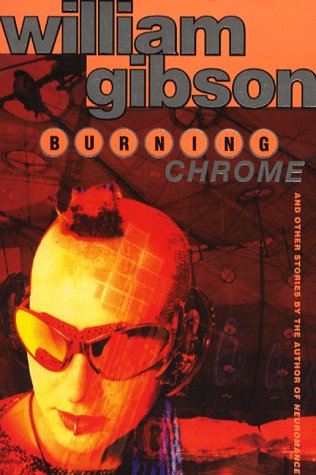
Burning Chrome

and other stories  
by William Gibson
various editions since 1986

A classic collection of sci-fi stories by the writer who invented the term cyberspace and probably did more to shape what our vision of the future looks like in movies than most people realize.

Though technically not a book written for children, I am including it here because I think it's a solid read for teens, and have a review for it up at Guys Lit Wire specifically for that purpose.  I thought rather than cross posting reviews I'd take this moment to talk a little more about the problem of sci-fi in children's writing.  Specifically to ask why there isn't more of it.

As genres go, there are plenty of detective mysteries in children's literature, and books about interpersonal relations between boys and girls to qualify as romance, and certainly enough fantasy to fit any young reader's interest in things from wizards to mermaids to magic.  But where are the stories that speak of the future, a future that isn't entirely a dystopic nightmare?  Where are the stories that look at the problems of artificial intelligence, that propose difficult solutions to our current problems, allegories and cautionary tales, stories about ideas kids can latch onto?

I think we sell younger readers short by not providing them with these stories and having to send them to the adult shelves to find what they're looking for. 

And they are looking for them.  If books like The City of Ember and life as we knew it and The Hunger Games and The Adoration of Jenna Fox and Unwound have taught us anything it's that kids really like talking about the issues these books bring up.  And this is what science fiction does well, it brings up social issues in settings that allow the reader to perhaps see them for the first time and challenge the thinks they think they know or feel.

Perhaps the fear in providing younger readers with science fiction is that they will take the wrong lessons from it, misinterpret the message in a way that binds and blinds.  It was only recently that Ray Bradbury acknowledged that for years people have taken the wrong messages from Fahrenheit 451, that it's not (as its taught in high schools) about censorship, or a reaction to the McCarthyism of the 1950s, but a cautionary tale about the dangers of television destroying the interest in reading.  But even as we misread Bradbury's intent the fact remains that the literature provides a point of contemplation, so I'm not sure the excuse holds up as a reason for a dearth of science fiction for children.

Is the problem Science-based fiction? 

Have we become a society that fears to discuss speculative ideas based on science and technology for fear of an anti-science backlash?  Has science fiction become the Dalits of children's literature, or been smeared with the taint of the creationist-evolutionist battles? My hope is that we can hold back on the aliens, on the life-in-space stories, on all the external elements that get shoved into science fiction for kids, and instead seek out more stories about who we are as a species and where we are headed, or might be headed, down the road. 

Monday, August 9

Old Abe, Eagle Hero

The Civil War's Most Famous Mascot
written by Patrick Young
illustrated by Anne Lee


Traditionally-told biography of a bald eagle who was a wartime mascot, which is sort of odd when you think about it.  I thought so at least. But this book has bigger fish to fry, like the fact that it's riddled with inaccuracy.

"Found" in a nest high in a tree (i.e. stolen from its home) a Native American (here called an American Indian) named Chief Sky raises a fledgling eagle and then trades it to a farmer named McCann who, though he can farm, cannot apparently fight in the war due to his leg so he sends his eagle in his stead.  Old Abe rides a standard into battle for Wisconsin Volunteer Infantry's Company C and, though he has a few close scrapes, comes out alive after over a dozen battles.  Once home, Old Abe lives out his life as a celebrity, with a two-room apartment in the state capital and tours to the Liberty Bell in 1876 for the Centennial.  

All well and good, if it didn't have so many issues that makes the book more fiction than biography.

This is what happens when you do a life-to-near-death style biography and reshape historical events in the process.  One of the problems I have with picture book biographies is when information is diluted for its intended audience who in turn come away with the wrong idea about the story.  Chief Sky, as a boy and so clearly not the adult depicted here, spent hours scoping out the tree where the eagle's nest was, and had to fend off attacks by the eagle's parents.  This is a far cry from the illustration that shows Chief Sky as an adult calmly standing with a baby bird in his hand.  The illustration and text are framed in such a way as to have you believe it was an honorable and humane undertaking, more a rescue than a kidnapping, and not the antics of a boy. 

Next we have Chief Sky trading away his bird when his tribe goes downriver to conduct business with the white settlers.  It would have been just as easy to start the story here, with Chief Sky trading the eagle away without having to whitewash its provenance, and it wouldn't have affected the story at all.  To a point.  What isn't in the story, but I learned from a very quick Internet search, was that the bird was traded away for a bushel of corn. I think that's the sort of detail a young reader would find interesting, and would make for a good point of discussion; would you trade away your pet for something, and if so, what would you be willing to trade it for?

Then later, unlike the way it's presented in the book, McCann is reported as having made several attempts to sell the adult bird, finally finding a regiment that paid McCann five dollars (or $2.50, depending on which source you use) for their mascot.  Nothing about sending the bird to war in his stead, as suggested in this text.

At this point we're barely a fourth of way into the book, and I've grown impatient about trying to sort out what is ans isn't factual, or at least what is presented in a way that a reader doesn't draw the wrong conclusions.  For example, at one point a infantryman is shot and Old Abe is described as dragging "his buddy to safety."  At most, an adult eagle is going to weigh 15 pounds and can rarely lift or carry anything above its own weight... and you want me to believe a bird dragged a man ten times its weight to safety?  A kid reads that, sees that depicted in a book, they aren't going to question it.  Why should they?  We're giving them a book and telling them it's non-fiction, meaning it really happened.  Do we want them to think we're liars?

Best tidbit also not in the story, according to Wikipedia (which, unlike this book, cites references): Old Abe was a female eagle.  I don't fault the Wisconsin soldiers for not being able to correctly sex a bird, but at the very least it could be pointed out and the pronoun "she" could be used throughout the text to indicate that, now, we know better.  It sells an audience short to say they wouldn't understand that mistake, or that they'd get confused by a masculine name on a female animal.  And it continues to perpetrate known falsehoods.  We're back to the myth of Washington chopping down the cherry tree again.

I find it odd that an author who is a science and medical writer (or his publisher for that matter) wouldn't think to include a bibliography.  There is some backmatter about bald eagles, which is nice, but nothing specifically about Old Abe that might correct some of the inaccuracies in the text.  This would be the place to explain how war stories (like eagles dragging men to safety) were sometimes exaggerated by newspapers, or how it's likely that young Abe "danced" when McCann played music because its wings were clipped and it couldn't fly away, or even how Old Abe was actually female.  Also implied with in the subtitle – the most famous Civil War mascot – is the idea that there were other mascots of the war between the states.  Like that Dadblamed Union Army Cow.  Were there others?

I've said this before (and I've written a critical thesis about it for my MFA) I think that when it comes to presenting biographies and other factual materials to younger readers, particularly readers of picture books, those books need to be accurate, thorough, and perhaps even vetted to make sure the information present or implied isn't misleading.  We do no favors to children by teaching them about something or someone new to them if what we teach them is wrong.

Friday, August 6

Picture This

How Pictures Work
by Molly Bang
Chronicle Books 2000


A short study on graphic composition that's an accessible introduction to the subject for the artistically inclined, and those who just want to understand better how illustrations 'work.' 

Picture book illustrator Bang comes to the subject of her book honestly, at the beginning of her introduction.  A visiting friend makes a suggestion about her drawings and then realizes "You really don't understand how pictures work, do you?"  Undaunted, Bang decides to do as she's always done with her illustration career, to learn by doing, and in the process comes up with a book that explains how to compose pictures. 

By showing her trial and error, and by explaining what is and isn't working, Bang gives us a frame-by-frame construction of a scene from Little Red Riding Hood using essentially only two shapes (triangles and rectangles) and four colors (black, white, red, lavender).  Along the way she plays with scale, perspective, balance, focal points, tension, emotion, and other elements that go into the design and layout of an illustration.

In teaching herself these things, Bang originally started by experimenting with third graders before moving on to eighth and ninth graders, and then adults.  Working with cut paper collage and keeping the shapes simple she makes the exercise accessible to everyone, though she admits that it is best understood by teens and older. 

I would consider this a good fundamental text for students who are interested in the arts.  Any of the arts, not just drawing or painting.  The ability to compose an illustration is no different than composing a shot in photography or designing a stage set for the theater.  Animators need to understand how to direct focus, tension, and emotion within a scene, and even creative writers can benefit from understanding the effects of color in setting tone and establishing themes.

Though there are many other books out there that go into far greater detail about how to draw or compose a drawing or illustration, what Bang's book does is make the ideas accessible and encouraging.  A good deal of this probably comes from the fact that Bang herself didn't learn these things formally in an art school setting and so comes about it humbly and suscinctly.

Have have few reference books I would consider required for all students entering high school – Strunk and White's The Elements of Style and Hoff's How to Lie With Statistics – but I'm considering adding Bang's Picture This because, like those other books, it deceptively packs a lot of basic information into very little space and provides a solid foundation for further studies.

Wednesday, August 4

boom!

(or 70,000 light years)  
by Mark Haddon 
David Fickling / Random House 2009 

A middle grade my-teacher-is-an-alien story from the author of The Curious Incident of the Dog in the Night-time.  Entertaining, if strangely familiar. 

While secretly eavesdropping on their teachers, Jimbo and his friend Charlie discover that two of their teachers are, in fact, aliens from another world on the far reaches of our galaxy.  Once the aliens discover that Jimbo and Charlie know their secret, and are coming for them, the boys decide to follow the clues to a remote Scottish locale that serves as an intergalactic transport station. Finding themselves on the planet Plonk, they learn that the aliens are trying to repopulate their planet with humans (specifically sci-fi fans who find the experience cool) but are temperamental to the point of threatening to blow up Earth.  Jimbo and Charlie make their escape with the help of Jimbo's obnoxiously punk sister Becky and, returning home, save the day. 

What starts off feeling very much like Bruce Coville's My Teacher is an Alien and winds up feeling like an lost scene from Men In Black is, as can be gleaned, a goofy send-up of aliens-among-us-and-kids-save-the-day.  It was a breezy read, and one I think most middle schoolers would enjoy, particularly the boys. 

That said, I found it curious while reading the introduction (something I don't normally like to do) to hear Haddon make mention of this being a retread of an earlier published book from 1992.  Odd, because The Curious Incident was hailed (by the New Yorker, among others) as his big debut when, in fact, he had a handful of book published before that.

Oh.  His big ADULT debut.  His books for children don't count. 

I remember feeling the same about Gregory Maguire's "debut" Wicked, knowing he had scads of books nearby in the children's section.  Perhaps we've gotten away from that notion that a children's book author isn't somehow as legitimate until the "break out" into the adult consciousness, but it still chaps me a bit. 

All of that aside, Haddon does a have a way with engaging and funny characters – Jimbo's family is like the most offbeat collection of individuals from a British TV sitcom – and creates a Douglas Adams class of aliens, complete with dated disco-era catch-phrases as their primary form of communication. 

In updating the original 1992 book – with it's unpronounceable title of Gridzbi Spudvetch! – Haddon claims to have started with modernizing the technology only to have changed every sentence of the original.  I like the idea of a successful author being able to revisit an earlier work and make something new out of it.  And if I didn't have a million other things to do it could be instructive to track down a copy of the original and do a side-by-side comparison.  

By the way, I went with the Italian edition's cover (a) because I like the yellow instead of the orange that the English language editions have and (b) because it's subtitle La strana avventura sur planeta Plonk translates as "The strange adventure to planet Plonk," which I kinda like.

Monday, August 2

Diary of a Wimpy Kid: Dog Days

by Jeff Kinney
Amulet / Abrams 2009

The fourth book in the Wimpy Kid series continues with the misadventures of Greg Heffley trying to make it through the summer with as little effort and trauma as possible.  But if that happened there'd be no book...

After the initial blast of the first Wimpy Kid book, and the subsequent popularity, I sort of let the series go as one of those things that's good for a laugh not not, you know, something I felt obsessive about.  Like Charlie Brown and other cartoon creations, once you know who they are as characters you can pretty much guess their travails and it really becomes a question of individual limits.  I know one summer way back when I obsessively read every paperback that had the MAD magazine logo on it, followed by every Wizard of Id collection I could nab.  It's a kid thing, a summer thing, a perfectly solid way to wile away those dog days of late July and August.

Wimpy Kid Greg Heffley starts off by claiming that summer is nothing more than a three-month long guilt trip because while everyone else is outside he'd rather stay in playing video games.  Of course, everything Greg either attempts or is forced to do that takes him away from his game time supports his thinking that he'd be better off indoors and away from everyone.  Which, when you think about it, is a fairly stagnant place for a character to be; anti-social, unable to enjoy anything outside of himself, constantly finding nothing but misery about his situation.  Even his attempts to do something constructive  – start a lawn care company – is driven by his desire to make money to pay off a country club debt and nothing else.  Even when I was laying around reading comics I still had days where I schemed to make money and build massive tree forts that were structurally unsound.

Greg Heffley is a bit of a downer.

But that's what makes him work.  Kids recognize what a downer he is and laugh at him, not with him, in a way that sometimes borders on mean.  I think Kinney comes up with some great situations for mischief and misadventure, where readers can see with devilish glee what unsuspecting Greg is about to get himself into.  But after three books it isn't just wearing thin, its beginning to look like Greg might actually be suffering from sort of brain damage.  How else do you explain a character who, as the mock definition of insanity goes, keeps beating his head against the wall expecting a different result?  Maybe if the kid had something go right once in a while it would make all the other mishaps and screw-ups have more impact.

By now, these books are criticism- and review-proof.  Kids read them, and enjoy them, and despite being mislabeled as graphic novels (they aren't) are perfectly fine amusements. 

Wednesday, July 21

midsummer notice

First, greetings to new visitors to the excelsior file, particularly my fellow VCFA peeps. Thanks for visiting and drop me a line to tell me what you think.

For regular visitors who may be wondering about the reduced activity, I want to assure you that the blog is not going anywhere but may take a bit to get back up to speed.  I am currently looking at some long-term changes and adjustments for 2011.  Yeah, I like to plan, but reviews will return in a matter of days. 

In the meantime, might I suggest combing through the wreckage archives for some older reviews?  Any of you long-term readers think I should revive the Grimmoire?  I've heard alternating opinions about longer vs. shorter reviews – what side are you on?  No, really!  I'm curious!

Thanks for the patience, understanding, and your kind attention.  Or, as the old billboards used to say: Watch This Space!

~david

Friday, June 4

godless


by Pete Hautman
Simon & Schuster 2004

A teen boy questions religion by playfully inventing one of his own based on a water tower, but things get out of hand as everyone who participates views the new religion differently. 

This is a book I've started several times over the last three years and only now finally managed to read it straight through.  It's no fault of the book or its author, I've simply had my attentions diverted elsewhere every time I tried to pick it up again.  This time I had a hard time putting it down.  Sometimes books have to find their moment.

Jason's tired of boring Catholicism.  It doesn't speak to him, and attempts to reach out with youth ministry only push Jason further toward atheism.  One day while helping his science nerd friend Shin hunt snails under the two water tower the boys run into Henry, a charismatic bully who would just as much read sci-fi as knock a kid down.  While musing over the ideas of religion Jason wonders if it isn't possible to start a new religion with the water tower as their god.  The idea, meant to provoke others, takes root in his friend Shin and Jason finds it serves his purposes to promote the new religion with Henry and a cute girl named Magda.  Jason's real desire is to climb to the top of the water tower and he wields his new position as founder of the religion as an excuse to get Henry to show him how to climb it and to perhaps win the attentions of Magda.

But Shin's obsession over creating the bible for the new religion push his rational thinking aside, and Henry's bad-boy behavior does more to win Magda to his side as the new religion fractures, and in the end the kids find themselves in trouble when they discover the can get inside the tower's reservoir and pollute the town's drinking water.

This idea of teens inventing their own religion as a way of exploring what exactly it means to have faith is both rich and organic – I was part of a group in high school who playfully did the same thing as a way to explore the elements of religion with which we found common ground.  In the end, of course, everyone reverted to the religion they were raised with, and the idea quickly lost its hold.  Jason comes out the other side of his ordeal in much the same way I did, which was to realize that having religion is different than having faith.  He clings to his invented religion because within it he can define right and wrong in a way that makes sense to him, in way that allows him to not simply accept the moral contradictions placed on members of many other organized religions.

Hautman does a nice job of keeping the theology light and allowing enough room for a reader to draw their own conclusions.  A good choice for the National Book Award for Young Readers back in 2005.

Wednesday, June 2

Booth

Written by C. C. Colbert
Illustrated by Tanitoe
First Second  2010

A graphic novel exploration of the other half of the Lincoln assassination story, of its key player John Wilkes Booth, that lacks a very crucial element: motivation.

For as much as people refer to the United States as The Great Experiment in Democracy the simple truth is that it's history is marred by a pair of gaping wounds that will never heal out of willful neglect: racism and the Civil War.  Until we can have a frank and open discussion about these rifts, and can come to a place of peace with them, the Great Experiment can never be considered a success. 

Historian Colbert presents a pastiche of the life of John Wilkes Booth in an attempt, perhaps, to show us the other side of the story surrounding Lincoln's assassination.  We first learn of the Booth acting dynasty and the rift between brothers John and Edwin standing in the shadow of their master Shakespearean father.  Edwin, the prodigal, has the talent, but John has the looks, and the brothers are equally divided in their political loyalties once the War Between the States emerges.  While Edwin is content to gain accolades for his acting, John's attentions are split between the stage and his political activities helping the South. At it's simplest, Booth presents John as a racist, separatist villain with no respect for democracy, and his particular brand of theatrical arrogance finds favor among those who would use his access to political figures via his fame for their own ends.

But why does he do it?  How do a pair of brothers raised in the same house come to be divided over their politics during one of the most contentious periods of American history? Is it that Booth identifies with the South on an emotional level – be it an inferiority complex, a sense of entitlement, or simply an adolescent break from the parental confines – or is he nothing more than a pawn in a political game of chess?  What drives the disgruntled beyond grousing and into the realm of sedition?  These are the questions Booth doesn't answer, and given the ability to use the graphic novel medium to present a fairly large canvas it doesn't seem wrong to expect something more than backroom meetings and casual philandering for a shot at starring in the role of a lifetime.  We see a surly, angry Booth but we never know why or what has pushed him to this point.  Indeed, we aren't really shown anyone's motivations beyond the most one-dimensional of explanations.

Which brings me back to the point I started with, this idea that we are a nation scarred by the things we refuse to address.  History is as full of conspiracies and plots and schemes as it is honest efforts and high-minded ideals, but these things all come about by the will of people, and people have their reasons for doing the things they do.  If we cannot discuss their reasons, and do not engage in dialog through the ages over why people were motivated to do the things they did, we risk furthering old grievances and hatreds and misunderstandings.  With a change of scenery and dialog, Booth could easily be refashioned into the story of Lee Harvey Oswald.  I'm not saying the stories are identical, but that their backgrounds are equally murky and their motivations oversimplified.  And we risk the possibility of allowing history to repeat itself with every successive generation so long as we continue to not discuss these divisive issues. 

While I applaud Booth for wanting to address the idea that history has more than one side I find it lacks the necessary depth required for comprehending a difficult time in history.

Friday, May 28

Belly Up

by Stuart Gibbs
Simon and Schuster  2010

When the recently-deceased hippo mascot of a zoo turns out to have been murdered it falls to a 12 year old boy to solve the mystery none of the adults seem to be able to, but not without the help of a girl. 

Did that sound cynical?  Huh, I wonder why.

Could it be another mystery (albeit with an unusual victim) solved by a kid where no adult seems able to get to the bottom of things?  Could it be that the boy, who is all action and no thought, absolutely could not have solved anything without the help of the girl whose father own the zoo?  Could it be because it's impossible to imagine such an immense zoo run by so many incompetent adults?

And don't get me started about ANOTHER book where the boy needs a smart girl to solve the mystery.  

I was trying to understand why this bothered me so much, why there's such a line in sand between smart kids and dumb adults in fiction, and I think it's a misreading of what kids want.  To a kid's perspective everything adults do, they way they think and behave, comes with a set of knowledge that was developed over time.  The world of a kid runs by its own rules and the conflict comes when what they think bumps against the harsh reality.  It's the struggle of trying to puzzle out the world. 

But the way this gets represented in books is that there is an external problem to be solved and only the kids care enough to take it, only the kids are smart enough to get to the bottom of things.  The adults are obstacles meant to complicate plot but not to represent a real conflict between kid-think and adult-think.

So in Belly Up, when Teddy Fitzroy decides he needs to report the FunJungle mascot, Henry the Hippo, has been murdered the police right him off with all the gruff derision of a b-movie cop.  Large Marge, the beat security guard, is physically just a mountain to outrun.  The zoo director Martin del Gato is a Snidley villain to glower (and one can imagine twirling a mustache) and make people's lives miserable because his life is miserable.  The only reason Teddy is smarter than the adults is because he is surrounded by stereotypes and not adults. 

This is no less true in Hiassen's Hoot or Sacher's Holes, though both of those books are better at this sort of game because they bother to develop characters in the process.  For Hiassen there is a dynamic between recent transplant Roy, runaway Mullet Fingers, and his bruiser of a sister Beatrice that underscores their very different personalities and upbringings.  For Sacher there is a layer of magical realism in both Stanley's family history and in locale.  Gibbs tries, I think, to give Teddy a concerned wildlife researcher for a mother that feeds the boy's desire to see justice done over a murdered hippo, but if his mother was really that concerned she would have actually done more to stop the building of this farcical zoo before it ever opened.  I don't buy the "she was promised to supervise that it was done right" argument because principled individuals are wary of too-good-to-be-true offers like this, especially from wealthy industrialists who build mammoth zoos on a whim for the sake of their young daughters. 

Gibbs does write with insider's knowledge of zoos, showing the ugly underbelly of what it means to "educate" and entertain people with exotic animals, but its not enough to pull the book out of the realm of perfect-for-TV-movie-adaptation.

Wednesday, May 26

Sparky

The Life and Art of Charles Schulz 
by Beverly Gherman 
Chronicle Books  2010 

A well-told and nicely-presented biography of the man who created the most loved comic strip of the 20th century. 

Reading this biography of Charles Schulz I found myself feeling as if I knew most of this story from previous sources.  I knew about his first published drawing being in a Ripley's Believe It Or Not panel, about his early drawing exercises, about the real names behind the characters names.  Here and there I found a tidbit I wasn't as clear about – that he won a Reuben award for his Peanuts strip, yes, but not that he actually accepted the award from its namesake Rube Goldberg – and the occasional detail that might have been shielded from my younger eyes in the past (divorce and remarriage weren't the kinds of things that used to be in biographies for children). 

This time, amid the narrative that gambols casually through time and not always 100% linearly, what I was most struck with was how incredibly lucky Schulz life had been.  I'm not saying he didn't have talent or skills, but for as socially awkward as he was and for as insecure he never really had to suffer.  He had his early years in the wilderness immediately following his career in the Army after WWII, but when he landed his first syndicated cartoon strip, it was Peanuts and he spent the next fifty years doing it.  After those first ten years he produced a Christmas special that became an iconic tradition.  Second probably to Mickey Mouse, Snoopy may be the the most identifiable character the world over, and the man never had a full studio or a theme park to make it happen. 

It seems impossible that Schulz could have walked any other path in his life, that he was called to do this one thing and he nailed it.  He didn't dream any of it, so he can't be said to have followed the usual "do what you love" sort of thinking we often impress upon children that leads them to long for stardom.  He had a talent, he knew the job, he sat down and executed it the best he could.

This message isn't overtly stated, and I'm not sure how much that is by design.  I think that biographies ought to strive to present information in a way that allows the reader to draw conclusions while providing a clear picture of the individual being portrayed.  Gherman does that here, and while there are probably few young readers who know the comic strip but might know the TV specials, this book could provide a perfect introduction to the man and invite further investigation.

Monday, May 24

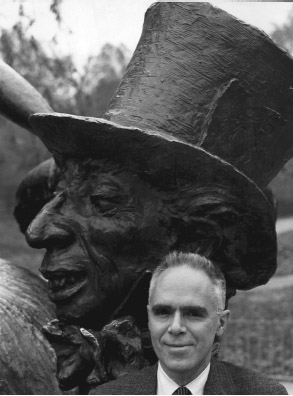
Martin Gardner 1914 - 2010

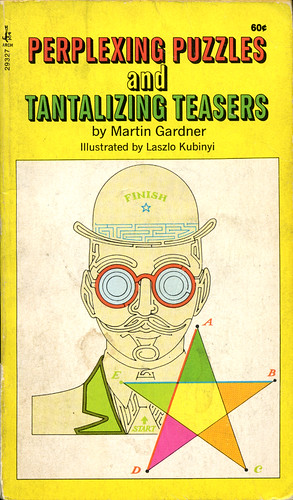
I don't know that I would have cared that much for the books of Lewis Carrol if it hadn't been for Martin Gardner.  I certainly never would have discovered The Hunting of the Snark back in fifth grade, and I don't know that I would have enjoyed lateral thinking if I hadn't discovered Perplexing Puzzles and Tantalizing Teasers around the same time.  As an adult, an educator, seeking sources for presenting logic problems and puzzles to students Gardner's Aha! books reminded me not only of those earlier books but that he had been a much larger influence on my reading then I realized.  

The summer of 1972 my family moved to another part of town, to a new neighborhood.  In those odd, alienated days of late June I remember exploring my new neighborhood and discovering the local branch of our town library.  It was carved into the stage left wing of my new school's cafetorium, a room perhaps ten feet wide and forty feet long.  Seeing that our family of six had just moved from a two-bedroom apartment to a spacious three-bedroom house the smallness didn't seem unusual or limiting to me; cramped living arrangements happened in the world, libraries included.  The library was an open-armed sanctuary with a choice selection of books for a lonely 11 year old boy.  That library and its books shaped a lot of who I am as a person and a reader.  

I was probably looking for books I already knew – Pick a Peck of Puzzles by Arnold Roth seems likeliest – when I stumbled onto Martin Gardner.  I remember Perplexing Puzzles looking very approachable, with clear language and Laszlo Kubinyi's pen and ink illustrations, even though I often couldn't solve the riddles or puzzles.  Unlike many of the other similar books intended for children the puzzles didn't talk down to me as a reader or go for short term entertainment; the problems invited contemplation even after I had given up and gone in search of the answers in the back of the book.

When I went in search of more books by Gardner I was surprised to be led to Alice in Wonderland, exhaustively annotated by Gardner and full of crazy details outlining all of Carrol's logic and whimsy.  I confess, I might not have actually read Alice before then, having probably assumed I knew all I needed to know from the Disney movie adaptation.  I do know that I read and grew a deeper appreciation for for the possibilities of nonsense even when it wasn't thick with hidden meaning.  The invention of words, Carrol's definition of portmanteau words, the rhythm of the language... I can't say I would have picked that up without Gardner and might not have continued my friendship with books and libraries if I wasn't constantly in search of the type of surprise that came with discovering books like Gardner's. 

Edward Lear wasn't far behind, and books of codes and ciphers, Ray Bradbury and Vonnegut closely after that.  Although it sometimes seems like very distinct, wildly disparate times in my reading timeline the through-line from Dahl's Charlie and the Chocolate Factory to Vonnegut's Welcome to the Monkey House is a scant two years.  And in between I don't know how many times I went back to Gardner to help pull at the taffy of my brain and expand it further into shape for lateral thinking.

I don't know that the current generation of emerging adolescent readers have anyone doing for them what Gardner did for me back then, but at least his books are still in print and widely available just in case.

Monday, May 10

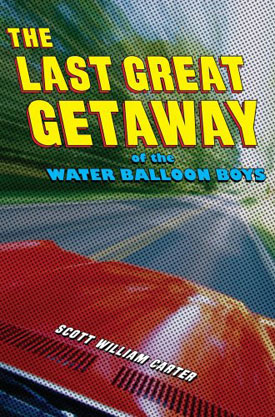
The Last Great Getaway of the Water Balloon Boys

by Scott William Carter
Simon & Schuster  2010 

Two boys hit the road in a stolen car on a journey to both run away from and confront their parental relationships.  It's practically a teenage Roger Corman film from the 1960s, except it isn't.

Sensitive artist Charlie can't believe his mom is about to marry her stiff accountant boyfriend, while at school he's being menaced by bully Leo because he dared to ask Leo's girlfriend to the prom.  He's about to take a pounding after school when Charlie's ex-best friend turned bad boy Jake pulls up in a stolen car (the principal's) and takes them on an unplanned road trip that leads to a dead kid four states away.

The book opens with Charlie explaining that he has to backtrack a few days to tell you how he ended up killing this kid, which becomes the hook that drags the reader the rest of the way.  Who is this kid that gets killed?  Why and how does he do it?  What happened during those three days that made this inevitable?  Read on, read on... 

Charlie really is a straight laced bit of worrywart, and Jake has clearly become a loose cannon since the days when the boys would pall around beaning people with water balloons.  Jake smokes, steals cars, makes out with girls casually, and generally is the sort of kid Charlie would have to be warned to stay away from.  But when Jake comes to his rescue Charlie can't shake that somewhere beneath this tough boy act is the same kid he used to call a friend.  Being weak-willed, Charlie goes for the ride as they outrun cops, hitch a ride with a suicidal girl they meet on the road, and try to make things right even in the midst of screwing things up with every turn. 

That Charlie, the "good" one of the two, manages to be the one who pulls the trigger (it's self defense, but the boys aren't in the right) underscores the point that if he were truly good he had dozens of opportunities to get out of the car and away from Jake.  Of course, Jake the "bad" one has good reasons for his actions, even if he masks them behind his arrogant braggadocio.  In the end it's a frantic, unplanned, twisted road trip of two teen boys working out their father issues and the unfinished business that broke their friendship.

The story breezes like a screenplay for a two-teens-on-the-run type of story.  It doesn't seem promising when it opens with the typical trouble-at-home, trouble-at-school scenario, but it quickly burns rubber from these scenes and turned out to be better than I had expected.  I don't know what I expected.

Maybe it has to with the title.  The Last Great Getaway would be fine of there were other getaways prior to this, but it's all one, long, single getaway so that seems misleading.  It's also pretty generic sounding, so I understand adding of the Water Balloon Boys, except for the fact that it suddenly makes the story sound a lot more juvenile than it really is.  The first half of the title could be Raymond Chandler and the second half Neil Simon.

Thursday, May 6

How to Survive Middle School...

(without getting your head flushed) and Deal with an Ex-Best Friend, ... um, Girls, and a Heartbreaking Hamster
by Donna Gephart
Peachtree Press / Random House 2010 

I think the only thing the title doesn't include is the main character's love of Jon Stewart, and perhaps the fact that he isn't legally old enough to have a YouTube account... 

David Greenberg is a bit of a nebbish who wants so much to be like Jon Stewart when he grows up that he spends his free time creating a one-man TV show called Talk Time.  The show comes off like n amalgamation of different late night elements – a top six-and-a-half list, a quasi monologue, and a regular feature called "The Moment of Hammy" featuring David's pet hamster.  But just before the first day of school David and his best friend Elliot have a falling out and – because you can't have a middle grade story without a bad guy – Elliot teams up with the school bully to make Elliot's transition to middle school a nightmare.  The girl of the title is Sophie, a whipsmart, previously homeschooled girl who not only loves his videos but manages to get them a wider audience that spreads all the way to the top.  And by that I mean they get the attention of the producers of The Daily Show with Jon Stewart.  In the end scores are settled, amends are made, and David might just survive middle school after all.

I've been knee deep in a fair amount of middle grade books with boy main characters lately, and I've had a difficult time reconciling these characters with real middle grade boys. It isn't that they're way off base in characterization so much as they all seem so narrowly focused.  And I don't necessarily mean self-centered (though there is a bit of that) but that their desires and behaviors are confined to a personal goal, a school-based conflict, a home-based conflict, and a resolution that comes with external aid or understanding and not entirely from within the character themselves.  I guess I'm sensing a formula, and by the looks of it I'm going to have to conclude it's a successful one in terms of getting published.

Something else that always comes to mind is that readers of this age tend to be younger than the main character by a few years.  In this case the ideal reader is going to be nine or ten years old.  So what is an older elementary school reader going to get from this reading experience?  The idea that middle school is something to fear?  That you should be career minded by the age of eleven?  That all it takes is a YouTube account and a girlfriend with a homeschool network to become famous enough to take newspaper interviews and land on national television?

I suppose the other thing that eats at me is this idea of a bully as a stock character to be overcome without addressing the actual problems or solutions of bullying in the first place.  The bully as an obstacle, entrenched as a brick wall, with no attempt to understand the reasons beyond the superficial "he has no father" or "she's just insecure."  As we've seen in the news lately, though it's hardly new, the reasons for bullying and the way students and adults deal with it is far more nuanced than some kid offering up knuckle sandwiches or adults saying "There oughta be a law."

In How to Survive Middle School... Tommy Murphy is a kid whose name screams stock character from the rafters.  If it had been written that he was born in the back of an Irish bar, I wouldn't have been surprised.  "That kid's crazy mean" David's cousin Jack warns him, and apparently that's all you need to know.  Like Checkov's maxim that a gun in the first act will be fired by the third, an off-screen bully introduced at the beginning of the story is going to be nothing but a menace throughout.

At this level the bully ceases to exist as a character and simply becomes a device.  An antagonist without a narrative arc of their own who stands out like a two-dimensional cut-out in a crowded room reduces the other characters to little more than plot devices themselves.  Yes, a main character needs obstacles to overcome, but they need to be organic to the story, they need to rise from the characters desires and not simply a road block plonked into the middle of the road.

So I guess in this roundabout way I've decided that for David Greenberg the only thing that stands between him and fame is... nothing.  Because despite his mom having run off to be a hippie beet farmer, his best friend taking sides with the cardboard bully, and being liked by a new girl to the school, all of poor David's conflicts have nothing to do with whether or not he can achieve notoriety for his videos.

Tuesday, May 4

City of Spies

by Susan Kim & Laurence Klavan 
artwork by Pascal Dizin 
First Second Press 2010 

This World War II espionage graphic novel set in New York is nothing short of an American cousin to Tintin, right down to the ligne claire style of artwork and youngsters in peril and adventure. 

It's 1942 and young Evelyn is getting dumped onto her NYC Aunt Lia so her dad can get married again.  Used to being left to her own, she creates the continuing comic adventures of Zirconium Man and his sidekick Scooter, who resembles Evelyn.  After a rocky start, she teams up with Tony, the super's boy, and they spend the summer searching the streets of New York for Nazi spies.  When Evelyn discovers a code template and works out its meaning, she and Tony attempt to route out the spies themselves, but they get in way over their head and find themselves hoping they've left enough of a trail that they can be saved in the nick of time. 

This doesn't even scratch the surface of what is going on in City of Spies, which is part of what makes it a rollicking adventure story.  The fact that Evelyn's family is Jewish, that they live in an ethnic neighborhood where everyone is desperately trying to cover their ethnic roots behind red, white, and blue patriotism, not only gives some great background to what wartime America was like but serves as a subtle echo to modern times where post-9/11 businesses were forced to place American flags in their windows for the same reasons.  As Evelyn and Tony discover, it's easy to see foreign agents wherever you look, and far too often it's the people who have assimilated themselves all too well who avoid suspicion.

At times I found Evelyn's comic book interludes to be a bit contrived.  They exist to give insight into how Evelyn is feeling – about being abandoned by her father, about losing her mother, about the nightmare of creeping Nazi fascism – and they rarely added enough to be worthwhile.  I was grateful at the end when her comics shifted toward an Evelyn-and-Tony team of Indiana Jones-type of adventurers, her fantasy realm now based on a cooperative friendship instead of paternalistic heroism.

The writing in brisk and well paced, with enough story for the secondary characters to move around in as well.  Dizin's art and color palate does Herge one better in presenting New York as a city with more that six colors; I don't fault Herge's limitations, he was one of the best at the time, but color processing was different 70 years ago. Would it be too much to hope for more Evelyn stories, adventures of a spunky girl in peril set in the mid-century that entertain against a historical background?  It might take a bit of jiggering (dad moves to New York so Tony could continue to be involved?) but I suspect this would hit the Tintin audience – boys and girls alike – and do very well.

Wednesday, April 28

The Castaway

by James Stevenson
Greenwillow 2002

In 1937 Hubie the mouse and his family go to the movies where they see a horror film typical of the day: The Island of No Return.  Although the young mouse is clearly freaked out by the movie's tidal waves and volcanoes, Hubie tries to play it cool.  At home, a postcard arrives from Aunt Ella vacationing on Barabooda Island, which gives Hubie's family the idea to vacation there themselves.  Despite Hubie's objections, they board a dirigible for their trip and very quickly Hubie wanders off to distract himself from his fear of heights.  Falling out of the dirigible, Hubie lands on a nearly deserted island occupied by a castaway named Leo.  On Leo's island he has fashioned many things to amuse himself – a drum kit, a baseball stadium, a mini golf course – and Hubie ends up having a great time. On an ill-fated test run of Leo's new "car," Leo and Hubie fall in a river, go over a waterfall, and land safely on the dirigible.  Hubie reunites with his family and proceeds with the vacation as if he had never been gone.  Back at home his family is confused by the pictures Hubie had taken – they don't appear to be of the same island they vacationed on – and he's ready for the next family trip... to Mt. Everest? 

The rambling narrative in this hybrid picture book/comic is typical of the kind of thing one of my writing teachers used to refer to as the "one damn thing after another" sort of story.  Initially I bristled at this sort of description of a narrative because, in my scholarly MFA haze, I believed it was a possible approach to storytelling that would appeal to boys and was not bound by the hard and fast laws of Aristotlean thought.  What I've since come to understand is that the real problem with this sort of structure is that it is difficult to pull off, and as a result it is easy to declaim it as an inferior narrative device rather than confuse young writers with nuance. 

If this seems like far too heavy an approach to a children's picture book allow me to suggest that underneath the visceral "I like" and "I don't like" there are sometimes sophisticated reasons beneath what "works" and doesn't, and puzzling out what causes that rift I find useful.  In The Castaway what doesn't work is that the one-thing-after-another (which for a variety of reasons I think of as an Ovidian structure) doesn't convincingly build to it's conclusion.  In the beginning we have Hubie who is clearly afraid, and in the end we have Hubie the fearless, and in between we have a series of events that happen to him that show no shading of his changing emotional state.  It doesn't "work" because it doesn't satisfy our desire to see exactly how the character changes.  Events happening to a character don't necessarily change a character unless we can see how. Things happen just because, and we all understand how unsatisfying "just because" can be as an answer. 

Along those same lines I think Stevenson gets away with it because he can, because his stature as a children's illustrator is high enough that he can put together a story like this and not be challenged at the editorial level because the publishers can bank on his name making more sales than if an unknown were to put out a similar book.  Don't misunderstand, I genuinely like Stevenson's loose ink drawings for the same reasons I like Quintin Blake's work; both artists have a shabby gestural style that is immediately recognizable and for the most part fun. 

I wouldn't say I had high hopes going into this book, but it did surprise me that Stevenson had put out essentially a graphic novel for the picture book set before it fell into vogue and I was curious to know why it hadn't shown up on my radar before.  Now I know.  Style and concept can't carry weak execution on the narrative level. 

Thursday, April 22

Doctor Proctor's Fart Powder

by Jo Nesbo
translated from Norwegian by Tara Chace
Aladdin 2010 

Proving that some humor is universal, this Norwegian import is a romp worthy of all the comparisons to Roald Dahl that I've read in other reviews.  

Tiny Nilly moves to a new neighborhood in Oslo and discovers that his neighbor, Doctor Proctor, is a bit of a nutty professor who invents wacky, seemingly useless stuff.  Like an industrial-strength fart powder that doesn't smell and can hurl a human into the atmosphere.  Enter the villains, a set of twin boys named Truls and Trym and their Hummer driving father who plot to steal the powder and sell it to NASA before the good doctor can.  And just because this sort of premise isn't weird enough there is a man-eating snake in the sewers and the problem of there being no gunpowder to set off the cannons on Norwegian Independence Day.  Oh yeah, it'll all come together in the end. 

If the subject of farting as an integral part of the narrative turns you off, if it would prevent you from enjoying a funny and engaging narrative, then that's a shame.  While I certainly don't condone gratuitous use of potty humor to engage young readers we have, for better or worse, lost those days where a story like this could be told about belching or something more innocent.  In fact if I think too hard about this there's a quite bit of The Absent Minded Professor in this story, which makes it hardly the most original idea.  But Nesbo keeps things light and, uh, airy, and fills the story with bits of the preposterous that make it genuinely funny.

Like flushing poor Nilly down a toilet so he can escape a prison cell and swim (yes, swim) through raw sewage in order to escape, but becomes swallowed by the boa that lives there.  And there's Nilly, watching as the snake's digestive juices dissolve the rubber on his shoes, accepting his fate and not the least bit frantic (maybe a little nervous)... until he notices something promising about some of the other contents in the snake's stomach.  Without giving too much away, Nilly does indeed escape and Nesbo gives this image of a snake flying out the sewer drain and flailing around the skies above Oslo's harbor like a giant balloon quickly deflating.

Nesbo has, until recently, been an award-winning writer of detective fiction in Norway and this is his first foray into children's literature.  Normally I get a hinky feeling when I hear about successful adult writers tapping the children's market because sometimes it feels like the author is trading on their name, and the publishers are simply going with a known quantity over seeking out quality.  That isn't the case here as Nesbo clearly knows how to entertain the audience with clever, goofy humor.   And I sincerely hope that the second book, Doctor Proctor and the Time Bathtub, manages to find its way to translation soon.

ALA question: Could this be a contender for the Mildred L. Batchelder award, or is it not serious enough?

Tuesday, April 20

The Adventures of Jack Lime

by James Leck
Kids Can Press  2010

A trio of hardboiled detective stories for the upper middle grade set.

Jack Lime is a kid people go to when they need to have problems solved.  Problems like cheating boyfriends and missing bikes and gambling rings and kidnapped... hamsters.

As with all detective stories, Lime has to wade his way through the sort of half-truths and double-crosses he's presented with, trying to reconcile what peopletell him with what he has to piece together through observation.  And as with all who meddle in the affairs of others there is a price, usually a punch to the face or the breadbasket.  Getting around the issue of doing a job for hire, Lime does what he does for the favors he can collect and use as barter down the road.  He's a lone wolf (orphaned, living with his grandmother), worldly (from big city LA to small town Iona),  who can usually solve the case but rarely gets the rewards he deserves.

Written in the first-person tough-guy voice of classic hardboiled fiction, Jack Lime is the closest I've seen to anyone grafting Raymond Chandler's Marlowe into children's literature.  Not that other's haven't tried, but those others all suffered from the strain of their own efforts to appear clever and arch.  Leck has managed to find just the right tone and though it is still an affectation of style it comes off as effortless and natural. 

And it's appropriately short.  I would have been happy for any one of these cases to be a book unto themselves, but that Leck gets three satisfying stories into 126 pages makes its case against those books that drag out a single drama for upwards of 275 pages.  Present the case, get on the job, land in some trouble, wiggle out of trouble and solve the case.  No need to get clever and drag things out endlessly.  The "crimes" are within the realm of possibility, if slightly exaggerated to match the genre, solved without the use of unbelievable talents, and doesn't pit whiz kids against idiot adults.  I think this is my new standard for what can and should be done with detective stories aimed at the older middle grade reader.

Tuesday, April 6

The Wonder Book

by Amy Krouse Rosenthal
drawings by Paul Schmid 
HarperCollins 2010


A fine collection of illustrations, accompanied by an okay set of poems. 


I admit, sometimes I come to books from odd directions, especially illustrated books.  A good deal of my life has been dedicated to a number of visual arts and occasionally that is the greater draw for me.  I'll forgive weak content over strong visuals, and sometimes I'll even miss the weak content.  Not here, though. 

Paul Schmid is an illustrator I would hire to do spots drawings for my mythical magazine I hope to one day start.  His black and white line drawings do echo Silverstein, but there's often more than meets the eye.  They have a childlike whimsy and an innocence about them, his characters all blobby and bendy and spindly at the same time.  And there are the odd details that beg you to dig further, to look back at the text, and find the invisible connecting thread between them.  Yes, I'm talking here about the elephant on the page.  Literally. 
Too bad I hid a boot.
Rosenthal's palendrome is nothing new – I have it in at least two other books I own – so it falls to Schmid to give us a new reading with his picture.  And what do we have?  A small boy in a striped shirt (or old fashioned one-piece bathing suit) holding a shovel and a pail and wearing only one rain boot.  Cute, but that's not all.  Flanking the boy on either side are a pair of elephant rear ends, both facing the boy.  For a boy who looks primed to try and shovel several pounds of maneuer into a two pint bucket it is, indeed, too bad his is minus a boot. 

Not every illustration contains such quiet gems, but then the poems don't always exactly inspire more than a literal representation.  Which is not to say this is a terrible collection, but it is a weaker one for the effort.  I think it is far too easy with poems for children to go for the rhyme or the unusual without actually stretching the imagination.  When I look at poems for children  – especially humorous poetry – I am looking for something that would make both me and the reader wonder how a mind could come up with such images, such quirkiness.  Puns and palindromes and the recasting of nursery rhymes are fine, but lacking a theme or the spark of something truly unique the collection becomes pedestrian. 
This little piggy played the stock market
This little piggy loved a gnome
This little piggy was a toast thief
This little piggy loved a nun
(And the French little piggy went Oui Oui Oui all the way home)
This is the sort of thing writing students toss off to keep the juices flowing, a game of Tweak the Familiar.  It dosen't really satisfy as nonsense because it doesn't take enough of a risk to differentiate itself from the original or stand out on its own.  

The lasting effect of this collection was that when it was over I had to start over again because I couldn't remember a single poem.  But the illustrations were fun.  

Friday, April 2

Garmann's Street

by Stian Hole
Eerdmans Books 2010

The photoshopped freakishness of Garmann's Summer returns with another look at a socially awkward boy and the near-death, stamp-collecting retiree he is drawn toward. I'm beginning to think Garmann is the son of Death...  
 
Garmann doesn't exactly fit in well with his peers, and here his peers are a bully boy and the fence-sitting twins who fawn over him.  When bully boy kinda-sorta dares Garmann to light some matches you have to expect what happens next: the overgrown grassland that is his neighbor's yard catches fire and everyone bolts except for Garmann who, oddball that he is, takes off his flimsy t-shirt and attempts to bat the fire down.  But this incident exists to introduce Garmann to his neighbor, a retired postman all the other children (perhaps rightly) fear.  He's a daft old man, this postman, who natters on about stamps and the number of days in a life and other bits of philosophy that would fly right over the head of most kids.  In the end both Garmann and the postman are happy to have met, with a subtle indication that now that they have the postman can die happy. 

If my reading of this story is off it's probably because I was struck early on that in this sequel to Garmann's Summer we once again see a boy more socially comfortable in the presence of the elderly who appear to find comfort in the boy.  It's as if Garmann we're Death's cute little boy from down the lane come to prove that his dad's not the meanie everyone thinks he is.  "How could Death be so bad and raise such a nice, well-intentioned little boy," they might reason.  And throughout there are visual clues – crows and dead trees and stamps of famous dead people – that suggest what the text does not: that the end is near for someone on that block.

Most frustrating is how these other children exist as a measuring stick for Garmann, but their interaction is superficial at best, and are merely a flimsy shorthand for character types.  True, outcasts often get their unfair share of bully boys and snooty girls, but there has to be something for them to aspire to, especially if the main character is a bit touched themselves. 

I feel like I'm missing something, or that something didn't translate well from the original Norwegian text.  Is Garmann truly shy or is he just dim?  Are these books intended to show children to pay closer attention to their elders, or is it just a romp where a boy deals with (as publicity material states) "the fun and crazy personalities" of his neighborhood?  And, sheesh, are these digitally maipulated illustrations grotesque.  I'm not saying picture books have to hold to some great barrier of beauty or whimsy, but they should at least be somewhat friendly. This is one of those books I bet no child picks up willingly, or asks to have read over and over.

No child except Garmann, perhaps.