by Jonathan Maberry
Simon & Schuster 2010
Deja vu? Perhaps. I am cross-posting this review from Guys Lit Wire today.
The zombie apocalypse has happened. Never mind how, it just did, fourteen years ago when Benny was eighteen months old and was spirited away from his parents by his half-brother Tom before they became victims themselves. Since then, the living have taken to enclosed cities and let the undead roam in what is now called the Rot and Ruin.
Fifteen is the age of maturity, and that means getting a part-time job in order to continue receiving rations. Benny, like many teens, doesn't really want to work, and he certainly doesn't want to take up the family business of becoming a bounty hunter of the undead. Worse, his brother Tom is legendary, but all Benny knows ans remembers of his much-older brother is that he was a coward who ran away and left their parents to become zombies.
There are plenty of other bounty hunters though, guys like Charlie and The Hammer who told war stories of their times in the Rot and Ruin and talked up their kills in ways Tom never did. Benny could never understand why his brother never talked about work, or why Tom was so revered by town elders, but he finds out quick enough when he finally agrees to become his brother's apprentice after failing at pretty much every other job he attempts. One trip into the Rot and Ruin changes everything Benny ever knew, or thought he knew, about what it means to be human, both living and undead.
While zombies are currently in vogue and it would seem there is little to add to canon of kill-or-be-killed, Jonathan Maberry's Rot & Ruin takes the idea of a world full of the undead and makes it a dystopia where questions of good and evil become slippery. Is a zombie out for brains any worse than the people who use them for blood sports? Can the dead and undead coexist in a delicate test of God's will, and what of the moral ambiguity in believing that murder is wrong but murdering zombies is okay; after all, zombies were and are still human beings, right? And what sort of "civilized" society has been preserved when, in financial desperation, the living would subject themselves to enter a fighting ring to do combat with zombies for the entertainment of others, where a blind eye is turned away from those citizen who organize such contests?
The zombie apocalypse could stand in for anything – a plague, global thermonuclear war, or even world-wide environmental collapse. What Maberry poses is that no matter how it comes about, how we behave afterward defines who we are as a society, and what Benny learns quickly is that his whole life he and his friends have been sheltered from the reality that the post-apocalyptic world is not a pretty place. Whacking zombies sounds like fun until you begin to attach names and families to the undead, until you realize that the "other" you're out to kill could easily be a friend or relative.
I can't be the first person to think this, but I've been wondering about the rise of zombies in popular culture recently and in doing so came to an oddly chilling conclusion. When monsters have become popular in our cultural entertainment they usually do so as a surrogate for some other fear. Nuclear war and radioactive fallout gave us the mutant monsters of the 1950s. The rise of horror films in the 1980s reinforced messages of morality at the dawn of the AIDS epidemic. The rise of vampires has been slow and steady for some time, but dawning of zombies is more than a replacement for any trend, it seems to tap into a deeply rooted fear of something in Western culture that is dark and difficult to understand or deal with in a rational way.
Like fundamentalist terrorism.
This may have been the farthest thought from Maberry's intention with Rot & Ruin, but in showing the remains of civilization as a gated community under constant threat from brain-dead outsiders who are, by lack of choice, simply trying to survive, I can't help but see the metaphor for what we are seeing today in the world. While the United States continues to promote and preserve its freedoms as a gated, civilized community, the rest of the world remains a threat to those very ideas simply by wanting an equal chance at the good life. Of course, to make this analogy I would have to equate the zombies for Islamic fundamentalist terrorists out for blood, but isn't that the image we inside the gates are fed all the time by politicians and the media? And what if, like Benny, we come to learn that these people are just that, people, and that as long as we continue to demonize them or use them for our own expendable purposes we will forever be at war.
Politics aside, its an engrossing take on the dystopic zombie apocalypse, and a solid adventure that can be enjoyed at the surface level as well.
Wednesday, November 10
Rot & Ruin
Labels:
'10,
apoca-lit,
dystopia,
jonathan maberry,
politics,
simon and schuster,
zombies
Wednesday, October 20
abandoned: Mockingbird
by Katherine Erskine
Philomel / Penguin 2010
Everyone's been raving about this book. It just got nominated from a National Book Award. It's been on the periphery of my radar so I figured it was time to pick it up. Twenty-five pages later it was time to put it down.
There is no worse feeling than to not like a popular book and feel, somehow, like you're defective for thinking it. Worse if you like to think of yourself as a writer, because when you go against the grain (and then do so publicly in a place like a blog) you're almost certain to alter people's opinions of you. Not necessarily for the better.
Is it wrong to feel like the first-person child narrator with Aspergers is a tired trend? Is it wrong to even think of it as a trend? Curious Incident of the Dog in the Night-Time. The London Eye mystery. Emma Jean Lazarus Fell Out of a Tree. Three or four other titles I've read in the last year or so whose titles I cannot remember.
So what's my problem anyway? Do I not want kids to read about characters who are different then themselves, to better learn and understand about differently-abled kids and to show some respect and tolerance? Isn't calling these stories "tired" akin to saying the same thing about vampires?
Here's the deal: when I'm reading, and there is something about the narrative that continually pulls me away from the story being told, I no longer enjoy the reading experience. Erskine's narrator is ten year old Caitlin. As a child with Aspergers I am willing to accept that she finds a certain disconnect with the world, with an inability to read facial expression or to know how to respond to people without taking the world literally. What I have a hard time with is a ten year old with Aspergers being all these things and yet more articulate than any ten year old I've ever met, including highly gifted ones. I realize this conceit is necessary to give the reader a sense of what is going on while at the same time trying to put them inside the head of main character, but on every page I kept finding myself unable to suspend the disbelief.
I'd also like to see more stories told from the perspective of the friend of a child with Aspergers (or ADHD for that matter) who don't doesn't really understand what makes their friend behave the way they do but is fine with them anyway. Sort of like the idea of having a gay character in a story where the story isn't about the character being gay, it's just who they are. In the long run isn't that what we want from the readers, from children, to be able to recognize these differences and not have them matter in a way that causes them to be viewed as "other" than themselves?
I am not closed to the idea of revisiting this book down the road if someone can truly convince me that I can't just read the last thirty pages of this book and feel like I missed something in the middle that I haven't seen before.
Labels:
'10,
abandoned,
asperger syndrome,
katherine erskine,
penguin,
philomel
Monday, October 18
Mercury
by Hope Larson
Atheneum / Simon & Schuster 2010
A tale of gold prospecting and romance and karmic debts paid off over several generations with just a kiss of magical realism in this graphic novel.
In the settled Canadian province of Nova Scotia the Fraser's of French Hill have settled into a life of barely sustainable farm life when the mysterious stranger Asa Curry comes calling. He's discovered gold on the Fraser property and looks to help mine it with a share of the proceeds. In the Fraser household daughter Josey has become smitten with Asa and over time he becomes the forbidden fruit she pledges herself to. But there's something dark about Asa that causes Josey's mother to worry that he is a harbinger of death.
One hundred and fifty years later the Fraser house has remained in the family but has burned down, causing the current Frasers, Tara and her mother, to become displaced. While her mother works to find a new job and get settled in a new town, Tara returns to attend high school and, with the aid of a mercury-filled pendant that's been in the family for generations, solve a mystery that connects Tara's story with Josey's. The phoenix out of the ashes of the house fire, as it were, allows Tara and her mother the chance at a new life that was denied their ancestors.
Jumping back and forth between stories it becomes clear that Tara and Josey's stories will cross paths, but with Larson that doesn't mean it is easy to guess. The tale of the stranger with seemingly magical (and dark) powers is not unusual for the 18th and 19th centuries, and here those elements are handled as matter-of-fact as we treat the "magic" that allows us to use cell phones today. This is Larson territory, where the magic is real, and she leaves much for the reader to discover and define for themselves. Crows with faces of people, "spells" that can see the future, gold-seeking pendants and yellow snake guides are blended with they typical stories of teens encountering first loves and exploring territories as mysterious to them as anything else in this world.
Larson's pacing and scene-setting is measured and exacting – nothing moves too fast or too slow – poetically cinematic in flow. Having the panels set in the past against black backgrounds, while the present day sections are set against traditional white space, almost seems superfluous because we can the different ages by costume, but in a black and white comic it has the effect of turning the past almost sepia. The visual darkness takes advantage of our knowledge of the pasts limitations and shrouds them in the darkness of a time before we became "illuminated" and magic was replaced by science and logic. Larson's magic is elemental – mercury, gold, fire – with powers we can barely contain. How is that not like love?
Wednesday, October 13
Yummy
The Last Days of a Southside Shorty
by G. Neri
illustrated by Randy DuBurke
Lee and Low Books 2010
The tragic account of an act of inner city violence that briefly gripped the nation and put a young face to seriousness of the problem.
In the spring of 1994 there was a shooting in the Roseland area of Chicago, on the city's southside. Robert "Yummy" Sandifer, age 11, out to make a name for himself in a local gang called the Black Desciples attempted to shoot rival gang memebers and killed 14 year old Shavon Dean by accident. With the aid of the Desciples Yummy hid from police for three days but was then found shot dead by members of the gang he was trying to impress.
Yummy: The Last Days of a Southside Shorty tells the story of those last days from the perspective of a fictional narrator named Roger who, under better circumstances, might have been Yummy's friend. In unraveling the story after the fact, Roger attempts to see Yummy's life from all perspectives, to try and understand how someone as young as him could end up both a killer and killed at such a young age.
Yummy is a true tragic character. Neglected and beaten from an early age, parents in and out of jail, lost through the cracks in social services, Yummy is a poster child for what was (and still is) wrong with the inner cities. He starts out shoplifting and holding up people at ATMs with a toy gun, then moves to stealing cars for members of the local gang. These attempts to get attention and find himself a stable and safe family are almost textbook examples of how kids end up in gangs but what was so shocking to many was how young Yummy was as he ascended into gang life. The gangs use younger kids – nicknamed shortys – to do their dirty work because they can't be tried as adults. And there's always an endless supply of kids looking to impress the gang leaders and become "made." The mortality rate in the socioeconomically depressed areas makes a gang member over the age of 19 is a senior citizen. Yummy barely made it half way there.
The ugliest side of this story was that when Yummy was on the run there were people who knew where he was and didn't really act on his behalf. The gang only hid Yummy initially because they wanted to keep the heat of their activities. When Yummy, acting as a scared 11 year old naturally would, calls his grandma to pick him up he gets swept up by local people who want to get rid of him as quickly as possible for fear of attention being drawn on them. It isn't clear why the women who are keeping him "safe" until his grandma can fetch him are quick to let him go with a pair of Desciples who clearly out to clean up the mess Yummy made by driving him to a secluded location where he would later be found dead. The implication is that the moment Yummy pulled the trigger on the gun he was officially on his own and no one would be able to save him – a chilling thought the reader gets to chew on long after they've closed the book.
Neri isn't interested in taking sides here or pointing the figure but instead lets the various sides of the story speak for themselves, trusting the reader will understand that sometimes there is no right answer, that regardless of circumstances there is always a choice and that you need to be careful about the choices you make.
There's a grittiness to the black and white illustration in this graphic novel that both fit its dark mood and, for me at least, push the issue back into history. And if I had any criticism it's that the story does feel pushed back in a way that might make it easier to dismiss. Given that teen readers will barely have been born when all this originally took place it might be seen more as an historical graphic novel and not a reflection of modern times. I think it might have been nice for there to be some back matter or a coda that tied these events to the present and perhaps made the readers feel more inclined to want to change the way things are.
======
This review is cross-posted over at Guys Lit Wire today. Guys Lit Wire, where reviews of books of interest to teen boys are posted fresh each weekday.
Labels:
'10,
comics,
crime,
g neri,
gangs,
graphic novel,
lee and low,
randy burke
Friday, October 8
Copper
by Kazu Kibuishi
Graphix / Scholastic 2010
A collection of occasionally-connected comic strips about a boy and his dog and a very strange, strangely reminiscent world...
As a boy named Copper walks home with his dog he imagines his backpack is a jetpack that takes him zooming around the skies. Instantly he's surrounded by other jetpack fliers... who all are dropping bombs on a city below. The fantasy ruined the boy returned to reality and sadly walks away. This is the first adventure and typical of many of the early single-page comic strips in this collection. At first the adventures all end with Copper coming back to reality from a dream, often with clues that influenced his dreams surrounding his room. Soon, recurring characters and situations surface. Who is the girl trapped in a bubble in his dreams, and does she have any connection with the girl in reality who keeps lobbing drawings and mash notes at him from afar? Soon the waking aspect of the stories disappear – is it all a dream, or an alternate universe? Are they trapped on an island? Where can I find a melon bread stand with doughy goodness made with love?
It has to be said: the earlier strips in this collection borrow very strongly from Windsor McKay's Little Nemo in Slumberland comic strip from a hundred yeas ago. Not bad source material to borrow from, but I was worried in the beginning that the stories would be fancy and fantasy and derivative. And there are other cartoon references as well, including an early tip to Charles Schulz and Charlie Brown's love of a little read-haired girl. Or the fact that it's a boy and his – is it a beagle? –who waxes philosophically and may not be as intrepid a traveler as he seems.
After a while the one-page stories grow to several pages, some stories connect in a semi-linear fashion, all of it takes on a certain veneer of other-ness. Kibuishi may be familiar to those who have are following his Amulet series, or the Flight collections he edits annually. The style here is featherweight compared to his other work, and the worst on could say is that it's a nice collection. Of comic strips, mind you, not a graphic novel; there's no through-line or coherent cohesive structure here that grants it novel status. Perhaps down the road Kibuishi will take Copper out for a lengthier adventure and perhaps answer some of the many question left unanswered here.
Labels:
'10,
charles schulz,
comic strips,
graphix,
kazu kibuishi,
little nemo,
scholastic
Wednesday, October 6
Brains For Lunch
A Zombie Novel in Haiku?!
by K. A. Holt
illustrated by Gahan Wilson
Neal Porter / Roaring Brook Press 2010
zombied middle school
desegregation among
living and undead
haiku and romance
bullies and librarians
imperfect but fun
Loeb's a zombie
smart, but he hides it from friends
has brains, eats them, too
cute librarian
suggests Loeb enters contest
reading his haiku
smitten, he agrees
meanwhile, fends off bullies
both living and dead
enter the girl
Siobhan, a gothic Lifer
snake oil peddler
she defends Loeb
seems interested in him
but Loeb has doubts
a living girl
and an undead zombie boy
is love possible?
Loeb wins contest
has a heart-to-undead-heart
and gets the girl
Holt combines haiku
zombies and middle school life
(with racial tensions)
a humorous spin
of traditional school yarns
freshly presented
though not true haiku
much like this review's format
sometimes feels forced
but is zips along
short chapters, ghoulish pictures
what's not to like here?
Labels:
'10,
gahan wilson,
haiku,
k.a.holt,
middle school,
neal porter,
novel in verse,
roaring brook
Monday, October 4
Smile
by Raina Telgemeier
Scholastic 2010
The memoir of the author's teen years told in graphic novel format focusing on her orthodontic adventures following a severe injury.
Everyone has a story tell about themselves, and in theory everyone has a reason for telling that story. We do this all the time in conversation when someone mentions a topic and our memories spark with a story, account, or anecdote that relates to the topic in question. In theory the story of ourselves we tell is also appropriate to the situation – when told, for example, about an elderly person's death after a fall we don't automatically launch into a humorous story about that one time we fell while carrying a gallon of mustard and ended up on the floor covered in it.
The memoir is very much like the stories we tell casually. Unlike a biography which is an attempt to get a story factually straight, or to understand better the person behind the story, the memoir is an elective tale told by the author toward a specific goal or to make a particular point. And as with any narrative it is presumed that the point of the memoir is the natural accumulation of the episodes depicted, a sort of realization that comes from the conflicts presented.
So we begin smiles with a sixth grade Raina who one day falls and lands on her face, accidentally knocking out her front two teeth. For the next six years (and 200+ pages) Raina goes through an elaborate series of dental surgeries, adjustments, and reconstructions that would naturally traumatize any teen. Her circumstances are unique in that she doesn't just need braces, she'll need to have her teeth shifted to fill the gaps, fix an overbite, and then correct for misalignment.
Along the way we learn about Raina's love of video games, her crushes on boys, her artistic temperament. As she gets older and moves on to high school she feels herself pull away from her friends, or rather, her friends are unchanged and she's moved on. She finds a new crowd to hang with and in the end is happy with the person she's become.
Initially Raina's friends make fun of her in various situations, mocking her for her "vampire teeth" and and for liking a younger boy, until finally Raina calls them out and walks away for disrespecting her. This lesson in self-esteem would seem to be the main message of Smile, and not entirely inconsistent with Raina's situation, but I found myself flipping to the last page saying "And?"
As a document in the orthodontic experience Telgemeier's book could serve as an introduction to children who are wondering what they are in for (and aren't easily scared) but these experiences don't fully integrate into the rest of the story. If the dental sections were removed the story of Raina and her life would remain coherent but the story would reveal itself to be rather weak. In that sense Smile is like a special effects movie with a weak story constructed to justify what's on the screen. It isn't necessarily bad, nor is it badly rendered, but the goal of this memoir is thin at best and takes a backseat to a play-by-play on what to expect when your teeth need correcting. I never really felt Raina's two worlds connected, and her anxieties are almost indistinguishable from the teen angst of kids who don't have such trauma, that I never really understood what the point of the story was throughout.
A more even balance between both stories, with emphasis on how the surgeries played into the character's esteem, could have made this a winner.
Labels:
'10,
graphic novel,
memoir,
middle grade,
raina telgemeier,
scholastic
Friday, October 1
The Monsterologist
A Memoir in Rhyme
Ghostwritten by Bobbi Katz
Illustrated by Adam McCauley
Sterling 2010
A picture book collection of monster poems in the guise of a memoir of a monster hunter. What's not to like?
Every couple of years is seems we get a collection of ghoulish rhymes and monster-themed picture books, with one that stands out. Off the top of my head the only recent one I can think of is Adam Rex's Frankenstein Makes a Sandwich, full of truly odd takes on classic movie monsters. Bobbi Katz's The Mosterologist is this year's model.
There's little new one can say about classic monsters that hasn't been covered before except to couch them in unusual settings or framed within a larger context. Here, Katz has "ghostwritten" a memoir of a monster hunter who records his exploits and descriptions in verse. All the usual suspects are here: Medusa, Frankenstein's monster, Werewolves, a Kraken, but there are some lesser-knowns and a few newly minted monsters in the bunch as well. Grendel and the Golem don't usually find as much coverage as they do here, "Bluebeard's Personal Ad" will probably fly over the heads of the kids, and the "International Zombie Survey" is a nice take on the current fascination with the living dead (it's a census form). Making their debut are "The Verbivore" which has eaten the verbs out of a well-known macabre poem ("The Worms Crawl In"), "The Suds-Surfing Sock-Eater," and "The Compu-Monster," which are probably the two weakest poems in the bunch.
For the original monsters, perhaps the problem is that the poems have to explain what these monsters are where the other poems play of some passing familiarity of the subject. Trolls, Count Dracula, and a cyclops show up in other stories and so don't require an explanation of what they do and why they're monsters. Also, I have a hard time thinking of a sock eater or a verb eater as being as scary as Grendel's recipe for Danish Pastry (yes, using fresh Danes).
This is one handsome book, by the way. The cover is embossed and designed to look like a quasi-old leather-bound book, the endpapers are facsimiles of postage stamps featuring various monsters, and the pages are collections of paper ephemera from the Monsterologist's collection with the poems laid out on them. McCauly's art is alternately loose for illustrations but at the same time the "artifacts" are well conceived and look plausible. It's a nice mix and visually interesting without looking too cluttered or chaotic.
So, yeah, I liked it.
Labels:
'10,
adam mccauley,
bobbi katz,
picture book,
poetry,
sterling
Wednesday, September 29
Round Robin
by Jack Kent
Prentice Hall 1982
A baby bird becomes so focused on eating it cannot fly south for the winter and is forced to walk the entire way. In doing so there are some unintended consequences, both good and bad.
Last week when I reviewed Hoddy Doddy I felt like I wanted to give Kent another chance. I thought maybe I was looking too closely, maybe I caught the one book of his that rubbed me wrong, and since there were plenty of books to check out I thought I'd give him another go.
Unintentionally, I think this book was ahead of its time.
Among the baby robins born there is this one who just loves to eat. And eat. And eventually becomes so rotund that the only way it can get around is by walking everywhere. Come winter, when everyone else is flying south, the poor bird can only trudge along through the snow and rain. By the time it catches up with the rest of the flock the robin is back to its normal size, slimmed by the exercise of walking. And so, in celebration, it eats. And gets round again, just in time to fly north for the summer. Except for the poor robin who is now faced with the prospect of having to walk all the way again.
An analogy for our consumerist ways, a satire on the dieting mentality, or simply a foreshadowing of the obesity epidemic in the United States? You decide.
And you have to decide for yourself because Kent doesn't make it an issue beyond the fact that the poor bird can't fly. The other birds don't judge robin for being what it is, so on the one hand it can be about acceptance. Then again, if you're presenting the book to a child and telling them that people will accept you for who you are no matter what, well, that's one of those adult "lessons" that has a funny way of coming back to bite.
Once again, Kent's illustrations are simple, clean, and charming. Like cross between Charly Harper and Ed Emberly, all bold colors and simple outlines. I'm going to give this one a thumb's up and maybe check out one more Jack Kent book to give it the two-out-of-three final verdict.
Wednesday, September 22
Hoddy Doddy
by Jack Kent
Greenwillow / William Morrow 1979
Three folksy tales of the town fools in an Old World unnamed Danish town. An interesting window onto a slightly politically incorrect beginning reader by the creator of the King Aroo comic strip.
In a little Danish town, where these stories are all set, we see three small portraits of hoddy doddy's, or what Kent calls "foolish fellows." The first is a baker who, when told a Norwegian ship has arrived, goes to the harbor because he's never seen a Norwegian before. When he arrives at the dock the ship is empty except for some stray lobsters that have fallen out of nets, and the baker assumes these are the Norwegians. In the second tale, the town has learned that the enemy is approaching. In their panic to save the town clock, their most powerful possession, they dump it into the harbor where no one is likely to find it... including the townfolk. In the last tale a town-proud miller spends his free time admiring how much better his homeland is than others. Upon hearing a contest between cuckoos of neighboring town, he decides to climb the tree and help his town's cuckoo win the contest. For this he gets a statue erected in his honor as a town hero.
There is little denying the amount of story Kent manages to pack into these brief tales – and their illustrations take on the sort of Old World charm reminiscent of Paul Coker's work with the Rankin Bass animated holiday specials that also mined this territory – but there's something off kilter about identifying the residents from this town as being from Denmark. The matter of fact presentation and definition of the phrase hoddy doddy makes it seem as if we are reading regional folk tales, but I've recently become aware of the phrase through The 1811 Dictionary of the Vulgar Tongue in which it's defined as "all ass and no body," which itself was slang to describe short, clumsy people.
I can't presume that the late Jack Kent, whose visual work strikes a nostalgic thrum in me, was attempting to make fun of the Danes deliberately. It may be that he'd heard the phrase and its meaning divorced from its original use and was simply using it as a peg on which to hang a set of fool's stories. But it may also have been that its offensiveness went unnoticed until after publication, which may explain why it appears to be no longer in print but not why it's still readily available in my town library. There's also the chance that I'm being overly sensitive, but it really jumped out at me from page one.
Had Kent not singled out "a town in Denmark" all I would have been able to talk about was his skill at condensing three vignettes into an enjoyable beginning reader with humor and an economy of language.
Labels:
70s,
beginning reader,
denmark,
jack kent,
norway
Monday, September 20
The Crowfield Curse
by Pat Walsh
Chicken House / Scholastic 2010
The arrival of a mysterious stranger to a medieval abbey draws an orphan boy into a battle between forces in the Old Magic realm searching out an angel for their own purposes.
I'm going to ask for leniency up front for those of you better versed in fantasy. It isn't a place I go to often so forgive any naivety or genre transgressions on my part.
When his parents were lost to dark forces in a fire, young will was apprenticed to a nearby abbey for his upbringing. One day while gathering wood he comes upon a hob stuck in an animal trap. Secreting the hob back to the abbey for care two things become clear: Will has the gift of sight as few humans can see fay folk, and Brother Snail who Will brings the hob to shares this gift as well, which makes him an odd person to find in a Christian brotherhood. While the hob mends and Will goes about his business a mysterious gentleman named Jacobus Bone arranges to spend some time at the abbey. Though Bone is a leper the abbey could use the money he is willing to give them to be put up for a spell, and it is more than coincidence that has brought them to this part of the country; many years earlier an angel appeared to fend off an evil force, was killed, and rumored to be buried nearby. Soon Will, the hob, Bone and his manservant Shadlock are enmeshed in a in a race to locate the angel before darker forces of the forest do and bring evil to the land.
Now, if you were to ask me if I wanted to read a story about an orphan who lives in a medieval abbey, and who gets himself involved with Magic and fairies and the lot, I'd have probably politely said "No, thank you." And I'll tell you, I could just as easily have put this book down twenty, thirty pages in if it weren't for one thing.
The hob.
Walsh doesn't exactly give a full description of the creature who gets named Brother Walter in the abbey, instead offering a more contextual impression. A description of his red fur here, the way he curls his tail around him as he sleeps there. By not drawing attention to the creature Walsh forces the reader to pay closer attention to the details when they appear. I wanted to know more about Brother Walter and that desire, however slight, was enough to pull me through until the story in full took over. There's also something about the matter-of-fact way Will reacts to seeing the hob, a creature modern readers would assume to be mythical but here treated as a "few see them" with nothing about this revelation really shocking Will that much. The effect is of a time and place we know to be real while at the same time existing outside of our historical knowledge of those times. The story is a nicely woven tapestry that, while covering some familiar territory with regards to good versus evil and magic, nonetheless feels fresh and would find appeal among readers who might insist they don't generally read or enjoy fantasy.
Like me.
Labels:
'10,
chicken house,
fantasy,
medieval,
middle grade,
mystery,
pat walsh,
scholastic
Wednesday, September 15
Jimi: Sounds Like A Rainbow
A Story of the Young Jimi Hendrix
by Gary Golio
illustrated by Javaka Steptoe
Clarion 2010
A picture book storyography of the 60's icon's early years told with an unusual objective that isn't obtrusive or moralistic. Or is it?
Okay, a picture book about Jimi makes me wonder two things before I even open the book: how do you convey the sense of person who would come to change the way rock and roll was approached, and how do you deal with the fact that he died from an overdose. On the musical front the one thing I find myself thinking is that no book is ever going to be able to fully convey the music, and this is true of jazz and country and any other genre of popular music. And I presumed that the point of focusing on Jimi's early days was a way around dealing with, what the British might have called back then "death by misadventure."
From and early age Jimi has got the music in him. He's pucking out a rhythm against the rain, he's playing the mouth trumpet to amuse his friends, he's rockin' a mean air guitar to Chuck Berry and Elvis. It's only a matter of time and fate that would land Jimi and his peripatetic father in a boarding house where the landlady's son will part with his worn guitar for five bucks. Soon Jimi's playing songs on the radio note for note, then getting a job with bands, and finally hooking up with a low-end electric guitar and learning how to bend notes and pitch feedback. We leave Jimi at the crest of his creative wave, ready to shower the world with his rainbow of music... then onto the back matter.
It was while soaking in this book that the phrase bait-and-switch came to mind. The current trend in picture book bibliographies (or storyographies, those books that don't tell a whole life but instead lean on creating a narrative tone poem) is to cover the stories that would most appeal to a young reader and then cover the bases with more complete info in the back, either to inform more curious readers or to give the adults a chance to weigh what is worth sharing to the children in their charge. For some of these books, this back matter is a sort of "out" for playing fast and loose with the subject's story, an opportunity to lay down the facts in a straightforward if not exciting way. But in some books, and Jimi: Sounds Like a Rainbow being one of them, this back matter offers an interesting perspective on the subject that underscore the purpose of the narrative's approach.
First, we get a "More about Jimi Hendrix" spread that does the traditional birth-to-death overview that speaks in the specifics the storyography didn't cover. Golio chooses to paint a picture of Jimi's childhood as a carefree series of musical encounters that spill over with color and sound, often making slight references to some of Jimi's lyrics. There's almost a subliminal quality to the phrasing, as I imagine an impressionable reader one day hearing Jimi for the first time having a light bulb moment without realizing where it came from. Then, as mentioned, the back matter that covers the bases in terms of where and when.
But then Golio does an interesting thing with the author's note. He dedicates this space to discussing Jimi's accidental overdose at the age of 27, mentioning the experimental drug use of the day, following it up with a sympathetic entreaty the problems of alcohol and substance abuse, including websites and reference books for further exploration. Suddenly I find myself going back and seeing the narrative with new eyes. Golio wasn't putting a gloss over the darker moments in Jimi's life, or deliberately sheltering readers from a harsh reality, he's showing readers that Jimi lived for the music and didn't hide within it. There may be a presupposition that Jimi was abusing drugs at a time when there was widespread experimentation, and that the "emotional abuse, and depression of childhood poverty" was at play in Jimi's life, so while I applaud the frank and direct discussion of Jimi's death I'm a little put off at the thought of adults using this book as channel for opening up conversations about substance abuse. Especially given that none of this emotional turmoil or depression are even hinted at in the narrative.
And don't think that just because Jimi wrote a song called "Manic Depression" that he was writing autobiographically. The phrase was given to him by his manager during a press conference and Jimi introduced the song as being about a guy who was frustrated because he wanted to make love to music. Well, maybe that was Jimi a little bit, but he wasn't clinically depressed as far as anyone can tell.
On the illustrations, Steptoe decides to go with collages made from layered plywood. Yes, plywood. In looking for a material that would mirror Jimi's music he went with wood, the same material used in the guitars Jimi manipulated for his art. Chunky at times, rough-hewn and weathered-looking, I'm not quite sure it best conveys either the essence of Jimi or his music, but then I think there's always a problem in trying to show or express what is generally best left heard.
In the end, as Elvis Costello said (or Martin Mull, they're both credited but neither one is owning up to it) "writing about music is like dancing about architecture." I think books about musicians ought to include music, especially so for kids. You can't see Jimi's rainbow, you have to hear it. Or as Jimi might have insisted, you'd have to experience it.
Labels:
'10,
biography,
clarion,
gary golio,
javaka steptoe,
jimi hendrix,
picture book,
storyography
Monday, September 13
Killing Mr. Griffin
by Lois Duncan
Dial 1978
A group of high school kids decide to teach their hard nosed English teacher a lesson in humility by kidnapping him and threatening to kill him. Hilarity ensues. (Not!)
As a "light reading" choice among the other required reading for one of my daughters this summer I decided she might enjoy Killing Mr. Griffin. She has an odd sense of taste and humor, and my recollection was that this story would be a nice respite from some of the heavier reading she was doing (i.e. The Book Thief, her new favorite book of all time). When the book came home from camp at the end of summer with a bookmark a third of the way in I was confused. Did she not have time to read it? Was it too dark? "I just didn't like it," said the girl who finished practically everything she picks up. So I decided to reread for the first time in maybe decades.
I understand now what happened.
Though this sort of story has proven to be popular over time – the movie Heathers probably owes some debt of gratitude to Duncan, as does Michael Northrop's Gentlemen – what probably kills this book for a contemporary reader is the language. I can't tell if it's a question of style, a book of it's day, or if Duncan was trying for something Gothic in tone, but all throughout she uses words and phrases that would strike a modern reader to be stale as opposed to of an era. There were words that nicked and jabbed at me as I read, then on page 30 I was stopped dead.
The word "foodstuff," the stiffness of "Good old mom" and the tortured dialog tag "he muttered resignedly," these didn't just tumble clumsily in my head, they were actually hard to read aloud without stumbling. I probably should have sensed it coming from the beginning when a character Susan "told herself vehemently" and "thought wryly." I could accept that the English teacher in question, a pompous ass who gave up college level teaching in order to show the high school world how it's done right, would speak formally and in drawn out, stilted phrasing, but to have a teen thinking (much less speaking) in such obvious SAT adjectives should have tipped me off.
At the story level, coming out in the late 70's as it did, I'm not surprised by the troubled-kid-leads-the-others-astray morality summation. I don't think it would have been possible to write this as the lark of well-intentioned kids gone haywire back then; books for teens still needed to justify themselves beyond entertainment. The problem is that it takes an unsympathetic character like Mr. Griffin and tries to get us to like him by making him a victim when, in fact, he was a terrible instructor with no interpersonal skills and should never have been teaching in the first place.
My daughter never got to figure that out, though. She gave up on it possibly because of the language and possibly because there were no characters she could identify with. The good characters are weak, the bad characters are whiny, and the title character is a jerk. A lesson here on making sure you fully remember (or reread) older books before handing them off to younger readers today.
Dial 1978
A group of high school kids decide to teach their hard nosed English teacher a lesson in humility by kidnapping him and threatening to kill him. Hilarity ensues. (Not!)
As a "light reading" choice among the other required reading for one of my daughters this summer I decided she might enjoy Killing Mr. Griffin. She has an odd sense of taste and humor, and my recollection was that this story would be a nice respite from some of the heavier reading she was doing (i.e. The Book Thief, her new favorite book of all time). When the book came home from camp at the end of summer with a bookmark a third of the way in I was confused. Did she not have time to read it? Was it too dark? "I just didn't like it," said the girl who finished practically everything she picks up. So I decided to reread for the first time in maybe decades.
I understand now what happened.
Though this sort of story has proven to be popular over time – the movie Heathers probably owes some debt of gratitude to Duncan, as does Michael Northrop's Gentlemen – what probably kills this book for a contemporary reader is the language. I can't tell if it's a question of style, a book of it's day, or if Duncan was trying for something Gothic in tone, but all throughout she uses words and phrases that would strike a modern reader to be stale as opposed to of an era. There were words that nicked and jabbed at me as I read, then on page 30 I was stopped dead.
He put a pan of water onto the stove to boil and opened the cabinet where his mother stored foodstuff. There were two boxes of Jell-o, cherry and banana.
"Good old mom," he muttered resignedly.
The word "foodstuff," the stiffness of "Good old mom" and the tortured dialog tag "he muttered resignedly," these didn't just tumble clumsily in my head, they were actually hard to read aloud without stumbling. I probably should have sensed it coming from the beginning when a character Susan "told herself vehemently" and "thought wryly." I could accept that the English teacher in question, a pompous ass who gave up college level teaching in order to show the high school world how it's done right, would speak formally and in drawn out, stilted phrasing, but to have a teen thinking (much less speaking) in such obvious SAT adjectives should have tipped me off.
At the story level, coming out in the late 70's as it did, I'm not surprised by the troubled-kid-leads-the-others-astray morality summation. I don't think it would have been possible to write this as the lark of well-intentioned kids gone haywire back then; books for teens still needed to justify themselves beyond entertainment. The problem is that it takes an unsympathetic character like Mr. Griffin and tries to get us to like him by making him a victim when, in fact, he was a terrible instructor with no interpersonal skills and should never have been teaching in the first place.
My daughter never got to figure that out, though. She gave up on it possibly because of the language and possibly because there were no characters she could identify with. The good characters are weak, the bad characters are whiny, and the title character is a jerk. A lesson here on making sure you fully remember (or reread) older books before handing them off to younger readers today.
Friday, September 10
Don't Touch That Toad
& Other Strange Things Adults Tell You
written by Catherine Rondina
illustrated by Kevin Sylvester
Kids Can Press 2010
A collection of superstitions and folklore passed down by adults, refuted and supported, and an attempt to arm kids with the facts behind the phrases. Entertaining, but it's no snopes.com.
I like the idea of arming kids with the truth as a way of disarming the myths kids often find themselves presented with, whether from parents as this book presents or, as I experienced many of them, from other kids. Everything from french fries can give you acne to ostriches burying their head in the sand when scared shows up here, with the myth presented on one page with the reveal on the page turn. Grouped under health, science, weird, and animal, with a special section set aside for the unexplainable things parents say ("I wasn't born yesterday, you know!") Don't Touch That Toad fits snugly among those nonfiction titles that benignly amuse and casually educate.
If only.
In presenting the information in a light-hearted conspiratorial tone it would be nice if the counterarguments presented had some bite to them, and perhaps a little more background. Early on we get An apple a day keeps the doctor away which we're told is false. It's yummy and packed with vitamins but eating one a day won't prevent you from getting sick, a reader is told. So, yes, technically, it's not correct. And the text goes on to explain how apples have the ability to kill bacteria in the mouth, helping prevent tooth decay, so it reasons that an apple a day might keep the dentist away. But what is the origin of the phrase? If a reader were told that an apple helps fight high cholesterol, that daily apples can improve repertory problems including asthma, that the vitamin C they contain helps promote the immune system, could it be that there's more truth to the phrase than simply the idea that if you eat an apple you won't get sick?
Another canard I was hit with as a kid is here, If you swallow a watermelon seed, a watermelon will grow inside your stomach. Preposterous, given the number of seeds accidentally swallowed every year by people of all ages. My aunt used to scare me that an apple seed (apples again!) if swallowed would grow a tree out of my navel. In disproving this myth the text goes so far as to talk about a doctor trying to replicate the conditions of a human stomach in which to grow seeds.
He should have tried replicating lungs. As recently as a couple weeks ago a man was discovered to have a pea germinating in his lungs. And a year ago a man in Russia was discovered to have a fir tree sprouting in his lung. It doesn't negate the point that the myth of swallowing seeds holds no merit, but if the point is to arm young readers with facts to bat down their parents this counter-intelligence should include things to arm parents into being more responsible with what they tell children. Another myth was based on the idea of the "three second rule" for eating food that's been dropped on the floor, but one day recently in the kitchen my kids and I heard an NPR story about a scientist who did studies and found that depending on the environment the rule could extend to a full 18 seconds. That's quite a different result than the one presented in Don't Touch That Toad. What's a kid to do in the face of such contradictions?
I realize this borders on the idea of criticizing the author on what they didn't write, but the fact is my kids heard the news story about the 18 second rule at the same time I did. They head about the seeds growing in people's lungs as well. News of the weird is out there, and in the battle against superstition and urban legend truth is almost always more alarming than fiction, and the best antidote.
Okay, so the book probably shouldn't scare kids with too much depth. I get that. But that aside, I would have wished the book included more background into where these notions come from in the first place, especially with the "parentisms" at the end of the book. Many of these are idiomatic phrases, like no use crying over spilt milk and you made your bed now you lie in it, that are written off as "unexplainable" when clearly they could be.
I like the idea behind Don't Touch That Toad, I like the format and what it covers, but I'm afraid that if you're going to offer kids information to combat the sayings and aphorisms adults toss out then you need to truly arm them with information that will stop them cold.
Labels:
'10,
catherine rondina,
idioms,
kevin sylvester,
kids can press,
myths,
non-fiction,
phrases,
urban legends
Wednesday, September 8
Outwitting Squirrels
101 cunning stratagems to reduce dramatically the egregious misappropriation of seed from your birdfeeder by squirrels
by Bill Adler, Jr
Chicago Review Press 1988
A very opinionated, wryly humorous approach to preventing squirrels from eating out of bird feeders, intended for serious birders, but chock full of amusing anecdotes and information about those pesky rodents.
This might not, on the face of it, seem like an appropriate book for children, and indeed, it wasn't written originally with them in mind. But for the teen who is beginning to take an interest in birding, and for the teen interested in learning more about the cunning of squirrels, this book makes for good reading. Also, it's pretty funny.
When I was six I announced to my parents that I wanted a pet squirrel. There was a coat closet under the stairs in our apartment that was under utilized and I was determined to turn it into a squirrel habitat. Never mind that I had never seen a live squirrel in my urban neighborhood, ever, or that the closet habitat had no source of natural light, and that in my mind it would just live in the dark except for when I chose to visit it and occasionally throw it acorns I found at the park, I was determined.
Until I'd read Outwitting Squirrels I hadn't realized there was such a huge division between bird people and squirrel people, much like there are cat people and dog people. Clearly, from the age of six, I knew which side I was on, and Adler does a pretty good job in his book proving that I chose the right side.
Adler admits to having casually set out a bird feeder, only to find it ravaged by squirrels due to easy access. Then, like the maniacal groundskeepper Karl in Caddyshack, he purchases and mounts an increasing array of feeders designed to keep the rodents out... if he can only find the right place to do so. Squirrels, it turns out, are true acrobats in the animal world, diving and climbing and jumping from incredible angles and dangling from various positions in their attempt at a good, free meal. They aren't easily discouraged and, compared to birds, appear to be a lot smarter about using the tools at their disposal. In all, Adler explains how he went through almost two dozen different feeders in his attempts to keep those furry little creatures from eating the seed intended for the winged creatures.
In studying his enemy, Adler learns and shares a great deal of information you would normally expect on a dry nature documentary. But who would watch a dry documentary about squirrels when you could read one outrageous story after another describing how, in a matter of hours, squirrels have once again defeated Adler in his attempts to keep them away. Then there are the casual-but-curious facts. I had assumed (as many do) that squirrels keep a memory of where they bury their nuts. Not true. In fact, squirrels are communal animals, socialists if you will, who bury food for the community. Come spring when they go rooting around for food, they are merely sniffing out the grounds where they suspect others in their community may have buried things. They have territories, which they share, and they will chase away those digging in their food beds, but otherwise whatever they find is a question of luck, not memory. Fascinating!
There is a rather dry section – a good middle third of the book – devoted to brands, models, and design features of specific squirrel-proof bird feeders. The book is very serious in its subtitle. But After reading it twice for fun I can promise that those pages about feeders can be easily skipped and the rest of the book enjoyed for its tales – unless, of course, the reader is truly interested in birding and finding the right feeder. Then the book doubles as a valuable resource written by someone who has seemingly tested them all!
Practical, funny, short non-fiction. Perfect for fall as the family Sciuridae is out and about, stealing from birds and acting like the socialists they are.
(This review, in a slightly different form, is cross-posted today at Guys Lit Wire. Looking for books recommendations for boys? That's the place to go!)
Labels:
'80s,
bill adler,
birds,
humor,
non-fiction,
squirrels,
teen
Monday, September 6
Dark Life
by Kat Falls
Scholastic 2010
A dystopic sci-fi hybrid of life between settlers who have gone to homestead the sea and the topsiders who remain on land in overcrowded conditions. And a child shall lead them...
Living and farming under the sea with his family, Ty cannot wait to turn 18 and claim a homestead of his own. One of the first children born and raised entirely in the ocean, Ty's abilities and instincts seem almost super-human. His skin has the sheen of luminescence from eating deep sea fish, but what of his being able to see and hear things others cannot?
The arrival of Gemma, a topsider and ward of the surviving Commonwealth, comes looking for her lost brother in order to become emancipated from the welfare system and so they can live happily as a family again. She suspects he's gone prospecting which puts her in 16 year old Ty's world, a sort of a reverse of the fish out of water.
Additionally, there's a gang of criminals who have been stealing from the homesteaders, who have been supplying the topsiders with food grown in the ocean, creating a tense situation between all sides. The homesteaders are charged with bringing in the undersea thugs or risk losing their supplies from the mainland, Gemma must find her brother, and Ty finds himself up to his neck in danger as it becomes clear that he possesses a Dark Gift that makes him either special... or a threat.
I have to admit that I guessed most of the twists in this story early on but was compelled to read onward for the descriptions of life under the sea. Falls does a fun job of thinking through this world and making it seem plausible even in moments when I doubted the possibilities. In a lot of ways it's no different than a story set on a Martian colony, except that it's based on Earth, in the ocean, and that's a subject I find intrinsically fascinating. What would it be like to live under the water, to adapt to the environment, to suddenly have the other 70% of the world available to you to explore. Yeah, yeah, ambiguities between good and bad guys, uh huh, strange new human superpowers, whatever, just give me more of what life is like under the sea!
It doesn't come as a surprise that this has already been optioned for a movie – Falls is a professor of screenwriting, and the pacing of a feature film is all there. Though to be honest the inevitability of the ending causes the action to feel drawn out because so much action has to be explained where in a film it would all flash by in visuals that take up much less time. I'm starting to wonder if that isn't the actual root of the problem I have with a lot of kidlit being about 100 to 150 pages too long; that authors are writing more cinematically and in doing so find themselves given in to recording detail better handled in pre-production by set designers and special effects departments.
The book is solidly middle grade, but I suspect that Hollywood will gear the movie toward an older teen audience much like they did with The Lightening Thief. The book's strength is in it balance of politics and action (at least until the final action scenes) and if I could have hoped for more it would have been in understanding how and why it takes the homesteaders so long to have a teen boy explain to them why the topsiders need the frontiersmen and women more than the other way around. But like I said, give me a story about humans colonizing the sea and I'll forgive it just about anything.
Labels:
'10,
dystopia,
kat falls,
middle grade,
ocean,
scholastic,
sci-fi
Monday, August 23
Fast & Slow
Poems for Advanced Children and Beginning Parents
by John Ciardi
illustrated by Becky Gaver
Houghton Mifflin 1975
A somewhat lackluster collection of poems for children by an otherwise great American poet who might have been caught in the trade winds of children's poetry...
I have read various collections of Ciardi's poems over the years and find him to be rather sturdy when it comes to quality, though I have to confess I have yet to come across a poem of his I wanted to quote or memorize. Whether or not this should be a measure of a good or great poet can be debated, but I would argue that with poetry, with so much focused on the language and the phrasing, the idea of being moved by a particular passage or insight is crucial.
In reading this collection I had a strange feeling of displacement. Not of myself but of the poems and the poet. This collection came out a full year after Shel Silverstein's Where the Sidewalk Ends, a book whose poems still resonate today, and between these two titles I get the feeling there was a seismic shift in poetry for children.
Ciardi was of the old school, a more pastoral observer. He writes poems about the differences between youth and age (the title poem), meditations on nature ("Why the Sky is Blue"), and the nature of friendship ("What Johnny Told Me"). Some of the poems are short but many are lengthy narratives that seem more keen on telling a quirky story in rhyme as if somehow the beat and the meter will transcend the absurdities of the narrative ("A Fog Full of Apes"). On the other hand you have Silverstien's odd paeans to selling one's sibling ("For Sale"), advice on avoiding those who would stiffle your dreams ("Listen to the Mustn'ts") and the cautionary tales of children who refuse to do chores ("Sarah Cynthia Sylvia Stout..."). Silverstien's poems often read like short jokes and one-liners, but as subject matter they celebrate the world of the child from the child's perspective; Ciardi's poems come from a top-down world view.
Perhaps it's unfair to compare these two, but while reading Fast & Slow I couldn't help feel that sense that I was witnessing the historical shift in children's poetry between the old and the new. Scholars can probably define it better, for me reading Ciardi felt for the first time like I was listening to a kindergarten teacher on the edge of retirement treating her charges the same way she did forty years earlier. There's a stodgy innocence in these poems; they aren't bad, necessarily, but neither are they bold, adventurous, or relevant. There is a reason Where the Sidewalk Ends keeps getting anniversary editions and Ciardi's books keep turning up in the withdrawn and discard bis at the library. It's sad to think of poetry falling out of favor, and to have it replaced with works that are newer and flashier and perhaps weaker in their poetic rigor, but I totally understand.
Labels:
'75,
houghton mifflin,
john ciardi,
poetry,
shel silverstein
Friday, August 20
The Adventures of Ook and Gluk
Kung-Fu Cavemen From the Future
The second graphic novel by
George Beard and Harold Hutchins
the creators of
Captain Underpants
(along with Dav Pilkey)
Blue Sky Press / Scholastic 2010
Those bad boys of hypnotic mischief are back (finally!) with an epic 175 page tale of time-traveling cavemen who learn kung-fu and save the planet, both then and in the future. Really, do you need to know anything more?
While many have looked forward to the third book in another series this summer -- something about games of hunger, or something -- this is the book I've been looking forward to. And for no other reason that it's about dang time Dav Pilkey put out another book. What's it been, four or five years now? Imagine if you FOK-ers (Friends of Katniss, what did you think I meant?) had to wait four years for another installment instead of a single year.
So Ook and Gluk. They're cavemen. They get into mischief just like their creators, George and Harold, the two boys who created Captain Underpants, who is in fact their school principal under hypnosis. Never mind that story, it doesn't come into play here. Instead we have a couple of cave boys who run afoul a dude that looks like a cross between a tiki god and a salt shaker named Big Chief Goppernopper. One thing leads to another, Goppernopper has his goons out to destroy the boys, and so on and son on, until one day Goppernopper comes across some guys in heavy machinery clearing whole forests. Turns out that a Gopernopper of the future has depleted the planet's resources hundreds of thousands of years in the future and has come back through time to steal the resources available from the past. Bada boom, bada bing, the boys are fugitives and wind up stuck in the future until they can think up a way to go back and save the past. Luck has them hook up with a kung-fu master who teaches them the martial arts and how to not use violence to solve their problems...
Look, naturally everything turns out okay in the end. This isn't a ride you get on for the scenery, or the flowery language (though sensei Wong gives the boys a bit of wax-on wax-off style philosophy), this is a book you gobble up for fun, and then start over from the beginning because there isn't anything else to read. Not like this. This is the long-form graphic novel that third grade (and some WAY older) boys have been waiting for, and it comes as a perfect late-summer respite to required summer reading.
Granted, we are talking about the type of antics seen in countless cartoons on television, the one-dimensional bad guys, the simple chase scenes, but how different is this really from any other genre reading out there? It's got drawings, and puns, misspelled words and crazy flip-o-rama animation at the end of every chapter. It's got cavemen and robots and time machines and kung-fu. It's got boys behaving like boys and, believe it or not, a bit of romance and puberty thrown in for good measure. Sure, there's a problem with the time travel continuum and the messing with events thing, and I'll bet there are still parents and teachers and librarians out there who find these comic adventures inane and loathsome.
So yeah. No ALA medals here. And so what?
Labels:
captain underpants,
cavemen,
comics,
dav pilkey,
graphic novel,
time travel
Friday, August 13
Calamity Jack
written by Shannon and Dean Hale
illustrated by Nathan Hale
Bloomsbury 2010
Sequel to the graphic novel Rapunzel' Revenge, this time following the backstory and continuing adventures of Jack, skewering fairy tales along the way.
Having helped Rapunzel escape, Jack's intention is to bring her back to his home city of Shyport and make restitution for the mess he's left behind. And what a mess. There's a reason this boy is nicknamed Calamity, and you know it's bad when even your family members wish you away so as to stop harming them in the process.
As this is a world based on fairy tales, we learn that Jack is none other than Beanstalk Jack, with perhaps a bit of Jack-be-nimble thrown in to account for his days as a petty thief. As the tale goes, Jack discovers the Giant in the sky – here, he's a wealthy Baron living in a floating penthouse – wherein an uncooperative golden goose is kept. The Giant also brings his own special flour to be used by Jack's mother in her bakery to make bread. One guess what the Giant grinds to make that flour. Liberating the goose infuriates the Giant but Jack leaves town with a price on his head without thinking about the consequences of his actions.
This is the backstory that leads up to Repunzel's Revenge, and serves as the introduction to Jack's return. Hoping to show off his old town Jack finds much has changed. The town is menaced by massive ants who destroy the town (or at least specifically targeted places in town) only to be driven off by the Giant's army. Shyport looks like a cross between three different London's: steampunk, Dickensian, and WII. And all of this chaos brought on by Jack's misadventure many years previous. Naturally, it's up to Jack (with the help of Rapunzel and some friends from his previous life) to set things right.
Hinted at in the first book, and played up here, there is a romantic element between Jack and Rapunzel. It's never really been a secret to anyone but Jack, including readers, and there's a bit of his bumbling that makes me reach the edge of that place where I want to shout "Oh, just kiss her already!" With their budding romance at the end, and their flying off into the moonrise in a zeppelin chased by the Jabberwocky, it seems as if there will certainly be a third book in this graphic novel series.
As a follow-up to Rapunzel's Revenge this book does a nice job filling Jack's past while bringing both characters forward in a continuation of their adventures together. It does occasionally suffer the problem inherent in many comics of bringing readers up to speed with a sort of "origins story" but with some minor reservations the sequel is as strong as its predecessor.
And on a side note, while a certain series concerning Hunger and Games has been anxiously awaited in this house by a certain teen, this was the book my tween daughter could not wait for me to put into her hands at the beginning of summer vacation. She could not (or would not) explain why she wanted to read it so badly, only that she was willing to even clean her room and do her own laundry in order to read it. For what it's worth.
Labels:
'10,
bloomsbury,
dean hale,
fairy tales,
graphic novel,
nathan hale,
shannon hale
Wednesday, August 11
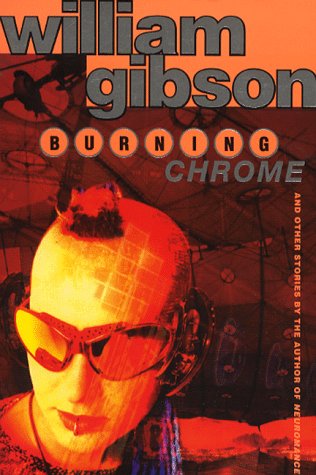
Burning Chrome
and other stories
by William Gibson
various editions since 1986
A classic collection of sci-fi stories by the writer who invented the term cyberspace and probably did more to shape what our vision of the future looks like in movies than most people realize.
Though technically not a book written for children, I am including it here because I think it's a solid read for teens, and have a review for it up at Guys Lit Wire specifically for that purpose. I thought rather than cross posting reviews I'd take this moment to talk a little more about the problem of sci-fi in children's writing. Specifically to ask why there isn't more of it.
As genres go, there are plenty of detective mysteries in children's literature, and books about interpersonal relations between boys and girls to qualify as romance, and certainly enough fantasy to fit any young reader's interest in things from wizards to mermaids to magic. But where are the stories that speak of the future, a future that isn't entirely a dystopic nightmare? Where are the stories that look at the problems of artificial intelligence, that propose difficult solutions to our current problems, allegories and cautionary tales, stories about ideas kids can latch onto?
I think we sell younger readers short by not providing them with these stories and having to send them to the adult shelves to find what they're looking for.
And they are looking for them. If books like The City of Ember and life as we knew it and The Hunger Games and The Adoration of Jenna Fox and Unwound have taught us anything it's that kids really like talking about the issues these books bring up. And this is what science fiction does well, it brings up social issues in settings that allow the reader to perhaps see them for the first time and challenge the thinks they think they know or feel.
Perhaps the fear in providing younger readers with science fiction is that they will take the wrong lessons from it, misinterpret the message in a way that binds and blinds. It was only recently that Ray Bradbury acknowledged that for years people have taken the wrong messages from Fahrenheit 451, that it's not (as its taught in high schools) about censorship, or a reaction to the McCarthyism of the 1950s, but a cautionary tale about the dangers of television destroying the interest in reading. But even as we misread Bradbury's intent the fact remains that the literature provides a point of contemplation, so I'm not sure the excuse holds up as a reason for a dearth of science fiction for children.
Is the problem Science-based fiction?
Have we become a society that fears to discuss speculative ideas based on science and technology for fear of an anti-science backlash? Has science fiction become the Dalits of children's literature, or been smeared with the taint of the creationist-evolutionist battles? My hope is that we can hold back on the aliens, on the life-in-space stories, on all the external elements that get shoved into science fiction for kids, and instead seek out more stories about who we are as a species and where we are headed, or might be headed, down the road.
Monday, August 9
Old Abe, Eagle Hero
The Civil War's Most Famous Mascot
written by Patrick Young
illustrated by Anne Lee
Traditionally-told biography of a bald eagle who was a wartime mascot, which is sort of odd when you think about it. I thought so at least. But this book has bigger fish to fry, like the fact that it's riddled with inaccuracy.
"Found" in a nest high in a tree (i.e. stolen from its home) a Native American (here called an American Indian) named Chief Sky raises a fledgling eagle and then trades it to a farmer named McCann who, though he can farm, cannot apparently fight in the war due to his leg so he sends his eagle in his stead. Old Abe rides a standard into battle for Wisconsin Volunteer Infantry's Company C and, though he has a few close scrapes, comes out alive after over a dozen battles. Once home, Old Abe lives out his life as a celebrity, with a two-room apartment in the state capital and tours to the Liberty Bell in 1876 for the Centennial.
All well and good, if it didn't have so many issues that makes the book more fiction than biography.
This is what happens when you do a life-to-near-death style biography and reshape historical events in the process. One of the problems I have with picture book biographies is when information is diluted for its intended audience who in turn come away with the wrong idea about the story. Chief Sky, as a boy and so clearly not the adult depicted here, spent hours scoping out the tree where the eagle's nest was, and had to fend off attacks by the eagle's parents. This is a far cry from the illustration that shows Chief Sky as an adult calmly standing with a baby bird in his hand. The illustration and text are framed in such a way as to have you believe it was an honorable and humane undertaking, more a rescue than a kidnapping, and not the antics of a boy.
Next we have Chief Sky trading away his bird when his tribe goes downriver to conduct business with the white settlers. It would have been just as easy to start the story here, with Chief Sky trading the eagle away without having to whitewash its provenance, and it wouldn't have affected the story at all. To a point. What isn't in the story, but I learned from a very quick Internet search, was that the bird was traded away for a bushel of corn. I think that's the sort of detail a young reader would find interesting, and would make for a good point of discussion; would you trade away your pet for something, and if so, what would you be willing to trade it for?
Then later, unlike the way it's presented in the book, McCann is reported as having made several attempts to sell the adult bird, finally finding a regiment that paid McCann five dollars (or $2.50, depending on which source you use) for their mascot. Nothing about sending the bird to war in his stead, as suggested in this text.
At this point we're barely a fourth of way into the book, and I've grown impatient about trying to sort out what is ans isn't factual, or at least what is presented in a way that a reader doesn't draw the wrong conclusions. For example, at one point a infantryman is shot and Old Abe is described as dragging "his buddy to safety." At most, an adult eagle is going to weigh 15 pounds and can rarely lift or carry anything above its own weight... and you want me to believe a bird dragged a man ten times its weight to safety? A kid reads that, sees that depicted in a book, they aren't going to question it. Why should they? We're giving them a book and telling them it's non-fiction, meaning it really happened. Do we want them to think we're liars?
Best tidbit also not in the story, according to Wikipedia (which, unlike this book, cites references): Old Abe was a female eagle. I don't fault the Wisconsin soldiers for not being able to correctly sex a bird, but at the very least it could be pointed out and the pronoun "she" could be used throughout the text to indicate that, now, we know better. It sells an audience short to say they wouldn't understand that mistake, or that they'd get confused by a masculine name on a female animal. And it continues to perpetrate known falsehoods. We're back to the myth of Washington chopping down the cherry tree again.
I find it odd that an author who is a science and medical writer (or his publisher for that matter) wouldn't think to include a bibliography. There is some backmatter about bald eagles, which is nice, but nothing specifically about Old Abe that might correct some of the inaccuracies in the text. This would be the place to explain how war stories (like eagles dragging men to safety) were sometimes exaggerated by newspapers, or how it's likely that young Abe "danced" when McCann played music because its wings were clipped and it couldn't fly away, or even how Old Abe was actually female. Also implied with in the subtitle – the most famous Civil War mascot – is the idea that there were other mascots of the war between the states. Like that Dadblamed Union Army Cow. Were there others?
I've said this before (and I've written a critical thesis about it for my MFA) I think that when it comes to presenting biographies and other factual materials to younger readers, particularly readers of picture books, those books need to be accurate, thorough, and perhaps even vetted to make sure the information present or implied isn't misleading. We do no favors to children by teaching them about something or someone new to them if what we teach them is wrong.
Labels:
10,
anne lee,
bald eagles,
civil war,
kane miller,
native americans,
patrick young
Friday, August 6
Picture This
How Pictures Work
by Molly Bang
Chronicle Books 2000
A short study on graphic composition that's an accessible introduction to the subject for the artistically inclined, and those who just want to understand better how illustrations 'work.'
Picture book illustrator Bang comes to the subject of her book honestly, at the beginning of her introduction. A visiting friend makes a suggestion about her drawings and then realizes "You really don't understand how pictures work, do you?" Undaunted, Bang decides to do as she's always done with her illustration career, to learn by doing, and in the process comes up with a book that explains how to compose pictures.
By showing her trial and error, and by explaining what is and isn't working, Bang gives us a frame-by-frame construction of a scene from Little Red Riding Hood using essentially only two shapes (triangles and rectangles) and four colors (black, white, red, lavender). Along the way she plays with scale, perspective, balance, focal points, tension, emotion, and other elements that go into the design and layout of an illustration.
In teaching herself these things, Bang originally started by experimenting with third graders before moving on to eighth and ninth graders, and then adults. Working with cut paper collage and keeping the shapes simple she makes the exercise accessible to everyone, though she admits that it is best understood by teens and older.
I would consider this a good fundamental text for students who are interested in the arts. Any of the arts, not just drawing or painting. The ability to compose an illustration is no different than composing a shot in photography or designing a stage set for the theater. Animators need to understand how to direct focus, tension, and emotion within a scene, and even creative writers can benefit from understanding the effects of color in setting tone and establishing themes.
Though there are many other books out there that go into far greater detail about how to draw or compose a drawing or illustration, what Bang's book does is make the ideas accessible and encouraging. A good deal of this probably comes from the fact that Bang herself didn't learn these things formally in an art school setting and so comes about it humbly and suscinctly.
Have have few reference books I would consider required for all students entering high school – Strunk and White's The Elements of Style and Hoff's How to Lie With Statistics – but I'm considering adding Bang's Picture This because, like those other books, it deceptively packs a lot of basic information into very little space and provides a solid foundation for further studies.
Labels:
00,
art,
chronicle,
composition,
design,
illustration,
middle grade,
molly bang,
non-fiction,
reference,
teens
Wednesday, August 4
boom!
(or 70,000 light years)
by Mark Haddon
David Fickling / Random House 2009
A middle grade my-teacher-is-an-alien story from the author of The Curious Incident of the Dog in the Night-time. Entertaining, if strangely familiar.
While secretly eavesdropping on their teachers, Jimbo and his friend Charlie discover that two of their teachers are, in fact, aliens from another world on the far reaches of our galaxy. Once the aliens discover that Jimbo and Charlie know their secret, and are coming for them, the boys decide to follow the clues to a remote Scottish locale that serves as an intergalactic transport station. Finding themselves on the planet Plonk, they learn that the aliens are trying to repopulate their planet with humans (specifically sci-fi fans who find the experience cool) but are temperamental to the point of threatening to blow up Earth. Jimbo and Charlie make their escape with the help of Jimbo's obnoxiously punk sister Becky and, returning home, save the day.
What starts off feeling very much like Bruce Coville's My Teacher is an Alien and winds up feeling like an lost scene from Men In Black is, as can be gleaned, a goofy send-up of aliens-among-us-and-kids-save-the-day. It was a breezy read, and one I think most middle schoolers would enjoy, particularly the boys.
That said, I found it curious while reading the introduction (something I don't normally like to do) to hear Haddon make mention of this being a retread of an earlier published book from 1992. Odd, because The Curious Incident was hailed (by the New Yorker, among others) as his big debut when, in fact, he had a handful of book published before that.
Oh. His big ADULT debut. His books for children don't count.
I remember feeling the same about Gregory Maguire's "debut" Wicked, knowing he had scads of books nearby in the children's section. Perhaps we've gotten away from that notion that a children's book author isn't somehow as legitimate until the "break out" into the adult consciousness, but it still chaps me a bit.
All of that aside, Haddon does a have a way with engaging and funny characters – Jimbo's family is like the most offbeat collection of individuals from a British TV sitcom – and creates a Douglas Adams class of aliens, complete with dated disco-era catch-phrases as their primary form of communication.
In updating the original 1992 book – with it's unpronounceable title of Gridzbi Spudvetch! – Haddon claims to have started with modernizing the technology only to have changed every sentence of the original. I like the idea of a successful author being able to revisit an earlier work and make something new out of it. And if I didn't have a million other things to do it could be instructive to track down a copy of the original and do a side-by-side comparison.
By the way, I went with the Italian edition's cover (a) because I like the yellow instead of the orange that the English language editions have and (b) because it's subtitle La strana avventura sur planeta Plonk translates as "The strange adventure to planet Plonk," which I kinda like.
Labels:
09,
1992,
aliens,
humor,
mark haddon,
middle grade,
teachers
Monday, August 2
Diary of a Wimpy Kid: Dog Days
by Jeff Kinney
Amulet / Abrams 2009
The fourth book in the Wimpy Kid series continues with the misadventures of Greg Heffley trying to make it through the summer with as little effort and trauma as possible. But if that happened there'd be no book...
After the initial blast of the first Wimpy Kid book, and the subsequent popularity, I sort of let the series go as one of those things that's good for a laugh not not, you know, something I felt obsessive about. Like Charlie Brown and other cartoon creations, once you know who they are as characters you can pretty much guess their travails and it really becomes a question of individual limits. I know one summer way back when I obsessively read every paperback that had the MAD magazine logo on it, followed by every Wizard of Id collection I could nab. It's a kid thing, a summer thing, a perfectly solid way to wile away those dog days of late July and August.
Wimpy Kid Greg Heffley starts off by claiming that summer is nothing more than a three-month long guilt trip because while everyone else is outside he'd rather stay in playing video games. Of course, everything Greg either attempts or is forced to do that takes him away from his game time supports his thinking that he'd be better off indoors and away from everyone. Which, when you think about it, is a fairly stagnant place for a character to be; anti-social, unable to enjoy anything outside of himself, constantly finding nothing but misery about his situation. Even his attempts to do something constructive – start a lawn care company – is driven by his desire to make money to pay off a country club debt and nothing else. Even when I was laying around reading comics I still had days where I schemed to make money and build massive tree forts that were structurally unsound.
Greg Heffley is a bit of a downer.
But that's what makes him work. Kids recognize what a downer he is and laugh at him, not with him, in a way that sometimes borders on mean. I think Kinney comes up with some great situations for mischief and misadventure, where readers can see with devilish glee what unsuspecting Greg is about to get himself into. But after three books it isn't just wearing thin, its beginning to look like Greg might actually be suffering from sort of brain damage. How else do you explain a character who, as the mock definition of insanity goes, keeps beating his head against the wall expecting a different result? Maybe if the kid had something go right once in a while it would make all the other mishaps and screw-ups have more impact.
By now, these books are criticism- and review-proof. Kids read them, and enjoy them, and despite being mislabeled as graphic novels (they aren't) are perfectly fine amusements.
Labels:
09,
jeff kinney,
middle grade,
summer,
wimpy kid
Wednesday, July 21
midsummer notice
First, greetings to new visitors to the excelsior file, particularly my fellow VCFA peeps. Thanks for visiting and drop me a line to tell me what you think.
For regular visitors who may be wondering about the reduced activity, I want to assure you that the blog is not going anywhere but may take a bit to get back up to speed. I am currently looking at some long-term changes and adjustments for 2011. Yeah, I like to plan, but reviews will return in a matter of days.
In the meantime, might I suggest combing through thewreckage archives for some older reviews? Any of you long-term readers think I should revive the Grimmoire? I've heard alternating opinions about longer vs. shorter reviews – what side are you on? No, really! I'm curious!
Thanks for the patience, understanding, and your kind attention. Or, as the old billboards used to say: Watch This Space!
~david
For regular visitors who may be wondering about the reduced activity, I want to assure you that the blog is not going anywhere but may take a bit to get back up to speed. I am currently looking at some long-term changes and adjustments for 2011. Yeah, I like to plan, but reviews will return in a matter of days.
In the meantime, might I suggest combing through the
Thanks for the patience, understanding, and your kind attention. Or, as the old billboards used to say: Watch This Space!
~david
Friday, June 4
godless
by Pete Hautman
Simon & Schuster 2004
A teen boy questions religion by playfully inventing one of his own based on a water tower, but things get out of hand as everyone who participates views the new religion differently.
This is a book I've started several times over the last three years and only now finally managed to read it straight through. It's no fault of the book or its author, I've simply had my attentions diverted elsewhere every time I tried to pick it up again. This time I had a hard time putting it down. Sometimes books have to find their moment.
Jason's tired of boring Catholicism. It doesn't speak to him, and attempts to reach out with youth ministry only push Jason further toward atheism. One day while helping his science nerd friend Shin hunt snails under the two water tower the boys run into Henry, a charismatic bully who would just as much read sci-fi as knock a kid down. While musing over the ideas of religion Jason wonders if it isn't possible to start a new religion with the water tower as their god. The idea, meant to provoke others, takes root in his friend Shin and Jason finds it serves his purposes to promote the new religion with Henry and a cute girl named Magda. Jason's real desire is to climb to the top of the water tower and he wields his new position as founder of the religion as an excuse to get Henry to show him how to climb it and to perhaps win the attentions of Magda.
But Shin's obsession over creating the bible for the new religion push his rational thinking aside, and Henry's bad-boy behavior does more to win Magda to his side as the new religion fractures, and in the end the kids find themselves in trouble when they discover the can get inside the tower's reservoir and pollute the town's drinking water.
This idea of teens inventing their own religion as a way of exploring what exactly it means to have faith is both rich and organic – I was part of a group in high school who playfully did the same thing as a way to explore the elements of religion with which we found common ground. In the end, of course, everyone reverted to the religion they were raised with, and the idea quickly lost its hold. Jason comes out the other side of his ordeal in much the same way I did, which was to realize that having religion is different than having faith. He clings to his invented religion because within it he can define right and wrong in a way that makes sense to him, in way that allows him to not simply accept the moral contradictions placed on members of many other organized religions.
Hautman does a nice job of keeping the theology light and allowing enough room for a reader to draw their own conclusions. A good choice for the National Book Award for Young Readers back in 2005.
Labels:
04,
national book award,
pete hautman,
religion,
simon and schuster,
theology,
YA
Subscribe to:
Posts (Atom)