Wednesday, November 19

Knucklehead


Tall Tales & Mostly True Stories About Growing Up Scieszka
by Jon Scieszka
Viking 2008

I totally dig that Jon Scieszka had the kind of wigged-out childhood that makes for good kid biographies, but I would hate to see the report some kid would write using this as their source material. Or maybe I wouldn't hate it. Maybe it's what some poor unsuspecting teacher deserves.

In 38 brief and amusing chapters the author of The Stinky Cheese Man and our current National Ambassador of Young People's Literature by the Library of Congress digs up the kind of family dirt that most people try to hide. From pee fights, to fundraising in order to name starving pagan babies in Africa, to threatening to have younger brothers hauled away for misbehaving -- this book is chock-full of all the things that naturally occur in a household of five boys.

This book hardly needs any recommendation. Boys who know the name Scieszka will pick it up and know what to expect. Mostly. If they haven't done similar things recounted in this book they probably thought them. And if they never thought them, then this book will inspire them. Word of mouth will ensure that boys pass this along and read these impossible to forget stories.

Reading, getting boys to read. A steady of diet of this stuff would kill anyone, but boys deserve a treat everyone once in a while. Oh, and for the adult boys out there who might have forgotten what it was like to be 8 or 10 or 12 years old, I'm sure there are a few memories kindled by these accounts.

As for these stories being either tall tales or "mostly true" all I can say is, having once been a boy, a disclaimer like that was probably some editor's idea. I can't imagine any true boy denying any of this as anything but the whole truth.

Monday, November 17

My Father's Son


by Terri Fields
Roaring Brook Press 2008

The only thing missing from the front of this book is an exploding gold medallion with the words RIPPED FROM THE HEADLINES! printed in bold red letters.

One day as Kevin Windor is watching TV he sees a news bulletin: The notorious DB25 serial killer has been apprehended. What Kevin sees on the screen, though, is his own father being escorted away by police. It can't be, Kevin says in shock, he knows his dad is innocent!

Already Fields has lost me. Without establishing that Kevin's dad is (or might be) a good father I have to take Kevin's emotional, determined word that his dad isn't the killer. That means that Fields wants me to either take a stance against the main character -- essentially lumping me with all the local citizens who have seen the news reports and leveled guilt on Kevin's dad -- or I have to have faith that Kevin's unwavering and naive support of his father will be justified in the end. In the later case, since I have to correctly guess the end of the story in order to be sympathetic to Kevin, what's the point of reading further? Happy ending, story over.

Constructed like the worst sensationalist television drama, Kevin moves through the accusation and his father's unwillingness to tell the truth (despite the fact that it would support his innocence) like a clueless teen whose knowledge of the law and the real world came exclusively from watching cop shows. Bad ones, with corny stilted dialog. When he goes to confront his father's lawyer Kevin seriously believes that if he could only talk to his dad and hear directly from his that he's innocent that everything will be okay. Then when his dad cuts off communication and says he's going to plead guilty -- to a string of murders, mind you -- Fields has upped the ante in manipulative absurdity.

Unless Kevin's dad truly was guilty of the crimes he's accused of, and the story is an examination of what it feels like to be the child of such notoriety and parental deception, the only reason to have Kevin crusade on his father's behalf is to show how a trial-by-media and guilt-by-association brings out the worst in people, the worst in society. Rather than letting the reader into what Kevin feels it's as if Fields wants to hold up a mirror and accuse the reader of being no better than the people who shun Kevin and his mother.

Now, if Fields were instead using Kevin to serve as a detective to prove his father's guilt (with his father's knowledge and cooperation) we might have had a reasonable mystery story here. There'd still be the son-of-a-serial-killer stigma involved, but it would serve as an adversity for Kevin to battle with emotionally. But that's not the book Fields wrote, and in the worst tea cozy mystery tradition she has dad explain everything to Kevin in the end, a tidy little summary delivered in the best tell-don't-show fashion.

My Father's Son is episode of Jerry Springer turned into an ABC After School Special. It's high concept, lowbrow entertainment. Minus the entertainment.

Friday, November 14

Poetry Friday: 3 by Christina Rossetti


taken from
Poems
An Early-Start Preschool Reader
illustrated by Victor Lazzaro
Wonder Books 1965

I haven't yet been able to get into Proust, but I can dig where he's coming from. I think we all know too well how easy a little thing can trigger deeply buried remembrances. Having grown up in the post-war capitalist republic that I did, many of my memories are associated with commercial things: Board games and television commercials, music and books.

Many of the books of my childhood did not survive the punishment they took in our household. If I didn't destroy them through a lack of care then they eventually disintegrated in the hands of my younger sibling. As a result, there are countless books I have read but do not remember until chance brings them back into my adult consciousness.

Our local library has a nook just inside the entrance where they hold a year-round sale to benefit the friends of the library. As the library sells off profitable donations and purges its shelves of unread books, the stock of what's available varies almost daily and a frequent scavenger can stumble across some treasures. This week I spotted a small square book that I nearly ignored. It looked too old, too old-fashioned, to hold my interest. But a second glance, and something about the cover design, made me look inside.

In typical 1960's style the book contained line drawings with a single spot color of brown. Flip, flip, and here it was, the image of a child in a rain poncho on cobblestones, and I was back at El Rincon Elementary School. The poem that accompanied the picture, "The Rain" by Robert Louis Stevenson, was more than vaguely familiar. It was as if it had been tattooed along the edges of my reptile brain, the fingers of memory running over the raised edges of those words in darkness. Though not this exact copy, I have held this book in my hands, once, long ago. Whether it was mine or not, I owned this book.

I paid the twenty-five cents for the book and took it home without looking any further inside. Luck, fate, or karma had returned this book to me, another piece of my childhood regained, another fragment of memory restored, another piece of the puzzle that is me put back into place.

A collection of shorter poems based on nature, the book contains two anonymous poems, three by Robert Louis Stevenson, one my Alfred Lord Tennyson, and three by Christina Rossetti. At first I was surprised to see the authors names in a preschool book, then I began to wonder about the unfamiliar name, Rossetti. Was she someone hired by Wonder Books to fill out the slim volume?

No.

We'll have to save an examination of Christina Rossetti for another day, but it turns out she was an English poet who wrote romantic, devotional, and children's poetry. She bears some investigation as it appears she was a proto-feminist who did such things as volunteer at a home for prostitutes while writing children's poems. Fascinating. She also shares my birthday, along with Joan Didion and Walt Disney. Odd company, indeed.

For today I'm featuring the three poems from this crazy sliver of my childhood. Care for a madeleine?

The Clouds

White sheep, white sheep
On a blue hill.
When the wind stops
You stand still.


The Wind

Who has seen the wind?
Neither you nor I.
But when the trees bough down
their heads,
The wind is passing by.


The Clouds

Boats sail on the rivers,
Ships sail on the seas
But clouds that sail across
the sky
Are prettier far than these.


The Poetry Friday round-up is being hosted today by Yat-Yee Chong.

Wednesday, November 12

The Spectacular Now


by Tim Tharp
Knopf 2008

(cross-posting today at Guys Lit Wire)

It's an odd, almost unsettling experience to finish reading a book, fire up the internet to see what sort of buzz the book has, and then discover that almost simultaneously the book was just named as a finalist for the National Book Award. That's exactly what happened a few weeks back, in one of those moments when you wonder if the universe is trying to tell you something important.

Cue eerie music.

Sutter Keely is a charmer. A senior without a care, he is an unrepentant alcoholic living in the now, willing to embrace the weird. The only problem is that his beautiful fat girlfriend Cassidy is getting tired of his shtick. He's late and constantly drinking Seagam's and 7-Up; he's fun but irresponsible; he's a good time at parties but he's selfish. When the last straw comes and Cassidy finally dumps him Sutter figures she'll eventually come back around to his wannabe Dean Martin swagger.

The problem is that Cassidy is looking down the road at life beyond high school and Sutter isn't there. And not just Cassidy, all of Sutter's friends seem intent on trying to figure out what comes next. After years of floating without a care Sutter doesn't see the big deal, or the need to plan beyond his current buzz. So when Cassidy shows how serious she is by picking up with a new boyfriend, Sutter redirects his energies toward hooking up his best friend Ricky with a girl of his own.

Wallowing drunk, he is found passed out on a lawn early one morning by Aimee, one of those withdrawn girls everyone walks all over. Taking her on as his own special project to help her grow a spine and realize her inner self, Sutter finds himself promising to take her to the prom, officially declaring her his girlfriend, and knowingly leads her on in an effort to build self esteem. But Aimee isn't like the other girls he's dated, willing to hang out with a party boy until it's no longer fun. Aimee has fallen in love -- deep, hard, and seriously -- and slowly begins to entangle Sutter into her plans and dreams, into their combined future together. She could be the girl Sutter has always needed, the one he never realizes he'd always wanted, a girl who could change him for the better.

If Sutter doesn't first succeed in dragging her into his own dead-end spiral.

Will Sutter reform, confront his deadbeat father and clean up his drinking? Or will Aimee become his sloppy, drunken sidekick, the girl who abandons her dreams of college and NASA to stay by the side of the only guy that has ever bothered to give her the time of day?

Up until the final pages there's no way of knowing how this is going to turn out. Tharp does a nice job of having the characters remain true to themselves in such a way that every meeting is a quiet trial of wills. When Cassidy continues to get together with Sutter on Thursday afternoons after they break up -- and with the full knowledge of their new dating partners -- Cassidy makes no bones about the fact that she will probably always be drawn to Sutter's bad boy antics but cannot let him back into her life as anything more than a buddy. This suits Sutter just fine, but his unspoken longing for Cassidy seeps in and pushes him that much farther along. He's like a comet that gains velocity in her orbit, then spins wildly out into the universe seemingly with a lack of control, but he's always drawn back into her gravitational orbit when he reaches the outer limits with Aimee.

Tharp pulls a nifty trick in giving us the portrait of a charming young drunk well on his way toward becoming a pathetic one. But he doesn't judge -- Sutter's friends are more than willing to do that, and they do it with a large dose of tough love despite the apparent futility of their gestures. There were moments when I was almost afraid Tharp was romanticizing teen alcoholism in trying to present a realistic portrait, but Sutter's own aimlessness undermines anything remotely cool about being drunk. It plays as humor when Sutter goes to his sister's house for dinner and nearly sets himself on fire when he tries to secretly smoke a joint in her closet, but Sutter's empty apologies and quick judgments about his family members make the laughter ring hollow.

I wasn't as impressed with Tharp's last outing, The Knights of Hill Country, because there was something about it that felt stale. This time out Tharp returns to his Oklahoma soil with an approach that feels slightly on edge. Not edgy, but teetering at the brink of excess and charm -- much like its main character. It is unflinching in its handing of teen drinking, almost casual, but equally sober about what sort of dead end that leads to.

I don't think it's necessarily undeserving the National Book Award, but given the competition I'm having a hard time seeing this pull through as the winner. Then again, perhaps the universe was indeed trying to tell me something. We'll find out soon enough.

Friday, October 31

The Crows of Pearblossom


by Aldous Huxley
illustrated by Barbara Cooney
Random House / Weekly Reader Books 1967

I'd been meaning to do this for a couple years now, and this week I finally figured out how to make the scanner work, so...

When I was a kid my mom signed me up for the Weekly Reader Book club one summer. I don't remember how often them came but in between book shipments there were book club editions of books. One of them freaked me the heck out at the time but I never said anything about it for fear that I would have the book club taken away from me.

I talked about this book when I was older, in college, and no one believed it existed. My memory of the story was strong but I never remembered the author until one day in my 30's when I caught a passing reference to it in some magazine. It did exist. But I still had to wait another six years or so for the internet to be invented before I could locate a copy of my very own.

The Crows of Pearblossom was Aldous Huxley's only children's book, perhaps for good reason. He wrote originally for his niece in 1944 and a manuscript floated around until Random House and Weekly Reader hooked up with illustrator Barbara Cooney to create a book that creeped me out.

Over time I have come to recognize the value in telling stories that creep kids out. I find the sanitized fairy tales of the Brothers Grimm that are constantly appropriated by Disney, or watered down to "modern sensibilities" to be highly distasteful. It's as if picture books for children must be as sterile as anti-bacterial toys for children, raising a generation of readers so protected from the realities of the world that they don't develop the appropriate immune systems for reading. Could the first wave of these bubble-living readers be the adults looking to ban books for fear of infecting their children?

Anyway, it's Halloween, so here's the treat. The Crows of Pearblossom, scanned and available for your reading pleasure over at my Flickr! account (click on the cover above for the link). Give it a gander and let me know what you think.

Monday, October 27

J. Edgar Hoover


A Graphic Biography
by Rick Geary
Hill and Wang 2008

Just what the world was waiting for, the life of J. Edgar Hoover as a graphic novel. Actually, in a way, I was. Sort of. I mean, I think there any number of political and cultural figures from the 20th century who could use some better coverage than might appeal to a younger audience.

Geary in many ways is a perfect choice for Hoover. His mannered crosshatch style almost bespeaks a certain Victoriana that suits the man who built and ran the FBI for over 50 years. Using almost no dialog but plenty of narrative text, he recounts Hoover's rise and fall with carefully staged scenes and expressions. The effect is almost like a Ken Burns documentary in graphic novel format, which isn't a bad thing. You can practically hear the period music as the narration methodically connects the dots in Hoover's life, from his low days as an average government worker to one of the most powerful unelected figures in American politics.

I joked with friends that I was a little upset that Geary stayed clear of gossip and rumor -- though there is a single panel suggesting what Hoover looked like if the rumor of his attending a party in drag was true -- there is also only the lightest gloss on his one man war against those he felt were his and the nation's enemies. In some ways, the chapter on the Kennedy's could be a book unto itself, as could the chapter on his secret surveillance war on MLK and John Lennon, but these events are passed over and given none of he weight I personally felt they deserved.

I also worry that a reader getting all their information on Hoover from this book might not fully understand that he wasn't really all that good for the country. If that sounds a little biased then it balances the book's non-committal position of Hoover as a politically neutral man who ran his office with an iron fist. he ran more than his office with that fist, and ruined a great many lives, and none of that comes through.

I love Geary's work in general, and hope he does more of these books in Hill and Wang's series of biographical graphic novels.

Sunday, October 26

Screenwriting for Teens


The 100 Principles of Screenwriting Every Budding Writer Must Know
by Christina Hamlett
Michael Wiese Productions 2006

It's been a while since I've run across a book that leaves me running hot and cold depending on my mood when I pick it up. On the one hand what we have is a thorough course in film media awareness, a textbook for exploration of writing for television and film; On the other hand the aim seems to be driven toward raising an army of teen screenwriters armed with the skills to keep turning out the same sort of studio drivel that has been cranked out for decades now. In the end I find myself forced to admit that had this book been around when I was a teen I would have owned it and probably would have been a different writer as a result, for better or worse I couldn't say.

Hamlett presents each of the principles on the right side page with a clear explanation and examples. Flip the page and there is a "look and learn" segment recommending films, TV shows, and even commercials that support the principle at hand. There's also a "brainstorming" section that provides three different exercises to reinforce the lesson and provide young readers with a broader background in understand how to write.

The book opens with a lesson on the differentiation between books and movies, with a brief study of classic story structure, and quickly builds up to short studies on cinematic structure and the Hollywood method for developing a marketable screenplay. In these bite-sized segments a young writer will learn much of what is taught in most other books and seminars on screenwriting and it is highly accessible. The examples are, for the most part, well-chosen and the exercises are solid enough even for experienced writers to get something from them.

Where the book falters for me is how it seems to go out of its way to not look like a textbook or something equally formidable, but in doing so treats the serious student too casually. "If you're not already keeping a daily journal, start one" seems like something that should come at the beginning of the book and not as an aside eight chapters in. Additionally, there is an unspoken assumption that the reader has an endless amount of time and access to watching television shows and movies without really letting the budding writer know what they're getting into. Granted, the serious student will devour these assignments and hunt down whatever looks interesting to them, but just as many might find the task daunting part way through and be tempted to give up.

With the ever-changing television line-ups and cultural phenomena there are references to television shows no longer on the air, as well as films that even most film students have never seen (to say nothing of older films they probably never heard of). And very quickly it becomes clear that this is a book that one cannot breeze through in a month or even a few months. Watching the recommended films and programs, following through on the activities will take time. What Hamlett hasn't also adequately prepared the budding screenwriter with is a lesson in patience.

Yet, I still like what this book does. It says to the teenage screenwriter "Okay, this is what it's all about" and plows ahead with its challenge to keep up. Those who think that writing for television or movies is a shortcut to fame will quickly learn that the modern screenwriter's craft is no less arduous than any other writer's. Serious teens who believe this is truly their destiny should make this a first test of their strength and endurance. This would only be a first stop because there is much more about character and scene development that a solid screenwriter needs to know and should learn from other books on the craft. Syd Field's books, and Robert McKee's Story and, just to get some perspective from a master in the field, William Goldman's Adventures in the Screen Trade.

For the first-timer, the student looking to make solid short films and develop themselves as screenwriters, Hamlett's book is a step in the right direction.

Friday, October 17

short, short poems

An Anthology of Short, Short Poems
Edited by William Cole
Macmillan Company 1967

Sometimes what you want from a poem is short. Brevity the soul of wit and all. This compact little book collects over 250 poems that fit the bill, collected thematically, each chapter heading a line pulled from one of the poems. You get chapter titles like "Here dead lie we..." and "...into the daily accident."

All of the usual suspects are here: Auden, Keats, Pope and Pound, Frost and Yeats and Dickenson, in addition to some upstarts like Brecht and Updike and some woman named Anonymous. There are playground rhymes and terse bits of light verse, though Cole points out in his introduction that short doesn't necessarily mean trivial. Short can whet or cleanse the palate between longer literary journeys, or occupy the mind while visiting the lavatory.

Admittedly this collection, these poems, can be a little stale around the edges, and almost Parade-esque. I like to think of them as holiday cookies left out overnight after the party -- what they lack in freshness is compensated by their continued flavor and the memories they revive.

These are some of my faves from the collection.
By a rich fast moving stream

I
saw
the
dragonfly
become a
dragon and
then a poem
about a dragonfly
becoming a dangerous
reader in fast pursuit
of summer transformations.

~John Tagliabue


To a Man in a Picture Window Watching Television


Watching TV,
How aptly
You're framed,
As if on TV --
Observer observed!

Deeper in shade,
Still others may sit
Watching me
Watching you
Watching it.

~Mildred Weston


The Wheel Change

I'm sitting on the grass by the roadside.
The driver is changing the wheel.
I don't like it where I came from.
I don't like it where I'm going to.
Why am I watching the wheel change
With impatience?

~Berthold Brecht, translated by Eric Bentley


Please Tell Me Just the Fabuli


Please tell me just the fabuli,
The miraculi,
The gargantua;
And kindly, kindly spare me
All this insignificia.

~Shel Silverstein


England

Oh, England.
Sick in the head and sick in the heart,
Sick in the whole and every part:
And yet sicker thou art still
For thinking that thou art not ill.

~Anonymous, seventeenth century (and perhaps a bit closer to home as well)


untitled

Must
All this aching
Go to making
Dust?

~Alun Lewis


The round-up for Poetry Friday is at Becky's Book Reviews today.

Wednesday, October 8

Prince of Persia


Prince of Persia
Created by Jordan Mechner
Written by A.B. Sina
Artwork by LeUyen Pham and Alex Puvilland
First Second 2008

I'm cross-posting today. This is my review from Guys Lit Wire.

Based on the video game, soon to be a major motion picture... eh, forget all that. Prince of Persia purports to be the legend behind the game, but any knowledge of this graphic novel's origins are completely unnecessary. What we have here is a great, multi-layered tale of power and and palace intrigue over the course of centuries, a story rich in Eastern myths and torn allegiances.

In the 9th century city of Marv, the warrior Saman has not only conquered but rebuilt the city in great splendor. Among his children, the twin brother and sister Guiv and Guilan, he has adopted Layth, the orphaned son of his enemy, and raised them as equals. Growing up together they vow strength in unity and insist on ruling as one when their time comes. The problem is that Guilan and Layth have fallen in love and that Guiv becomes an outcast when he tries to kill Layth in his sleep...

The 9th century blends with a 13th century where Shirin, daughter of the current ruler of Marv, leaves a palace that has become the home of decadence and lies to discover the truths that have been hidden from her. After nearly drowning in a well Shirin is rescued and taken to a citadel that is the secret home to Ferdos, who relates the stories of the past to her. The tales of two centuries echo each other as we learn of the rise of two princes, and how the power of the desert city is in the hands of those who control the waterways that have been built from ancient springs.

The thing about Prince of Persia, the element I long for in graphic novels, is the sense of the novel. It isn't merely a question of length, but when a story is rich in character and story threads, that's what pulls me in. I want to get lost in a story, in a time and place, and to know that the storyteller is weaving an elaborate tapestry. For me, it's part of what separates a comic from a graphic novel, this feeling of story heft, and Prince of Persia has it in spades.

I can't ignore how location resonates between the story and our own lives. How different are the days when an elite group of people controlled the means of survival for a larger community? Does it matter that it was water in the 9th and 12th centuries and oil in the 20th and 21st? Is the ancient Persian empire, no matter what it is called today or in the future, destined to be where all of our international battles for power will be set?

I read somewhere (advance word from Publisher's Weekly perhaps?) that the graphic novel wouldn't be as successful for its intended gamer audience because it lacked the interactive element of the game. Excuse me? Are gamers so limited in their abilities that unless a book based on a game is interactive like a game they couldn't appreciate it? That makes no sense, it sells gamers short, and totally ignores what a separate experience the book is from the game.

What we have here is reminiscent of great Eastern myths and storytelling. It may play off familiar images from what most people know of Arabian Nights stories, it has some magic and mythical qualities (no genies, however, but earth- and animal-based magic), but also has some grounding in the real world. In the 12th century the city of Merv was briefly the largest in the world, built on an oasis along the Silk Road, and no doubt a place where stories and myths were built around the tales of travelers in the region. It does not seem out of place that the stories included in Prince of Persia could have sprung from the ancient city of Merv.

My simple wish to those who can grant it: More like this, please.

Wednesday, October 1

Splat the Cat


by Rob Scotton
HarperCollins 2008

I'm going to open with what was originally my closing paragraph. You can decide whether to read further after that.

Note to Publishers and Art Departments everywhere: you never look like greater fools than when you don't have any faith in your books and feel the need to use cover space for advertising copy. It doesn't matter if it's front or back cover, picture book or YA, the minute you sell off the book's real estate you have admitted a lack of confidence and a savvy buying public can smell your desperation.

-------

The National Lampoon, in its heyday back in the late 1970s, used to have a feature in its Photo Funnies section called "Worlds God Never Made," or something similar. Readers would send in snapshots of various businesses that had the word 'world" somewhere in its name, like Chemical World or World of Chicken. It would never cease to amaze me how many people thought they were being clever by naming their business something-world when in fact, the reach and influence of their world scarcely reached across the city limits.

Over time, though, the humor wanes. In a world full of worlds, the idea of yet another world with it's cheap-o plastic yellow sign (always yellow) and its flickering fluorescent bulbs has lost as much of its humorous capital as it does its ginormous placement in the pantheon of large businesses.

Equally, I find that books or movies that lay claim to being "the next (fill in the blank)" or "from the bestselling author of..." are generally trying to sell me the idea that the creator's previous efforts were something so great that I would blindly take on their next creation as brilliant with nary a second thought to its quality. Oddly, in a majority of these cases, I am being sold a familiarity with some other object or product I only know of by reputation. "From the producers of..." tacked at the beginning of a movie title I did not see as a way of proving the pedigree of a another movie I probably won't see is only designed to wedge me into catching the more recent film out of a sense of consumer guilt. Well, I missed that last one, and the ads said it was good, so maybe I better see this one to find out what all the fuss is about. In the end, with so much out there laying claim to some measure of quality we're supposed to all fall in line with -- is there a cultural consensus about anything in this country anymore? -- the idea of quality by association might as well have the word 'world' tacked onto it.

From the director of Psycho comes Frenzy World!

It extends into the world of children's books, and with Splat the Cat I find myself not liking it even before I open the damn thing. Right there under the author's name, on the cover of a book intended for pre-school and pre-reading children are the words "Bestselling Author of Russell the Sheep and Russell and the Lost Treasure." Well, with a one-two combination like that we might just be talking about the next book to top the bestseller list for several months running.

Except we're not.

There's a world of people out there who, surely, this sort of thing must work for. But why? Is it that they loved Russell the Sheep so much but couldn't be bothered to remember the author's name? Could it be that in a world where chain bookstores don't bother to train their staff to handsell children's books that publishers must turn their covers into advertisements for themselves? No kid is going to be sold by this tag line (and if they are then there's something unfortunate about that child's upbringing) and no adult making an informed, conscientious decision about buying a child a book is going to be sold by this attempt to cash in on another set of titles.

After all, if the book cannot sell itself, there's already a problem.

I suppose I ought to actually talk about the book now. The only problem is that everything I've discussed is far more interesting.

Splat is a stand-in for every kid nervous about his first day of school. Splat resists going, comes up with every excuse he can think of to keep from going, finds himself in a class full of new cat friends, and in the end can't wait to go back the next day. That's it in a catnap. Owning a pet mouse, and bringing it to school in his lunch for security, poses the possibility for tension when the teacher informs them that chasing mice is what cats do. But all is diffused when the mouse helps them get to their milk locked in the closet.

Bestselling author of Russell the Sheep? Bestselling? Really? This is supposed to convince me that my thoughts of mediocrity are somehow wrong or misplaced?

I think more than anything what turns me off the most is how much the artwork reminds me of the sort of thing normally found on one of the "edgier" imprints at Hallmark Cards. You know, slick and stylized and not cute little bunnies or soft-focus flowers, art only in the sense of being very workmanlike. There's a sterility to it that makes me feel certain that, if properly shredded, it would prevent a litter box from smelling for weeks.

It's sad when a book causes me to worry about the precious resources being used in its creation. When I start thinking I should go out and plant a replacement tree I get a more than a little disheartened with publishing. A picture book shouldn't make me feel this way; this book does.

Monday, September 29

Jack and the Box


by Art Spiegelman
Toon Books 2008

Earlier this year when the first batch of Toon titles came out I was less than enthused. The problem as I saw it then was that the titles seemed little more than traditional comic book fare with expensive paper, better printing, and hard covers. I couldn't reconcile the content with the cost and felt that they were best suited for libraries who would do well with studier bindings, not with the general consumer (picture book readers) who would tire of the titles quickly.

Now with the second round of releases I'm finding this less to be the case, but its book specific. Spiegelman's Jack and the Box isn't merely " a first COMIC for brand-new readers" as it says on the cover, it's actually a subtle and sophisticated tool that helps introduce readers to the concepts in reading and understanding comics. It is a primer on comic literacy at the simplest level, and clever. I doubt Spiegelman could have delivered anything less.

The book opens simply enough with a single illustration of Jack (Rabbit) being given a new toy. Two simple word balloons establish the order of both reading left-to-right and lead the viewer's eyes to follow the action accordingly. With a flip of the page we are now presented with a double page spread of four equal sized panels. There's the conflict of the first panel (Jack can't open it), the tension in the second panel (watching the box, waiting for something to happen), the action in the third panel (a clown pops out of the box, jack-in-the-box style, scaring Jack), and a punchline in the fourth panel ("Ha ha!" "What a silly toy!"). With a few words and some simple pictures a first encounter with a jack-in-the-box is turned into the core joke on which all future variations will be built. Since humor is generally derived from the unexpected turn, from the deviation from what is expected or established, Spiegelman can now train young comic readers to learn how to read for visual cues and verbal repetition. It's a winning combination and, to the casual reader, a subtle lesson in how to read comics.

Jack now has a series of comic adventures with the toy, each four panels across the spreads, built on the idea of an uncooperative toy and its unexpected behavior. We've been told it is a very silly toy so we aren't surprised to see it talk back or misbehave. There's the slightest hint of Cat in the Hat style mischief, and a sense of a child's play world being realistic to the child but confusing to adults, which adds another layer to the book. As the comic stories add and build, and the chaos grows, there is a need for release at the end that comes in Jack explaining all that has transpired to his curious parents, the denouement so to speak. Order is restored, and Jack now safely has mastered the silly toy the same way the reader has mastered the complexities of a comic narrative.

While there are other books out there for the picture book crowd that work within the comic framework (Regis Faller's Polo books, for example) there are few that work this hard, this effortlessly to train readers to the art of comic literacy. I hope that Toon continues to build off this lesson with their other titles.

Wednesday, September 17

Baker Cat


by Posy Simmonds
Red Fox / Random House 2004

A mean old baker and his lazy wife have a cat who literally does everything for them. He sweeps, he peels, he slices, he mixes, he rolls, he ices, he bakes, he does the washing up, and at the end of the day is sent exhausted into the storeroom and told he has to ear his keep by catching mice. Exhausted, the poor marmalade tabby collapses while the mice have their way.

The mice take pity on Baker Cat and strike a bargain: if Baker Cat promises to leave them alone they'll get the baker to leave him alone. The plan involves spinning yarn to look like mouse tails, trophies of his night's work that the baker uses as a gauge to determine how much to reluctantly feed him.

And for a while it works, until the free reign of the mice depletes the larder and the baker threatens to turn Baker Cat into fur gloves if he can't make meringues and tarts appear by morning. Again, it's the mice to the rescue, and the next morning they have set a trap to make the shop look infested by all sorts of vermin. Fed up, the mean baker and his lazy wife ditch the shop, leaving it for Baker Cat and the mice to manage on their own, free of human oppression.

So many questions!

First, if the cat is this accomplished, why doesn't he go into business for himself? Oh, that's right. He's a cat. But then, he's already dealing with customers and working the kitchen so clearly he has some extra-feline skills. Perhaps it's an opposeable thumb. Is it because he needs humans to get the supplies? Well, the mice are excellent thieves, so that takes care of that.

You know, I like this. I'm not looking to tear it apart, but it's so... odd. It's odd in a way I can only call British but without support. It's from that part of the country where the world of nursury rhymes still live, where people possess animals as slaves as well as pets. It isn't alarming or distressing that there is a cat wearing an apron pushing a broom across the shop floor, it appears folks rather expect it. No one seems concerned with cat hairs on their breads - they probably have hairier food in their cottages just down the lane.

But here's another thing: Baker Cat is a passive protagonist. Baker Cat works, Baker Cat suffers, and in the end is too exhausted to do anything about it. Okay, you say, Cinderella didn't exactly make her own dress or conjure her own ride to the ball. Ah, but she had a dream, a desire, and in her longing she was provided for. Not Baker Cat, he just waits until the mice rescue him. And rescue him. And after the mice have twice rescued him he is rewarded for his lack of efforts by gaining a store that the mice help run. It's like a cross between The Cinder Girl and The Shoemaker and the Elves, but with animals, and with less ambition. Baker Cat may not be mean like his former owner, but he sure is lazy.

At least Baker Cat and the mice live in harmony, and the mean and lazy are vanquished.

Simmonds is a cartoon artist, and there are elements of her cartoon work present here. Spreads in the picture book alternate between full page illustration and smaller, panel-free progressions across the page. She has an engaging style slightly reminiscent of Raymond Briggs crossed with William Steig. I came across his while looking up her graphic novel Gemma Bovary and I have to say I preferred this quite a bit.

* * * * *

Why I didn't think of this before I'll never know, but here on out I'm going to try and link the cover to someplace where you can purchase the book at hand. I'm not out to necessarily shovel business for gain, I'm only thinking that maybe I could save folks some time if they're interested.

Wednesday, September 10

Here Lies Arthur

by Philip Reeve
Scholastic 2008

It's said history is written by the winners, but who writes the legends?

The Legend of King Arthur is one that weaves fact and folklore into an irresistible tale of medieval knights, battles and romances, intrigue and mysticism. As legends go Arthur's is as mailable as they come. Defender of Britons against the Saxons, crusader for the Holy Grail, the Arthur of legend is of a man who speaks both to and for a Christian God while receiving gifts from Pagen mistresses in lakes.

Playing against the backdrop of familiarity, Philip Reeve's Here Lies Arthur takes the legend of Arthur, son of Uther Pendragon, and presents him as he might have been: a boorish, petty warrior with a thirst for conquest and the gift of a good Public Relations man.

Arthur, nicknamed the Bear, and his band of knights roam the countryside like Medieval Mafia offering protection from the Saxons in exchange for tribute. Those who remain loyal to others find their villages laid to waste. To ensure a smoother, more peaceful transition (and to avoid fighting wherever possible) Arthur has his storytelling friend Myrddin arrive in advance telling tales and spinning yarns about the man who will unify them once and for all. There is magic woven into this spin doctoring, a cheap magic designed to fool the superstitious, and Myrddin has dedicated his final years toward convincing one and all that Arthur is the leader they need in these troubled times.

Ah, but the thing here is who is telling the story of the creation of the legend.


When Here Lies Arthur opens we are in the midst of a raid on a small village. In the chaos a young girl named Gwynna escapes by slipping into the river and swimming downstream. When found by Myrddin, this girl with her ability to hold her breath underwater provides him with the opportunity to help the Bear unify a local band of knights behind him. After that, Myrddin decides to take Gwynna as his servant but must pass her off as a boy in order to keep her close by. It's Gwynna - now the boy Gwyn - who tells the story of Arthur as she knew him, from the height of his limited empire, through his days with Gwenhwyfar and a preposterously creaky round table, to his last sad, almost pathetic moments. It's a great adventure, full of battles and questionable alliances, and it lays down a nice little spin on the idea that great legends often mask the ugly truths behind those tales. In this case the clue is in the title's verb.

It's an interesting take on the power behind the throne. Myrrdin has but all his eggs in one basket and is willing to overlook Arthur's weaknesses because he feels that his importance as a polarizing figure are more important. Sometimes it's difficult not to see the parallels with modern politics where, say, a presidential advisor might be the one secretly behind the scenes pulling strings and diverting public attention. As Reeve has Gwynna/Gwyn slip in and out of various circles on influence we see the legend as it might have been, from the eyes of dull villagers trying to survive, through the adreneline charged eyes of the knights, to the cloistered whispering of the ladies of the house.

A few words of caution here. Yes, I realize this story is told from the perspective of a girl, but anyone who ditches this book because of the fact is doing themselves a great disservice. Gwynna is a tough, resourceful narrator who discovers she is much happier being one of the boys (especially later when Myrddin has her become a girl again in order to keep eye on Gwenhwyfar for him). She's a keen and wary observer, full of mischief, and a a growing sense of consciousness that allows her to question what she sees as clearly wrong.

It's easy to want to go looking for connections with previous tales, to match the Old English names with the ones we know today. Reeve plays with all the elements anew, almost deliberately seeming to debunk as much as he can, so for those who find the legend of Arthur sacrosanct you may wish to take a pass at this. You'd be missing out on a great yarn, but you'd wind up arguing with the book's recombined narrative.


Also, don't go looking for this book with the awesome UK cover (top) because Scholastic decided to wimp out and go with something a little more fantasy looking. I can understand not wanting the face of a boyishly handsome Arthur on the cover of a book narrated by a girl, but did Scholastic have to go with the dull electric sword (middle)? Couldn't they at least have been bolder and gone with the German cover(bottom)? Hmm, maybe that German cover wouldn't work either.

Normally I like to wait until a book is out before reviewing it, but this one has me busting at the seams. I'm sure advance copies are floating around already, but otherwise keep an eye peeled around the end of October.

This post is is also over at Guys Lit Wire today. Also, a bunch of us guys who review for Guys Lit Wire are part of a group interview today at Innovative: A Word for the Wri-teen.

Monday, September 8

The Bad Book


by Aranzi Aronzo
Random House / Vertical 2007

So many words to choose from, so many possible titles. People, people, don't give your book titles that can serve as their own reviews.

Okay, so maybe it isn't the worst thing I've seen, but I'm trying to remember now why someone thought I would like this. Basically it's like a snarky Hello Kitty comic, cute but sarcastic. More like a Batz Maru squared, actually, because the main characters are Bad Guy and Liar. In a collected of super short, often pointless cartoon stories, Bad Guy and Liar engage in the type of shenanigans that might pass for humor in a flash animation pop-up box on the internet. Bad Guy in summer is squirting a hose and SPLASH! he squirts you in the last panel. Bad Guy trips Liar and has a good laugh until he sees blood, then Liar lifts his head and says "I was lying" while an arrow points to the red pool and notes it's tomato juice. Ha ha, it is to laugh.

Thoughout there are photo spreads of a highly marketable Bad Guy doll riding the escalator rails, dressing badly, and generally mugging for the camera. Cute, but not quite cute enough.

Aranzi Aronzo are actually a pair of Japanese young women who are big on cute crafts and have a passel of cute books to their credit. It is part of the Japanese cute movement (kawaii) that would include the likes of pandas, bunnies and, no doubt, the Queen of Sanrio. As marketing, well, I guess there's always an opening for something between Strawberry Shortcake and Ugly Dolls, but I'm not feeling it here.

Oddly, this title was lurking in the YA section at the library. Perhaps in a world of lowered expectations some might find this amusing. I can't imagine a pair of teens or even tween pulling something like this together and creating an American kawaii empire of their own. Perhaps it might even be amusing.

I need to remember who suggested this to me, and then I need to make sure I take those suggestions with a grain of salt in the future.

Wednesday, August 6

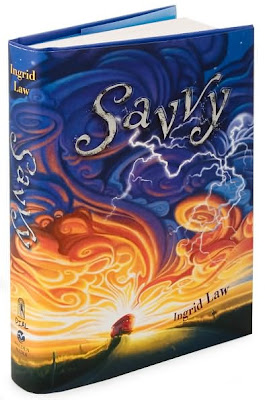
Savvy


by Ingrid Law
Dial / Penguin 2008

Ugh.

It has taken me days to try and sort out what bothers me about this book. I think it's the mixture of pseudo-magical realism and corn-pone storytelling. The narrator won't shut up, isn't very bright (none of the kids in this story are), and is the mouthpiece for the author's ham-fisted "everybody is special in their own way" message.

On their thirteenth birthdays the Beaumont's receive their "savvy," that special something they possess that no one else does. For Mibs, on the eve of her thirteenth birthday, the question is what form will her savvy take. Will it be the the quiet kind, like her mother's ability to do everything perfectly, or like her grandmother's ability to capture radio waves in mason jars like lightning bugs? Or will it be like her brother's, one who can harness electricity and another who creates hurricanes whenever he's near a large body of water?

Sadly, Mibs birthday plans are interrupted when the author decides to drop an obstacle in Mibs path: her father is involved in an accident on the highway and is laid up in a hospital to the south. Convinced by the lamest of evidence that her savvy involves "waking" objects previously believed to be permanently inert, Mibs in convinced she can bring her daddy out of his coma. But how to get to the hospital when she's been left behind by her mother?

That's right, stow away in the back of a traveling bible salesman's bus. And while you're at it, why not make it you and two of your sibling. And a couple of preacher's kids. Got it? That's five kids who think it's a good idea to stow away on a stranger's bus. The fact that he's a bible salesman is supposed to make you feel safe about it all.

Once they discover they're headed the wrong direction they prevail upon said salesman to deliver them where they need to go. He agrees that he can take them there eventually, but has his stops to make first.

Yeah, I've got a vehicle full of stowaways and I think I'll just drive around with them for a bit while they sort things out among themselves. No one's going to ask me down the road what the hell I was thinking, driving them around for days without anyone knowing...

Oh, and Mibs gets her savvy. And I have to ask: is this a metaphor for getting your period, or having ritual circumcision, or a bar mitzvah? Anyway, she gets it. Her savvy is being to hear what people are thinking but only through whatever ink happens to be on their skin. Even a temporary tattoo is able to speak to Mibs who figures this out several chapters after the reader has and is falling asleep.

I'm sorry, I can't seem to give a straight summary here.

Here's where you first lose me: The character's name is Mississippi but her younger sibling can't pronounce that and calls her Mibs. Okay. But that's what everyone calls her? She lets teachers and strangers and friends and enemies call her by her family name? No, I don't think so. But that's a quibble.

Next wrong fork in the road: stowing away on a stranger's bus to get someplace. Uh huh. You don't first admit knowing it's wrong, then try to lay a claim that you believe the driver to be safe, all the while exhibiting a failure to understand your own critical facilities. A history of bad judgment in a character shouldn't allow for safety to prevail at its most crucial point. Kids get into trouble all the time thinking they know enough to stay safe, make bad decisions, and trust people they shouldn't as a result. Here we have not one but FIVE kids who all fail to do the right thing, believing there's safety in numbers while they are on a bus headed in the wrong direction with no one knowing where they are.

Yeah, yeah, don't give me that stuff about the news bulletin on the TV throughout and the police looking for them. That's all after the fact (and worse, it is there to tie up a loose end concerning he paternity of one of the kids!). The fact is dumb kids + dumb decisions should not = positive results. We don't live in that world, and even if we lived in a world full of people with secret "savvies" it would strain credulity to believe that these are the actions of smart, savvy people.

Lastly (for now), if you want a main character to spout the curious homilies and expressions of a Southern Carl Sandburg at least make them sound like they're coming from a kid and not an old lady. Kids will incorporate the language they learn and know, but not with such abundance and variety as they do here. Yes I get that it supposed to take on the feel of a tall tale, all that language-of-the-people stuff, but it feels as wrong as shoulder pads on a t-shirt; it's a statement, but is that really the statement you want to make?

In a bit of backward glancing at all the people who loved this book, and all of those that didn't, I'm starting to get a sense that this book could be a new litmus test for determining whose judgment I can trust. I think there are a lot of people out there, many of them librarians, who would consider this prime Newbery material. Sadly. Probably the same ones who agreed with the Newbery committee over The Higher Power of Lucky. Savvy nabbed a Boston Globe/Horn Book Honor recently. Let's hope it stops there.

*shudder*

I'm not going to burn in a place I don't believe in, but I'm sure my ass is going to get bit one day for this.

Tuesday, August 5

Chiggers


by Hope Larson
Atheneum 2008

Abby has arrived at camp first (as usual, due to her mother) and as the other girls arrive everyone slips back into their camp personalities and cliques. Abby's closest friend Rose has returned as a counselor this year and her additional duties preclude her and Abby from hanging out as much.

As the bunks fill in her cabin Abby ends up with new girl Deni beneath her who spends her day complaining about what a dump the camp is and her nights scratching herself into oblivion. The girls come back to their cabin and find Deni mysteriously gone, and quickly the rumor is she contracted chiggers and was sent home.

The next girl to fill the bunk is Shasta, a hippie-esque weirdo who refrains from many camp activities due to her own mysterious illness, a illness that requires a daily medication she refuses to take. While Abby has always been a sort of fifth wheel around her cabin mates, Shasta is the out-and-out weirdo, and when Abby is stuck showing the new camper around she finds herself battling between distancing her self from Shasta and making friends with her.

Shasta, it turns out, was struck by lightning and occasionally finds her hair raised on end and little balls of lightning drift into her cabin looking for her. There's tension between Abby and Shasta when they find themselves attracted to the same boy until Shasta is sent home for failure to take her medicine. Camp ends with a kiss and a bandanna and memories that make camp that place where strangers are friends for life until it's time to go home.

Larson's graphic novel pulls off the trick of being episodic without feeling episodic, telling the story of a summer without a plot. Abby, and all the girls for that matter, are mean and nice, conflicted and assured, friends and enemies. They are kids at that age where everything is possible which means they run hot and cold with the wind. Everything is possible at camp, and Larson picks out those moments that highlight those possibilities; the friendship bracelets, the games of capture the flag, the overnight hike with the ghost stories and a flashlight. None of it cliched or bathed in the patina of nostalgia or underscored with "deeper meaning" than the moment it exists in.


More like this, please.

Monday, August 4

My Dad's a Birdman


by David Almond
illustrations by Polly Dunbar
Candlewick 2008

Lizzie's a bright, independent girl who gets her self up in the morning, gets dressed, makes tea and toast, and calls her dad down to breakfast. But dad drags. Dad droops. And when asked what his plans are for the day while she's at school dad announces that he's going to fly like a bird and enter the human bird competition. Suddenly we are faced with a role reversal of a responsible parent-like child and a child-like parent. What would cause this reversal only becomes obvious by the lack, and no mention of, Lizzie's mother. This is made clear a few chapters in when Lizzie's Aunt Doreen drops by to see to how Lizzie and her dad are getting along. Once she sees that dad has fashioned a set of wings for himself and has taken to eating bugs (in order to be more bird-like), and that Lizzie has taken to staying home from school to watch after her dad it becomes painfully clear that we are dealing with a great unspoken grief.

In the end Lizzie and her dad participate together in the Great Human Bird Competition, a sort of flugtag where people adorn themselves in wings and rockets and whatnot and attempt to traverse a body of water propelled under their own power. Dad's obsession with flying at first seems a bi-product of a mental break-down, but as Lizzie (and eventually her Headmaster) discover as they participate in the competition, the act of faith necessary to hurl yourself into the world is exactly what they both need in order to move ahead with their lives. Feeling more alive than before, they reconnoiter back at Aunt Doreen's for some dumplings and find themselves dancing with a new-found joy, a joy that leaves them lighter than birds and flying off the ground.

Almond has managed to dip his pen into Roald Dahl's inkwell and produce a magnificent examination of what it means to find joy after loss, for a family to find their way through the other side of the darkness no matter how odd it may look on the outside. Aunt Doreen and the Headmaster understand the situation and are keeping tabs to make sure that Lizzie and her dad don't fall to far off track, but they hang back enough to let the process run its course.

The feel of this book is what gives it the Dahl flavor in my mind. It would be hard to imagine this story in a contemporary environment without meddling government agencies and relatives who would insist on remaining in the home to assure everything was alright. Aunt Doreen makes a social call but is driven from the house by the sheer absurdity of it all, promising to return with help. The help she return with isn't the police or child protective services but the school headmaster who is more interested in joining Lizzie and her dad in their adventure rather than find fault, place a judgment, or insist on a return to normalcy. It is also in the child as the responsible one and the adults as fools that I find the spectre of Dahl lurking.

Almond can't seem to get away from the connections he makes with birds and death, and certainly there's enough mythology, symbolism, and history to support these connections. But Almond chose the bird's ability to fly to show a rising above, a phoenix-like symbolism for a family being reborn from the ashes of their sorrow. There is nothing sad or sorrowful in the book itself, the entire affair has a sense of whimsy to it, but it's all there just below the surface allowing us to how happiness and joy can re-emerge from experience.

Friday, August 1

Big Plans


by Bob Shea
illustrated by Lane Smith
Hyperion 2008

He's got big plans! Big plans (he says)! Over and over and over...

Last year author Shea gave us some New Socks to play with, and they were good. Just the one image of that a chicken, with glasses, using a sock as a phone was enough for me. That's how kids are, that's how they play, I'm good. I think that for a certain age level picture books ought to try and capture that sense of childlike whimsy (claiming they're the biggest thing in the ocean, for example) and New Socks did it.

Shea's back, tugging illustrator Lane Smith for the ride, and things don't roll so smoothly. We start with a boy facing the corner of his classroom, obviously on punishment, the chalkboard full of all the "I will not's" he's most likely committed. From this single opening spread we learn that this boy rolls his eyes, schemes, laughs when others speak, isn't nice, proves the teacher wrong, considers himself the boss of the class, and announces that what he says goes.

I hate this kid.

I hate this kid so much that everything that follows better show me in some way that he is charming or in some other ways undeserving of this punishment in the corner, otherwise this book is really going to piss me off.

This book pissed me off.

He's got big plans, he announces, and he screams these words in 240 point type across most of the book. He's going to shout at the yes-men in the boardroom, take on the mayor, verbally assault the president. He's going to wear a skunk as a hat (because the only thing that stinks worse is this kid's attitude) and march all over the world shouting down everyone and everything else with his big plans. He's going to take over a losing football team (with his yes-man mynah bird) because losing is not part of his big plans. He'll order people to do this and that, and when he goes to the moon he'll order the rocks be moved so they can be read from Earth announcing his big plans.

And in the last spread we see that all his planning and scheming were a direct result of all the things surrounding him in the time out corner. There's a map of the moon and a book of presidents, and his snide little smirk that says "Yeah, they can put me in the corner, but I'll show them one day."

I never want that kid to leave the corner.

You know how it is when you get an email from someone who doesn't realize that writing in all caps reads like shouting? This book feels just like that, only worse. It's a bossy kid with a microphone hooked up to the Who's loudspeaker system shouting about his big plans at 160 decibels ten feet from your face. Did it have to be so loud, Lane? Couldn't the kid be less of a schmuck and more of a dreamer? Couldn't there be something in this kid that would make us want to root for him to take over the country and fly to the moon and be the star football player?

Not cute, not endearing, and please, let no one read this to boys at story hour unless they want an army of bossy boys shouting down adults and thinking they own the world, or a dozen time-out corners in need of occupants.

Wednesday, July 9

1001 People/Events That Made America

I'm a particular fan of American history in that I'm particular about the parts I like. It isn't an ideological divide as much as it is that there are certain periods that appeal to me for some reason. I'm fond of the colonialists and the American Revolution, but for the stories of the smaller moments and not the battles. I also have a soft spot for the socialist movement of the 1930's and anything that sheds light on the deceptive prosperity of post-war American in the 1950's and 60's. In a lot of cases, the history I'm attracted to are the stories of people who left a lasting impression.

I'll be frank: what originally drew me to these books by Alan Axelrod -- 1001 People Who Made America and 1001 Events That Made America -- was the subtitle on 1001 Events -- "A Patriot's Handbook." Indeed! 1001 events to serve as a handbook for patriots? Now I'm curious.

1001 Events proved to be exactly the book I expected, a collection of short paragraphs that chronicle the history of the country from the original Asian migration 40,000 years ago to Hurricane Katrina. Though presented chronologically, Axelrod suggests (and I agree) that the book should be perused for areas of preference. Using the index in the back one could look up a topic of interest -- like Manifest Destiny -- and read a quick summary to sate one's curiosity before glancing at the entries to either side for a little historical context. In this instance there is a paragraph immediately preceding about the New York Knickerbocker Baseball Club formalizing the rules for baseball, disputed by the suggestion that the game had been invented in Philadelphia 12 years earlier. The entry following manifest Destiny informs us that Texas was admitted into the Union, "vitually ensuring a war with Mexico." Why is that? Well, you'll have to read back a few pages to find out what's been going on in that part of the country.

That, for me, is the joy of this sort of collection, being able to jump around at will. The actual content is fairly safe -- no mention of the Chinese perhaps discovering America, but also no mention of when the Russians first occupied Alaska -- and the brevity of the information given ensures that the curious will need to seek detailed information elsewhere. I was surprised to see that a certain Volney Palmer of Philadelphia becomes the first ad agent and coins the term "advertising agency" in 1841. Not very long after that we get our first "modern" presidential campaigns full of slogans, songs, and negative attack ads. God Bless America!

Which leads me to Axelrod's other book, which in some ways s more satisfying. It would seem a daunting task to believe that the number of people it took to "make" American can be reduced to 1001, but this alphabetical listing of noted Americans does a fine job.

In addition to the usual suspects -- the presidents, the rich and famous -- are the names of those readers might know but never considered the person behind the name. The Armour behind the meat packing business, the Colt behind the gun, the Henry McCarty who was Billy the Kid. I'm pleased to see a fair number of players in the Watergate saga are here: Woodward and Bernstein, of course, but Haldeman, Ehrlichman, Hunt, Dean, and Sam Ervin all make an appearance. The last time I saw a high school history textbook the Watergate scandal was given cursory coverage, and certainly less than what there is here. Usually we get that Nixon was involved in a break-in and cover-up and that's about it. These entries won't fill in all the 18-minute gaps but it's a start.

Artists, musicians and writers are also represented (though not as well represented as I'd like) as are some whose distinction in "making" this country can be seen as dubious. The Reverend Jim Jones and the cuddly Charles Manson are here, but so is Monica Lewinsky. That these people had an effect on events in our nation cannot be ignored, but to say their actions "made" this country what it is strikes me as a bit much. This is where the limitation of 1001 entries is perhaps the book's weakness. I find myself wishing there were more artists mentioned, more women... but to the exclusion of whom?

I suppose questions like that cannot be helped. Recently I was asked to name my top three films of all times and found myself stumbling. For every title I could come up with there were easily three more that sprang to mind, and suddenly I was trying to find some way to winnow down a couple dozen into just three. I suspect it's no less difficult narrowing a list of noted Americans down to 1001 as well.

I found little in 1001 Events to support the claim toward being a patriot's handbook -- unless the implication is that it contains all the information one might need to know to pass a citizenship exam -- and noticed that in the paperback edition National Geographic has left the subtitle off the cover. It's easy to tout patriotism and another to define it. Leave the fuzzy work to politicians and give me raw bits of history to gnaw on instead.


(This post also appears over at Guys Lit Wire. Really, you haven't checked it out yet? You really should.)

Friday, July 4

Duel! Burr and Hamilton's Deadly War of Words


by Dean Brindell Fradin
illustrated by Larry Day
Walker Books 2008

It's a reflection of my quality education that I graduated without knowing the story of the duel between Aaron Burr and Alexander Hamilton. Or it's proof of what a horrible student I used to be. But perhaps if I'd had this nifty little picture book when I was younger it would have stuck with me while I was attempting to handle the grind of AP US History at the same time my family was falling apart.

In a few quick pages Fradin shows us the troubled childhoods of these two men, how they suffered similarly as boys, and grew to be men with something to prove. Throughout their adult lives their paths cross and intertwine, Hamilton the insecure with a chip on his shoulder for being foreign born, Burr the arrogant with anger management issues. It quickly becomes apparent that these two men were as star-crossed as any, rivals fated to shoot it out on the shores of the Hudson river one cold morning. To summarize any more would be to retell the book, and Fradin does such a great job swiftly hitting the highlights in this historic rivalry that it makes you want to reach out and shake either Hamilton and Burr and point out "Dudes! You're on the same side! Quit fighting!"

Day's watercolors have some best dramatic compositions I've seen for a non-fiction book in a stretch. The cover image looks like a frame borrowed from a spaghetti western, and the illustrations throughout are no less striking for their choice of angles and moments.

As always with picture books like this I'm a little uncertain about the audience. Readers old enough to be interested in the details of history like this would prefer, to my mind, something other than a picture book.